HSS vs SSS vs HH Pickups: Which Configuration Is Best for You?
HSS vs SSS vs HH pickups can be confusing until you connect each layout to how you actually play. Pickup configuration affects noise, how “full” the bridge position feels, and how easily you can cover different styles without fighting your tone. This guide keeps it practical so you can choose the right setup fast – especially if you want one guitar that actually fits your real-life playing, not just the spec sheet.
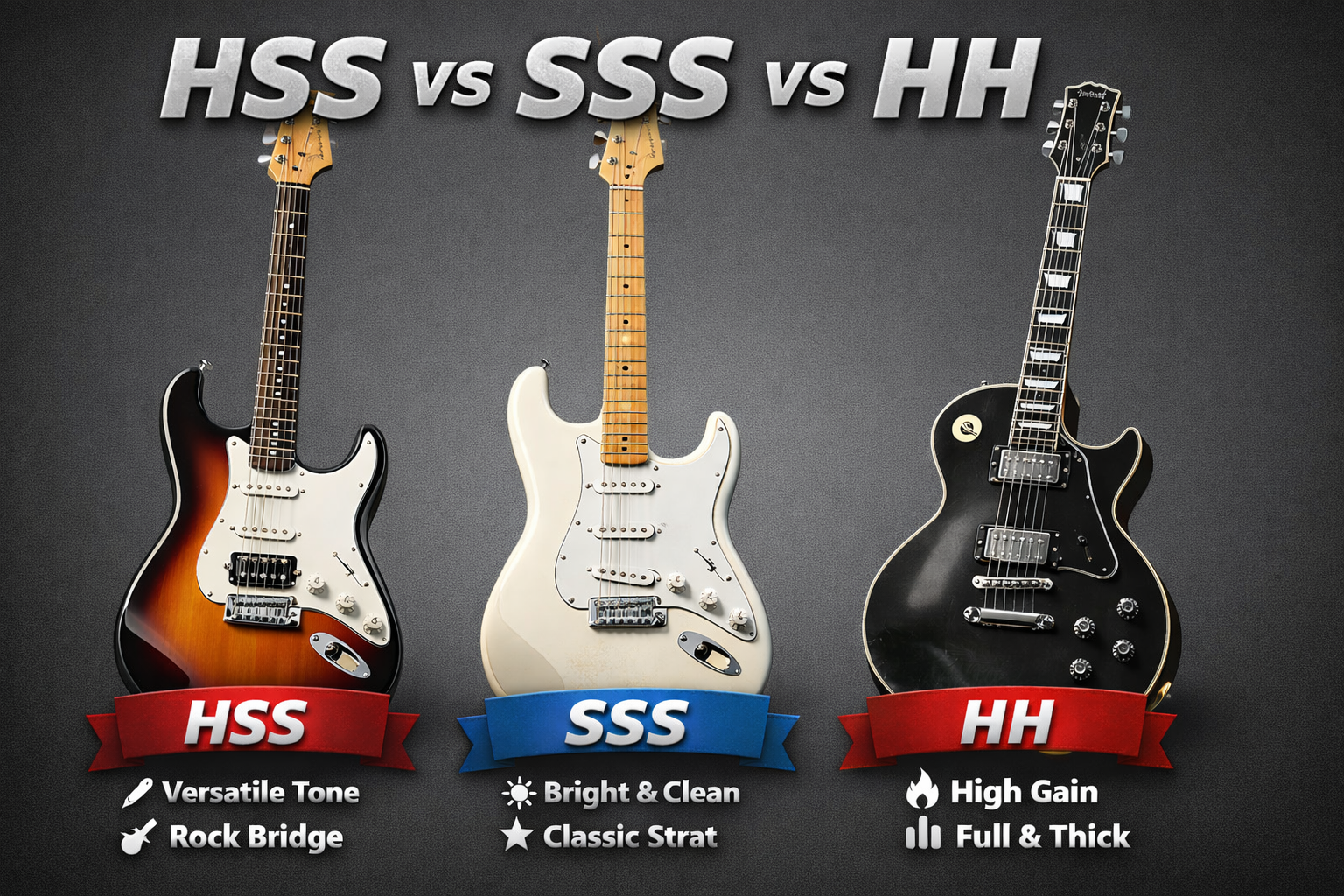
HSS vs SSS vs HH pickups: the 10-second answer
- SSS (three single-coils): classic Strat-style clarity and sparkle. Great for clean and edge-of-breakup, but more hum under gain.
- HSS (humbucker + two single-coils): the “one guitar for most situations” choice. Single-coil cleans plus a thicker, easier bridge for rock.
- HH (two humbuckers): thicker, smoother, usually quieter under gain. Best if you live in crunch/high-gain territory.
What H and S actually mean in pickup configurations
S = single-coil
Single-coils tend to sound clearer and brighter with more snap and string detail. Chords can feel more separated and “open.” The trade-off is that they can pick up hum and noise more easily, especially with higher gain and noisy power or lighting. If your guitar already feels a bit harsh at home, it might be worth looking at your string gauge and overall setup before blaming the pickups.
H = humbucker
Humbuckers are usually thicker, louder, and smoother on top. They’re also typically quieter (less hum), which makes them easier to live with for heavier sounds and high-gain practice. If your home tone feels fuzzy or undefined, pairing humbuckers with a good low-volume amp or amp sim can make things a lot more controlled.
Why pickup layout matters more than tiny specs
You can obsess over output, magnet type, DC resistance and marketing names forever, but the layout usually decides how usable the guitar feels day to day:
- Noise level: how much hum you deal with under gain.
- Bridge feel: thin vs thick for riffs and leads.
- Clean character: glassy sparkle vs warm fullness.
- Usable sounds: how many positions you actually want to use.
If your guitar already sounds bad or harsh at home, it’s often a mix of pickups, amp choice and room volume. This is where understanding why your guitar sounds bad at home and how low-volume tone works matters just as much as pickup layout.
| Aspect | SSS | HSS | HH |
|---|---|---|---|
| Overall character | Bright, open, snappy and very touch-sensitive. | Strat-style cleans with a thicker, stronger bridge. | Thick, smooth, focused and naturally compressed. |
| Noise under gain | Most hum and noise, especially with higher gain. | Neck/middle can hum; bridge humbucker is quieter. | Usually the quietest option under high gain. |
| Clean tones | Most glassy, chimey cleans and “2/4” in-between sounds. | Great cleans on neck/middle; bridge cleans are fuller. | Warm, round cleans with less top-end sparkle. |
| High-gain feel | Can work, but thinner and noisier unless carefully dialed in. | Much easier bridge tone for rock and heavier crunch. | Best default choice for rock, punk and metal. |
| Versatility | Best if you mainly live in clean and edge-of-breakup territory. | The most flexible “one guitar for most situations” layout. | Best if you mostly live in gain and riff-focused styles. |
| Best suited for | Clean rhythm, funk, pop, indie, blues and classic rock. | Mixed styles: clean, crunch and occasional high gain. | Rock, hard rock, punk, metal and modern high-gain tones. |
| Main trade-offs | More noise; bridge can feel thin or harsh for heavy styles. | Less “pure vintage Strat” and still some single-coil hum. | Less snap and glassy clean; fewer in-between textures. |
SSS pickup configuration (three single-coils)
What SSS really feels like
SSS is the classic Strat world: bright, open, and touch-sensitive. Clean chords feel airy, and low-to-medium gain keeps definition in complex voicings. With the right amp, SSS is perfect for chimey rhythm and expressive lead work that reacts clearly to your picking dynamics.
Best for
- Clean rhythm, funk, pop, indie and worship-style parts.
- Blues and classic rock at low-to-medium gain.
- Players who live in the in-between “2 and 4” positions and love that quack.
Trade-offs of SSS
- More hum and noise with higher gain or bad power.
- Bridge single-coil can feel thin or ice-picky for heavier rock without careful EQ.
If you go SSS and mostly play at home, it helps a lot to understand basic guitar EQ and to use a good clean or edge-of-breakup amp, like the ones in these practice amp recommendations.
HSS pickup configuration (humbucker + two single-coils)
What HSS really feels like
HSS is basically “Strat-style cleans plus a bridge that doesn’t feel weak.” You keep the single-coil neck and middle vibe, while the bridge humbucker gives you thicker riffs and easier lead sustain. It’s the classic “one guitar that can show up to almost any gig or rehearsal and survive” layout.
Best for
- Players who switch between clean, crunch and heavier tones.
- Beginners who want one guitar to cover most styles without constantly fighting the bridge pickup.
- Anyone who likes Strat ergonomics but wants a stronger, more forgiving bridge sound.
Trade-offs of HSS
- Not always the most “pure vintage Strat” experience (depends on pickups and wiring).
- You’ll still get some single-coil hum in non-humbucker positions.
Pair HSS with a flexible practice amp or modeler and it becomes a true do-it-all setup. If you’re in the “mostly home player, sometimes rehearsal” camp, check out options like the Boss Katana Mini or the amps in this sub-$200 practice amp guide so the guitar and amp complement each other.
HH pickup configuration (two humbuckers)
What HH really feels like
HH is the thick, stable, high-gain-friendly setup. Distorted rhythm tends to feel fuller, and leads sustain more easily. Clean tones can still be good, but usually warmer and less sparkly than SSS. HH often feels “easier” if you play a lot of power chords, palm muting and saturated lead tones.
Best for
- Rock, hard rock, punk, metal and modern high-gain styles.
- Players who hate noise and hum and want a more forgiving setup.
- Anyone who uses the bridge pickup a lot for riffs and chunky rhythm.
Trade-offs of HH
- Less snap and glassy clean shimmer than true single-coils.
- Fewer signature in-between clean textures compared to SSS or HSS.
If HH plus high gain is your world, it’s worth learning how gain vs volume vs master really work and how to keep your tone tight at realistic home levels. A focused amp or modeler and good headphones for guitar practice can make HH rigs much more usable in an apartment or bedroom.
HSS vs SSS vs HH for home and bedroom players
Most players asking “HSS vs SSS vs HH?” are actually asking a different question: “What will feel good in my room at the volume I’m allowed to use?”
- SSS at home: amazing for clean and edge-of-breakup, but hum and harshness get exposed if your room and amp aren’t dialed in. Learning to tame this with EQ and reading a bedroom tone guide helps a lot.
- HSS at home: great middle ground. You can keep neck single-coil cleans and still have a bridge that doesn’t die at low volume, especially with a small amp or amp sim setup.
- HH at home: easiest to keep quiet and controlled under gain, but you may need to work a bit harder to get truly sparkly cleans unless your amp is voiced bright.
If your guitar already feels wrong at home, it’s worth checking out common guitar buzz causes and why your tone falls apart in a bedroom before you assume your layout is the whole problem.
Real-world examples of SSS, HSS and HH tones
Sometimes it’s easier to think in terms of players and records instead of theory:
- SSS, classic Strat territory: Think John Mayer and many of the sounds in our John Mayer tone guide, plus the glassy side of players like David Gilmour and Mark Knopfler.
- HSS, modern Strat flexibility: Many “do-it-all” Strats aimed at modern players live here – bright neck sounds with a beefier bridge for rock and lead.
- HH, thicker rock tones: Les Paul and Superstrat territory, closer to the gainy world you’ll find in our Eddie Van Halen breakdown and similar high-gain rigs.
You don’t need to copy any player exactly, but it helps to know which layout naturally leans toward the sounds in your head.
How to choose the right pickup setup for your style
- Mostly clean / edge-of-breakup / bright rhythm: go SSS if you love clarity and in-between positions.
- Mixed styles (clean plus rock riffs plus occasional heavy): HSS is usually the safest and most flexible choice.
- Mostly gain / tight rhythm / less hum: HH keeps things stable and quiet, especially with a focused amp or modeler.
If this is your first serious guitar, pair your decision with a quick sanity check using a beginner guitar checklist and think about what amp you’re likely to use most often – a small practice amp, a modeler, or a louder combo. If you are also shopping for your first instrument, our guide to electric guitars under $300 can help you match pickup layout with the rest of the spec sheet.
Does coil-split change the decision?
Coil-split can make HH or HSS more flexible, but treat it as a bonus, not the main reason to choose a guitar. A split humbucker can get brighter and more “single-coil-ish,” but it usually won’t fully replace true Strat-style single-coils in positions like 2 and 4. Think of it as an extra flavor you might use occasionally, not the core of your tone.
A simple checklist before you decide
- Do you rely on the bridge pickup for riffs? If yes, HSS or HH is usually safer.
- Do you love sparkly clean rhythm and in-between positions? If yes, SSS is the most natural fit.
- Do you play with gain often and hate hum and noise? If yes, HH (or HSS with a good bridge humbucker) will feel easier.
- Do you want one guitar that covers most situations with minimal fuss? HSS is the safest default for most home and beginner players.
HSS vs SSS vs HH: quick FAQ
Is HSS more versatile than SSS?
In most real-world situations, yes. SSS gives you the purest Strat-style cleans and in-between tones, but HSS adds a stronger, thicker bridge for rock riffs and leads while still keeping those clean single-coil positions.
Can you play metal with SSS pickups?
You can, but it is harder. SSS single-coils tend to be noisier and thinner under high gain. With the right amp, gate and EQ you can get there, but if metal or modern high-gain is your main thing, HH (or at least HSS) will feel more natural.
Is HH better than HSS for beginners?
Not automatically. HH is easier for high-gain tones and noisier environments, but many beginners benefit from the cleaner, more articulate neck and middle sounds on HSS. If you want one guitar that can clean up well and still rock, HSS is usually a safer first choice.
Does coil-splitting make HH as flexible as SSS?
Coil-split humbuckers can get you closer to single-coil flavors, but they rarely replace a true SSS Strat. If you absolutely live for glassy cleans and in-between positions, start with SSS or HSS and treat coil-split as a bonus, not a shortcut.