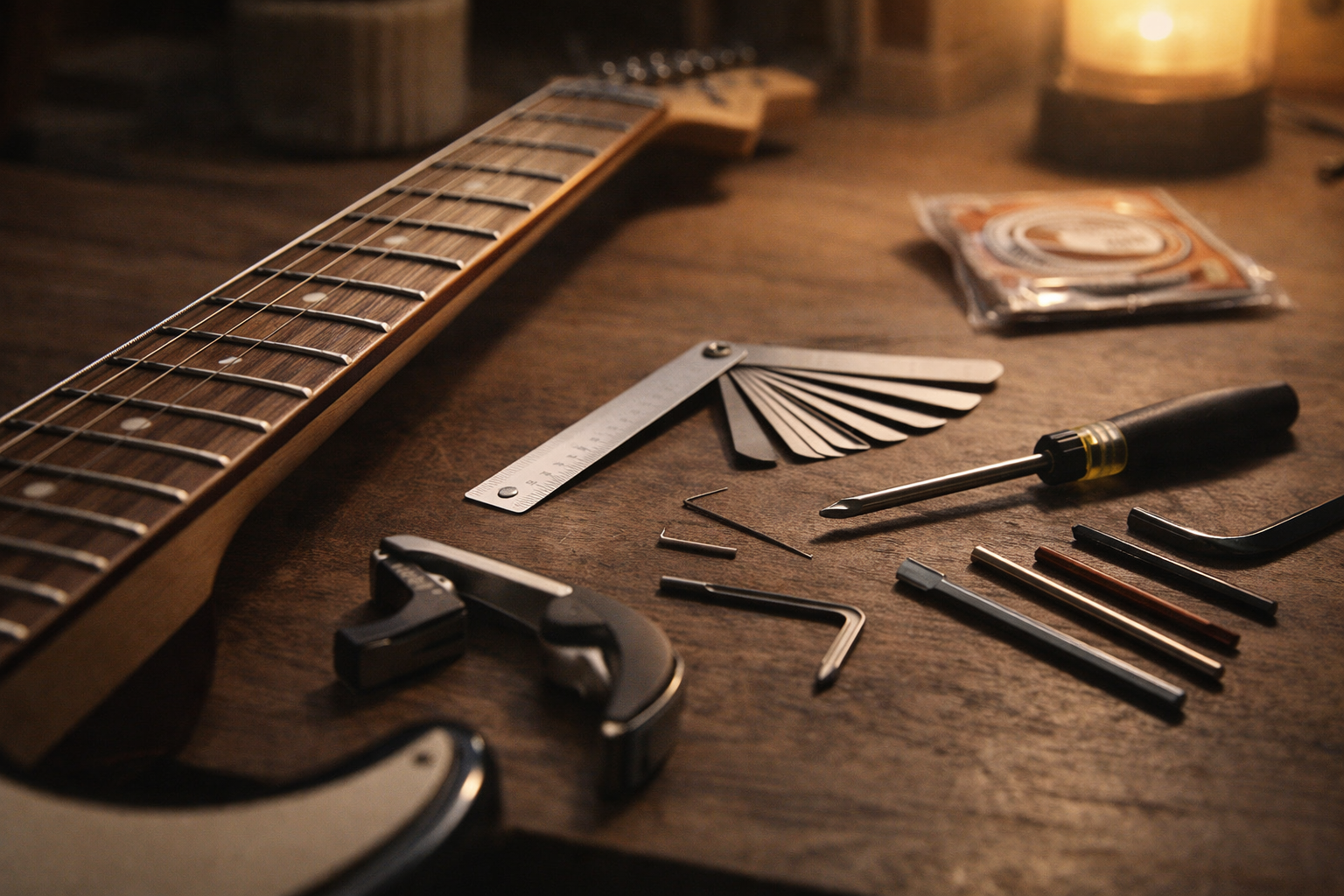
How to Fix Fret Buzz on Electric Guitar (7 Real Causes + Fixes)
Guitar buzz – more precisely fret buzz or string buzz – is one of those problems that makes you question everything—your guitar, your amp, even your hands. The truth is usually boring (in a good way): most electric guitar fret buzz comes from setup, strings, or technique, and you can diagnose it quickly without buying anything.
If your tone also feels thin, harsh, or “boxed” at home, don’t assume you need new gear—your room + volume + EQ can be the real culprit. Start here: Why Your Electric Guitar Sounds Bad at Home (And How to Fix It). And if you’re still confused by the front panel knobs, this will save you time: Gain vs Volume vs Master: What They Actually Do on Your Amp.
This guide shows you how to fix fret buzz on electric guitar step by step. It breaks down the most common causes of fret buzz (and similar “rattle” noises), how to spot each one, and the fastest fixes you can try at home. If you’re not comfortable adjusting hardware, you’ll still leave with a clear description of the issue to give a tech.
How this fret buzz guide was built
- Use-case: real-world home setups (bedroom amps, small interfaces, amp sims and practice volumes).
- Method: start with the easiest visual/feel checks, then move toward things that genuinely need a tech.
- Goal: help you describe the problem clearly so you either fix it yourself or give your tech the right info.
Guitar buzz / fret buzz: a 2-minute diagnosis checklist
- Where do you hear it? Open strings only, or fretted notes too?
- Which frets? First few frets, middle of the neck, or only high up?
- One string or many? One string often points to a nut slot or a single high fret.
- Acoustic-only or amplified too? Some rattles are hardware, not frets.
- Did anything change recently? New strings, lower tuning, weather/season change, new setup?
Quick fret buzz causes & fixes (at a glance)
If you just want the fast version, this table maps the most common electric guitar fret buzz causes to quick checks and first fixes.
| Cause | What it sounds like | First move |
|---|---|---|
| Action too low | Buzz on many frets, especially when you pick hard | Raise saddles slightly, then re-tune and re-check |
| Neck relief off | Buzz around 5–9th frets or appears after weather/season change | Check neck gap (1st + last fret test), then consider tiny relief adjustment or tech visit |
| High fret | One note chokes or buzzes badly, neighbours are fine | Confirm it’s one fret only; real fix is fret leveling/dressing |
| Nut slot issues | Buzz mainly on open strings, improves when you fret 1st fret | Likely nut work; usually a job for a tech |
| Bridge / saddles | Metallic rattle even when fretted cleanly | Touch/tap hardware, tighten loose screws, tame trem springs |
| Loose hardware | Random buzz that doesn’t follow fret patterns | Check tuners, string trees, pickguard, jack, strap buttons |
| Technique / strings | Buzz changes a lot with picking force or tuning | Try heavier strings, softer attack, and fretting closer to the fret wire |
1) Action is too low (fret buzz on lower frets and across the neck)
What it sounds like: Buzz across multiple frets, especially when you pick harder. Many players first notice this as fret buzz on lower frets when they chase ultra-low action.
Quick test: If you play with a lighter touch and the buzz improves a lot, ultra-low action is likely part of it.
Fast fix: Raise the bridge/saddles a tiny amount. Do it in small steps, then re-tune and re-check.
When it’s normal: A little acoustic buzz that doesn’t come through the amp can be acceptable, especially on very low-action setups.
2) Neck relief is off (truss rod / seasonal change, fret buzz on high frets)
What it sounds like: Buzz around the middle frets (often 5–9) or inconsistent buzz that appeared “out of nowhere.” Sometimes it feels like you get fret buzz on high frets while the lower ones are fine.
Quick test (no special tools): Fret the low E at the first fret and the last fret at the same time. Look at the gap around the 7th–9th fret. If there’s basically no gap, the neck may be too straight/back-bowed. If the gap looks huge, there may be too much relief.
Fast fix: If you know what you’re doing, truss rod adjustments must be tiny and careful. If you don’t, this is the point where a tech is worth it. A small relief correction is one of the most common “buzz disappeared instantly” fixes.
3) A high fret (or uneven fretwork)
What it sounds like: A specific note chokes/buzzes badly on one fret, while nearby notes are fine.
Quick test: Buzz that happens on one note, but disappears if you fret one fret higher/lower, often points to a high fret.
Fast fix: There’s no real home shortcut that replaces leveling. You can sometimes reduce the symptom by slightly raising action, but the real fix is fret leveling/dressing.
Tip: Even good guitars can develop a few uneven frets after shipping and humidity changes.
4) Nut slot issues (open-string buzz)
What it sounds like: Buzz/rattle mainly on open strings, but it improves when you fret at the 1st fret.
Quick test: If the string is quiet the moment you fret the first fret, the nut slot is a prime suspect.
Fast fix: This is usually not a DIY job unless you’ve done it before. The correct fix is a nut adjustment or replacement.
5) Saddle/bridge problems (rattle that isn’t fret buzz)
What it sounds like: A metallic rattle that can happen even when fretted cleanly. Sometimes it changes when you palm-mute or touch the bridge.
Quick test: Lightly touch bridge parts (saddles, springs, screws) while plucking. If the rattle changes or stops, it’s hardware.
Fast fix: Tighten loose saddle screws, check intonation screws, and make sure nothing is vibrating freely. On trem guitars, a tiny piece of foam in the spring cavity can reduce spring noise.
6) Loose hardware (tuners, string trees, pickguard, jack, strap buttons)
What it sounds like: Random buzzing/rattling that doesn’t follow a specific fret pattern.
Quick test: While plucking a note that triggers the noise, gently touch tuner buttons, string tree, pickguard edge, jack plate, and strap buttons. If it stops, you found it.
Fast fix: Carefully snug screws/nuts. Don’t over-tighten—just “firm.” This is one of the most common “mystery buzz” causes.
7) Technique + string choice (the uncomfortable truth)
What it sounds like: Buzz happens mostly when you play harder, switch to lighter strings, or tune down.
Quick test: Play the same note with a lighter touch and then with a heavy attack. If buzz changes dramatically, your setup may be fine, but your technique and string tension are driving the buzz.
Fast fix:
- If you tuned down (Eb/Drop D/Drop C), consider heavier strings or a setup for that tuning. For a simple overview of how gauge affects tension and feel, see our guitar string gauges guide.
- Try slightly softer picking and let the amp do the work.
- Fret notes closer to the fret wire (not in the middle of the space).
How much fret buzz is normal?
On electric guitar, a small amount of acoustic fret buzz is often normal, especially with very low action and a more aggressive picking hand. If you only hear a faint rattle unplugged and your notes sound clean through the amp on a reasonably clean tone, your setup is probably fine.
You should worry more when:
- The buzz is obvious through the amp, even on clean or lightly driven sounds.
- A single note chokes out completely, especially on bends.
- The guitar feels harder to play and won’t intonate properly.
If your frets feel under control but your overall bedroom tone still feels off, this pairs well with our bedroom tone guide and guitar EQ cheat sheet for cleaning up the rest of your signal chain.
Quick fret buzz rescue order (do this before you panic)
Use this simple order of operations to get rid of fret buzz on electric guitar without randomly turning every screw on the instrument.
- Check for loose hardware and bridge rattles.
- Identify if it’s open-string only (nut) or fretted too (setup/relief/action/frets).
- If it’s everywhere: raise action slightly.
- If it’s middle frets or appeared suddenly: suspect neck relief.
- If it’s one note only: suspect a high fret.
When to stop and go to a tech
- You suspect a truss rod/relief issue but don’t feel confident adjusting it.
- A single fret/note consistently chokes out (high fret / uneven fretwork).
- Open-string buzz strongly points to nut slot depth/shape.
- Your guitar won’t intonate properly after basic tweaks.
If you’re also not sure whether the guitar is “healthy” overall, our beginner guitar checklist is a good way to see if anything else is working against you.
FAQ
How to fix fret buzz on electric guitar fast?
Start by ruling out loose hardware and bridge rattles, then check whether the buzz is only on open strings or on fretted notes too. If it is everywhere, raise the action slightly. If it is focused around the middle of the neck, suspect neck relief. If a single note always chokes on the same fret, you likely have a high fret that needs leveling. When in doubt about truss rod or fret work, a tech is the safest move.
How much fret buzz is normal on an electric guitar?
A small amount of acoustic fret buzz is often normal on electric guitar, especially with low action and a more aggressive picking hand. If you only hear a faint rattle unplugged and your notes sound clean through the amp on a reasonably clean tone, your setup is usually fine. You should worry more when the buzz is obvious through the amp or single notes choke out completely.
Should I adjust the truss rod or the bridge to fix fret buzz?
If the buzz is focused around the middle of the neck and appeared with a season or humidity change, neck relief is a likely culprit and the truss rod may need a small, careful adjustment. If the buzz is more uniform across the neck and improves when you raise the saddles a little, your action was simply too low. Never crank the truss rod if you are not sure what you are doing.
Why does my guitar buzz even with new strings?
New strings don’t fix underlying setup issues. If your action is too low, neck relief is off, or you have a high fret or nut problem, you will still get fret buzz with brand new strings. Fresh strings can even make existing buzz more obvious because they ring more clearly.
When should I take my guitar to a tech for fret buzz?
If you suspect a truss rod or relief issue and you are not confident adjusting it, notice a single note that always chokes out, or have strong open-string buzz that points to nut slot problems, it is time to see a tech. A good tech can quickly check relief, action, frets and nut, and usually eliminate fret buzz in one setup session.





2 Comments
Comments are closed.