Boss Katana Mini Review – Tiny Practice Amp with Big Boss Tones
This Boss Katana Mini review is for players who want a really small amp that still feels like a “real” rig, not a toy. On paper it looks simple: 7 watts into a single 4″ speaker, three amp types, basic EQ and a single delay. In practice, it is a surprisingly punchy little portable mini practice amp that can live on your desk, couch, or even in a backpack and still give you convincing Boss-style crunch and lead tones at low volume.In this price and size range it naturally competes with compact modeling combos like the Fender Mustang LT25 and stereo practice amps such as the Blackstar ID:Core 10 V4. The Katana Mini takes a different route: no menus, almost no digital complexity, just physical knobs and a very small footprint.
You can always look up the raw specifications on the official Boss Katana Mini product page, but in this Boss Katana Mini review the focus is on how it actually feels to use as a home and travel practice amp.
Quick Specs
- Power: 7 watts solid state
- Speaker: 1 x 4″ custom Boss
- Amp types: Clean, Crunch, Brown
- Controls: Gain, Volume, Bass, Middle, Treble, Delay Time, Delay Level
- Effects: Single tape-style delay (no reverb, no modulation)
- Inputs/Outputs: Guitar input, Aux in, Phones/Recording out (cabinet voiced)
- Power options: 6 x AA batteries (portable) or optional AC adaptor
- Size/weight (approx.): 230 x 181 x 116 mm, about 1.2 kg
On the spec sheet it is clearly designed as a grab-and-go practice amp: enough power for a bedroom or hotel room, basic tone shaping, and simple connectivity for headphones and backing tracks.
Build & Design
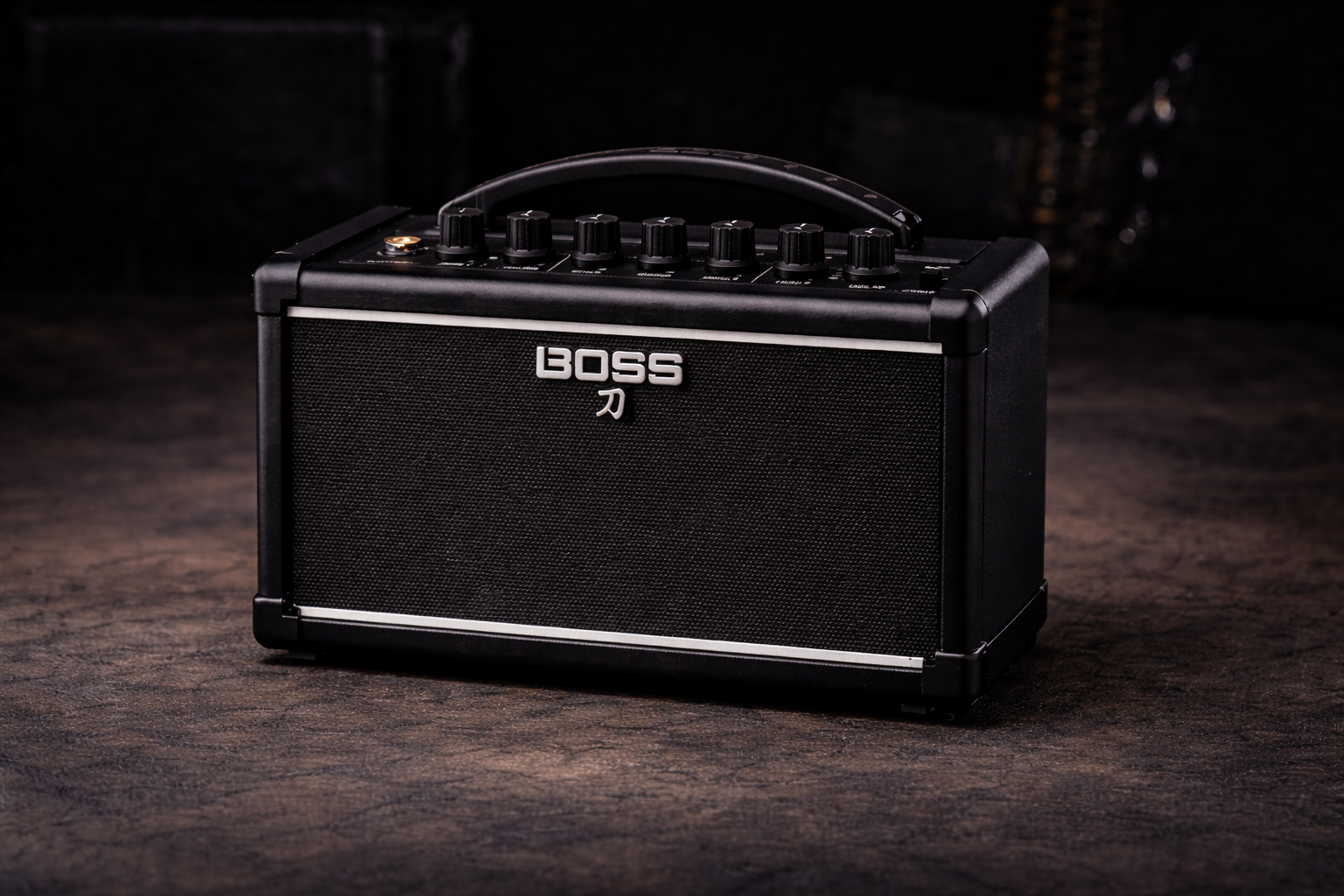
The Katana Mini looks and feels like a shrunken version of a “proper” amp head sitting on a tiny combo cabinet. The front panel is all knobs and switches – no screen, no patch names. Boss kept the design straightforward: cream-colored chickenhead knobs, a simple three-position amp selector, and a small delay section on the right side.
The enclosure is plastic with a metal grille, but it does not feel flimsy. You can easily pick it up with one hand, throw it on a crowded desk, or move it around the room without babying it. It is not a road-case touring amp, but for home, office, and travel use it feels sturdy enough to survive being tossed in a backpack or car trunk.
The only thing you might miss physically is a tilt-back leg or some kind of angle stand. Because the speaker is small and low to the surface, angling it slightly toward your ears (on a stand, stack of books, or the edge of a desk) usually gives a clearer sound, especially at lower volumes.
Boss Katana Mini Review: Clean, Crunch, and Brown Channels
The Katana Mini is not trying to be a full modeling amp. Instead of dozens of amp models, you get three voices that each cover a broad range with the gain and EQ controls. That simplicity is a big part of why it feels “plug in and play” rather than “scroll around and tweak”.
Clean
On the Clean setting, with gain around 9–12 o’clock and the EQ near noon, the tone is surprisingly full for a 4″ speaker. It is not a massive hi-fi sound, but it has enough low mids to keep single-coil bridge pickups from sounding harsh. Turn the gain up and you get a gentle edge of breakup that works well for bluesy rhythm or classic rock strumming.
Compared to something like the Fender Mustang LT25, the Katana Mini’s clean sound is less “studio polished” but more immediate. There is no compressor or hidden processing smoothing everything out. What you pick is basically what you hear, just scaled down in volume.
Crunch
Crunch is where the Katana Mini starts to show its character. With gain just past noon, you get a classic rock rhythm sound that sits nicely for power chords, punk, and 90s alt-rock. It has enough midrange to stay audible at low volume, which is crucial for home practice – scooped sounds tend to disappear on tiny speakers.
Pushing the gain further takes you into saturated rhythm territory. Palm-mutes stay tight enough for pop-punk and light hard rock, but you start to feel the limits of the small speaker if you expect “big” low-end chug. For tight modern metal rhythm at low volume, a stereo modeling amp like the Blackstar ID:Core 10 V4 will move more air and feel wider in the room.
Brown
Brown is the high-gain voice and probably the main reason many players buy this amp. It is clearly inspired by modern Boss lead tones: tight, compressed, with plenty of sustain even at bedroom levels. Leads sing, pinch harmonics jump out easily, and you can practice metal riffs without needing huge volume.
For fast alternate-picking or solo practice, Brown plus a little delay is a fun combo. It does not replace a full Katana head into a 1×12 or 2×12 cab, but for a 4″ speaker it stays surprisingly controlled. If you tune down heavily or use very hot pickups, turning the Bass down a touch usually keeps the sound tight.
Delay, EQ and Connectivity
The only onboard effect is a tape-style delay. You get Time and Level controls, so you can move from a short slapback to a more ambient echo. There is no tap tempo and no way to store presets – you just set it by ear and play. For a desk or couch amp, that is enough: it adds a bit of space and sustain without dragging you into deep editing.
The three-band EQ is fully analog and more powerful than it looks. Small tweaks go a long way because of the small speaker. Turning the Bass down to 9–10 o’clock and pushing the Mids slightly up helps the amp sit better at very low volume. For darker humbuckers, raising Treble and Mids gives back articulation without getting ice-picky.
On the back panel you get an Aux in for playing along with backing tracks from your phone or laptop, plus a Phones/Recording out that is cabinet-voiced. The phones output works well for late-night practice; just keep in mind that the feel through headphones will be a bit different from the tiny speaker in the room.
There is no USB audio interface here. If you want plug-and-play recording into a DAW with built-in cabinet simulation and more hi-fi stereo ambience, a compact smart amp or modeling combo like the Hotone Pulze offers deeper tone shaping. The Katana Mini is more of a simple practice amp that can also give you a usable line out when you need it.
Home & Travel Practice: What It’s Like to Live With
The big selling point here is portability. Running on six AA batteries means you can play anywhere: couch, balcony, rehearsal breaks, or even outdoors. For many players it becomes the amp you use when you “cannot be bothered” to hook up a full setup but still want a proper guitar tone instead of a dry DI into headphones.
Volume-wise, 7 watts into a 4″ speaker is more than enough for a bedroom or small living room, but it will not compete with a loud drummer. That is the trade-off: it is genuinely small and neighbor-friendly, but it is not a rehearsal or gigging amp. Think of it as a dedicated home and travel practice tool.
One underrated detail is how fast it is to get a sound. No presets, no apps, no USB negotiation – just flip the power switch, pick a channel, adjust gain and EQ, maybe add a bit of delay, and you are ready. For this Boss Katana Mini review, that “zero friction” factor is one of the main reasons it stands out as a realistic daily practice amp.
Who Is the Boss Katana Mini For?
The Katana Mini makes the most sense if you:
- Mostly practice at home or in small rooms.
- Want a plug-and-play amp with physical knobs and no screen or menus.
- Like rock, punk, hard rock and light metal tones more than pristine studio cleans with tons of effects.
- Need something genuinely portable you can run on batteries.
- Already own “serious” gear and just need a tiny amp you will actually use every day.
It is less ideal if your priority is deep amp modeling, built-in tuner, USB recording, or stereo effects. In that case, the Mustang LT25 or the ID:Core 10 V4 will probably fit better as your main practice rig.
Pros & Cons
Pros
- Genuinely portable: battery powered, lightweight, small footprint.
- Three useful amp voices that cover clean to high gain without menu diving.
- Simple, hands-on control layout – easy for beginners and relaxing for experienced players.
- Cabinet-voiced headphone/recording out for late-night practice or basic tracking.
- Feels more like a “real amp” than many tiny plastic practice boxes in the same price range.
Cons
- No USB audio interface or deep editing software.
- No reverb, modulation, or multi-effect section – only delay.
- Single 4″ speaker means limited low-end and “air”; it will not fill a room like larger combos.
- Optional AC adaptor is typically sold separately, which adds to the real cost.
Alternatives to Consider
If you like the idea of a small amp but want more built-in sounds and a screen, the Fender Mustang LT25 is a logical step up. You get a bigger 8″ speaker, 25 watts of power, multiple amp models, effects, presets, a color display and USB recording. The trade-off is more complexity and a larger footprint on your desk.
For stereo practice with modern features, the Blackstar ID:Core 10 V4 brings dual 3″ speakers, six amp voices, multiple effects, CabRig cabinet simulation and USB-C audio. It is still compact, but it feels more like a mini modeling rig than a simple grab-and-go combo.
If you are into app-driven, hi-fi practice with more flexibility, the Hotone Pulze sits closer to the “smart amp” category. Compared with the Katana Mini, it typically gives you wider stereo feel and deeper tone shaping, but you lose some of the Katana’s minimalism.
The short version: if your priority is the smallest possible box with real amp feel and no app dependency, the Katana Mini still holds a very strong position. If you are happy to go a bit bigger, these alternatives broaden what your practice setup can do.
Verdict: Is the Boss Katana Mini Worth It?
The Boss Katana Mini is not trying to be the only amp you will ever need. It is trying to be the amp you actually use on days when you do not want to set anything else up. On that front, it succeeds. The tones are genuinely usable, especially on Crunch and Brown, and the simple control layout makes it easy to dial a sound in seconds.
In the context of this Boss Katana Mini review, the most important point is that it feels like a real amp scaled down, not a plastic gadget. If you expect deep modeling, USB recording, stereo ambience and a huge soundstage, you will be happier with a larger modeling combo or smart amp. But if what you want is a tiny box with real Boss character that you can throw on any surface and just play, the Katana Mini earns its place.
For beginners it is a friendly first amp that does not overwhelm you with options. For more experienced players it is a grab-and-go home and travel practice rig that feels far more serious than its size and price would suggest.
Boss Katana Mini FAQ
Is the Boss Katana Mini loud enough for band practice?
No. It can keep up with a quiet acoustic player or low-volume jam, but it is not designed to compete with a drummer or a full band. Think “bedroom, office, hotel room” volume rather than rehearsal levels.
Can I record with the Boss Katana Mini?
Yes, but only via the Phones/Recording out, which provides a cabinet-voiced signal. You still need an audio interface to get that signal into your computer. There is no built-in USB audio like you find on more full-featured modeling amps.
Is the Boss Katana Mini good for beginners?
Yes. The controls are simple, the three amp voices cover a lot of ground, and the volume is easy to manage in a bedroom or small apartment. It is a good first amp if you prefer a straightforward practice setup instead of scrolling through dozens of presets.
Does the Boss Katana Mini work well with pedals?
Simple boosts, overdrives and wah pedals generally work fine in front of the Katana Mini. Big ambient boards with multiple delays and reverbs can feel constrained by the small speaker and limited headroom, so it is best treated as a standalone practice amp rather than a platform for a full pedalboard.
Is the Boss Katana Mini a good choice for apartment players?
Yes. Its small speaker and 7 watts keep the volume very manageable, and the cabinet-voiced headphone out lets you practice quietly at night. As long as you are not expecting it to feel like a 1×12 or 2×12 combo shaking the room, it fits apartment life very well.