Positive Grid Spark GO Review – Pocket-Sized Smart Amp for App-Based Practice
This Positive Grid Spark GO review is for players who want a truly portable smart amp that still feels like a serious practice tool. Spark GO is a 5-watt ultra-portable combo with a single 2″ speaker, rechargeable battery and deep integration with the Spark app.
On its own it is a tiny Bluetooth speaker and practice amp. With the app it becomes a full modeling rig with backing tracks, Smart Jam and thousands of downloadable tones. It sits in a different lane than simple mini amps like the Boss Katana Mini or traditional modeling combos such as the Fender Mustang LT25 and stereo practice amps like the Blackstar ID:Core 10 V4 that often show up on best practice amps lists.
Spark GO is all about tight app integration, recording, and playing along with music anywhere you can fit a battery-powered speaker. If you are looking for a straight, real-world spark go review, that is exactly what this page is about.
Positive Grid Spark GO at a Glance
- You can check the marketing specs on the official Positive Grid Spark GO page, but in this Positive Grid Spark GO review the focus is on how it actually works as a daily home and travel practice amp.
Quick Specs
| Spec | Positive Grid Spark GO |
|---|---|
| Power | 5-watt class D |
| Speaker | 1 x 2″ full-range |
| Models & Effects | 33 amp models, 43 effects (via app) |
| Connectivity | Guitar in, phones/line out, USB-C, Bluetooth 5.0 |
| Battery | 2500 mAh, up to ~8 hours |
| Size & Weight | 125 x 85 x 45 mm, ~346 g |
On paper it is more than a mini amp: it is a small modeling rig, Bluetooth practice amp and USB interface that fits in one hand.
Build & Design
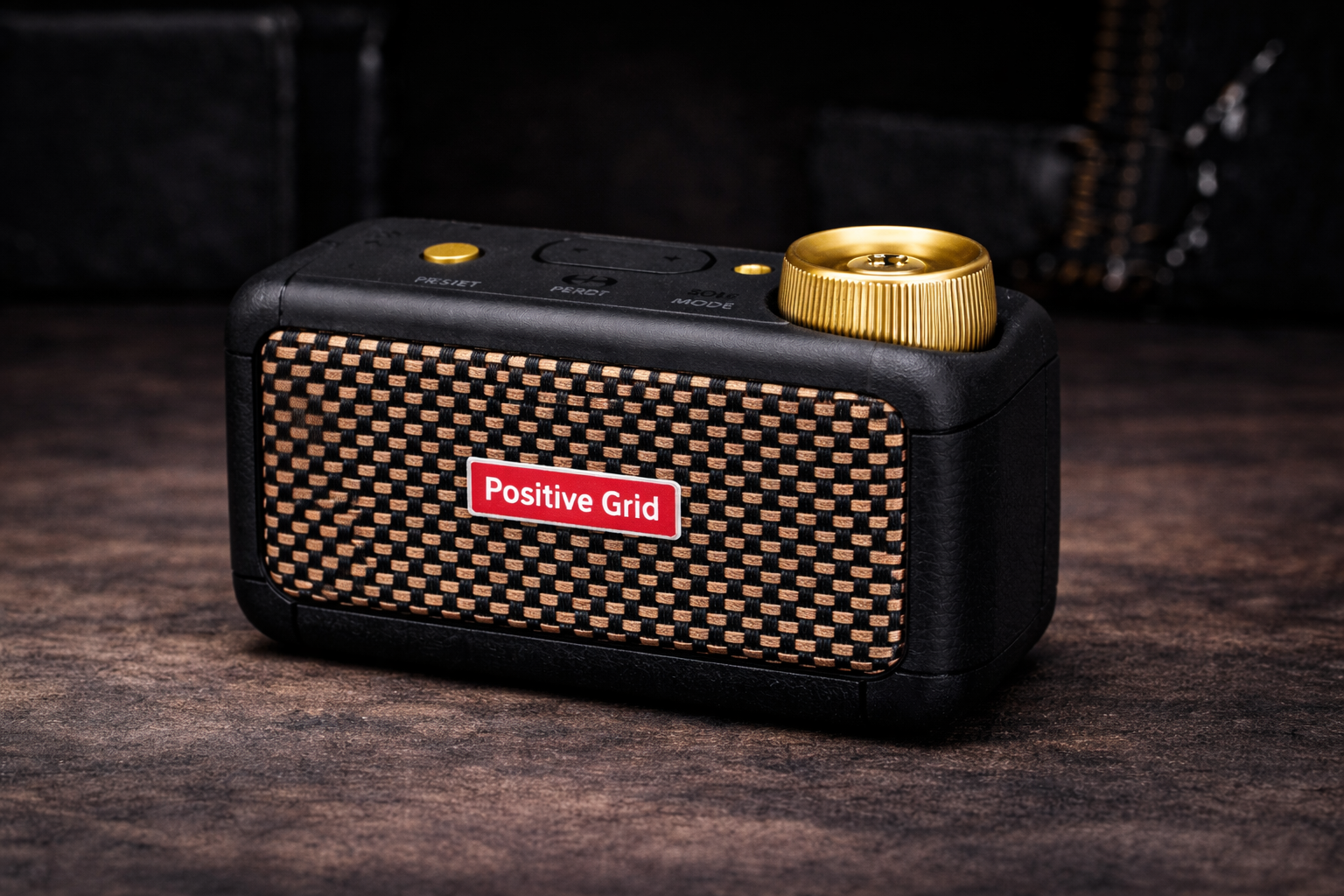
Spark GO looks like a squashed-down Spark Mini. It is roughly the size of a thick smartphone power bank, with a rubberized outer sleeve, woven or hardshell grille, and a reversible strap that works as both a carry handle and a way to angle the amp on a desk.
The design is clean and modern rather than vintage. The enclosure feels tougher than its size suggests. Positive Grid clearly expects this thing to be thrown into bags, backpacks and gig cases, so the corners and grille have extra protection.
The top panel is minimal: instrument input, three small knobs, a preset button and indicator LEDs. There is no screen; most of the deep control lives in the app. On the side you get USB-C and headphone/line out. Everything is small but legible, and the knobs have enough resistance that you do not bump them every time you move the amp.
Positive Grid Spark GO Review: Core Tones & Feel
Out of the box, Spark GO ships with four onboard presets you can cycle through with the preset button. They cover a typical spread: clean, edge-of-breakup, higher-gain rhythm and a more saturated lead sound with delay or reverb.
You can overwrite these via the app with any tones you design or download. The tiny 2″ speaker obviously cannot move as much air as a bigger combo, but at close range it sounds fuller than you might expect.
Clean tones have a hi-fi, FRFR-style character rather than classic amp coloration. Crunch and high-gain sounds lean on Positive Grid’s modeling engine and stay surprisingly detailed, especially at lower volumes where a traditional small speaker would usually struggle.
Spark GO is not the right tool if you are chasing “amp in the room” feel from a single box. It excels more as a near-field practice monitor and Bluetooth speaker. For straight-ahead rock tones on a budget desktop rig, something like the Hotone Pulze or a larger combo may feel more physical, but the GO keeps up well considering how small it is.
Spark App, Smart Jam & ToneCloud
The hardware is only half the story. Spark GO leans heavily on the Spark app for iOS and Android, which unlocks the full set of 33 amp models and 43 effects, plus Smart Jam, Auto Chords and access to tens of thousands of community tones on ToneCloud.
You control amp type, gain, EQ, pedals and effects chains from your phone, then push presets down to the amp. Smart Jam listens to your playing and generates bass and drum parts that follow your groove, giving you a quick virtual band without needing backing tracks.
Auto Chords listens to songs from streaming services or YouTube through the app and shows you the chords in real time, which is especially useful for learning covers quickly. For structured practice you can build playlists of tones and backing tracks, save favorite presets, and grab artist-style sounds from ToneCloud.
In this Positive Grid Spark GO review context, the app is what turns a tiny box into a full practice platform rather than just a novelty mini amp.
Recording, USB & Bluetooth Speaker Use
Spark GO doubles as a small USB audio interface. Connect it to a computer with the included USB-C cable and you can record guitar directly into your DAW using the tones from the amp and app.
It shows up as a 1-in / 2-out interface at 44.1 kHz, 16-bit, which is more than enough for writing demos or capturing practice ideas. Latency is low enough for comfortable playing if your computer is reasonably up to date.
As a Bluetooth speaker, it is surprisingly loud for the size, especially in a bedroom or office. You can stream music from your phone and either jam along or just use it as a compact listening speaker. Instrument and music volumes are separate, so you can balance backing tracks and guitar easily.
The headphone/line out lets you practise silently or run into another system. With closed-back headphones it feels closer to a full-size Spark rig than the tiny physical speaker would suggest, which is a big part of the appeal as an “everywhere” practice solution.
Battery Life & Portability
The built-in 18650-style battery is rated for around eight hours of use at moderate output. In real life that means several practice sessions or an entire day of on-and-off playing before you need to plug it back in.
Charging over USB-C takes roughly a couple of hours with a standard phone charger. There is no dedicated fast-charge mode, but for a practice amp that is rarely a real limitation.
Size and weight are where Spark GO really stands out. At about 125 x 85 x 45 mm and just over 300 grams it is smaller and lighter than many multi-effects units. It fits in a mono gig bag pocket, a backpack side pocket, or even on a pedalboard as a dedicated “monitor and interface” box.
For players who move between home, school, office and rehearsal spaces, this kind of portability can matter more than raw volume. Spark GO is designed for spaces where a larger combo or a bigger smart amp would be overkill.
Who Is the Spark GO For?
Spark GO makes the most sense if you:
- Mostly practise with headphones or at low volume in small rooms.
- Like the idea of an app-based rig with Smart Jam, Auto Chords and downloadable presets.
- Want a tiny travel amp that can also be your quick recording interface.
- Already have a main amp but want something genuinely pocket-sized for daily practice.
It is less ideal if you never want to touch a phone or tablet while practising, or if you want bigger, more “amp in the room” sound without relying on headphones. In those cases, a more traditional practice combo like the Mustang LT25 or a stereo desktop amp such as the ID:Core 10 V4 might suit you better.
Pros & Cons
Pros
- Extremely portable: genuinely pocket-sized and very light.
- Deep Spark app integration with Smart Jam, Auto Chords and ToneCloud tones.
- Functions as USB audio interface for quick recording.
- Works as a Bluetooth speaker for general music listening.
- Rechargeable battery with up to around eight hours of playing time.
Cons
- Most of the power is in the app; without it, the four onboard presets are basic.
- The 2″ speaker cannot deliver the same “amp in the room” feel as larger practice combos.
- Requires a phone or tablet nearby for deep editing and tone management.
- Only 16-bit USB audio, which is fine for demos but not ideal for more demanding recording workflows.
Alternatives to Other Practice Amps
If you like the idea of a compact smart amp but want more physical punch from the speaker, the Hotone Pulze is a strong alternative. It offers stereo sound, more speaker area and a more traditional “amp on a desk” feel, at the cost of being larger than Spark GO.
For players who prefer a more traditional combo with a screen and deeper controls on the amp itself, the Fender Mustang LT25 gives you a bigger 8″ speaker, 25 watts of power, a colour display and USB recording. It is better if the amp will live in one room and does not need to fit in a gig bag pocket.
If you want stereo ambience and a simple control layout without relying too heavily on a phone, the Blackstar ID:Core 10 V4 offers dual speakers, six voices, built-in effects and CabRig IR-based cabinet simulation over USB. It is still desk-friendly, just not as ultra-portable as Spark GO.
If you want a larger combo from the same ecosystem, the original Spark 40 is often the focus of broader positive grid spark review articles, but Spark GO is the one that truly fits in a backpack.
Verdict: Is the Positive Grid Spark GO Worth It?
Spark GO is not trying to replace a full-size amp or multi-effects floorboard. It is trying to be the tiny box you always have with you, that lets you plug in, call up a tone, fire up Smart Jam or a backing track, and actually play. On that front it succeeds.
For players simply wondering is positive grid spark go worth it, the answer is yes if you value portability and app-based practice over raw volume. And if you are more generally asking is the Positive Grid Spark worth it, GO is the ultra-portable member of the Spark family that makes the most sense for home, office and travel use. The combination of portability, app features and USB recording makes it much more than a novelty mini amp.
From a Positive Grid Spark GO review point of view, the key question is whether you are happy living in an app-first workflow. If you hate using apps, you will probably find the experience frustrating, because most of the depth lives on your phone or tablet.
If you are comfortable managing tones on a screen and like the idea of a smart practice ecosystem that fits in your hand, the Positive Grid Spark GO is one of the most capable ultra-portable practice rigs available right now. For beginners it is a forgiving, inspiring first “smart rig” that can grow with you.
For more experienced players it is an always-with-you practice and recording companion that sits alongside, rather than replaces, your main amp, and it comfortably belongs in the conversation around compact practice amps. If you are shortlisting the best practice amps for home and travel, Spark GO deserves a spot on that list.
Positive Grid Spark GO FAQ
Is the Positive Grid Spark GO loud enough for band practice?
No. With 5 watts into a single 2″ speaker, Spark GO is designed for bedroom, office and travel practice. It can handle quiet jams but will not keep up with a live drummer.
Do I need the Spark app to use Spark GO?
You can plug in and use the four onboard presets without the app, but you need the Spark app to edit tones, access all 33 amp models and 43 effects, use Smart Jam and Auto Chords, and manage presets. The amp makes far more sense if you are willing to use the app.
Can I record directly into my computer with Spark GO?
Yes. Spark GO acts as a USB audio interface. Connect it over USB-C and select it as your audio device in your DAW to record guitar with the tones you set up in the app.
How do you use the Positive Grid Spark or Spark GO?
To use the amp, connect your guitar, select one of the four onboard presets and set your instrument and music volumes. For deeper control, open the Spark app on your phone or tablet, pair it over Bluetooth, choose an amp model and effects chain, then save them as presets to the amp. If you are searching for how to use Positive Grid Spark, the steps are basically the same: the full-size Positive Grid Spark and the smaller Spark GO share the same core workflow.
How long does the battery last on a full charge?
Positive Grid quotes up to around eight hours of use at moderate volume. At full volume you can expect closer to about half that, but for typical home practice it should comfortably last several sessions between charges.
Is the Positive Grid Spark GO a good first amp for beginners?
If you are comfortable using a phone or tablet, yes. The app-based workflow, Smart Jam and Auto Chords make learning songs and practising more engaging. If you prefer to avoid screens while practising, a more traditional beginner combo might be a better fit.