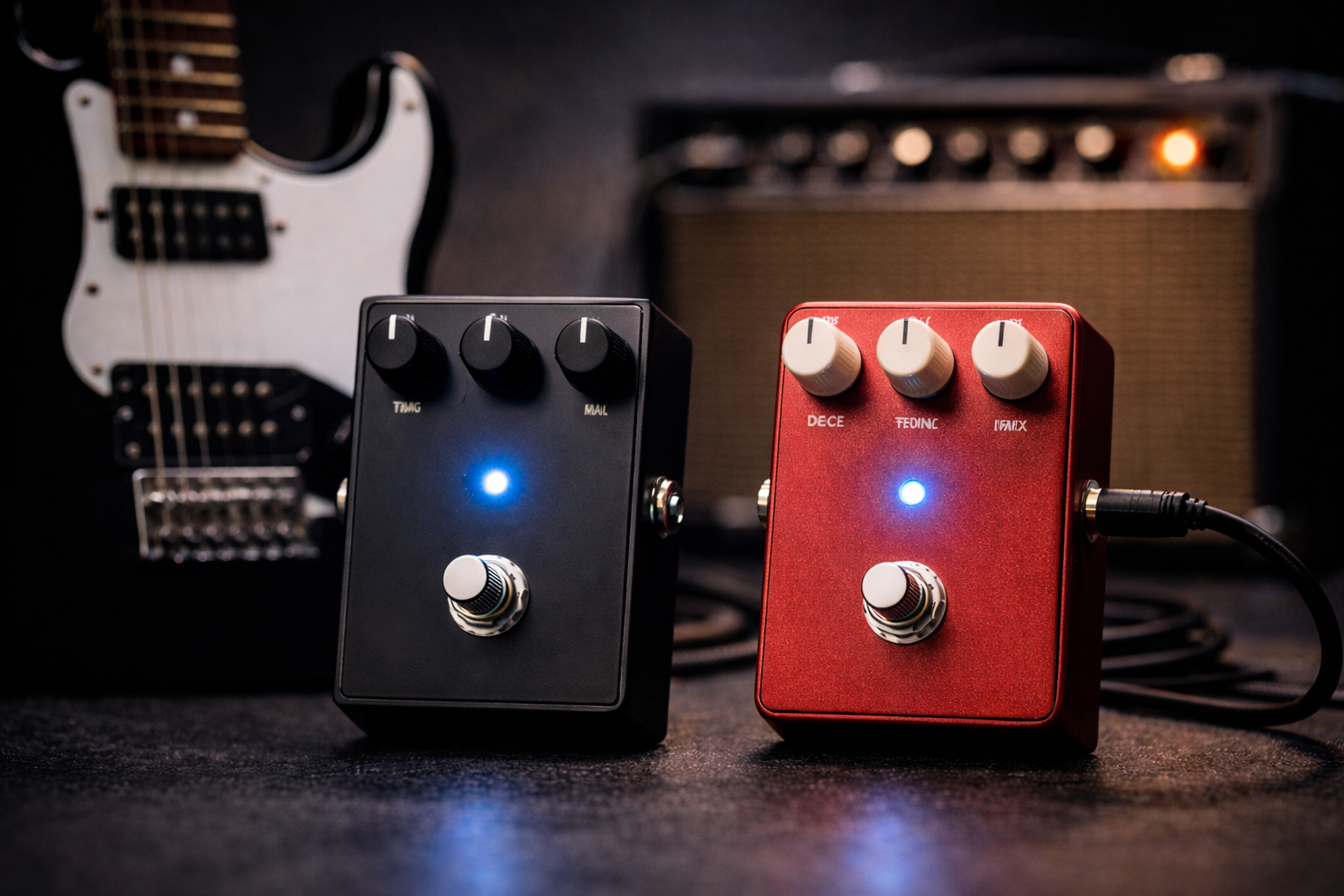
Delay and Reverb Pedal: Order, FX Loop & Starter Chains Explained
If you’ve ever stepped on a delay, added a bit of reverb, and thought “why does this sound messy instead of big?”, this guide is for you. We’ll keep it focused on real home rigs and small boards, not studio-only tricks.
Here you’ll learn how to place your delay and reverb pedal in the chain, how they interact with drive, and how to get a clear, musical sense of space without washing out your tone. If you’re still building your first board and want the full picture of drives, delay, reverb, and modulation, you can zoom out with the hub: guitar pedals for beginners.
We’ll also answer the classic question people type into Google—“reverb before delay or after?”— and give you simple examples so you can hear the difference for yourself instead of guessing.
If you want one simple answer: For most home guitarists, put delay before reverb and treat delay as rhythmic repeats, reverb as the “room” you put those repeats in. For deeper dives into each effect on its own, see what does a delay pedal do and what does a reverb pedal do.
What is delay and reverb (beginner version)
At a basic level, delay and reverb pedals both create “space”, but they do it in different ways.
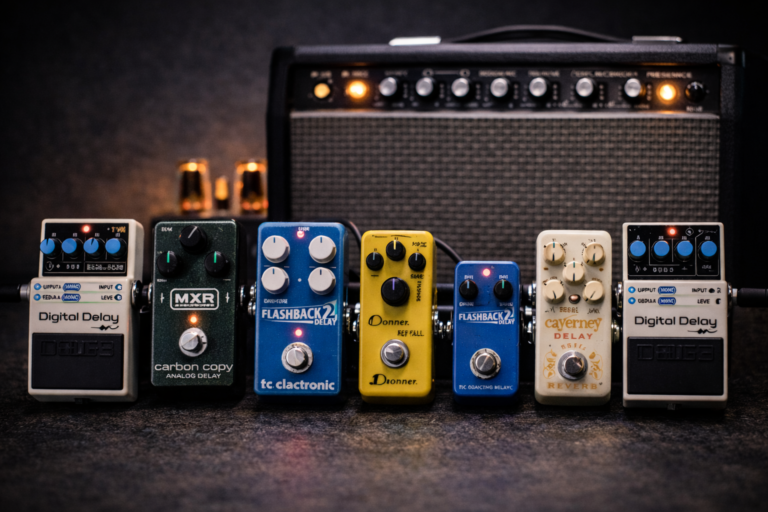
- Delay pedal: repeats your note after a short time. Think of it as a controllable echo that can be tight and rhythmic or long and atmospheric. For a full walkthrough of the controls and starter settings, see what does a delay pedal do.
- Reverb pedal: simulates the reflections of a room, hall, or plate. Instead of distinct repeats, you get a smooth tail behind the note. For more detail on decay, mix, and pre-delay, see what does a reverb pedal do.
If someone asks you what is delay and reverb in practical terms: delay gives you repeated notes, reverb gives you decay and depth. How you combine them is what makes the rig feel like a song instead of a dry practice tone.
Delay and reverb pedal order: the 10-second answer
Here’s the short, honest answer to where to place a delay and reverb pedal in a beginner board.
| Your situation | Best order | Why it works | When to break the rule |
|---|---|---|---|
| Home player, simple amp, basic board | Delay → Reverb | Repeats stay clear, reverb glues everything together | Almost never – this is the default for most rigs |
| Ambient / shoegaze textures | Reverb → Delay | Delay repeats the reverb tail for big, washed textures | Use on a separate preset; not great for tight rhythm |
| Using an amp with an FX loop | Guitar → Drive → Amp preamp → FX loop: Delay → Reverb | Time-based effects stay after distortion, like in a studio mix | Only move them in front if your loop sounds obviously worse |
Beginner-safe rule: If you catch yourself wondering “delay before reverb or after?”, use delay first, reverb last. That order will make sense on almost every beginner board, especially if your core gain tones are already sorted using guides like overdrive pedal explained, the dedicated electric guitar distortion pedal article, and how does a fuzz pedal work.
Reverb before delay or after? Pros and cons
The classic “reverb before delay or after” question is really about what you want to hear under your fingers. Both orders are valid; they just emphasize different things.
| Order | What it sounds like | Best for | Beginner watch-out |
|---|---|---|---|
| Delay → Reverb | Clear repeats sitting inside a room; chords stay readable | Most songs, solos over backing tracks, worship / pop / rock | Too much reverb mix can still blur things even in this order |
| Reverb → Delay | Every note + reverb tail gets echoed; very lush and smeared | Ambient pads, shoegaze, intros/outros where clarity matters less | Easy to lose timing; not ideal as the only setting on a board |
When you test both options, record a short phrase each way. Instead of arguing “should reverb go before delay?” in theory, compare the recordings and decide which one actually fits your playing and your mix. If your gain structure itself is still a question mark, a comparison like overdrive vs distortion vs fuzz helps you pick a foundation before you fine-tune ambience around it.
FX loop vs front of amp for delay and reverb pedals
Order is one part of the story; the other is where these pedals sit relative to your amp’s preamp or distortion.
| Placement | Chain | Feel | Recommended for |
|---|---|---|---|
| Front of amp | Guitar → Drives → Delay → Reverb → Amp input | Time effects hit the amp’s preamp; more “amp-like” smear | Clean amps, low-gain practice, amps without loops |
| FX loop | Guitar → Drives → Amp input → FX loop: Delay → Reverb → Return | Delay and reverb sit after distortion; clearer and more hi-fi | Higher gain, tighter rhythms, recorded-style clarity |
Simple rule: If your distortion lives in the amp, put your delay and reverb pedals in the FX loop. If your distortion lives in pedals (like a main overdrive, distortion pedal, or fuzz on the board), keep delay and reverb after those pedals into a mostly clean amp.
Beginner delay + reverb pedal chains
These example chains show how the delay before reverb or after question plays out in real home rigs.
| Rig | Signal chain | What it gives you |
|---|---|---|
| Clean amp, low gain | Guitar → Tuner → Overdrive → Delay → Reverb → Amp | Classic always-on space; delay stays defined, reverb ties it together |
| High-gain amp with FX loop | Guitar → Tuner → Drives → Amp → FX loop: Delay → Reverb | Leads and riffs stay articulate even with more saturation |
| Ambient / shoegaze preset | Guitar → Drives → Reverb → Delay → Amp / Loop | Huge, smeared tails for intros, outros, noise sections |
If you want more detailed starting points for each pedal on its own before stacking them, the dedicated guides what does a delay pedal do and what does a reverb pedal do walk through “one pedal at a time” setups you can then combine.
If the order is settled and the remaining question is which reverb belongs there, start with the job rather than the brand. For simple classic space, see the Holy Grail Nano review. For compact all-rounders, compare the Boss RV-6, MXR M300, and Hall of Fame 2. If the reverb itself is part of the arrangement, the Walrus Slö and Empress Reverb take you further into ambient and programmable territory.
For the full shopping comparison, use the best reverb pedal guide.
Starter settings for delay and reverb pedals
These settings aren’t magic numbers, but they’ll get most delay and reverb pedal combinations into a safe “doesn’t wreck your tone” zone fast. They work best if your dry EQ is already under control using small, predictable moves—if you’re lost there, the guitar EQ cheat sheet gives you a neutral baseline.
| Pedal | Control | Starter setting | Listen for |
|---|---|---|---|
| Delay | Time | 300–450 ms | Repeats sit between your phrases, not on top of them |
| Delay | Mix / Level | 10–15% | Notes feel thicker, but you still hear the original pick attack clearly |
| Delay | Feedback / Repeats | 2–3 repeats | Lines don’t turn into a wall of echoes when you play fast |
| Reverb | Mix | 10–20% | It feels weird when you turn it off, not obvious when it’s on |
| Reverb | Decay | Mid position | Tails die away naturally between phrases at home volume |
Quick reality check: If your sound gets muddy, lower reverb mix first. If timing feels messy, lower delay feedback and mix. The fix is almost never “add more”. At strict bedroom levels, it can help to combine these settings with the dedicated low-volume guitar tone guide so you’re not asking ambience to fix an already struggling dry sound.
Common mistakes with delay and reverb (and fast fixes)
- Stacking huge delay and reverb together: lower both mixes, then rebuild slowly. You should hear your picking before you hear the room.
- Using reverb as a blanket: if you’re hiding mistakes under a big wash, practice feels satisfying but progress slows. Keep a drier preset for “honest” practice and use more space only after your core tones (drive + EQ) are sorted.
- Putting time-based effects before heavy gain: reverb or delay into distortion usually turns to mush. Keep drives before your ambience section unless you’re chasing a special effect.
- Ignoring the FX loop: if your amp has one and your drive comes from the amp, moving delay and reverb into the loop often fixes clarity instantly.
FAQ
Should reverb go before delay?
For most setups, no. The clearest, most versatile chain is delay → reverb. That way delay repeats stay clean and reverb just adds space. Putting reverb before delay is more of a special effect for ambient textures than a default setting.
What does a delay and reverb pedal do in a guitar rig?
A delay and reverb pedal combo shapes the sense of space around your guitar. Delay adds rhythmic echoes that can thicken leads and riffs, while reverb adds the sense of a room or hall. Together they turn a dry practice tone into something that feels more like a finished part.
Where should I put delay and reverb pedals in my chain?
In a simple board, a safe order is: Guitar → Tuner → Drives → Delay → Reverb → Amp. If your amp has an FX loop and you use the amp’s distortion, move the delay and reverb into the loop so they sit after the preamp. For more context on each effect’s job, see the delay guide and the reverb guide.
How does delay and reverb behave in the FX loop vs in front?
In front of the amp, delay and reverb get distorted along with your signal, which can sound more old-school but also messier. In the FX loop, distortion happens first and the delay and reverb pedals sit after it, which usually sounds clearer and more controlled at home volume.
About this guide
- Who it’s for: guitarists building a first small board and trying to understand delay and reverb pedal order without studio-level theory, especially if they’re already using overdrive, distortion, or fuzz as their main gain sounds.
- How it’s built: real-world chains at home volume, simple comparisons for reverb before delay or after, and starter settings you can tweak by ear. It’s designed to sit alongside the individual delay and reverb guides as the “put them together” piece of the guitar pedals for beginners cluster.
- What it’s not: a giant reverb/delay model shootout or brand ranking—this is about using the pedals you already have.
- Last updated: 2026-09-21
One Comment
Comments are closed.