Best Delay Pedals for Guitar: 7 Picks from Budget to Ambient
Picture this: it’s late, your amp is at “don’t-wake-anyone” volume, and you finally kick on a delay sound. It either vanishes in the mix or turns everything to mush. You open a few tabs to fix it and get buried in endless lists, boutique hype, and jargon. This guide is for real rigs: home players, rehearsals, small boards, and practical budgets.
If you’re comparing the best delay pedal for guitar for your first board (or upgrading from a basic effect), the goal here is simple: pick a pedal that matches how you actually play — without paying for features you won’t use. If you want the basics first, start here: what does a delay pedal do?
- See what a dedicated delay pedal actually adds to a normal home or band rig.
- Decide if you genuinely need one now — or if it’s still overkill for where you are.
- Compare seven realistic options across budget, “one-pedal” versatility, and ambient needs.
| Your situation | Pick | Why it fits |
|---|---|---|
| You want one pedal that covers most styles (home + rehearsal). | Boss DD-8 | Reliable all-rounder with tap tempo + stereo; easy “main delay” choice. |
| You want warm repeats that sit behind the note (best analog delay pedal feel). | MXR Carbon Copy | Dark, blended repeats for “always-on” depth without clutter. |
| You want one box that can do clean, tape-ish, and ambient textures. | TC Flashback 2 | Versatile modes + TonePrint if you want more later, without buying another pedal. |
| Tight budget, first board, mainly home practice (best budget delay pedal case). | Donner Yellow Fall | Simple musical repeats for the money; easy to dial in. |
| You need a mini pedal because board space is limited. | Flashback Mini | Small footprint, flexible sounds via TonePrint. |
| You want delay + reverb in one pedal (best reverb delay pedal scenario). | Keeley Caverns V2 | One slot for space: usable delay + reverb together. |
| You want a simple rock delay with tap tempo (no menus). | Boss DD-3T | Fast dial-in, clear repeats, dependable live behavior. |
Who is a dedicated delay pedal actually for?
Not everyone needs a separate delay pedal on day one. Some players get plenty of mileage from an amp’s built-in effects, while others benefit from a dedicated unit near the end of the chain — especially if you want the best delay pedal for guitar to stay useful as your rig grows.
When a delay pedal makes sense
- You already like your basic clean and driven tones and just want them to feel more “finished.”
- You play songs where rhythmic echoes or dotted-eighth patterns are a key part of the sound.
- You record at home and want more control than your amp’s built-in effects provide.
- You’re starting to rehearse or gig and want one reliable delay you can keep long term.
When a delay pedal is probably overkill
- You’re still on your first guitar and amp and haven’t explored core tones yet.
- You mostly practice dry (or with a touch of amp reverb) and don’t feel limited.
- Your amp already has a decent delay you barely touch.
- Your monitoring (amp/headphones) is the real bottleneck right now.
If you’re still building your fundamentals and rig basics, this helps you prioritize what to fix first: beginner guitar checklist.
Main types of delay pedals
When guitarists say “delay,” they often mean a few different tools under one label. Most pedals in this guide fall into three practical categories.
Analog delay
Darker, softer repeats that naturally sit behind your dry tone and thicken it. Great for subtle depth and “always-on” warmth. If your priority is feel and blend over features, this is where many players end up when chasing a best analog delay pedal.
- Excellent for edge-of-breakup and classic rock leads.
- Helps solos feel thicker without obvious repeats on top.
- Usually shorter maximum delay time, but very musical where it counts.
Digital delay
Cleaner, more precise repeats with longer delay times and more control. Ideal for rehearsals, tight rhythm parts, and repeatable settings.
- Better for clear rhythmic patterns and dotted-eighth styles.
- Stays articulate under gain and in busy mixes.
- Often includes tap tempo and useful subdivisions.
Multi-mode / ambient delay
Multiple “flavors” (digital, tape, analog-style) and sometimes more atmospheric modes. Great if you want one box to cover both basic repeats and bigger textures.
- Strong for ambient, worship, post-rock, and cinematic cleans.
- Can replace multiple pedals if you’re OK with more options.
- Easy to overbuy if you only use one basic sound.
Buying checklist: what actually matters
Most people don’t need “more delay.” They need one sound that supports their playing, plus one backup setting that works everywhere. Before you pick from the list, it helps to sanity-check a few basics.
- Tap tempo: matters if you play with a drummer or use rhythmic delays.
- Max delay time: longer times mainly matter for ambient washes and slow repeats.
- Stereo: useful for stereo rigs and headphone/modeler setups; optional for simple amps.
- Trails: repeats continue after bypass (nice for live transitions).
- Ease of dialing: the “set and forget” factor beats extra modes for most players.
- Board space: mini pedals help, but don’t sacrifice usability.
Best delay pedal for guitar: quick picks by use case
- One pedal that covers almost everything: Boss DD-8
- Warm repeats that sit behind your tone: MXR Carbon Copy (a common best analog delay pedal choice)
- Budget-friendly and usable: Donner Yellow Fall (a safe best budget delay pedal pick for simple rigs)
- One slot for space + ambience: Keeley Caverns V2 (best reverb delay pedal style use case)
How we picked these pedals
These picks prioritize real-world use: quick dial-in, musical repeats, and features you’ll actually touch at home and at rehearsals. The point is to narrow down best guitar delay pedals that keep getting recommended for practical reasons — not hype.
- Use cases: home practice, headphones, rehearsals, occasional live use.
- Dial-in speed: how fast you can get a usable sound without menu-diving.
- Mix clarity: whether repeats stay behind the dry signal (or get in the way).
- Practical features: tap tempo, useful modes, and board-friendly form factor.
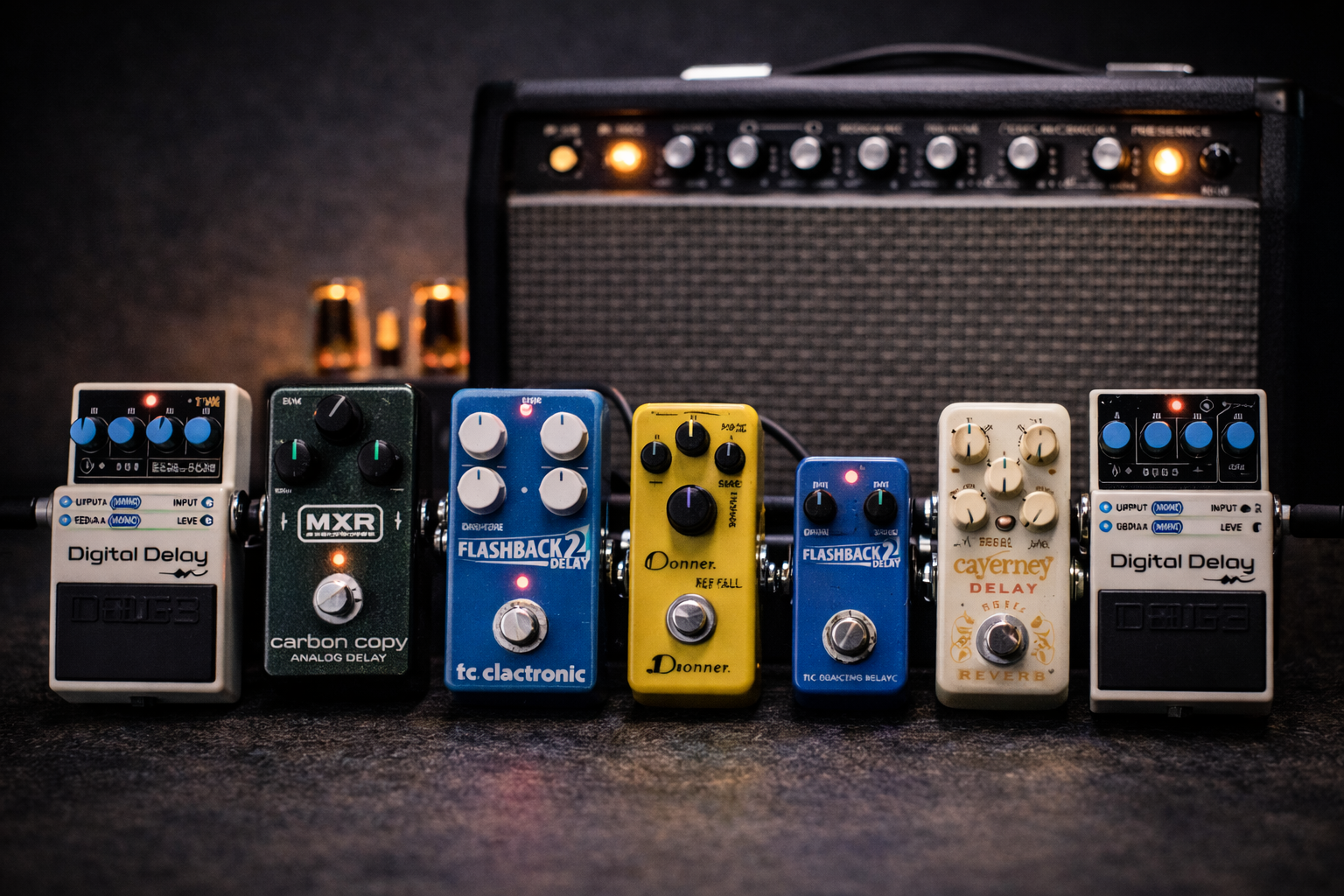
The 7 picks
Boss DD-8 (all-rounder)
A modern workhorse that covers the essentials (clean, tape-style, analog-style) plus practical features like tap tempo and a basic looper. If you want the best delay pedal for guitar as a single “do-it-all” choice that stays useful as your rig grows, this is the easy recommendation.
Read the full Boss DD-8 review for settings, rig matching, limitations and my hands-on verdict.
- Model: Boss DD-8
- Type: Digital, multi-mode delay
- Best for: One-pedal boards, rehearsals, wide style coverage
- Key features: Tap tempo, stereo I/O, multiple modes, looper
- Price tier: Mid
- Skip if: You only want dark, always-on repeats with minimal controls
MXR Carbon Copy (warm analog feel)
Dark, warm repeats that sit behind your dry sound instead of on top of it. Great for subtle thickening and “always-on” depth, and still a reference point for players shopping for a best analog delay pedal.
Read the full MXR Carbon Copy review for settings, rig matching, limitations and my hands-on verdict.
- Model: MXR Carbon Copy
- Type: Analog bucket-brigade delay
- Best for: Classic rock, blues, edge-of-breakup rigs
- Key features: Simple controls, musical repeats, optional modulation
- Price tier: Mid
- Skip if: You need very long delay times or ultra-clean rhythmic repeats
Works especially well once your drive foundation is solid: overdrive pedal explained.
TC Electronic Flashback 2 (versatile one-box)
Clean studio-style delay one day, tape-ish repeats the next. TonePrint is there if you want deeper customization later.
Read the full TC Electronic Flashback 2 review for settings, rig matching, limitations and my hands-on verdict.
- Model: TC Electronic Flashback 2
- Type: Digital multi-mode delay
- Best for: Players who want range without buying multiple pedals
- Key features: Multiple modes, tap tempo, stereo, TonePrint editing
- Price tier: Mid
- Skip if: You prefer a no-software approach
Donner Yellow Fall (budget pick)
Small, straightforward, and tuned for musical repeats. A practical entry point for first boards and practice rigs. If your goal is “good enough to use daily” rather than features, this is the kind of best budget delay pedal pick that makes sense.
Read the full Donner Yellow Fall review for settings, rig matching, limitations and my hands-on verdict.
- Model: Donner Yellow Fall
- Type: Mini analog-style delay
- Best for: First boards, practice rigs, occasional delay use
- Key features: Simple controls, forgiving darker repeats
- Price tier: Budget
- Skip if: You need tap tempo or multiple delay flavors
If your biggest improvement comes from monitoring (not pedals), start here: budget headphones for guitar practice.
TC Electronic Flashback Mini (small board solution)
Three knobs on top, a huge TonePrint library underneath. Great if board space is tight but you still want a legit delay.
Read the full Flashback 2 Mini review for settings, rig matching, limitations and my hands-on verdict.
- Model: TC Electronic Flashback Mini
- Type: Mini digital delay (TonePrint)
- Best for: Small boards, minimal setups
- Key features: Tiny footprint, loadable sounds
- Price tier: Mid
- Skip if: You want on-pedal tap tempo
Keeley Caverns V2 (delay + reverb)
One side delay, one side reverb — both voiced for guitar. A strong “one slot” solution if you want bigger ambience, and the kind of pick people mean when they search for a best reverb delay pedal.
Read the full Keeley Caverns V2 review for settings, rig matching, limitations and my hands-on verdict.
- Model: Keeley Caverns V2
- Type: Dual delay + reverb pedal
- Best for: Ambient, worship, post-rock, wide clean tones
- Key features: Two effects in one, guitar-focused voicing
- Price tier: Upper-mid
- Skip if: You only need a tight repeat for subtle thickening
Boss DD-3T (set-and-forget)
Clear repeats, easy controls, no fuss. Great for thickening rhythm parts and leads without menus.
Read the full Boss DD-3T review for settings, rig matching, limitations and my hands-on verdict.
- Model: Boss DD-3T
- Type: Simple digital delay
- Best for: Players who want one solid sound + tap tempo
- Key features: Quick dial-in, predictable live behavior
- Price tier: Mid
- Skip if: You want multiple delay flavors in one pedal
If you want repeats to stay tight under gain, gain structure matters as much as the pedal: gain vs volume vs master.
How a delay pedal fits into your rig
Delay tends to shine once your core tone already feels good. Placement in the chain — and how you monitor (amp vs headphones) — changes the result more than most people expect.
Home and headphones
For home players, the best results usually come from subtle settings: low mix, shorter repeats, and enough space to feel inspiring without blurring your picking. For most “home-first” readers, that’s what ends up defining the best delay pedal for guitar in practice.
- Keep mix low and repeats short so your dry tone stays clear.
- Pair delay with a solid practice amp or a good headphone chain.
- Save 1–2 favorite settings you can return to quickly.
If you practice on headphones, these reads usually move the needle faster than swapping pedals: bedroom tone guide and budget headphone picks.
Live and rehearsal
In a band mix, clarity beats “lush.” A short, controlled delay setting usually sits better than a big ambient wash.
- Use sensible delay times (or tap tempo) that lock to the song.
- Keep repeats slightly darker so they don’t fight vocals and cymbals.
- Have one “works on most songs” setting you can return to fast.
Alternatives and simpler options
If a dedicated pedal feels like too much right now, you can still improve your sound with simpler steps.
- Push your amp’s built-in delay or reverb before buying anything.
- Build a solid overdrive + amp foundation first.
- Test delay with plugins, then commit to hardware once you know what you like.
If you’re still building the fundamentals of your rig, this helps you prioritize what to fix first: beginner guitar checklist.
When a delay pedal is overkill
Sometimes the best move is simply not buying a delay pedal yet.
- You’re still fighting basic problems (tuning, fret buzz, noise).
- You haven’t found a core clean/drive tone you genuinely like.
- You play at very low volume and your practice setup isn’t consistent yet.
In that case, build the foundation first: beginner guitar checklist, electric guitars under $300 and bedroom tone guide.
Summary: should you buy a delay pedal now?
If you’re buying the best delay pedal for guitar today, match the pedal to your actual use case: one reliable all-rounder, a warm analog feel that blends behind you, or a budget option that still sounds musical. That “fit-to-purpose” approach is also what separates genuinely useful best guitar delay pedals from random lists.
- Start here: Boss DD-8 if you want one pedal that covers the most ground.
- Warm and blended: MXR Carbon Copy if you want repeats that sit behind the note.
- Budget-friendly: Donner Yellow Fall if you just need musical repeats for home practice.
Once delay is on the board, tightening your gain + EQ makes it translate better in real rooms: gain vs volume vs master and guitar EQ cheat sheet.
Delay pedal FAQ
Is a delay pedal worth it for beginners?
It can be — but usually after the basics are in place. If you don’t like your clean and driven tones yet, or you’re still fighting tuning and noise issues, even the best delay pedal for guitar won’t solve those problems. Once your core rig feels solid, a simple pedal from this list becomes a very effective way to make your sound feel more finished.
What’s the difference between analog and digital delay pedals?
Analog delay usually has darker, softer repeats that blend into your tone and are great for thickening leads and rhythms. Digital delay is cleaner, can go much longer, and is better for precise rhythmic patterns and dotted-eighth styles.
Can I use a delay pedal with a solid-state or modeling amp?
Yes. Delay pedals work well with solid-state and modeling amps. Most players place delay after drive pedals and before reverb. You can run it into the front of a clean amp, or use an FX loop if you’re using a lot of preamp gain and want a cleaner, more controlled repeat.