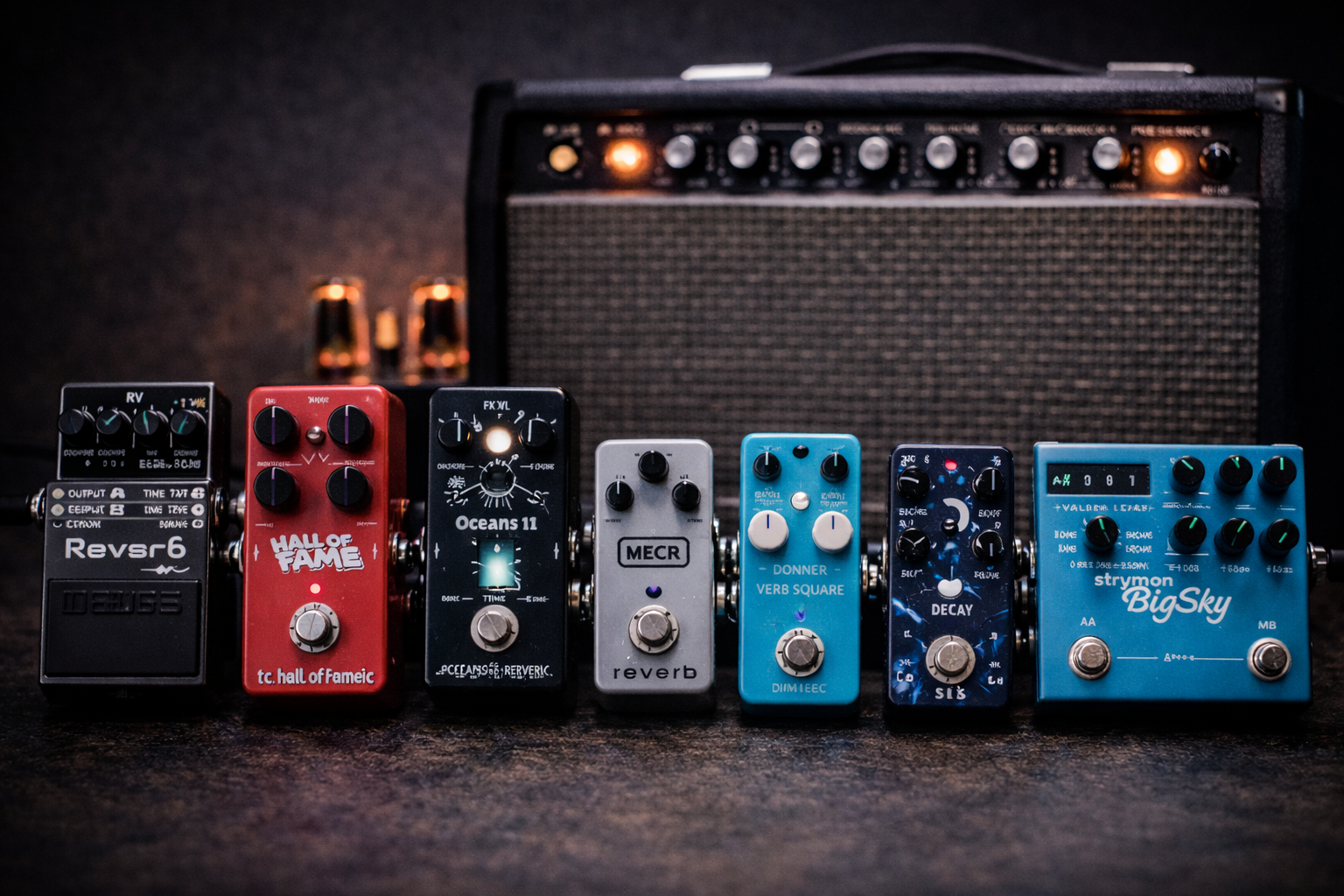
Best Reverb Pedal for Guitar: 7 Picks That Actually Make Sense
Reverb is one of those effects everyone says you “need” – until you open a shop page, see endless options, and realise your amp already has a reverb knob. Do you really need a dedicated box, or will any good reverb pedal do the job for home practice and small gigs?
I’m in the same boat as most readers here: mostly home player, some rehearsal volume, and I’ve used amp spring reverb, plugins and dedicated pedals side by side. This guide is the version I wish I’d read earlier – not just a list of “great reverb pedals”, but a way to match the best reverb pedal for guitar to how you actually play.
- What a dedicated reverb pedal adds to a normal home or band rig.
- How different reverb types feel (spring vs plate vs ambient) in real use.
- Seven realistic options from simple “always-on” boxes to full ambient textures.
| Your situation | Pick | Why it fits |
|---|---|---|
| You want one reverb that covers most styles (home + rehearsal) and just works. | Boss RV-6 | Simple controls, useful modes, and mixable shimmer – an easy “main reverb” choice. |
| You want classic spring / hall sounds that feel like an amp, not a spaceship. | Electro-Harmonix Holy Grail Nano | Straightforward “good reverb pedal” for classic tones with minimal menu-diving. |
| You want one box that can do plate, hall, spring and more experimental stuff. | TC Electronic Hall of Fame 2 | Multi-mode workhorse with TonePrint – one of the classic great reverb pedals. |
| Tight budget, first board, mostly home practice, you just want something musical. | Donner Verb Square | Compact and affordable; a practical best reverb effects pedal choice for budget rigs. |
| You need a tiny pedal because board space is already full. | TC Electronic Hall of Fame Mini | Single TonePrint slot in a mini box – choose your favourite sound and leave it there. |
| You want delay + reverb in one slot (ambient cleans, worship, post-rock). | Keeley Caverns V2 | One box for space: stacked delay + reverb without filling half the board. |
| You want lush ambient pads and shimmer textures above everything else. | Walrus Audio SLO | Dedicated ambient machine; a classic pick when people talk about the best guitar reverb pedal for big soundscapes. |
Who is a dedicated reverb pedal actually for?
Not everyone needs a separate reverb pedal on day one. Plenty of players stay happy with their amp’s built-in spring reverb for years. Others find that a dedicated box is what finally makes their cleans feel “finished” – especially when they start chasing specific hall or ambient sounds.
When a reverb pedal makes sense
- Your amp has no reverb, or only a basic spring sound you can’t tweak much.
- You want specific plate / hall / shimmer tones instead of one generic setting.
- You’re starting to build a pedalboard and want your cleans to feel more 3D.
- You play ambient, worship or post-rock and need more than a subtle room sound.
When a reverb pedal is probably overkill
- You’re still fighting basic issues (tuning, noisy rig, harsh amp EQ).
- You mostly practice dry or with a touch of amp reverb and don’t feel limited.
- You haven’t found a core clean / drive tone you genuinely like yet.
- Your monitoring (amp, headphones, room) is clearly the weak link right now.
If the rig itself feels rough, fixing volume, EQ and noise will move the needle more than buying the best reverb pedal for guitar on paper. These reads help with the basics: bedroom tone guide and guitar EQ settings guide.
Main types of reverb pedals
When guitarists say “reverb”, they might mean subtle spring, studio-style plates, or huge shimmer pads. Most pedals in this list fall into three practical categories. If you want the fundamentals before comparing products, our reverb pedal explainer covers the controls, reverb types, and how to dial them in.
Spring reverb pedals
Spring reverb is the amp-classic: bouncy, mid-forward tails that feel like a Fender combo in a room. A lot of players looking for a “good reverb pedal” actually want a simple spring sound that makes clean chords and surfy leads feel alive without washing everything out.
- Great for surf, rockabilly, classic rock and country.
- Pairs well with edge-of-breakup tones and tremolo.
- Often has fewer controls, but very familiar under the fingers.
Plate and hall reverb
Plate and hall settings are smoother and more even than spring. They’re better for “studio” type tones, modern pop cleans, and ambient swells that sit behind the guitar rather than bouncing on top of it.
- Good choice if you want your cleans to sound bigger without obvious spring drip.
- Plates work well for lead lines; halls work for lush chord washes.
- Where many “best guitar reverb pedal” all-rounders spend most of their time.
Ambient, shimmer and multi-mode reverb
Ambient and shimmer modes add octave-up tails, modulated rooms and long decays that turn your guitar into a pad. These are the settings behind a lot of worship and post-rock sounds.
- Perfect if you live on clean tones and want big, cinematic texture.
- Easy to overdo – great reverb pedals stay usable even at extreme settings.
- Often found in multi-mode boxes that also include more traditional sounds.
Buying checklist: what actually matters
Most players don’t need “more reverb types”; they need one or two sounds that reliably make their core tone feel better. Before picking from any list of the best reverb effects pedal options, it helps to zoom out and decide what you really need.
- Mix control: how dry you can stay while still feeling the effect.
- Decay / time: short for rhythm clarity, long for ambient pads.
- Type priority: spring vs plate vs hall vs shimmer – choose your defaults.
- Trails on/off: whether the reverb tail continues after you bypass the pedal.
- Stereo vs mono: stereo matters more for headphones / FRFR than small combo amps.
- Board space: mini pedals save room but can be fiddlier to dial in.
- Ease of dialing: a simple, repeatable setting usually beats endless menus.
Best reverb pedal for guitar: quick picks by use case
If you’re mainly after a single always-on reverb that works for home, rehearsal and small gigs, it’s hard to beat a solid all-rounder that behaves like the best reverb pedal for guitar in real-world use rather than just on paper.
- All-rounder (home + rehearsal): Boss RV-6 – one of the best reverb pedal for guitar choices if you want a single box that covers most situations.
- Classic spring / hall starter: Electro-Harmonix Holy Grail Nano – a dependable good reverb pedal choice if you want amp-like space without menus.
- Feature-rich all-rounder: TC Electronic Hall of Fame 2 – one of the most flexible great reverb pedals if you like to tweak.
- Budget-friendly starter option: Donner Verb Square – a sensible best reverb effects pedal pick for first boards.
- Ambient delay + reverb combo: Keeley Caverns V2 – ideal if you want spacious cleans without dedicating two pedalboard slots.
- Dedicated ambient / shimmer machine: Walrus Audio Slö – often mentioned as a best guitar reverb pedal style choice for big soundscapes.
Two other directions are worth considering if the seven picks above do not match the way you work. The MXR M300 Reverb is a strong direct-control option when you want six useful sounds, stereo routing, and no menu layer. If presets, MIDI, and deeper sound design matter more than compact simplicity, see our Empress Reverb review.
The 7 picks
These seven options cover everything from simple amp-like springs to lush ambient pads, so you don’t have to sort through endless lists of so-called great reverb pedals to find something that actually fits a normal rig.
Boss RV-6 (all-rounder)
The RV-6 is a modern workhorse: spring, plate, hall, modulated and shimmer in a familiar Boss enclosure. If you want the best reverb pedal for guitar as a single “do-it-all” choice that stays useful as your rig grows, this is an easy recommendation. In practice, it can live as your main always-on space from low-volume practice to full-band rehearsal.
- Model: Boss RV-6
- Type: Digital multi-mode reverb
- Best for: One-pedal boards, home + rehearsal, versatile rigs
- Key features: Multiple modes, expression input, simple layout
- Price tier: Mid
- Skip if: You only need a tiny always-on spring sound
TC Electronic Hall of Fame 2 (versatile one-box)
Hall of Fame 2 takes the original HOF idea and adds MASH pressure-sensitive control and more refined modes. It’s the classic “Swiss army knife” on many boards. It suits players who move between different projects and need one reverb pedal that can adapt with them.
- Model: TC Electronic Hall of Fame 2
- Type: Digital multi-mode reverb with TonePrint
- Best for: Players who want range without owning multiple pedals
- Key features: Plates, halls, springs, shimmer options, TonePrint editor
- Price tier: Mid
- Skip if: You dislike software editors or deep options
Electro-Harmonix Holy Grail Nano (simple classic)
The Holy Grail Nano is for players who just want a straightforward, amp-like reverb without menus or presets. It’s often the answer when someone asks for a small but good reverb pedal that they can leave on most of the time. Think of it as a classic amp-style reverb that simply makes cleans feel finished.
- Model: Electro-Harmonix Holy Grail Nano
- Type: Compact digital reverb (spring / hall / flerb, depending on version)
- Best for: Classic spring / hall sounds on simple rigs
- Key features: Minimal controls, plug-and-play behaviour
- Price tier: Mid
- Skip if: You want stereo, shimmer or ambient special effects
Donner Verb Square (budget pick)
Verb Square is a compact budget reverb pedal that covers the basics and a bit more: room, hall, plate and a few extra flavours. It’s not the fanciest unit on the list, but it’s a realistic starting point if you’re assembling your first board on a tight budget. It makes sense if you want to hear what reverb does for your playing before committing to a pricier box.
- Model: Donner Verb Square
- Type: Mini multi-mode digital reverb
- Best for: First boards, home rigs, “just need some space” players
- Key features: Multiple modes, small footprint, friendly price
- Price tier: Budget
- Skip if: You need stereo or top-tier ambient sounds
If your biggest upgrade is still monitoring rather than pedals, you may get more from improving your headphone chain first: budget headphones for guitar practice.
TC Electronic Hall of Fame Mini (small board solution)
Hall of Fame Mini gives you one TonePrint slot in a tiny pedal. The trade-off is obvious: no on-pedal mode switching, but a single, carefully chosen sound in the smallest possible footprint. It’s ideal when every centimetre of pedalboard space matters but you still want a quality reverb sound on tap.
- Model: TC Electronic Hall of Fame Mini
- Type: Mini digital reverb (TonePrint)
- Best for: Crowded pedalboards, grab-and-go rigs
- Key features: Tiny enclosure, loadable sounds via TonePrint
- Price tier: Mid
- Skip if: You need multiple reverb flavours available on the fly
Keeley Caverns V2 (delay + reverb in one)
Caverns V2 puts a voiced-for-guitar reverb on one side and a musical delay on the other. If board space is tight but you want both effects in one slot, this is where a lot of players land instead of buying separate boxes. If you live on spacious cleans, it can easily become the centrepiece of your ambience chain.
- Model: Keeley Caverns V2
- Type: Dual delay + reverb pedal
- Best for: Ambient cleans, worship, post-rock, wide soundscapes
- Key features: Two effects in one, guitar-focused voicing
- Price tier: Upper-mid
- Skip if: You already have a delay you love and just need a small reverb pedal
If you’re still choosing between separate delay and reverb boxes, pairing this guide with the best delay pedal for guitar article can help you decide which effect to prioritise.
Walrus Audio Slö (dedicated ambient machine)
SLO is built around lush, modulated, pad-like reverbs rather than subtle room sounds. It’s the pedal you reach for when you want your guitar to sit somewhere between melody and synth pad. It shines when your parts lean more towards soundscapes and swells than tight rhythm work.
- Model: Walrus Audio SLO
- Type: Ambient / shimmer reverb
- Best for: Worship, post-rock, cinematic cleans
- Key features: Multiple ambient modes, long tails, expressive control
- Price tier: Upper-mid / premium
- Skip if: You mainly need subtle spring or plate sounds
How a reverb pedal fits into your rig
If delay is also part of the board, use our delay and reverb pedal order guide for the practical front-of-amp vs FX-loop decision before you start changing reverb settings.
Reverb works best once your core tone already feels good. Where you place it in the chain – and how you monitor (amp vs headphones vs FRFR) – changes the result more than most people expect.
Home and headphone practice
For home players, the most useful settings tend to be subtle: conservative mix, medium decay, and enough space to feel inspiring without blurring your picking.
That’s often what ends up defining the best reverb pedal for guitar in real life.
- Keep mix lower than you think; let your dry tone stay in front.
- Use shorter decay for practice, save long tails for specific songs.
- Pair the pedal with a solid practice amp or a good headphone chain.
If you practice mostly at low volume, these guides often help more than swapping pedals: bedroom tone guide and why your guitar sounds bad at home.
Live and rehearsal
In a band mix, clarity beats “lush”. A short plate or hall with sensible mix usually sits better than a huge ambient wash that gets swallowed by cymbals and vocals.
- Use shorter decay times than you would alone at home.
- Keep reverb tails slightly darker so they don’t fight cymbals and vocals.
- Have one “works on most songs” setting you can return to quickly.
Gain structure still matters as much as the reverb itself. If your tone falls apart when you turn up, check out gain vs volume vs master as a companion read.
Alternatives and simpler options
You don’t have to buy a dedicated pedal to get workable reverb. There are also a few common alternatives worth considering:
- Using your amp’s built-in spring reverb and learning to dial it well.
- Relying on the reverb inside a multi-effects unit or amp modeler.
- Adding reverb in your DAW if you mostly record direct.
Smart practice amps and modelers already blend amps, effects and speakers in one box. If you’re still deciding how they fit into your rig, the amp simulator vs practice amp vs modeler guide walks through the bigger picture.
When a reverb pedal is overkill
Sometimes the best move is simply not buying a reverb pedal yet. You might be happier with:
- One good practice amp you really learn to dial in.
- A simple amp + drive + maybe delay setup you fully understand.
- Fixing noisy cables, bad intonation and harsh EQ before adding ambience.
If you’re still working through the basics – chord changes, rhythm, timing – gear probably isn’t your bottleneck. These pieces help you put together a sensible starter rig first: beginner guitar checklist and electric guitars under $300.
Summary: should you buy a reverb pedal now?
If you’re choosing the best reverb pedal for guitar today, match the pedal to your actual use case: one reliable all-rounder, a simple spring/hall box you can leave on, a tight-budget option that still sounds musical, or a dedicated ambient machine if that’s where you live.
- Start here: Boss RV-6 if you want one pedal that covers the most ground.
- Classic and simple: Electro-Harmonix Holy Grail Nano for straightforward spring / hall.
- Budget-friendly: Donner Verb Square if you just need usable space for home practice.
- Ambient and worship: Walrus Audio SLO or Keeley Caverns V2 if you want big textures and are chasing a best guitar reverb pedal feel for massive pads.
If you’re still deciding whether to put your budget into time-based effects at all, pairing this guide with the best delay pedal for guitar roundup makes it easier to choose whether delay or reverb should come first.
Once reverb is on the board, tightening your gain and EQ makes it translate better in real rooms: gain vs volume vs master and guitar EQ cheat sheet are good next reads.
Reverb pedal FAQ
Is a reverb pedal worth it if my amp already has reverb?
It depends how picky you are. Many amps only offer a single spring sound with limited control. If that already gives you the space you want, you don’t need a pedal. A dedicated unit becomes more valuable when you want different flavours (plate, hall, shimmer), stereo options, or just more precise control over mix and decay. If you’re still putting together a basic starter rig, it usually makes more sense to get your core guitar and amp sorted first – the beginner guitar checklist and electric guitars under $300 guides walk through that step-by-step.
What’s the difference between spring, plate and hall reverb pedals?
Spring reverb is bright and bouncy, like a classic amp tank – great for surf, country and old-school rock. Plate reverb is smoother and more studio-like, good for leads and modern cleans. Hall reverb simulates a bigger room or space, with longer, more even tails that are great for ambient parts if you keep the mix under control.
Where should I put a reverb pedal in my signal chain?
Most players put reverb near the end of the chain: after drives and modulation, often after delay. If your amp has an effects loop and you use a lot of preamp gain, putting the reverb pedal in the loop usually sounds clearer than running it into the front of a saturated amp.
Do I need an expensive reverb pedal for good ambient sounds?
Not necessarily. Premium pedals give you more tweakability, nicer interfaces and sometimes smoother tails, but many affordable units can do convincing ambient if you use sensible mix/decay settings and pair them with solid core tones. The bigger jump in quality usually comes from improving your basic rig (amp, monitoring, EQ) rather than just spending more on reverb.
3 Comments
Comments are closed.