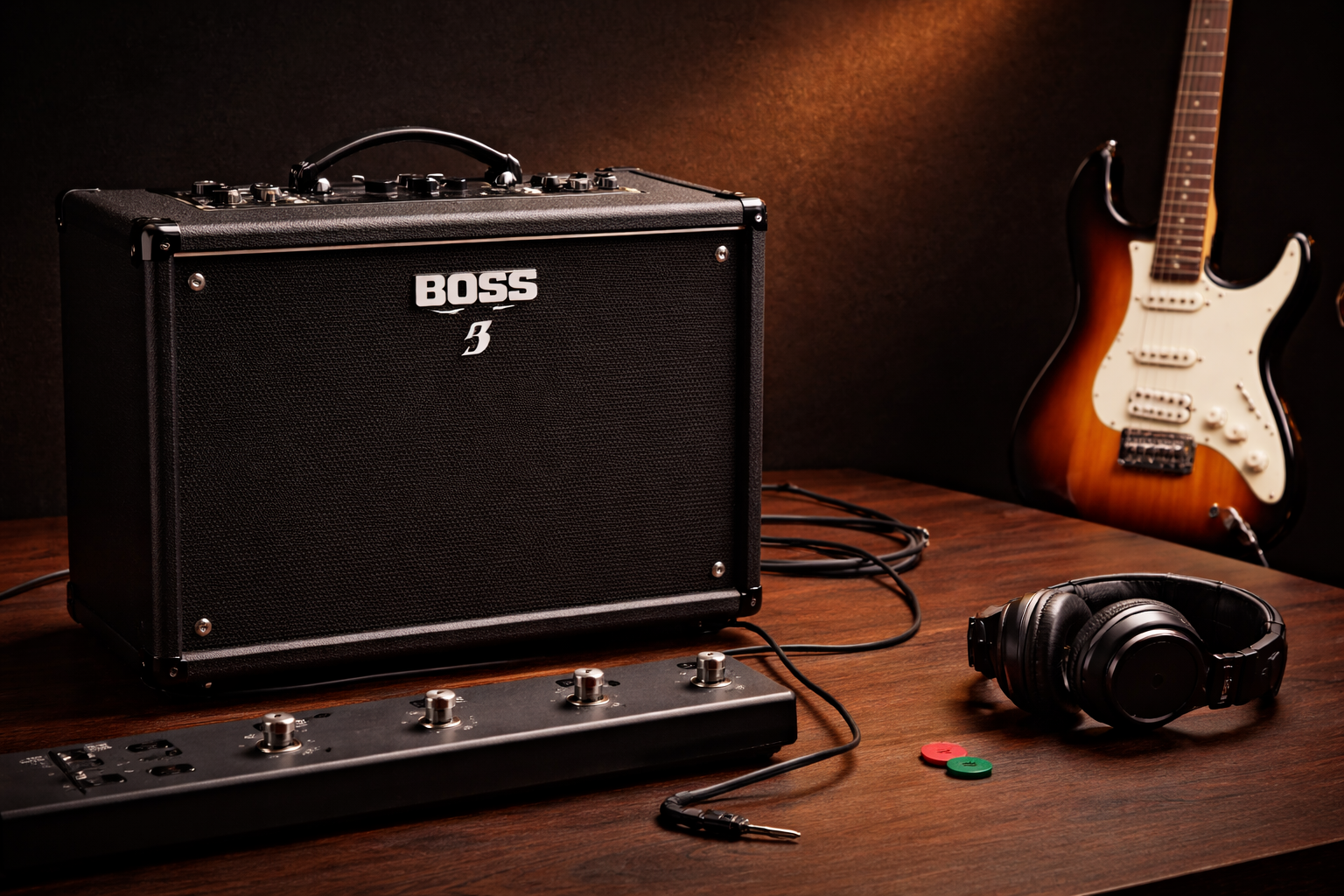
Boss Katana 50 Review: From Bedroom Practice to First Gigs
The Katana line shows up in almost every “what amp should I buy?” thread. On paper it looks like the safest answer, and plenty of boss katana reviews treat the 50 as the obvious step up from tiny starter boxes.
The real question is different: if you mostly play at home with occasional rehearsals, will this 50-watt 1×12 actually make you practise more and feel better about your sound, or will it just become another expensive box in the corner?
In this boss katana 50 review, the focus is how it behaves in real rooms, not spec sheets. If you are specifically comparing versions, this also functions as a boss katana 50 gen 3 review with the MKII context where it matters.
- Who it actually suits, based on how and where you play.
- What genuinely changed vs MKII (not the marketing version).
- How it holds up for bedroom volume, rehearsals and first gigs without hype.
| Your situation | Verdict | Why |
|---|---|---|
| Beginner–intermediate, mostly home, want one “proper” amp you will not outgrow quickly. | Good fit | 50-watt 1×12 with solid clean and gain sounds plus enough headroom for future rehearsals. |
| Already rehearsing with a drummer and playing small bar gigs. | Good fit | Covers most small rooms on its own and is easy to mic when you need more. |
| Thin-walled apartment, almost always at TV volume or headphones, no real band plans. | Maybe | Works at low volume, but a smaller, practice-first rig can make more sense if you never turn it up. |
| Already own a Boss Katana 50 MKII and are wondering if Gen 3 is a must-have upgrade. | No rush | Gen 3 feels nicer and adds Pushed mode, but it is not a mandatory upgrade from MKII. |
Boss Katana 50 Gen 3 specs at a glance
| Model | Boss Katana-50 Gen 3, 50-watt 1×12 combo (Gen 3 Katana series). |
|---|---|
| Power / speaker | 50-watt Class AB power section with custom 12″ speaker and Power Control (Standby / 0.5 W / Half / Max). |
| Amp characters | Six amp types – Acoustic, Clean, Pushed, Crunch, Lead, Brown – each with a Variation for 12 total voices. |
| Effects | Five independent effect sections (Booster, Mod, FX, Delay, Reverb), up to five effects at once, expandable via BOSS Tone Studio. |
| Tone memories | Four Tone Setting memories for storing complete amp and effect setups. |
| Typical use | First “proper” amp for home practice, jams and early band rehearsals; backup or grab-and-go combo for experienced players. |
| Price bracket | Sits above tiny practice amps and below high-end tube combos – usually in the mid-budget range for players considering one amp for practice-to-gig use. |
Who the Boss Katana 50 Gen 3 is actually for
Most people looking for a boss katana review are either moving on from a tiny starter amp, coming back to guitar after a break, or already rehearsing and tired of a weak combo. This 50-watt 1×12 sits right in the middle of those three situations.
Real-world use cases
When it makes a lot of sense
- You mostly play at home now, but want an amp that can genuinely handle a drummer later.
- You want clean, edge-of-breakup, crunch and higher gain in one box without building a big pedalboard.
- You like flexibility, but do not want a menu-heavy modeller that feels like software.
- You would rather learn one platform properly than keep flipping cheaper combos.
When it’s probably overkill right now
- You only ever play very quietly and have no realistic plans to rehearse or gig.
- Your current bottleneck is “my guitar fights me” – in that case, beginner guitar checklist and electric guitars under $300 will move you further than a 50-watt combo.
- You are mainly curious about sounds and already own a decent amp – guitar amp simulator vs practice amp vs modeler may be a better rabbit hole.
If your clean tone at home is harsh, boomy or thin no matter what you do, gain staging and EQ usually change more than swapping amps. The bedroom tone guide and guitar EQ cheat sheet are worth reading before you blame any Katana or other combo.
What’s new in Boss Katana 50 Gen 3 vs MKII?
Boss did not redesign the platform from zero. Gen 3 keeps the Tube Logic approach and Class AB power section, then tweaks the voicings and adds a few practical updates you’ll see referenced across many boss katana amplifier reviews.
- New Pushed amp type between Clean and Crunch for touch-sensitive edge-of-breakup tones.
- Refined Brown and higher-gain voices with a bit more clarity and focus than many MKII sounds.
- Small voicing changes that make the amp feel more detailed at normal volumes.
- Updated BOSS Tone Studio, USB-C and modern connectivity for saving patches and recording.
The useful way to think about it: Gen 3 is less about “new features” and more about how quickly you land on a tone you keep. Pushed fills the gap many players used to solve with pedals, and the higher-gain voices feel easier to keep controlled when you are not playing at full stage volume.
In plain language: if you are buying into the line now, Gen 3 is the obvious place to start. If you already own a MKII and like it, this is a refinement rather than a must-have upgrade — which matches what you’ll see across a lot of boss katana reviews threads.
Tone and feel: Clean, Pushed, Crunch, Lead, Brown
You get five core voices — Clean, Pushed, Crunch, Lead and Brown — each with a variation. That sounds like a lot, but it is really one clean platform plus several levels of breakup, organised in a way that is easy to learn.
Clean and Pushed
Clean stays clear without turning sterile. Chords have enough body that it does not feel like a toy practice amp, and the sound stays controlled when you roll the guitar volume back.
Pushed is the new sweet spot for many Gen 3 players. It behaves like a small valve combo that is just starting to give up: single notes pop, chords compress a little, and you can move from cleaner to gritty with picking and the guitar volume control.
Crunch and Lead
Crunch covers classic rock rhythm and medium gain riffs — the sound a lot of people expect when they search a boss katana 50 review demo. Lead adds more sustain and compression for solos without going instantly fizzy at normal volume.
- Both modes respond to dynamics once the master is above whisper level.
- Crunch with lower gain plus a boost in front can feel surprisingly “amp-like”.
- Lead works well for singing solos if you keep enough mids in the sound.
Brown and higher gain
Brown is the high-gain voice aimed at saturated rock and many modern tones. It stays more controlled if you avoid maxing the gain and keep the top end sensible.
- Plenty of gain on tap for modern rock and many metal styles from the amp alone.
- Noise stays manageable if you are sensible with gain and treble.
- Proper gain staging matters; the gain vs volume vs master guide helps you avoid thin, harsh high-gain at low volume on any Boss Katana amplifier.
Bedroom, rehearsal and small gigs
Many boss katana reviews repeat the same line: “great at home, loud enough for gigs”. That can be true, but only if your idea of “home” and “gig” matches what a 50-watt 1×12 combo is designed to do.
Home and headphone practice
On the lowest power setting, you can keep neighbours calm and still feel like you are playing a real amp. The key is to keep the master reasonably healthy and use channel level and gain for fine adjustment, rather than running everything at 1 out of 10.
- Very low master plus very low gain will sound thin on almost any amp, including this one.
- Saving one or two “safe” presets stops you from re-dialling from scratch every session.
- For late-night sessions, pairing it with a decent set of cans from headphones for practicing guitar keeps things inspiring without waking anyone up.
Rehearsals
At full power with the master up, it has enough volume for most rock rehearsals with a sensible drummer. Clean headroom is not infinite, but mix-friendly crunch and lead sounds are not a problem.
- Dial your main tones at rehearsal volume at least once; bedroom settings rarely translate perfectly to a band mix.
- Keep mids in the tone – scooped sounds disappear in a mix regardless of brand or model.
Small gigs
For bar gigs and small clubs, the Gen 3 50 is perfectly usable. In many rooms you can run the combo by itself; in bigger or fussier venues, treat it like any other 1×12: mic it and use the speaker mainly as your on-stage monitor. If you know you’ll need a proper direct feed to PA/recording, that’s where the Katana 50 EX (Line Out) or the 100 line makes more sense.
- Solo/quiet stage: the combo can often carry the room without help.
- Full band / louder drummer: assume you will be miced, and aim for a clear stage sound you can play comfortably.
- Mixed line-up venues: plan for consistency with a small set of reliable presets.
Features that matter day to day
The marketing sheet lists every knob and socket. In daily life, only a handful of things actually change how you feel about using this amp.
Focused amp types instead of endless models
You get a small, focused set of voices with variations, not dozens of half-finished models. That makes it realistic to build two or three trustworthy sounds and then stop thinking about gear and just play.
Built-in effects that remove early pedal pressure
The onboard delay, reverb and modulation are good enough that you do not have to buy pedals immediately. You can add drive, delay and reverb pedals later once you know what you are missing, instead of using them to paper over a weak practice amp. If you want to understand how delay and reverb sit around your core sound, the guide on using delay and reverb pedals together is a good next read.
Modern connectivity for real-world use
Updated USB and editor support take some friction out of recording and storing presets. Optional wireless control and backing tracks are nice to have, but not required to enjoy the core Gen 3 sound.
Buying checklist: what to buy based on how you actually play
This is the part many boss katana amplifier reviews skip: you do not buy an amp, you buy a workflow. Answer the questions below and the right choice becomes much clearer.
- How often will you play with a drummer in the next 6–12 months? (never / sometimes / weekly)
- Will you run time-based pedals (delay/reverb/mod) after distortion and need an FX loop? (yes/no)
- Do you need consistent direct sound for PA/recording more than “room sound” from the speaker? (yes/no)
| Your situation | Best fit | Why this works |
|---|---|---|
| Home-first player. You want one amp you can grow into, but you are not building a pedalboard yet. | Katana 50 (Gen 3) | Strong “learn one rig” value: convincing core tones, enough volume for most real rehearsals, minimal complexity. |
| You rehearse or gig regularly and you already know you will use external pedals properly (especially time-based). | Katana with an FX loop (typically the 100 line) | The loop keeps delays/reverbs clearer and makes a pedalboard behave the way players expect on stage. |
| You care a lot about repeatable direct sound to PA/recording and you do not want the speaker to be the “main” output. | A variant aimed at direct workflows (EX / direct-focused routing) | Less guesswork when venues or recordings depend on line signal consistency more than room volume. |
| Thin-walled apartment, almost always at very low volume or headphones, and you have no real drummer plans. | Downsize the rig (practice-first) | You are paying for headroom you will not use. A practice-first setup is faster to dial and easier to live with daily. |
| You spend more time editing tones than playing, and you want “plug in, good sound, done”. | Choose the simplest option you will actually use | The best rig is the one you use. If tweaking kills momentum, fewer decisions beats more features. |
Inside the Katana family: what you are really choosing
Katana 50 (Gen 3)
- Choose this if: home is the main use, but you want real rehearsal capability.
- Best for: building a small set of reliable tones and not thinking about gear every session.
- Watch-outs: if your sound depends on a pedalboard workflow, prioritise an FX loop option.
Direct/workflow-focused variant (EX-type choice)
- Choose this if: direct signal consistency matters a lot for PA or recording.
- Best for: players who want “same tone everywhere” more than “this exact speaker in this room”.
- Watch-outs: do not pay extra unless you will genuinely use the routing/direct advantages.
Katana with FX loop (often the 100 line)
- Choose this if: you gig or rehearse regularly and your pedalboard is part of your sound.
- Best for: integrating external drive/mod/time effects the standard way.
- Watch-outs: if you are home-first and not using a board, you may be paying for features you will not touch.
If you are still unsure after this, pick the option that reduces friction: the one that gets you to a “good enough” tone fast, with the least second-guessing.
When the Boss Katana 50 is overkill or the wrong choice
As good as the Boss Katana 50 Gen 3 is, there are plenty of situations where your money is better spent elsewhere for now.
- You are still at the basic chords and rhythm stage and do not practise regularly – almost any small amp plus a simple plan from the beginner guitar checklist will do the job.
- Your guitar is the real problem: tuning, setup and feel are so far off that no Katana will magically fix it. In that case, electric guitars under $300 matters more than a new combo.
- Your main frustration is how things sound at low volume – for that, learning how EQ and levels work will help on any rig, which is exactly what the guitar EQ cheat sheet and bedroom tone guide are built for.
The platform is strong and fairly priced. It just is not a shortcut around practice time, guitar setup or basic tone building.
Summary: is the Boss Katana 50 Gen 3 worth it?
Gen 3 does not turn the Katana into a different amp — it tightens what was already there. Pushed is the headline change for players chasing edge-of-breakup feel, while the refined higher-gain voices and updated connectivity are quality-of-life improvements you notice over time.
If you already own and like a MKII, staying put is completely reasonable. If you are buying in for the first time and want a single combo that feels at home in a bedroom and in a rehearsal room, this boss katana 50 review should make it clear why the 50-watt Gen 3 is such a common recommendation.
Boss Katana 50 Gen 3 FAQ
Is the Boss Katana 50 Gen 3 loud enough for band practice?
Yes. As a 50-watt 1×12 combo, it has enough volume for most rock rehearsals and small gigs with a sensible drummer. If you need very loud, totally clean tones on big stages without PA support, you are outside what a 1×12 in this price range is designed for.
Is the Boss Katana 50 good for bedroom practice?
It works well at home, especially with the power control set low and the master turned up enough for the speaker to actually move air. Compared with tiny practice boxes, it is much easier to dial in a clear, non-fatiguing sound that lets you hear your playing.
Is Gen 3 a big upgrade over the Katana MKII?
Gen 3 is a noticeable refinement, not a completely different amp. The Pushed mode, Brown tweak, overall clarity and updated connectivity are all welcome. If you are buying new, Gen 3 is the natural choice. If you already own a MKII and it does the job, it is perfectly fine to keep it.
Should I get the Katana 50, 50 EX or 100?
For most home-first players with occasional band use, the standard Gen 3 50 is enough. Choose the 50 EX if line-out and the upgraded speaker matter to you, or the 100 if you know you will use an FX loop and want more routing flexibility on stage.