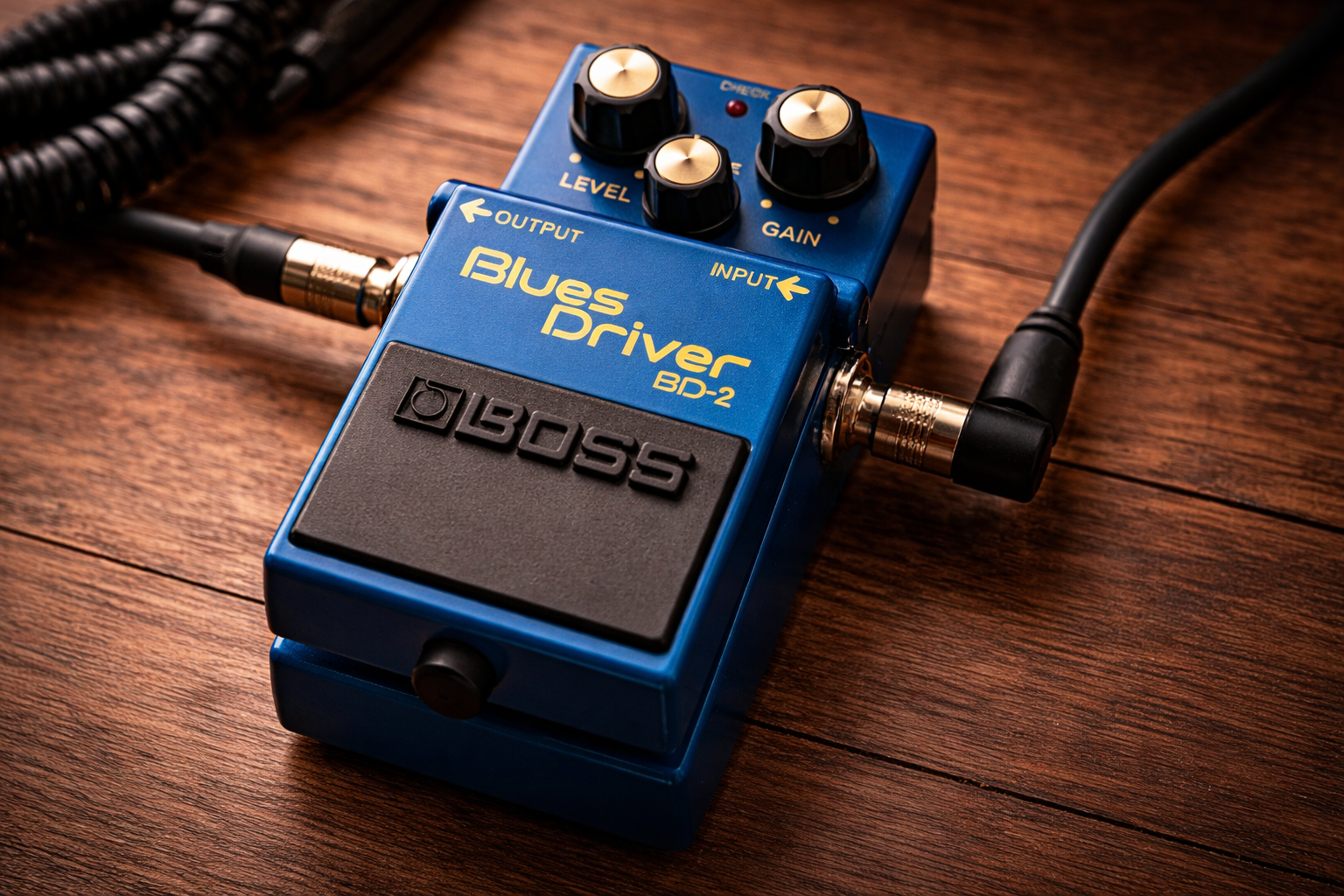
Boss BD-2 Review: Honest Guide to the Blues Driver Sound
The Boss BD-2 Blues Driver is one of those pedals you’ll keep running into—on beginner boards, working players’ rigs, and studio setups. Some guitarists love how “amp-like” it feels. Others plug it in at low volume, hear extra bite on the top end, and move on.
This Boss BD-2 review answers the practical question normal players actually care about: does the Blues Driver pedal make your clean or edge-of-breakup amp feel better at home volume, band volume, and typical small-room volume—or does it fight your rig?
I’ve used the BD-2 before with both single-coils and humbuckers and know its behavior well enough to evaluate who it suits, what it sounds like in real rigs, and when you should skip it. I’m not including audio/video here, so I’m focusing on how it reacts, how it sits in a mix, and how to dial it in.
What you’ll get from this Blues Driver review:
- Who the Boss BD-2 Blues Driver is actually for (and who will hate it).
- What “transparent but gritty” really means in a normal home/practice setup.
- Simple settings that work fast, plus common mistakes that make the BD-2 sound harsh.
- How it compares to other common overdrive choices (TS-style, Klon-style, OD-3, etc.).
Boss BD-2 Blues Driver: pros and cons at a glance
Pros
- Very dynamic and touch-sensitive—responds strongly to picking and guitar volume.
- Works as an always-on foundation, a main overdrive into a clean platform, or a boost into an already breaking amp.
- Open EQ that can add clarity to darker rigs without forcing a strong mid-hump.
- Easy to find, easy to resell, and generally a low-risk “classic” purchase.
Cons
- Can sound bright or gritty on bright amps (especially at very low master volume).
- Less forgiving than compressed, mid-heavy drives if your picking is inconsistent.
- Not a modern high-gain solution by itself; it’s an overdrive, not a metal distortion.
| Your situation | Verdict | Why |
|---|---|---|
| You want an expressive, amp-like overdrive for blues, classic rock and dynamic picking. | Strong fit | The Blues Driver pedal reacts like a pushed amp and keeps your touch intact. |
| You play with a band and need clarity that stays articulate in a mix. | Strong fit | The Boss BD-2 stays open and doesn’t over-compress your attack. |
| You mostly play quietly at home and want a soft, forgiving drive. | Maybe | At whisper volume the BD-2 can feel bright; you’ll need conservative Tone and sensible amp EQ. |
| You want thick, mid-boosted compression or modern saturated gain from the pedal alone. | Look elsewhere | A Tube Screamer-type, Klon-type, or a dedicated distortion will match that goal better. |
Boss BD-2 specs and Blues Driver variants at a glance
| Model | Boss BD-2 Blues Driver overdrive pedal. |
|---|---|
| Type | Low-to-mid gain overdrive with wide frequency response; designed for touch response and “amp-like” breakup. |
| Controls | Level, Tone, Gain — simple layout that covers edge-of-breakup, gritty rhythm and cutting lead boosts. |
| Bypass | Classic Boss buffered bypass — useful on real pedalboards and long cable runs. |
| Power | Standard 9V pedal power (center-negative) — compatible with typical pedalboard supplies. |
| Typical roles | Always-on “feel” enhancer, main drive into a clean platform, or boost into a crunchy amp channel. |
| Variants | Standard BD-2 and the BD-2W (Waza) version, which is widely considered a slightly more refined take with an additional voicing option. |
How I’m judging the Boss BD-2 (without demos)
Instead of pretending this is a lab test, I’m evaluating the Boss BD-2 Blues Driver the way players actually experience it: by how it reacts to pickup types, amp EQ, and volume levels. I’ve used the BD-2 before with single-coils and humbuckers and know its typical behavior—especially its top-end bite, its dynamic response, and how it stacks.
I’m focusing on the most common real-world contexts: home practice (lower master volume), rehearsal volume (where you need clarity), and small-room playing where your guitar must sit in a mix without turning into ice-pick highs.
Who the Boss BD-2 Blues Driver is actually for
The Boss BD-2 suits players who want an overdrive that behaves like an amp being pushed—responsive, open, and shaped by your hands. If you like riding your guitar volume and changing tone with picking intensity, this blues driver pedal makes a lot of sense.
If you want your overdrive to “do the work” by compressing everything into a thick, smooth blanket, the BD-2 may feel too honest. That honesty is the entire point—and also why some players sell it fast.
Real-world use cases
When it makes a lot of sense
- You want an expressive drive that changes with picking and guitar volume.
- You prefer open, amp-like overdrives instead of a strong mid-hump.
- You need clarity for rhythm parts and dynamic riffs.
- You want one practical overdrive that can stay on your board long-term.
When it’s probably the wrong vibe
- You strongly dislike brighter top end and always roll treble off hard.
- You want heavy compression that “levels” your playing automatically.
- You only play at whisper volume and want “instant thick” tone without tweaking.
- You expect modern high-gain saturation from the pedal alone.
If your home tone is harsh or thin no matter what overdrive you try, the issue is often basic EQ and gain staging rather than the pedal itself. The bedroom tone guide and guitar EQ cheat sheet can help you fix the foundation first.
BD-2 vs other Boss and common overdrive types
A useful way to understand any Boss BD-2 review is to place it on the “feel” spectrum: the BD-2 is generally more open and reactive than mid-forward, compressed drives. It keeps pick attack and high-end detail, which helps in a band mix—but can feel sharp on bright amps if you don’t dial it correctly.
| Option | General character | Best for |
|---|---|---|
| Boss SD-1 / TS-style | Mid-forward push, smoother feel, more compression. | Tightening a driven amp, focused solos, taming bright rigs. |
| Boss BD-2 | Open EQ, touch-sensitive, rawer edge, clearer top end. | Expressive rhythm/lead, amp-like breakup, dynamic players. |
| Boss OD-3 (style) | Often perceived as fuller/smoother than BD-2, less “bitey.” | Players who want body and smoothness without heavy mid-hump. |
| Klon-style | Clean-to-gritty boost vibe, mid presence, tight lows. | Pushing an amp, stacking, articulate lead lift. |
| Bluesbreaker-style | Softer attack, smoother breakup, lower gain feel. | Low-gain edge-of-breakup that stays polite and warm. |
| BD-2W (Waza) | A refined take with an additional voicing option. | Players who like the BD-2 idea but want a slightly more controlled feel. |
Tone and feel in the real world
People call the BD-2 “transparent but gritty.” Translation: it doesn’t clamp down on your dynamics, and it tends to keep more high-end detail than many classic mid-hump overdrives. That can be inspiring (more touch control) or annoying (more exposure) depending on your rig and hands.
Low gain and always-on use
With Gain low, the Boss BD-2 Blues Driver works like a feel enhancer: subtle breakup, more immediacy, and a little extra edge. This is where the BD-2 often makes the most sense for normal players—set it once, then use your guitar volume and picking to move between clean and gritty.
Medium gain rhythm sounds
At medium Gain, the Blues Driver pedal becomes gritty and articulate. It’s great for blues-rock rhythm, open chords, and dynamic riffs where you want definition. If your amp is bright, the fix is usually simple: don’t run the pedal Tone too high, and don’t scoop your amp mids.
- Bright amp tip: keep pedal Tone below noon and reduce amp treble before you kill the pedal’s Tone.
- Fullness tip: a slightly higher Level with moderate Gain often sounds bigger than maxing Gain.
Lead tones and pushing an amp
Used as a boost into a crunchy channel, the BD-2 gives extra edge and articulation without turning into a compressed “blanket.” If your leads get harsh, think “amp EQ first, pedal Tone second”—small amp changes usually beat drastic pedal changes.
- Solo lift: lower Gain + higher Level for a cleaner, louder boost.
- Harshness fix: reduce amp presence/treble a touch before you bury the pedal Tone.
Suggested BD-2 settings for common scenarios
| Scenario | Gain | Tone | Level | Notes |
|---|---|---|---|---|
| Always-on edge of breakup | 9–10 o’clock | 10–11 o’clock | Just above unity | Use guitar volume to move between clean and light grit. |
| Gritty rhythm into a clean amp | Noon | 11–1 o’clock | Slight boost | Great for blues-rock chords and dynamic riffs. |
| Boost into an already dirty channel | 8–9 o’clock | Often below noon | Noticeable boost | Adds edge and cut without burying pick attack. |
| Bright amp “tame the bite” preset | 9–11 o’clock | 9–10 o’clock | Unity to slight boost | Keep amp mids present; reduce amp treble a touch first. |
| Humbucker “reduce mud” preset | 10–12 o’clock | 10–12 o’clock | Slight boost | Use bridge pickup for bite; avoid scooped amp EQ. |
Home practice, rehearsals and small rooms
The biggest reason Boss BD-2 opinions vary is volume. At very low master volume, some rigs exaggerate fizz/brightness and make the Blues Driver pedal feel thin. At rehearsal volume, the same settings can suddenly make sense because the guitar sits in a mix and the top end becomes “clarity” instead of “ice pick.”
Home and quiet practice
At low volume, keep expectations realistic: most overdrives sound smaller when the amp isn’t moving air. If the BD-2 feels sharp, lower pedal Tone first, then slightly reduce amp treble/presence. If it feels thin, increase Level slightly and reduce Gain rather than boosting Gain.
- Very low master volume can make any open overdrive feel edgy.
- If you rely on headphones/modelers, the BD-2 can still work well—but EQ matters more.
Rehearsals
In a band mix, the Boss BD-2 usually improves because its open character helps the guitar breathe between bass and cymbals. This is where the BD-2’s “clarity” becomes a strength—especially with single-coils and a sensible amp EQ.
- Don’t scoop mids too hard; the Blues Driver responds better with some mid content intact.
Small rooms and typical playing volume
In small venues or louder rooms, the BD-2 shines as a main drive or a boost because it cuts without becoming overly compressed. If you want a pedal that keeps articulation when the band gets louder, this Boss BD-2 review lands firmly on the “yes” side.
- Use it to enhance a good foundation tone; don’t expect it to fix a bad amp sound.
Stacking and pedalboard roles
The Boss BD-2 Blues Driver stacks well because its EQ is relatively open. Whether you place it before or after another drive depends on what you want: more clarity, or more thickness and compression.
- BD-2 first: adds articulation and bite into a warmer/compressed drive.
- BD-2 second: works like an “amp-like” gain stage after a mid-forward boost.
Many players run the BD-2 as the base drive and add a mid-forward pedal for solos. If you’re building an ambient board, the guide on using delay and reverb pedals together can help you avoid muddy mixes after gain stages.
Buying checklist: BD-2 vs alternatives
You’re not just buying a pedal—you’re choosing the core “feel” of your gain setup. Answer these quickly and you’ll know whether the Boss BD-2 is your match.
- Is your main amp naturally bright, or darker/mid-heavy?
- Do you want dynamic feel or compressed consistency?
- Will you play with a band soon, or mostly practice at home?
- Do you prefer open lows, or tight focused bass?
| Your situation | Best fit | Why this works |
|---|---|---|
| You want one expressive drive for home and band use. | Boss BD-2 Blues Driver | Open feel, strong touch response, practical across many rigs. |
| You want a thicker, mid-forward push and smoother top end. | TS/SD-1 style overdrive | More compression and a more controlled top end for bright amps. |
| You want clarity + a tighter low end for stacking/boosting. | Klon-style drive | Great for pushing an amp and stacking without losing definition. |
| You only play at whisper volume and want instant smoothness. | Softer low-gain option | The BD-2’s strengths show more when your amp has room to breathe. |
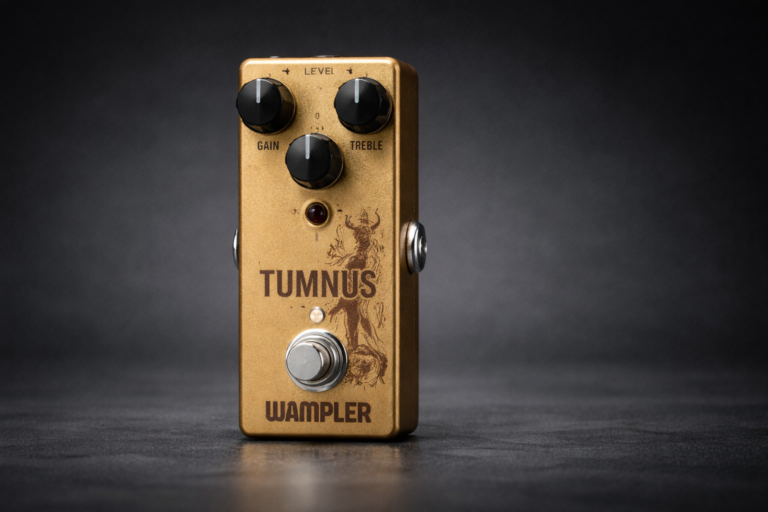
If you’re comparing the Boss BD-2 with other popular overdrive pedals, these in-depth reviews and the main roundup help you see where it sits in the wider picture: Donner Blues Drive, Boss SD-1, Ibanez TS9, Fulltone OCD, Wampler Tumnus, MXR Timmy Overdrive and the full cluster guide best overdrive pedal for guitar.
When the Boss BD-2 is the wrong choice
The Blues Driver pedal is versatile, but it’s not for everyone. Skip it if these describe you:
- You strongly dislike any bright edge and don’t want to manage EQ.
- You want heavy compression that “levels” your playing automatically.
- You expect modern high-gain saturation from the BD-2 alone.
- Your main problem is a harsh home setup—fixing amp EQ and gain staging will beat swapping overdrives.
Summary: is the Boss BD-2 still worth it?
The heart of this boss bd-2 review is simple: the BD-2 is a practical classic because it’s responsive, flexible, and sits well in real mixes. Treat it like a tone tool (not a magic fix), keep the Tone under control on bright amps, and it can be an “always-on” foundation or a cutting boost for years.
Boss BD-2 Blues Driver FAQ
Is the Boss BD-2 a good first overdrive for beginners?
Yes—if you want to learn touch control. The BD-2 is simple to operate, but it won’t hide inconsistent picking like a heavily compressed drive. If you want maximum forgiveness, a mid-forward, smoother overdrive may feel easier at first.
Why does the BD-2 sound bright, and how do I tame it?
The Blues Driver pedal keeps a lot of top-end detail. Start by lowering the pedal Tone below noon, then reduce amp treble/presence slightly. If it still feels thin, increase Level a touch and reduce Gain instead of boosting Gain.
Does the Boss BD-2 work with solid-state and modeling amps?
Yes—especially if you treat it as an EQ-and-feel enhancer rather than expecting it to replace amp character. Keep your amp mids reasonable and don’t run the pedal Tone too high on bright patches.
Should I consider the BD-2W instead of the standard BD-2?
If you like the BD-2 idea but want a slightly more refined feel (and an extra voicing option), the BD-2W is worth considering. If you want the classic rawer edge and the best value, the standard Boss BD-2 is the straightforward choice.
Is the Boss BD-2 still worth buying new, or should I look for alternatives?
If your goal is an expressive, amp-like overdrive that can be your main drive or a long-term stacking tool, the Boss BD-2 remains a safe buy. If you prefer thicker compression or darker voicing, consider TS/SD-1, Bluesbreaker-style, or smoother low-gain alternatives.