Donner Blues Drive Review: Budget Blues Driver Tones on a Tiny Board
If you’re building a practical board on a normal budget, you’ve probably looked at Donner at least once. The Donner Blues Drive is one of those “cheap but tempting” pedals that people buy to solve a real problem: getting bluesy, edge-of-breakup drive without spending boutique money.
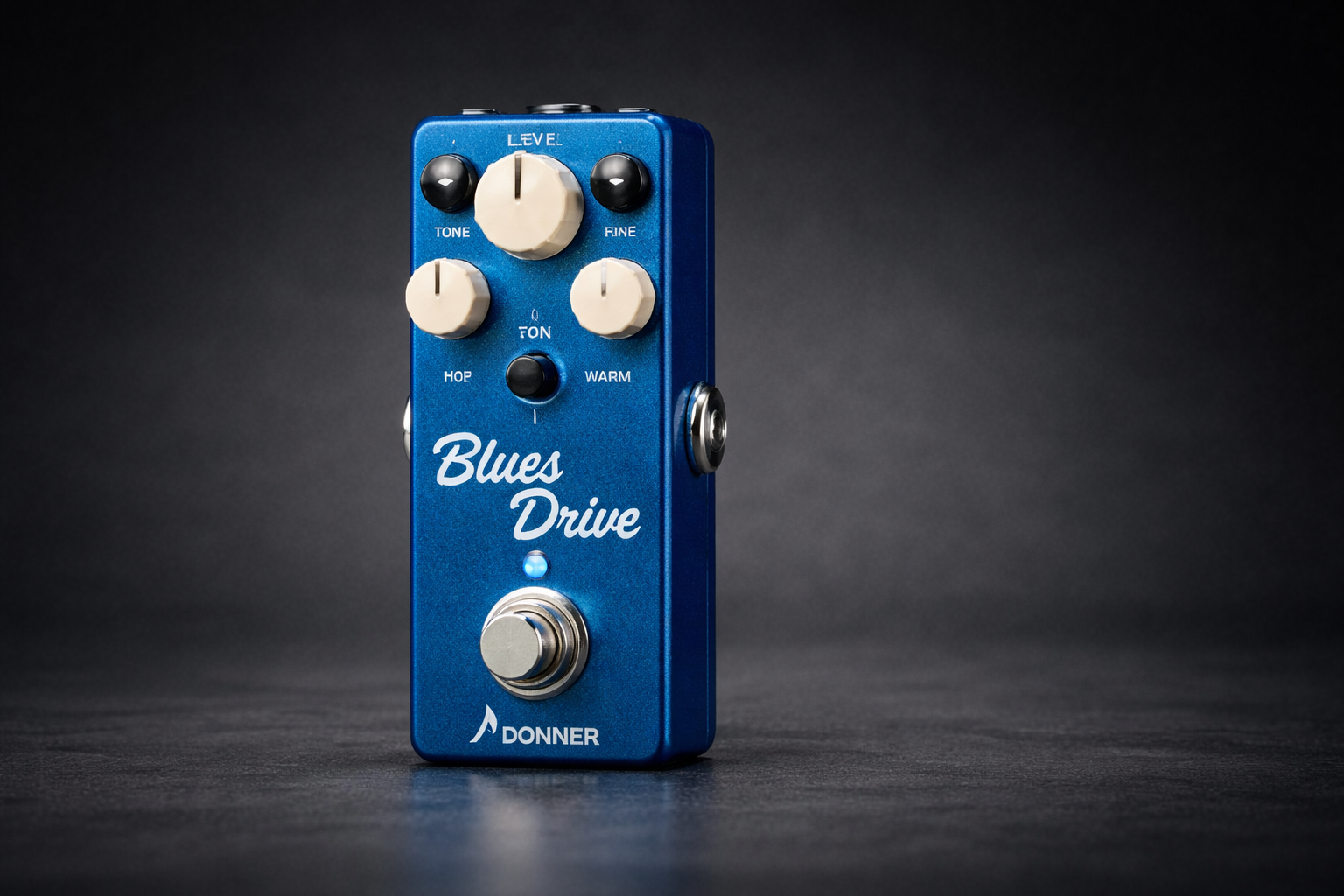
Think of the Donner Blues Drive as a budget, BD-2-style edge-of-breakup overdrive for players who want dynamics and clarity more than thick compression.
This Donner Blues Drive review is for players who care about what happens in real rooms at real volume. I’ve used blues-driver-style overdrives before and know the usual trade-offs: great dynamics and clarity when your rig is right, and harsh/bright frustration when it isn’t. The Blues Drive is also commonly searched as donner blues driver, so this guide covers that exact intent too.
What you’ll get from this guide:
- Who the Donner Blues Drive pedal is actually for (and who should skip it).
- Tone and feel at home volume, rehearsal volume, and small gigs.
- Fast settings you can copy for clean boost, low gain, and gritty rhythm.
- A direct “BD-2 style?” comparison, plus when a real BD-2 is worth it.
Donner Blues Drive: pros and cons at a glance
Pros
- Affordable way to get bluesy, edge-of-breakup overdrive tones.
- Open, dynamic feel that reacts to pick attack and guitar volume.
- Useful as a light always-on drive or a grit layer in a stack.
- Small footprint for tight pedalboards.
Cons
- Can sound bright or fizzy in some amps if Tone is set too high.
- Less forgiving than mid-hump drives if your technique is sloppy.
- If you want thick, compressed drive, this style can feel “too open.”
| Your situation | Verdict | Why |
|---|---|---|
| You want a budget blues driver tone for home practice and occasional rehearsals. | Strong fit | It covers edge-of-breakup to gritty rhythm without needing boutique spend. |
| You want an open, dynamic overdrive that responds to picking and volume knob. | Strong fit | Blues-driver-style circuits tend to keep dynamics intact instead of heavy compression. |
| Your amp is already very bright and you hate treble-heavy drives. | Maybe | You can tame it with Tone and amp EQ, but some rigs will fight this style. |
| You want thick, smooth compression or modern high-gain saturation from one pedal. | Look elsewhere | This is a low-to-mid gain, open overdrive—great for touch, not for high-gain walls. |
Donner Blues Drive specs and controls at a glance
| Model | Donner Blues Drive overdrive pedal. |
|---|---|
| Type | Low-to-mid gain, blues-driver-style overdrive with open dynamics. |
| Controls | Level, Tone, Gain. |
| Typical use | Always-on edge-of-breakup, gritty rhythm, stacking layer. |
| Best for | Players who want dynamic drive on a budget and don’t need heavy compression. |
Reality check (budget pedal expectations)
- This review focuses on practical dial-in and real-rig behavior, not lab specs or hype.
- Biggest variables with this style are bright amps and bedroom volume settings.
- Budget pedals can vary slightly unit-to-unit, so treat this as a guide to the lane and behavior, not a guarantee of identical feel in every setup.
Who the Donner Blues Drive is actually for
This Donner Blues Drive review is aimed at players who want “amp-like” breakup feel without paying premium prices. If you like overdrives that react to your pick attack and clean up with your guitar volume, this style makes sense.
Real-world use cases
When it makes a lot of sense
- You want edge-of-breakup and gritty rhythm for blues, classic rock, and pop.
- You like open, dynamic overdrives more than compressed mid-hump drives.
- You’re building a compact board and need a small, affordable drive.
- You want a “good enough” blues driver tone for practice and rehearsals.
When it’s probably the wrong buy
- You strongly dislike bright top end and never want to manage treble.
- You want thick, smooth compression as your default feel.
- You want high gain from the pedal alone.
- Your core amp tone is harsh or brittle and you’re hoping a pedal fixes everything.
How to dial it fast (micro guide)
The fastest way to get along with the Donner Blues Drive is to start with Tone lower than you think and use Level to make the amp “wake up.” Many harsh results happen because people crank Gain and Tone together at bedroom volume.
60-second dial-in method
Step-by-step
- Set Gain low (9 o’clock), Tone at 10–11 o’clock, Level at unity.
- Raise Level slightly above unity until the sound feels bigger.
- Increase Gain slowly until you hit the breakup you want.
- Only then adjust Tone: lower it if it’s harsh, raise it if it’s dull in a mix.
Fast fixes
- If it’s harsh: lower Tone first, then reduce amp treble if needed.
- If it’s thin: increase Level a bit and reduce Gain slightly.
- If it’s boomy: lower amp bass and avoid max Gain at low volume.
Tone and feel in the real world
The Donner Blues Drive aims for an open, dynamic overdrive that feels more like a pushed amp than a compressed pedal. In practice, that means it can be inspiring when your touch is consistent, and less forgiving if you want the pedal to smooth everything out.
Low gain (always-on)
With Gain low, this is where the Blues Drive often makes the most sense: a touch of breakup, more responsiveness, and a clearer feel. If you ride your guitar volume, you can move between clean and light grit without touching the pedal.
Medium gain (gritty rhythm)
At medium gain, it’s gritty and articulate for blues-rock rhythms and dynamic chord work. This is the zone where bright amps need careful Tone settings.
- On bright amps, keep Tone below noon most of the time.
- Use Level to create fullness before you add more Gain.
Higher gain (edge of its comfort zone)
Pushing Gain higher can work for more sustain, but this style isn’t about thick saturation. If you’re chasing modern distortion, you’ll likely want a different pedal.
Best settings (copy/paste presets)
| Scenario | Gain | Tone | Level | Notes |
|---|---|---|---|---|
| Always-on edge of breakup | 9–10 o’clock | 10–11 o’clock | Just above unity | Use guitar volume to move between clean and light grit. |
| Gritty rhythm into a clean amp | Noon | 10–12 o’clock | Slight boost | If it’s harsh, lower Tone before lowering Gain. |
| Boost into edge-of-breakup amp | 8–9 o’clock | 10–11 o’clock | Noticeable boost | More Level often feels better than more Gain. |
Home, rehearsal and small gigs
Most budget blues-driver-style pedals live or die by volume and EQ. At very low levels, they can feel brighter and smaller. As you turn up, the feel usually gets more natural and amp-like.
Home practice
At home volume, keep Gain moderate and Tone conservative. If you want the sound to feel bigger, raise Level slightly and let the amp react.
- Very low master volume often makes drive pedals feel thin.
- Basic EQ fixes more than chasing new pedals.
Rehearsals
In a band mix, the openness helps your guitar stay articulate. This is where the pedal can feel more “right” than it does in a bedroom.
- Keep amp mids present; scooped EQ makes overdrives disappear.
Small gigs
On small stages, use it as a main drive for light-to-medium gain or as a boost into an already breaking amp. Don’t expect it to replace a true high-gain pedal. If you’re gigging weekly and you want maximum long-term consistency, it’s worth comparing this budget option against the benchmark pedals.
- Dial Tone with the room; it matters more live than at home.
- Keep expectations realistic about noise and consistency at higher gain; budget pedals are best treated as practical tools, not “forever” keepers.
Stacking and pedalboard roles
The Donner Blues Drive works best when you treat it as a dynamic gain layer. It can sit as an always-on foundation or as a grit stage before a more voiced drive. If you’re building a full board, it helps to choose ambience pedals that stay clear after gain stages: best delay pedal for guitar and best reverb pedal for guitar.
Simple stacking recipes
As the base drive
- Keep Gain low-to-medium and Level healthy.
- Use your guitar volume for cleaner shades.
- Great for blues and classic rock rhythm.
As the first stage into another drive
- Lower Gain, raise Level slightly to push the next pedal.
- Keep Tone conservative to avoid harsh stacking.
- Works well before mid-hump drives for solos.
Donner Blues Drive vs Boss BD-2
The “Blues Drive / blues driver” conversation usually circles back to the Boss BD-2. If you want the reference point and the reasons people stick with it long-term, read the full comparison context here: Boss BD-2 review.
| Category | Donner Blues Drive | Boss BD-2 |
|---|---|---|
| Core role | Budget blues-driver-style overdrive for basic dynamic breakup. | Reference blues driver sound with strong dynamics and long-term reliability. |
| Feel | Open and dynamic, but can be picky with bright rigs. | More consistent “classic” feel across many rigs. |
| Best use case | Home and rehearsal value buy; compact board filler. | Players who want the benchmark and plan to keep it for years. |
Buying checklist: Blues Drive vs alternatives
If you’re still choosing your main overdrive category, this guide helps you decide the direction first: best overdrive pedal for guitar.
- Are you buying for home practice only, or band volume too?
- Is your amp bright (treble-forward) or dark (mid-heavy)?
- Do you want dynamics, or do you want compression?
- Will you stack it with another overdrive?
- If you want a mid-hump solo push: Ibanez TS9 review.
- If you want a more aggressive rock drive: Fulltone OCD review.
When you should skip this pedal
The Donner Blues Drive is a value play. It makes sense when you want a blues driver flavor without spending much. It’s not the right move if you want the pedal to do everything.
- You want thick, smooth compression as your default feel.
- You strongly dislike bright top end and don’t want to manage it with Tone/EQ.
- You want modern high gain from the pedal alone.
- Your amp tone is harsh and you’re hoping a cheap pedal fixes the core problem.
Summary: is the Donner Blues Drive worth it?
The best way to enjoy this pedal is to keep Tone conservative, use Level to add fullness, and treat it as a dynamic gain layer rather than a compressed “always perfect” drive. For budget boards, it’s an easy yes. For players chasing a lifetime keeper, use it as a stepping stone to the reference pedals.
Donner Blues Drive FAQ
What is the Donner Blues Drive?
It’s a budget overdrive designed to cover bluesy edge-of-breakup and gritty rhythm tones with an open, dynamic feel. It’s also commonly searched as donner blues driver.
Is the Donner Blues Drive a BD-2 style pedal?
It’s in the blues-driver-style lane: open, dynamic breakup rather than thick compression. If you want the full benchmark reference, compare it to the Boss BD-2.
Is it good for bedroom volume?
It can be, but keep Gain moderate and Tone conservative. At very low volume, open drive pedals can feel brighter and thinner than they do at rehearsal volume.
Does it stack well with other overdrives?
Yes. It works well as a dynamic base layer or as a first stage into a more voiced overdrive for solos, as long as you keep Tone under control to avoid harsh stacking.
What should I buy instead?
If you want a mid-hump solo push, a TS-style pedal is usually easier. If you want a more aggressive rock drive, look at OCD-style pedals. If you want the reference blues driver feel, compare against the Boss BD-2.