Wampler Tumnus Review: The Klon-Style Overdrive That Actually Fits Real Rigs
I’ve spent enough time building working pedalboards to learn one thing: the “best” overdrive isn’t the one that sounds impressive alone—it’s the one that behaves well at normal volume, stacks cleanly, and stays useful when your rig changes. That’s the lane the Wampler Tumnus overdrive pedal lives in: a Klon-style Tumnus guitar pedal built for real rigs, not just bedroom demos.
This Wampler Tumnus pedal review focuses on real use at home volume, in rehearsal mixes, and on small stages. The goal isn’t internet mythology. It’s a practical answer: does this Klon-style overdrive pedal make your guitar easier to place in a mix and easier to control, or does it just add another flavor you’ll flip in a week?
If you’re still choosing an overdrive category (transparent, mid-hump, bluesy, higher-gain), start here first: best overdrive pedal for guitar.
What you’ll get from this guide:
- Who the Tumnus suits based on your amp, volume and playing style.
- Tone and feel in real rooms, not just in isolation.
- Settings you can copy for always-on, rhythm grit, and solo lift.
- Stacking roles with common drive types.
- What the Wampler Tumnus Deluxe changes, and who should consider it.
- Price and value notes vs other overdrive pedals.
Pros and cons at a glance
Pros
- Excellent “always-on” option for clarity, cut, and feel without heavy compression.
- Strong as a boost into an already breaking amp or another overdrive.
- Helps guitars sit in a mix without needing extreme treble.
- Easy to dial fast and stays articulate in stacks.
- Buffered bypass keeps signal strong on longer boards.
Cons
- If you want thick, mid-hump saturation from one pedal, TS-style drives can feel more immediate.
- On already bright rigs, you may prefer conservative tone settings.
- Not a “high-gain distortion replacement” by itself.
- Deluxe version costs more and is overkill if you don’t need deeper EQ.
| Your situation | Verdict | Why |
|---|---|---|
| You want a clean-ish boost / always-on enhancer that keeps your rig’s character. | Strong fit | This is where Klon-style circuits shine: presence, clarity, and a more confident feel. |
| You use multiple drives and need a pedal that stacks without turning to mush. | Strong fit | It’s designed to push other gain stages while staying articulate. |
| You want a thick, mid-forward drive that instantly reshapes your sound. | Maybe | It can do gain, but it’s most valuable as boost/low gain rather than heavy saturation. |
| You want modern high-gain saturation from a single pedal. | Look elsewhere | This is an overdrive and stacker, not a dedicated high-gain distortion. |
Specs and what it’s designed to do
| Model | Wampler Tumnus overdrive pedal (standard version). |
|---|---|
| Type | Klon-style overdrive focused on boost, low gain, and stacking rather than high-gain distortion. |
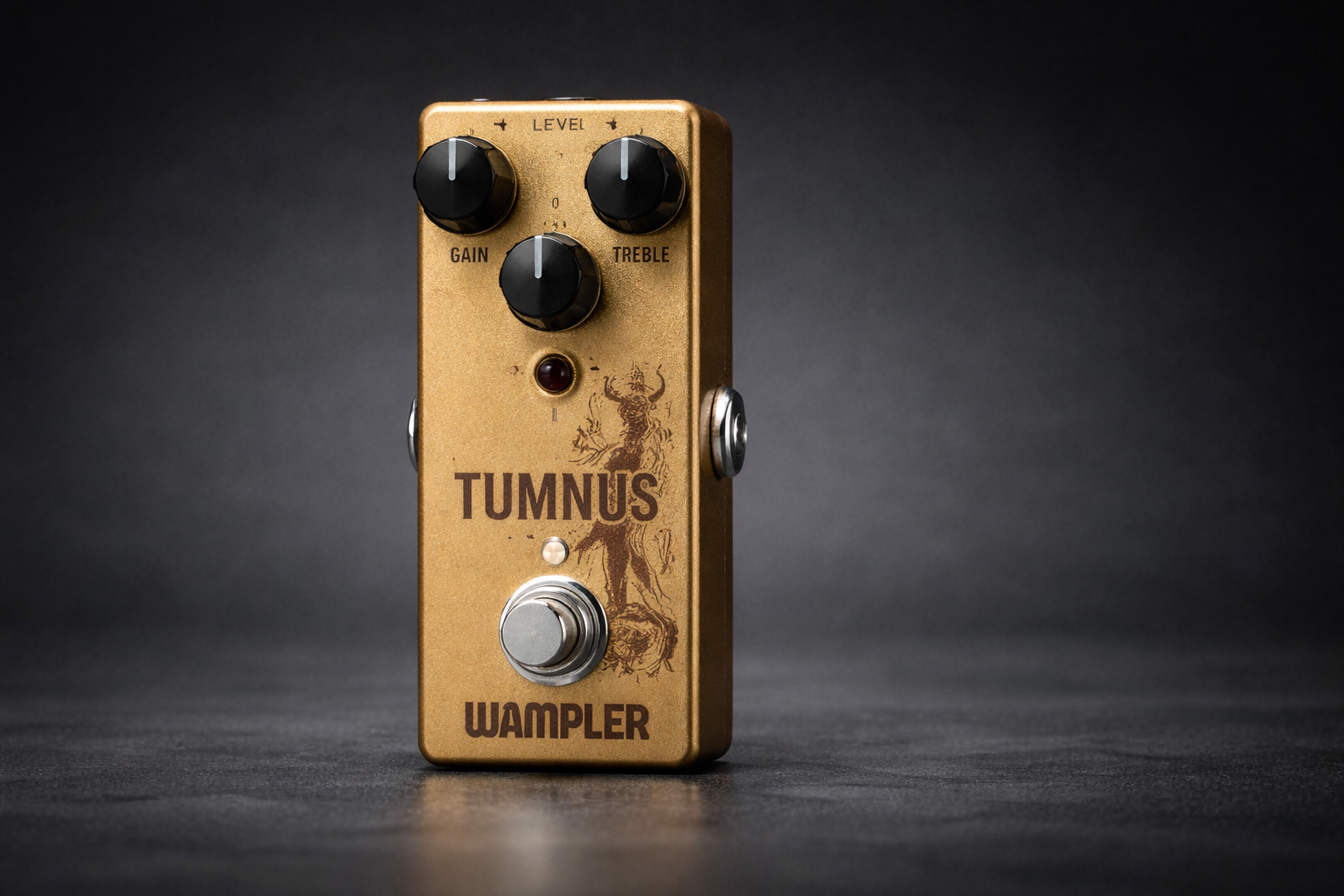
| Controls | Level (volume), Gain, Tone/Treble. |
| Bypass & buffer | Buffered bypass only; the buffer stays in the signal path even when the effect is off and can act as an always-on signal helper on longer boards. |
| Power | 9V DC, center negative (standard pedalboard supply). |
| Current draw | Approx. 20 mA, so it’s easy on most power supplies. |
| Dimensions | Roughly 63.5 x 114.3 x 38.1 mm; compact footprint that’s easy to fit on crowded boards. |
| Typical roles | Always-on enhancer, boost into a breaking amp, low gain drive, stacking tool, buffered line driver. |
| Best for | Players who want mix-friendly presence and clarity without harshness, and who often build tones around their amp rather than a single pedal. |
Rigs and contexts this review has in mind
The examples in this review assume the kinds of setups most players actually use:
- Single-coil and humbucker guitars.
- Clean and edge-of-breakup tube amps, plus simple solid-state practice combos.
- Home volume, rehearsals with a drummer, and small gig stages with or without PA support.
Reality check: what this pedal is (and isn’t)
- It’s most useful as a boost/low-gain enhancer and stacking tool, not a one-pedal high-gain solution.
- Most “bad” results come from too much gain too early and tone controls set for solo playing instead of a mix.
- Your amp’s brightness and your playing volume will shape the result more than tiny circuit mythology.
How “Klon” is the Wampler Tumnus overdrive pedal?
The Tumnus is voiced very much in the Klon family: clear, present, and slightly forward, with enough low end to keep things full and a focused upper-mid push rather than a massive mid hump. It’s less about being a part-for-part museum clone and more about delivering that “clean-ish boost into a good amp” feel in a compact, practical pedal. In a mix, the bigger differences you’ll hear usually come from your amp, speakers, and settings rather than from tiny circuit variations.
Who this pedal is actually for
It makes the most sense if you like your amp’s core voice and want it to feel more finished: clearer, slightly more forward, and easier to place in a mix. It’s also a strong pick if you run multiple overdrives and want something that can push them without collapsing definition.
Real-world use cases
When it makes a lot of sense
- Home / bedroom players: you want an always-on tone enhancer that still feels like your guitar and amp at reasonable volume.
- Cover band / worship players: you need a reliable boost into an edge-of-breakup amp that keeps parts defined under vocals and keys.
- Stacking fans: you stack drives and want tighter lows and clearer lead lift without mud.
- Pedalboard builders: you want more cut in a band mix without adding ice-pick treble, plus a useful buffer in the chain.
When it’s probably the wrong buy
- You want thick, compressed drive as your default tone.
- You prefer a strong mid-hump voice that instantly reshapes the rig.
- You need high gain from one pedal with no stacking.
- Your core amp tone is harsh and you’re hoping one pedal fixes everything.
How to dial it fast (micro guide)
Treat it like a Level-first pedal. Start by making the amp respond, then add gain for texture, then adjust tone for the room. This order avoids the most common mistake: adding gain first and ending up with a smaller, sharper sound.
60-second dial-in method
Step-by-step
- Set Gain low (8–9 o’clock), Tone around 11 o’clock, Level at unity.
- Raise Level slightly above unity until the sound feels bigger and more “forward.”
- Add Gain only until you get the grit you want.
- Adjust Tone last: lower if it’s sharp, raise slightly if you’re getting buried.
Fast fixes
- If it’s harsh: lower Tone first; keep amp treble/presence sensible.
- If it’s boomy: reduce amp bass slightly and keep Gain moderate.
- If it doesn’t cut: increase Level a bit before touching Tone.
Tone and feel in the real world
The core character is “clarity and lift.” It tends to keep your base tone intact while making it more present. That’s why it often becomes a permanent board tool: it’s less about dramatic distortion and more about making everything easier to hear and control.
Clean-ish boost and always-on use
This is the home base. Low gain, higher level: more immediacy, slightly more forward feel, and a more confident response. If you prefer a more raw, touch-sensitive breakup voice, compare it with a blues-driver-style overdrive: Boss BD-2 review.
Low gain rhythm
With gain around 10–11 o’clock, you get a clear, mix-friendly rhythm drive that stays articulate. This is useful when a band mix is busy and you need definition without harsh treble.
- On bright amps, keep the tone control below noon most of the time.
- Use level to add “size” before adding more gain.
Lead lift and stacking
The most effective lead use is level-forward with controlled gain. If you want an instant mid-hump solo push, a TS-style pedal can be the more automatic choice: Ibanez TS9 review.
- For solo lift: lower gain, raise level, set tone for the room.
- If you need more saturation: stack into a higher-gain drive rather than maxing gain.
Build quality, switching and noise
The Tumnus feels like a typical boutique pedal: compact metal housing, solid footswitch, and simple three-knob layout. The buffered bypass is quiet and generally helps long cable runs or busy boards feel more alive rather than dull, provided your gain staging and overall treble are kept sensible.
Best settings (copy/paste presets)
| Scenario | Gain | Tone | Level | Notes |
|---|---|---|---|---|
| Always-on enhancer | 8–9 o’clock | 10–11 o’clock | Above unity | Use level for “size”; keep tone conservative on bright rigs. |
| Low gain rhythm drive | 10–11 o’clock | 11–noon | Unity to slight boost | Clear rhythm tone that stays articulate in a mix. |
| Solo lift into edge-of-breakup amp | 8–9 o’clock | Taste, often 10–noon | Noticeable boost | Level-forward lift; adjust tone for the room. |
| Stacking boost into another overdrive | Low | 10–11 o’clock | Healthy boost | Pushes the next pedal cleanly; keep tone conservative. |
Home, rehearsal and gig behavior
This style is generally easy to enjoy at home because it can add clarity and feel without requiring high gain. At rehearsal and gig volume, the biggest advantage is how it helps you stay present without turning harsh.
Home practice
Keep gain modest and use level to create fullness. If the sound gets sharp, lower tone slightly before changing everything else.
- Very low master volume can make any overdrive feel smaller; level-forward settings help.
Rehearsals
In a full band mix, it shines as a rhythm enhancer and lead lift. It helps you stay present without fighting cymbals and vocals.
- If you disappear in the mix, try more level first, not more gain.
Small gigs
Live, it’s most reliable as an always-on shaper or a boost into a slightly breaking amp. If you need more aggression, stack it into a second drive rather than maxing gain.
- Set tone with the room; small rooms can exaggerate brightness.
Stacking and pedalboard roles
This pedal works well as a “stacking glue” tool: it can push other drives, tighten feel, and give a more confident lead lift. If your goal is a more aggressive rock voice, this reference point can help: Fulltone OCD review.
Simple stacking recipes
First in the stack (push and shape)
- Use low gain and higher level to hit the next drive harder.
- Great when you want more sustain without losing definition.
- Keep tone conservative to avoid harsh stacking.
After another drive (clarity and lift)
- Use it to restore clarity and add a clean-ish lead lift.
- Works well when the first drive is warmer or darker.
- Level-forward settings keep the sound big and present.
If you’re building a complete board, ambience choices matter after gain. These guides help keep mixes clear: best delay pedal for guitar and best reverb pedal for guitar.
Wampler Tumnus Deluxe vs Wampler Tumnus (standard)
The Deluxe version is the “more control” choice for players who want deeper EQ shaping and flexibility across different amps and rooms. If you already know your rig is inconsistent across venues—or you stack multiple drives and want more shaping options—the Wampler Tumnus Deluxe can be the smarter long-term tool.
| Question | Standard Tumnus | Wampler Tumnus Deluxe |
|---|---|---|
| Core role | Simple Klon-style boost / low-gain drive with always-on buffer. | Same core voice with added 3-band EQ and Normal/Hot gain modes. |
| Controls | Level, Gain, Tone/Treble. | Level, Gain, Bass, Mids, Treble, plus Normal/Hot and Buffer/True Bypass switches. |
| Bypass type | Buffered bypass only; can double as an always-on buffer. | Switchable true bypass or buffered bypass via side switch. |
| Power & current draw | 9V DC, ~20 mA. | 9V DC, roughly 70–80 mA. |
| You want a simple “set and forget” Klon-style pedal | Better fit | Usually overkill unless you really need the extra EQ and Hot mode. |
| You need more EQ control for different rooms and amps | Sometimes enough, but limited shaping options. | Better fit; 3-band EQ and extra gain mode make it easier to adapt. |
| You stack multiple drives and want more shaping options | Strong already. | Best fit if you want the Klon-style flavor plus fine control over lows and mids. |
Price and value: is it worth the money?
The Tumnus family sits in the mid-priced boutique overdrive bracket: more expensive than basic Tube Screamer clones, but generally cheaper than many high-end Klon-style clones or dual-channel drives. New and used prices tend to be fairly stable thanks to Wampler’s reputation and the ongoing demand for Klon-style overdrive pedals.
- If you mainly want a single, great always-on sound and a useful buffer in a tiny footprint, the standard Tumnus usually offers the best value.
- If you gig a lot of different rooms, share backline amps, or run complex stacks, the Deluxe version can save you from needing an extra EQ or second drive, which helps justify the higher price.
- Both versions are easy to flip or keep as “forever tools,” so you’re unlikely to be stuck with something you can’t repurpose on another board later.
Buying checklist: vs alternatives
Before you buy, decide what role you want: always-on enhancer, boost into a breaking amp, or a stacking tool. If you want a category overview first, use: best overdrive pedal for guitar.
- Do you want your amp to stay the main “voice,” or do you want the pedal to reshape everything?
- Is your main need clarity and cut, or thickness and compression?
- Will you stack it with another overdrive?
- Do you want simple controls, or extra EQ flexibility?
| Pedal | Type / voice | Why pick it over the Tumnus? |
|---|---|---|
| Ibanez TS9 | Classic mid-hump overdrive / solo boost. | You want an instant, vocal mid-forward lead sound and more compression from a single pedal. |
| Fulltone OCD | Higher-gain, aggressive rock overdrive. | You prefer a more modern, punchy rock voice with more gain on tap. |
| Boss BD-2 | Touch-sensitive, bluesy breakup. | You want raw, edge-of-breakup response that reacts strongly to pick attack. |
When you should skip it
Skip this pedal if you’re expecting thick, high-gain saturation from one box. This is a mix-friendly, clarity-forward overdrive that shines as a boost and stacker.
- You want heavy compression and thick saturation from the pedal alone.
- You need modern high-gain distortion without stacking.
- You dislike any added “forward” presence and prefer darker, softer drives.
- Your amp tone is harsh and you’re hoping one pedal fixes the entire rig.
Summary: is it worth it?
The best results come from level-forward settings, moderate gain, and sensible tone. Used that way, this Tumnus overdrive pedal makes rigs feel more present, more controllable, and easier to hear in a band mix without sacrificing the character of your amp.
FAQ
What is the Wampler Tumnus?
It’s a compact Klon-style overdrive designed for clean-ish boost, low gain, and stacking. In searches, you’ll also see phrases like tumnus pedal, tumnus guitar pedal, and tumnus overdrive pedal.
What’s different about the Wampler Tumnus Deluxe?
It adds more EQ control, a Normal/Hot gain mode, and switchable buffered/true bypass for players who use multiple rigs or play different rooms. If you want simple set-and-forget operation, the standard version is usually enough.
What are good starter settings?
Start with Gain low (8–9 o’clock), Tone around 10–11 o’clock, and Level slightly above unity. Use Level to add size first, then add Gain only for texture.
Does it stack well with other overdrives?
Yes. Keep Gain lower, raise Level, and set Tone conservatively to push another drive without harshness. It works well either before or after warmer overdrives.
Are “tumnus guitar pedal” and “tumnus overdrive pedal” the same thing?
Yes—those are common search phrases people use to find this Wampler Tumnus pedal and other devices in the Klon-style overdrive category.
Is the Wampler Tumnus true bypass or buffered?
The standard Tumnus is buffered bypass only, just like the original Klon. The buffer stays in the signal path even when the pedal is off, which can help keep long cable runs and bigger boards sounding clearer.
Does the Wampler Tumnus work on bass?
Yes. Used with care, it works as a subtle boost or low-gain overdrive on bass, adding presence and grit while keeping the core tone intact. Just be conservative with the Tone control and gain if you want to preserve low end.
How close is the Wampler Tumnus to a Klon Centaur or KTR?
Tonally it lives firmly in that family: clear, articulate, and slightly forward rather than thick and mid-heavy. In practice, the way you set gain, level, and your amp will usually matter more than the specific Klon-style box you choose.