Headphones for Practicing Guitar on a Budget (Best Picks Under $100)
Headphones for practicing guitar on a budget are not the same thing as cheap headphones that only play music. Guitar lives in the upper mids, distortion can turn fizzy in a second, and many budget models are tuned to sound hyped and exciting rather than honest.
This guide focuses on headphones for practicing guitar under $100: playing through a practice amp headphone out, using amp sims on a laptop, tracking quick ideas, and keeping silent practice actually quiet. If your tone already frustrates you at home, the bedroom tone guide and why does my guitar sound bad at low volume? article pair nicely with the headphone advice here. Prices move around a lot, so treat “under $100” as the target zone, not a guarantee.
Who These Headphones Are Best For
| Player situation | What to look for |
|---|---|
| Apartment / shared room, need silence | Closed-back models with good isolation (HD 280 Pro, MDR-7506). Lower leakage, safer for late-night practice. |
| Mostly amp sims on a laptop or desktop | Open or semi-open designs (SHP9500, K240, SR850/HD681). Wider soundstage, more “amp in a room” feel. |
| Beginner building a simple budget setup | Closed-back all-rounders like ATH-M30x or ATH-M20x. Easy to drive, predictable, low-drama choices. The beginner guitar checklist helps with the rest of the rig. |
| Recording and basic editing at home | More studio-leaning picks (MDR-7506, HD 280 Pro). Detail for tone decisions without going over budget. |
| Portable, casual practice with a small amp or dongle | Lightweight, foldable options like Koss Porta Pro. Comfortable, quick to grab, not meant for critical mixing. |
Quick Picks: Headphones for Practicing Guitar on a Budget
If you want fast answers, these headphones for practicing guitar cover the main use cases: tone dialing, isolation, comfort, and a more open feel for amp sims. Think of them as the best budget studio headphones and open-back alternatives that still behave well with guitar.
- Best for tone dialing and recording (closed-back): Sony MDR-7506
- Best isolation for apartment noise (closed-back): Sennheiser HD 280 Pro
- Best safe, simple all-rounder (closed-back): Audio-Technica ATH-M30x
- Best “more space” for amp sims (open-back, leaks sound): Philips SHP9500
- Best value if you don’t mind light EQ (semi-open): Samson SR850 / Superlux HD681
- Best lightweight grab-and-go option (open, on-ear): Koss Porta Pro
How These Headphones Were Chosen
For guitar practice, the best budget studio headphones are the ones that keep you playing longer and help you make better decisions. The picks below prioritize:
- Treble behavior: detail without turning distortion into ice-picky fizz.
- Comfort: clamp force, pads, heat build-up, long-session usability.
- Practical use: works with common outputs (laptops, small interfaces, practice amp headphone outs).
- Consistency: models that are commonly used by musicians and have predictable performance.
These recommendations are based on real home practice with practice amps, amp sims and small interfaces, plus how consistently these models are recommended by working musicians and producers.
Some are “more honest,” some are “more enjoyable.” Both can be correct for headphones on a budget, as long as you understand what you are buying.
What Matters Most for Guitar Practice
Closed-back vs open-back
Closed-back isolates better and leaks less. It is the safer choice for silent practice, shared rooms, and apartments. The downside is that cheap closed-backs can feel boxed-in and can exaggerate harsh upper frequencies.
Open-back often feels more natural for amp sims and edge-of-breakup tones. Reverbs and delays sound wider. The trade-off is heavy sound leakage: if someone is nearby, they will hear your guitar.
Treble is where guitar pain happens
Many budget headphones lift the upper treble to feel “clear.” With guitar, that can become fizzy distortion, exaggerated pick noise, and fatigue. If a headphone is known to be bright, a small EQ cut usually fixes it. For a deeper breakdown of where those problem frequencies sit, see the guitar EQ cheat sheet.
Power and impedance
Phones and some practice amp headphone outs can struggle with harder-to-drive headphones. If your tone sounds thin or quiet, it may not be your settings. Most of the models below work fine on typical gear, but semi-open studio models often feel better with a basic audio interface.
Latency and feel with amp sims
If you practice through plugins, latency changes your timing and feel. A cheap interface with stable drivers can improve practice more than upgrading headphones. Keep buffer size sensible and use direct monitoring only when you are recording a dry signal.
If you want to build a silent practice setup around a small amp, our guide to best guitar amps under $200 pairs well with the headphone choices below.
Simple EQ cheat sheet for guitar
If your distortion sounds harsh on headphones, try one of these small moves before blaming the amp model:
- Cut 6–10 kHz slightly to reduce fizz and scratch.
- Reduce presence before you reduce treble (presence often hits the painful zone).
- Use a proper cab sim / IR if you are going direct; “no cab” is almost always unpleasant on headphones.
- High cut around 8–12 kHz can instantly make distorted tones feel more realistic.
Best Budget Studio Headphones for Practicing Guitar (Under $100)
These are the models worth checking first if you want headphones for practicing guitar on a budget. Each one has a slightly different personality, so pick based on how you actually practice.
Sony MDR-7506
The MDR-7506 is a classic closed-back studio headphone that has survived for decades because it does the job. It is detailed, fast, and it makes problems obvious. For guitar practice, that means sloppy muting, noisy fretting, and harsh amp sim settings show up immediately.
It can lean bright. If your distortion already feels sharp, a small EQ cut around 8–10 kHz usually turns it into a very usable “truth teller” without fatigue.
- Best for: tone dialing, recording, hearing detail clearly
- Why it works for guitar: exposes fizz and harshness so you fix it early
- Watch out for: can be fatiguing at higher volumes if you like bright tones
Sennheiser HD 280 Pro
If isolation matters, the HD 280 Pro is one of the safest picks in this price bracket. It blocks outside noise better than most budget options, which helps you practice at lower volumes and still hear articulation.
It is more “studio practical” than “fun.” That is not a bad thing for practice. The main downside is clamp force: some people love the seal; others feel pressure after long sessions.
- Best for: silent practice, noisy apartments, keeping volume down
- Why it works for guitar: strong isolation improves focus at lower levels
- Watch out for: clamp can be intense for some head shapes
Audio-Technica ATH-M30x
The ATH-M30x is a straightforward closed-back pick when you want something affordable, durable, and easy to drive from almost anything. Tonally, it tends to be less “spotlight bright” than some studio staples, so distorted guitar can feel a bit smoother.
It is not the most spacious headphone on earth, but for everyday practice it is a solid, low-drama choice.
- Best for: general home practice, beginners building a simple setup
- Why it works for guitar: easy to drive, controlled sound, less brittle top end
- Watch out for: can feel closed-in compared to open-back options
Audio-Technica ATH-M20x
If you need to spend less than the M30x, the M20x is often the entry point. It is a basic closed-back headphone that does not try to be fancy. For guitar practice, that can be a good thing: it is generally usable, and it works fine from laptops and small practice amps.
Expect less detail and less refinement than the other picks, but as a first pair of headphones for practicing guitar, it is frequently good enough.
- Best for: tight budgets, basic practice setups, casual daily use
- Why it works for guitar: simple, easy to drive, predictable
- Watch out for: not the best for deep tone dialing or mix decisions
AKG K240 Studio (Semi-Open)
If you want a wider, more “amp in a room” feel from amp sims, semi-open designs like the K240 can be satisfying. Cleans and edge-of-breakup tones often feel less boxed-in than many budget closed-backs.
The trade-off is leakage and weaker isolation. This is better for solo practice in your own space than for shared rooms. Depending on what you plug into, you may also want a bit more output headroom than a phone provides.
- Best for: amp sims, clean and crunch tones, longer sessions
- Why it works for guitar: more space and air for natural-feeling tones
- Watch out for: leaks sound, isolation is low, may benefit from an interface
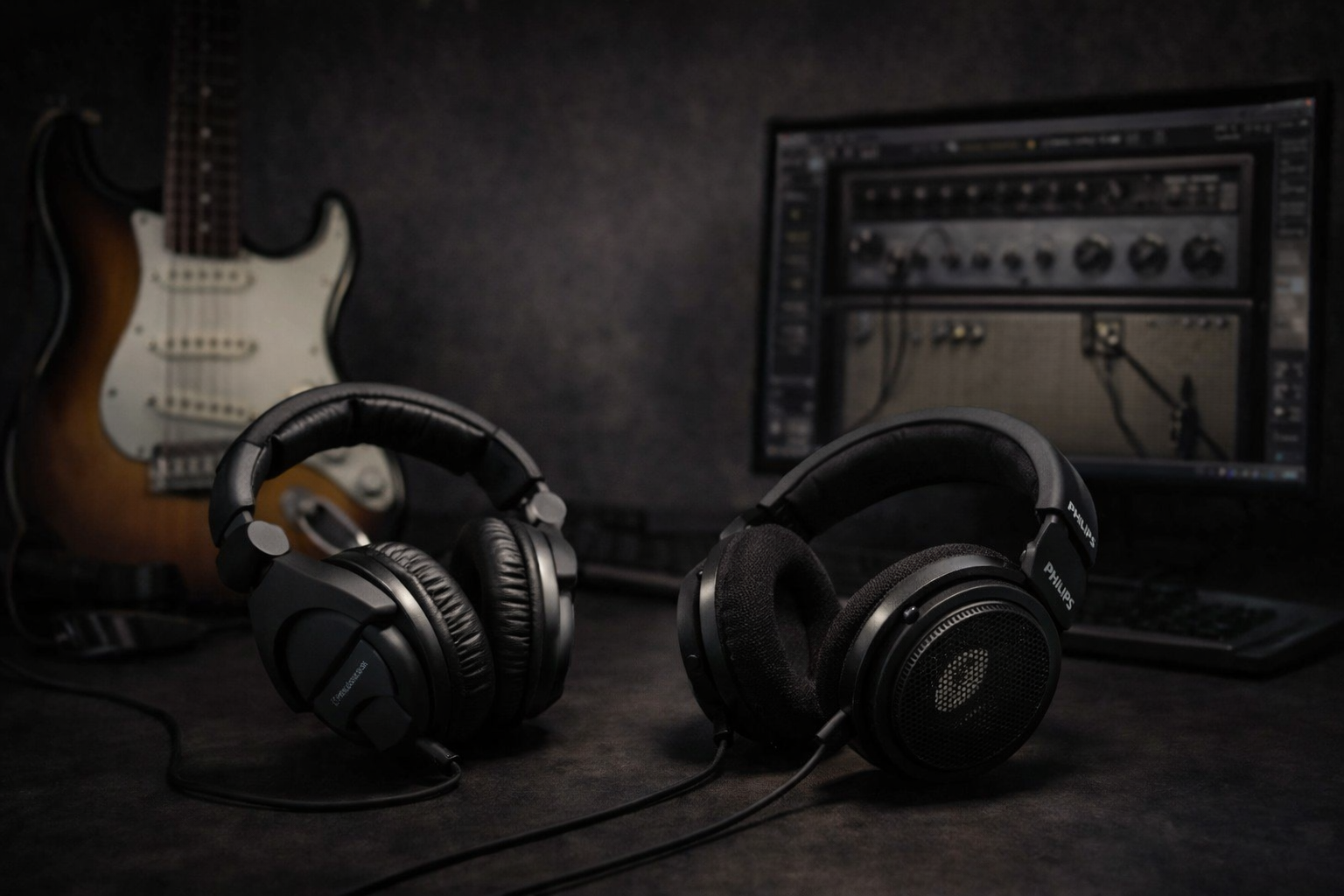
Philips SHP9500 (Open-Back)
The SHP9500 is popular because it offers a real open-back experience at a very approachable price in some markets. For guitar, that open soundstage can make practice feel less claustrophobic, especially with stereo delays and reverbs.
Open-backs do not isolate and they leak a lot. If your goal is “do not bother anyone,” a closed-back model is the safer buy.
- Best for: spacious amp sim feel, stereo effects, comfort-focused practice
- Why it works for guitar: natural space helps dynamics and phrasing
- Watch out for: heavy leakage, not ideal if others are nearby
Samson SR850 / Superlux HD681 (Semi-Open)
These are the classic “ridiculous value” picks: inexpensive semi-open headphones that can sound surprisingly lively and detailed. For guitar practice, they can be fun and revealing, especially if you like hearing pick attack and articulation.
The catch is tuning. Many units lean bright. A small EQ cut in the upper treble often turns them from fatiguing into genuinely impressive for the money, making them some of the best cheap studio headphones if you are willing to use light EQ.
- Best for: maximum value, detailed practice, experimenting with tones
- Why it works for guitar: articulation and detail help tighten technique
- Watch out for: brightness without EQ, leakage, comfort varies by pads
Koss Porta Pro (On-Ear, Open)
Porta Pro is not a studio headphone, but it can be a great budget practice companion if you want something light, portable, and forgiving. It tends to sound warm and musical, which can make practice more enjoyable if you hate sharp highs.
Because it is open and on-ear, it leaks sound and does not isolate. Think of it as a “grab it and play” option, not a surgical tone-checking tool.
- Best for: casual practice, portability, warm non-fatiguing sound
- Why it works for guitar: forgiving top end reduces fatigue
- Watch out for: leakage, not ideal for critical tone decisions
Quick Comparison
| Model | Design | Isolation | Best use |
|---|---|---|---|
| Sony MDR-7506 | Closed | Good | Tone dialing, tracking, detail |
| Sennheiser HD 280 Pro | Closed | Very good | Noisy apartments, lower listening levels |
| Audio-Technica ATH-M30x | Closed | Good | Balanced all-round practice |
| Audio-Technica ATH-M20x | Closed | Good | Cheapest usable starting point |
| AKG K240 Studio | Semi-open | Low | More air for amp sims |
| Philips SHP9500 | Open | Very low | Widest feel, stereo effects |
| Samson SR850 / Superlux HD681 | Semi-open | Low | Maximum value with light EQ |
| Koss Porta Pro | Open (on-ear) | Very low | Portable, warm, casual practice |
How to Choose Headphones for Practicing Guitar
These headphones for practicing guitar on a budget all work, but the right pick depends on what you care about most: isolation, a wider feel, or a more honest studio presentation.
If silence and isolation are the priority
Go closed-back. HD 280 Pro is the isolation king in this range. If you want more detail for tone work and recording, MDR-7506 is the sharper tool. If you want something simple and safe, ATH-M30x usually lands well and behaves like a classic pair of best budget studio headphones.
If you mainly use amp sims and want a more natural feel
Open or semi-open designs often feel more “alive.” SHP9500 is the spacious pick, while K240 is a semi-open alternative if you want some air but still prefer a more studio-oriented fit.
If you want the best value per dollar
SR850 / HD681 are hard to beat. Just assume you will do a small treble cut with EQ if distortion feels sharp; treated that way, they are among the best cheap studio headphones that still work for daily practice.
If you just want something light and enjoyable
Porta Pro is the “fun” option. It is not the most accurate, but it can make you pick up the guitar more often, which matters more than perfect graphs. For many players looking for headphones on a budget, that trade-off is worth it.
If you are also still choosing your first instrument, start with the what electric guitar is best for beginners? guide and then check the electric guitars under $300 list to match your guitar and headphones to a realistic budget.
Verdict: The Best Headphones for Practicing Guitar on a Budget
If you want one safe choice, start with the MDR-7506 for detail or the HD 280 Pro for isolation. If you want a more open, natural feel for amp sims, the SHP9500 is usually the most satisfying. These headphones for practicing guitar under $100 all work—your best choice depends on whether you prioritize isolation, comfort, or a wider soundstage.
Headphones for Practicing Guitar: FAQ
Do I need “guitar-specific” headphones?
No. You need a headphone that behaves well with distortion, stays comfortable, and works with your device’s output. Overly bass-boosted or aggressively bright headphones can make guitar tones harder to dial in.
Why does my distortion sound fizzy on headphones?
Headphones put your ear right on the upper treble content, and many budget models lift that range to sound “detailed.” Lower presence first, then use a gentle EQ cut around 6–10 kHz. Also make sure you are using a proper cab sim or IR.
Open-back or closed-back for practice?
If you practice alone and want a wider, more natural feel, open-backs can be great. If you need to keep things quiet for other people, closed-back headphones are the safer choice.
Can I record and mix on these?
You can record with any of them. For basic editing and tone checks, more studio-oriented models like MDR-7506 and HD 280 Pro are easier to work with, but serious mixing still benefits from referencing on multiple systems.