Best Guitar Amps for Under $200 (Apartment-Friendly Practice Picks)
Finding the best guitar amps for under 200 is harder than it looks. In a store everything sounds fine at “band volume”, but at home you are usually sitting one meter from the speaker, trying not to annoy anyone through thin apartment walls.
This guide focuses on realistic practice amps that stay inspiring at low volume: tones that still feel alive below halfway on the volume knob, useful headphone options, simple recording paths, and layouts that do not make you dig through menus every time you want to play. If you are hunting for the best practice amp for your apartment or bedroom, this is the angle we care about most.
All of the amps below are good guitar amps under 200 in most markets, and they are picked specifically with home and apartment players in mind rather than pub gigs or rehearsal-room volume.
Quick picks
Best Guitar Amps for Under 200 at a Glance
- Best all-rounder: Fender Mustang LT25
- Best stereo ambience: Blackstar ID:Core 10 V4
- Best tiny grab-and-go amp: Boss Katana Mini
- Best for tight high-gain (metal-friendly): Line 6 Spider V 20 MkII
Scroll for detailed reviews, a side-by-side comparison table and buying advice for apartment players.
On this page
- Best Guitar Amps for Under 200: Shortlist
- How We Picked (Apartment-Focused)
- What Makes a Good Practice Amp Under $200?
- Boss Katana Mini – Tiny, Grab-and-Go Practice Amp
- Blackstar ID:Core 10 V4 – Wide Stereo Practice Rig
- Fender Mustang LT25 – Flexible Modeling for Everyday Practice
- Positive Grid Spark GO – Smart Pocket Amp for Silent Practice
- Line 6 Spider V 20 MkII – Deep Modeling in a Small Combo
- Vox Pathfinder 10 – Classic, No-Nonsense Practice Combo
- Harley Benton DNAFX AmP20 – Budget Modeling All-Rounder
- Quick Comparison: Practice Amps Under $200
- How to Choose the Right Practice Amp Under $200
- FAQ: Practice Amps and Apartment Playing
Best Guitar Amps for Under 200: Shortlist
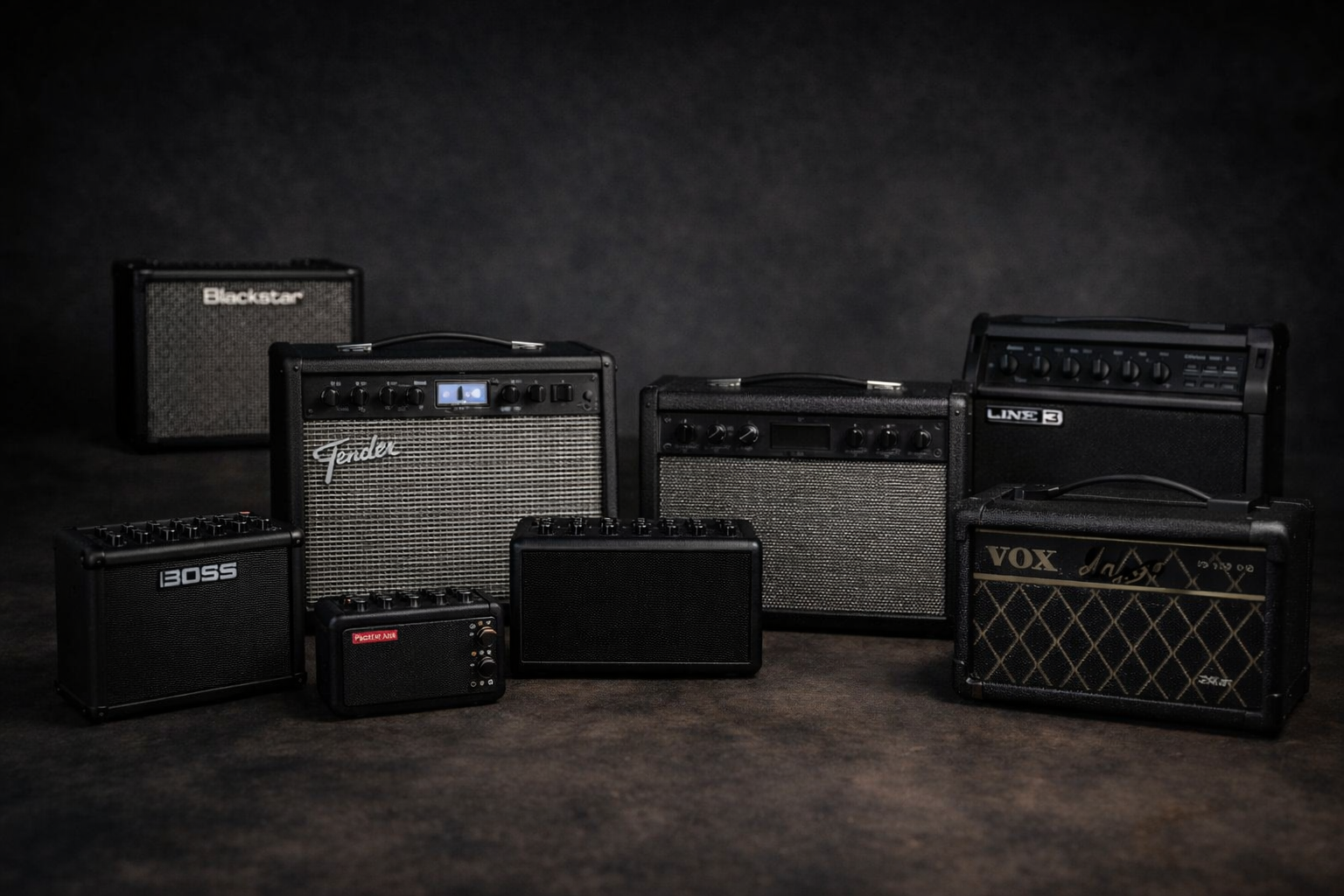
If you want a quick overview before diving into details, here is the core list this article covers. Any of them can be the best amp under 200 for you depending on how and where you practice:
- Boss Katana Mini – ultra-portable, simple three-voice analog-style practice amp.
- Blackstar ID:Core 10 V4 – stereo digital combo with wide, immersive sound.
- Fender Mustang LT25 – flexible modeling with presets and USB recording.
- Positive Grid Spark GO – app-driven smart amp and Bluetooth speaker in pocket size.
- Line 6 Spider V 20 MkII – 20W modeling combo with deep software editing.
- Vox Pathfinder 10 – simple, classic solid-state combo with headphone out.
- Harley Benton DNAFX AmP20 – budget 20W modeling combo with Bluetooth and multi-FX.
Below you’ll see how each one behaves at home volumes, what strengths and weaknesses it has, and who each amp is best suited for.
How We Picked (Apartment-Focused)
This is a “home volume first” shortlist. We prioritized the things that actually decide whether an amp works in an apartment:
- Low-volume feel: does it still sound like a guitar amp at “TV level”?
- Silent practice: is the headphone/line out usable and convenient?
- Low friction: can you get back to your core sounds fast (without menu pain)?
- Play-along workflow: AUX/Bluetooth convenience for backing tracks.
- Recording path (when available): USB or a practical line-out route for quick idea capture.
Quick verify in 10 seconds
- Set the amp to “TV level”: do chords stay full, or do they turn thin and brittle?
- Try headphones: does it feel like an amp tone, or a harsh direct signal?
- Play palm mutes quietly: are they punchy or do they collapse?
- Switch to your main tone: can you get there in 1–2 moves?
- Play along with a track: can you balance backing vs guitar easily at low volume?
What Makes a Good Practice Amp Under $200?
Budget practice amps used to be something you “put up with” until you could afford a real rig. Modern small amps are much better, but you still have to be careful: a lot of models look good on paper and fall apart the moment you turn them down to apartment levels. Your best practice amp will usually be the one that still feels like a proper guitar rig when the volume is barely above TV level.
Usable tone at low volume
The main test is simple: set the master volume around “TV level” and see if the amp still feels like a guitar amp or more like a thin radio. A good practice amp keeps its core character when it is quiet. Single-coil guitars should not become painfully bright and brittle, and humbuckers should not turn into a muddy brick as soon as you roll the volume down.
Headphones and silent practice
For many apartment players, headphones are not a backup plan, they are the default. Look for an amp with a proper headphone or line out that mutes the speaker and preferably includes some kind of cabinet simulation. This makes palm mutes, chords and bends feel much more like a mic’d amp instead of a direct, harsh DI signal.
Simple controls, repeatable results
Deep editing is fun for a weekend, but daily practice needs repeatable sounds. A practice amp should give you a few core voices (clean, edge-of-breakup, rock rhythm, a usable higher-gain tone) that you can get back to quickly. If you need to remember three button combinations just to find “the one sound you like”, you will practice less.
Size, weight and where it will live
Think about where the amp will physically live: on a desk, next to studio monitors, under a small table, or in a tight corner. A good practice amp is light enough to move every day if needed, compact enough not to dominate the room, and solid enough to survive being moved around a lot.
Extras that actually matter
Useful extras for home use include:
- AUX or Bluetooth input to play along with tracks without extra cables everywhere.
- USB recording if you want to capture ideas straight into a DAW.
- A built-in tuner, so you do not need another pedal on the floor.
Endless effect types and obscure amp models are less important than a couple of well-voiced delays, reverbs and modulation options that sound good at “neighbor-safe” volume.
Boss Katana Mini – Tiny, Grab-and-Go Practice Amp
The Boss Katana Mini is a 7W solid-state combo with a single 4" speaker and three core voices: Brown-style high gain, a crunchy middle option and a clean sound. It is battery powered but can also run from an adapter, and it weighs around 1.2 kg, so you can literally move it with one hand and place it wherever you like.
The control layout is classic: gain, three-band EQ and volume, plus a simple delay section. There is no display, no preset system and no USB. What you get instead is a surprisingly full and mid-focused tone that feels more like a tiny real amp than a toy practice box.
At very low volume the Katana Mini keeps enough body for riff practice and small chord work. Cleans can be set bright without becoming ice-picky, and with single coils you can sit in light breakup territory that feels very alive for blues and classic rock rhythms.
The PHONES/REC OUT jack gives you a cabinet-simulated signal that works well with headphones and can be fed into an interface if you want to sketch ideas. The downside is that you cannot load patches or edit deeper; it is intentionally simple.
Read full review: Boss Katana Mini review.
- Pros: extremely portable, simple controls, surprisingly full tone for a 4" speaker, usable headphone/rec out.
- Cons: no USB, no presets, no built-in reverb, not ideal if you want stereo ambience or app control.
- Best for: players who want a small, tough amp that can live on a shelf or desk and be ready in seconds for quick practice sessions.
Blackstar ID:Core 10 V4 – Wide Stereo Practice Rig
The Blackstar ID:Core 10 V4 is a 10W digital combo delivered as 2x5W Super Wide Stereo through a pair of 3" speakers. It offers six main voices: two cleans, two crunch tones and two higher-gain options, all shaped by Blackstar’s ISF control and a bank of built-in effects.
Delay, modulation and reverb each have multiple flavors, and CabRig Lite adds a modern speaker simulation section to the USB and headphone outputs. For a player sitting at a desk or in a small living room, this means you can get a lush stereo sound without ever pushing the volume into “complaint territory”.
At low volume, the ID:Core 10 V4 feels bigger than it physically is. Stereo chorus and delay spread the sound around you, which is especially nice for ambient clean or post-rock style playing. It also works well for backing tracks: the stereo image helps separate guitar and music even when the master volume is conservative.
Connectivity is strong for the price: USB-C for recording and editing, line in, Bluetooth playback on certain versions and a proper cab-sim headphone output. The trade-off is that you are working inside a digital environment; metal players who want very tight, percussive palm mutes might still prefer a larger speaker or a more focused amp.
If you want more detail on this amp, you can check our full Blackstar ID:Core 10 V4 review.
Read full review: Blackstar ID:Core 10 V4 review.
- Pros: big stereo sound at low volume, lots of built-in effects, USB-C recording, cab-sim headphone out.
- Cons: small 3" speakers can feel a bit hi-fi for aggressive tones, best tones come from a bit of tweaking, no “traditional” air-moving punch.
- Best for: players who love ambient cleans, wide stereo sounds and direct recording, and who mainly play at sensible apartment levels.
Fender Mustang LT25 – Flexible Modeling for Everyday Practice
The Fender Mustang LT25 is a 25W solid-state combo with a single 8" Fender Special Design speaker and a full modeling engine inside. You get a wide selection of amp models and effects, plus 50 presets accessible from a small color display and a straightforward front panel.
The LT25 covers a lot of ground: blackface-style cleans, British crunch, modern high gain and some more experimental presets. The simple layout lets you tweak gain, tone and master quickly, then save your favorite sounds so they are always a single button push away.
At low volume, the 8" speaker gives the LT25 more depth than mini-amps with tiny drivers. Chords feel fuller and palm mutes have more weight, even when the master is low enough for apartment use. The built-in stereo headphone output mutes the speaker and adds cabinet simulation, making late-night practice much more natural.
USB connectivity allows you to record directly into a DAW and update firmware when needed. With the Fender Tone software you can dig deeper into presets if you want to fine-tune details, but the amp is usable even if you never touch a computer.
For full official specifications, you can also visit the Fender Mustang LT25 product page.
Read full review: Fender Mustang LT25 review.
- Pros: wide range of tones, color display, USB recording, good-feeling 8" speaker, decent headphone experience.
- Cons: more menu interaction than simpler amps, some factory presets are over-processed, no stereo speakers.
- Best for: players who want one amp to cover everything from clean to high gain at home, and who appreciate presets and USB recording.
Positive Grid Spark GO – Smart Pocket Amp for Silent Practice
The Positive Grid Spark GO is a 5W ultra-portable smart amp and Bluetooth speaker with a small driver and a strong focus on app integration. It packs a serious modeling engine into a tiny box, with most of the control handled through the Spark app on your phone or tablet.
On its own, the top panel gives you basic control over presets, volume and a few key parameters. Paired with the app, the Spark GO turns into a deep modeling rig with Auto Chords, cloud-based tone sharing and backing-track tools that make learning songs easier.
At quiet apartment levels it works especially well with headphones. The cab-sim headphone output and computational audio design make it feel surprisingly big and three-dimensional for such a small unit. As a small speaker on a desk, it can also double as a Bluetooth music system when you are not holding a guitar.
The trade-off is that you are expected to use the app. You can definitely plug in and play without it, but you only unlock the real flexibility and effect variety when your phone is nearby. If you are okay with that, the Spark GO is one of the cleanest all-in-one silent practice solutions in this price range.
Read full review: Positive Grid Spark GO review.
- Pros: very small and portable, strong app ecosystem, Auto Chords and tone sharing, good headphone sound, Bluetooth speaker functionality.
- Cons: most features live in the app, single small speaker, not ideal if you dislike using a phone while practicing.
- Best for: players who practice mostly with headphones, like learning songs from streaming platforms, and appreciate a smart, app-driven workflow.
Line 6 Spider V 20 MkII – Deep Modeling in a Small Combo
The Line 6 Spider V 20 MkII is a 20W modeling combo with a single 8" speaker, a big model library accessible through the Spider Remote software, and 16 editable presets on the front panel. It is a compact entry point into the Line 6 ecosystem without jumping straight into a flagship processor.
The MkII update introduced a Classic Speaker mode that softens the very full-range feel of the earlier Spider series and makes the amp respond more like a traditional guitar combo. You can still switch to the full-range mode if you want more hi-fi style playback for backing tracks or acoustic tones.
At apartment volumes the Spider V 20 MkII feels comfortable as long as you keep gain and master balanced. The amp has enough low end to sound convincing, but not so much that it turns boomy in a small room. The cab-sim headphone output and USB interface make it easy to practice silently or record with minimal extra gear.
Spider Remote opens up deeper editing, including more detailed amp and effect selection, which is useful if you like to build very specific patches or match tones from recordings. If you just want a handful of bread-and-butter sounds, the factory presets can be trimmed down and saved to your taste.
Read full review: Line 6 Spider V 20 MkII review.
- Pros: large model library, Classic Speaker mode, USB interface, cab-sim headphone out.
- Cons: best tones require editing, interface is less immediate than simpler amps, factory presets can feel processed.
- Best for: players who like the Line 6 sound, want deep modeling tools in a small box, and intend to record or tweak patches on a computer.
Vox Pathfinder 10 – Classic, No-Nonsense Practice Combo
The Vox Pathfinder 10 is a 10W solid-state combo with a 6.5" speaker and very simple controls. There are two channels (clean and overdrive), a gain control, bass and treble EQ, and a volume knob. That is it—no menus, no screens, no hidden functions.
Despite its basic nature, the Pathfinder 10 delivers a distinctly Vox-flavored tone: chimey cleans with a bit of upper-mid bite, and a driven sound that leans toward classic rock and indie crunch rather than ultra-modern metal. It takes pedals reasonably well if you want to stack a drive in front.
At low volume, the amp stays articulate and clear enough for practice without losing too much body. The 6.5" speaker will not move a lot of air, but it is more than enough for bedroom-level playing. The headphone/line out is simple but effective for silent practice; when you plug in headphones, the speaker mutes.
Read full review: Vox Pathfinder 10 review.
- Pros: extremely simple to operate, recognizable Vox character, compact and affordable, headphone/line out for silent practice.
- Cons: no built-in reverb or delay, no USB, no modeling or presets, limited flexibility compared to digital rivals.
- Best for: players who value a straightforward, classic amp feel and mostly live in clean to low-gain territory.
Harley Benton DNAFX AmP20 – Budget Modeling All-Rounder
The Harley Benton DNAFX AmP20 is a 20W Class-D modeling combo with an 8" speaker, a selection of amp models, modulation and ambience effects, Bluetooth audio and user presets. It borrows technology from the brand’s DNAFX pedals, so you get a lot of functionality without a screen.
The amp models cover clean, country, blues, rock and several higher-gain flavors. Modulation and delay/reverb effects are controlled from the top panel with a combination of knobs and buttons, which keeps the footprint small but does require a short learning curve.
For apartment players, the AmP20 is strongest in low to mid-gain sounds. Blues and rock models in particular hold up well at lower volume, giving you enough definition for rhythm work and lead playing without turning boxy. Bluetooth lets you stream backing tracks from a phone, and the headphone output allows for silent late-night practice.
The downsides are mostly about interface quirks rather than raw sound: some users find the effect control scheme a bit fiddly at first, and not every amp model is equally strong. Still, for the price you get a lot of features and a convincing core tone platform for home use.
Read full review: Harley Benton DNAFX AmP20 review.
- Pros: lots of features for the money, Bluetooth playback, multiple amp models and effects, compact footprint.
- Cons: interface takes a little time to understand, some high-gain models feel less refined, no USB recording.
- Best for: players who want a flexible practice amp with more options than a basic analog combo, but who still want to stay under $200.
Quick Comparison: Practice Amps Under $200
Here is a compact look at apartment-friendly features side by side.
| Amp | Power / Speaker | Headphones / Line Out | USB Recording | Play-along (AUX / Bluetooth) | Best for |
|---|---|---|---|---|---|
| Boss Katana Mini | 7W, 1×4" | PHONES/REC OUT | No | AUX in | Fast desk/shelf practice |
| Blackstar ID:Core 10 V4 | 10W, 2×3" stereo | Headphone out (CabRig) | USB-C | Line in; Bluetooth varies by version | Stereo ambience at low volume |
| Fender Mustang LT25 | 25W, 1×8" | Headphones (cab-sim) | USB | Line in | Do-everything home practice |
| Positive Grid Spark GO | 5W, small driver | Headphone out | See your unit/version | Bluetooth | Silent practice + app workflow |
| Line 6 Spider V 20 MkII | 20W, 1×8" | Headphones (cab-sim) | USB | Line in | Tight high-gain / metal practice |
| Vox Pathfinder 10 | 10W, 1×6.5" | Headphone/line out | No | No | Simple clean-to-crunch |
| Harley Benton DNAFX AmP20 | 20W, 1×8" | Headphone out | No | Bluetooth | Max features under $200 |
Note: some connectivity features can vary by region/version. If a feature is critical, confirm it on the exact unit you’re buying.
How to Choose the Right Practice Amp Under $200
All of these amps can work in an apartment. The right choice depends on how you actually practice and what matters most to you day to day. For most players who want a do-everything combo, the Fender Mustang LT25 is the best amp under 200 in this list because it covers clean to high gain with presets and USB recording. But depending on your space and taste, a different model might be the best practice amp for you.
If you mainly play quietly at a desk
Look at compact, nearfield-friendly options like the Boss Katana Mini and Positive Grid Spark GO. They sit comfortably next to a laptop or monitor stand and still feel like real guitar setups at low volume, without dominating the room physically.
If you want stereo ambience and “big” sound at low volume
The Blackstar ID:Core 10 V4 is the obvious pick. Its stereo speakers and wide effects let you get immersive sounds for clean and mid-gain styles without turning up loud. If you love layering reverbs and delays, this one fits naturally into that workflow.
If you plan to record and use software a lot
The Fender Mustang LT25 and Line 6 Spider V 20 MkII both offer USB recording and deeper editing through companion software. They make sense if you want to build and save detailed presets, track ideas, or experiment with different amp and cab combinations in a DAW.
If you prefer simplicity over menus
The Vox Pathfinder 10 is the most straightforward option here. You turn a few knobs, find a sound and play. There is no preset management, no software and no app, which can be a relief if you just want to plug in after a long day.
If you play metal at home
If your main goal is tight, high-gain rhythm playing, you want the best practice amp for metal that still behaves at apartment volume. In this price range, the Line 6 Spider V 20 MkII is the strongest “tweakable” option, while the Fender Mustang LT25 is the most flexible all-rounder that also covers modern gain well.
If you want maximum features for minimum money
The Harley Benton DNAFX AmP20 packs in multiple amp models, modulation and ambience effects, Bluetooth audio and presets in a compact combo. It is a strong option if you want variety under $200 and do not mind spending a little time learning the control layout.
If you are also still choosing your first instrument, our guide to electric guitars under $300 pairs well with these practice amp options.
FAQ: Practice Amps and Apartment Playing
Do I really need a separate practice amp if I already use software?
Software amp sims sound great, but a physical amp that is always plugged in and ready removes friction. Being able to flip a switch and play for ten minutes without opening a DAW often means you practice more consistently, even if your ultimate tones come from plugins.
How many watts do I need for apartment practice?
For pure home use, anything between 5W and 25W is enough, as long as the amp sounds good with the master set low. Wattage matters more for clean headroom at stage volume than it does in a bedroom. Focus on how the amp feels at the volume you are actually allowed to use.
Is a headphone-only solution enough?
If you mostly play late at night, a great headphone experience can absolutely be enough. Just make sure the amp or device you choose has a proper cabinet-simulated output so the sound feels natural instead of thin and harsh. Some players still like having a small speaker for those moments when they can turn up a little.
Are digital modeling amps worse than small tube amps?
At very low volume, a small solid-state or modeling amp often works better than a tube combo that needs to be pushed to sound alive. Under $200 it is hard to find a tube amp that really opens up at apartment levels. Good digital amps give you consistent tones at any volume and add features like USB recording and built-in effects.
Can these amps handle small jams or coffee-shop gigs?
Some of them can, especially the 20–25W models with 8" speakers, but they are designed first as practice tools. For quiet duo jams or very small rooms they can cope, but if gigging is the priority you will usually want a slightly larger combo or a way to send a direct signal to a PA.