Best Pedalboard for Guitar: 7 Picks That Actually Make Sense
A good pedalboard doesn’t change your tone on its own, but it does change how often you actually plug in and play. The right board keeps your overdrive, delay and friends wired up, powered and ready, instead of living in a tangle of cables on the floor. The wrong board is heavy, awkward and half empty because it never quite fits your real-life rig.
I’ve gone from a cheap DIY plank to mid-sized aluminium frames and full cases, and the same pattern keeps showing up: the best pedalboard for guitar is the one that fits your current pedals, the way you travel and how often you really play. This guide is written from that angle – not just a list of “best guitar pedalboard” options, but a way to match the board to your situation so you don’t overbuy.
- How to choose the right pedalboard size and case type for home, rehearsal and gigs.
- The difference between flat, angled and case-style boards.
- Seven realistic picks from cheap guitar pedalboard options to premium all-rounders.
- Pedalboard ideas that match simple beginner rigs and more built-out setups.
| Your situation | Pick | Why it fits |
|---|---|---|
| You want a compact, no-nonsense board for a few core pedals at home or rehearsal. | Pedaltrain Nano+ | Lightweight aluminium frame with just enough space for a basic drive + delay + reverb chain. |
| You’re building a main all-round board for band use with 6–8 pedals. | Pedaltrain Classic 2 | Classic mid-sized frame; one of the safest “best pedalboard for guitar” choices for most players. |
| You want a hard case style board with lid and built-in patching for travel. | Boss BCB-90X | Molded case with removable lid and internal patching – easy to carry, quick to set up. |
| You’re on a tight budget and just want a cheap guitar pedalboard that still works. | Harley Benton Spaceship 40 | Affordable aluminium board with soft case – realistic budget option for first boards. |
| You like modular layouts and want clean wiring with side-mounted jacks. | Temple Audio DUO 24 | Perforated deck and modular plates let you hard-mount pedals, jacks and power neatly. |
| You want a slightly larger budget board for home and occasional gigs. | RockBoard Tres 3.1 | Angled one-piece frame with slot system for tidy cabling, good size for 6–7 pedals. |
| You barely leave the house and just need a tiny, cheap frame under a couple of pedals. | Donner DB-2 | Simple budget rail board; not fancy, but a usable starter platform for minimal rigs. |
Who is a dedicated pedalboard actually for?
You don’t need a full pedalboard on day one. Many players stay happy with a couple of pedals on the floor for years. A board becomes useful when rewiring starts to annoy you, or when you’re moving pedals between rooms and rehearsal spaces often enough that setup time matters.
When a pedalboard makes sense
- You have three or more pedals that you use regularly.
- You rehearse or gig and need faster setup and teardown.
- You want consistent pedal order and fewer cable problems.
- You’re starting to build a real rig, not just testing one pedal at a time.
When a pedalboard is probably overkill
- You mostly use a multi-effects unit or amp modeler by itself.
- You own one or two pedals and rarely move them.
- You’re still not sure whether you even like using individual pedals.
If you’re still figuring out which effects you actually need, starting with a simple rig built around a few core pedals and a basic beginner guitar checklist can be smarter than jumping straight into a big board.
Main types of pedalboards
Most of the best pedalboard for guitar options fall into three broad categories. Knowing which one matches your situation will narrow the field quickly.
Flat and angled aluminium frames
These are open-frame boards made from aluminium rails or a slotted platform. Pedals attach with Velcro or similar, power supplies often mount underneath, and the whole thing slides into a soft case or flight case.
- Lightweight, strong and easy to reconfigure.
- Good airflow around power and cables.
- Most common “best pedalboard” style for modern rigs.
Case-style pedalboards
These combine the board and case in one molded or wooden unit with a lid. You mount your pedals inside the base, then close the lid for transport.
- Very fast to set up: open the lid, plug in, done.
- More protection in cars, buses and storage.
- Usually heavier and less flexible than frame-style boards.
DIY and hybrid solutions
A DIY board can be as simple as a painted plank with Velcro or a cut-down shelf with rubber feet. Some players also build hybrid rigs with a small board plus a multi-effects unit.
- Cheapest way to get pedals off the floor.
- Good for testing layouts before buying a “forever” board.
- Can be rough around the edges, but perfectly workable at home.
If you want to go deeper into layouts and examples before buying anything, the explainer in guitar pedalboard explained walks through simple and hybrid pedalboard ideas in more detail.
Buying checklist: what actually matters
You don’t need the most expensive frame on the list; you need a board that matches your pedals, car, storage space and real-world use. Before picking from any list of the best guitar pedalboard options, it helps to zoom out and decide what you really need.
- Size: Lay your pedals on the floor first and measure that footprint. Then get the next size up, not three sizes bigger.
- Case type: Soft cases are lighter and cheaper; hard cases and molded lids are safer for gigging and travel.
- Power: Check whether the board can mount your preferred power supply under or on top, and how easy cable routing will be.
- Height and angle: Angled frames make back-row switches easier to hit but can feel tall on some setups.
- Weight: A big board plus power plus pedals adds up fast; be honest about how far you’ll carry it.
- Cable management: Slots, holes and side panels make it easier to keep patch cables and mains cables tidy.
- Budget: Decide whether you want a long-term main board or a cheap guitar pedalboard to get started while you refine your rig.
Best pedalboard for guitar: quick picks and pedalboard ideas
Best pedalboard for guitar if you just want one main board
If you’re after a single board that covers home, rehearsal and the occasional gig, it makes sense to pick something that behaves like a reliable everyday platform instead of juggling multiple frames.
- All-rounder (home + rehearsal): Pedaltrain Classic 2 – one of the safest “best pedalboard for guitar” choices if you run 6–8 pedals.
- Molded case option: Boss BCB-90X – great if you want a lid, built-in patching and fast setup.
- Modular / tidy wiring: Temple Audio DUO 24 – excellent if you care about cable management and side-mounted jacks.
Best pedalboard options for small and budget rigs
- Minimal board with a few pedals: Pedaltrain Nano+ – fits a drive, ambient pedal and maybe a utility box without feeling cramped.
- Budget aluminium frame: Harley Benton Spaceship 40 – realistic cheap pedalboard for first serious rigs.
- Ultra-budget starter: Donner DB-2 – basic rail board that still gets pedals off the floor at low cost.
Best pedalboard ideas by rig type
- Traditional amp + pedals: A Classic-2-sized frame with drive, modulation, delay and reverb, plus a proper power supply.
- Hybrid with modeler: A smaller board like Nano+ or Spaceship 40 carrying a modeler plus one or two favourite drives.
- Home-only rigs: A compact frame with a couple of gain pedals and ambience, paired with a good practice amp or modeler; if the amp side is still rough, why your guitar can sound bad at home is worth a read.
The 7 picks
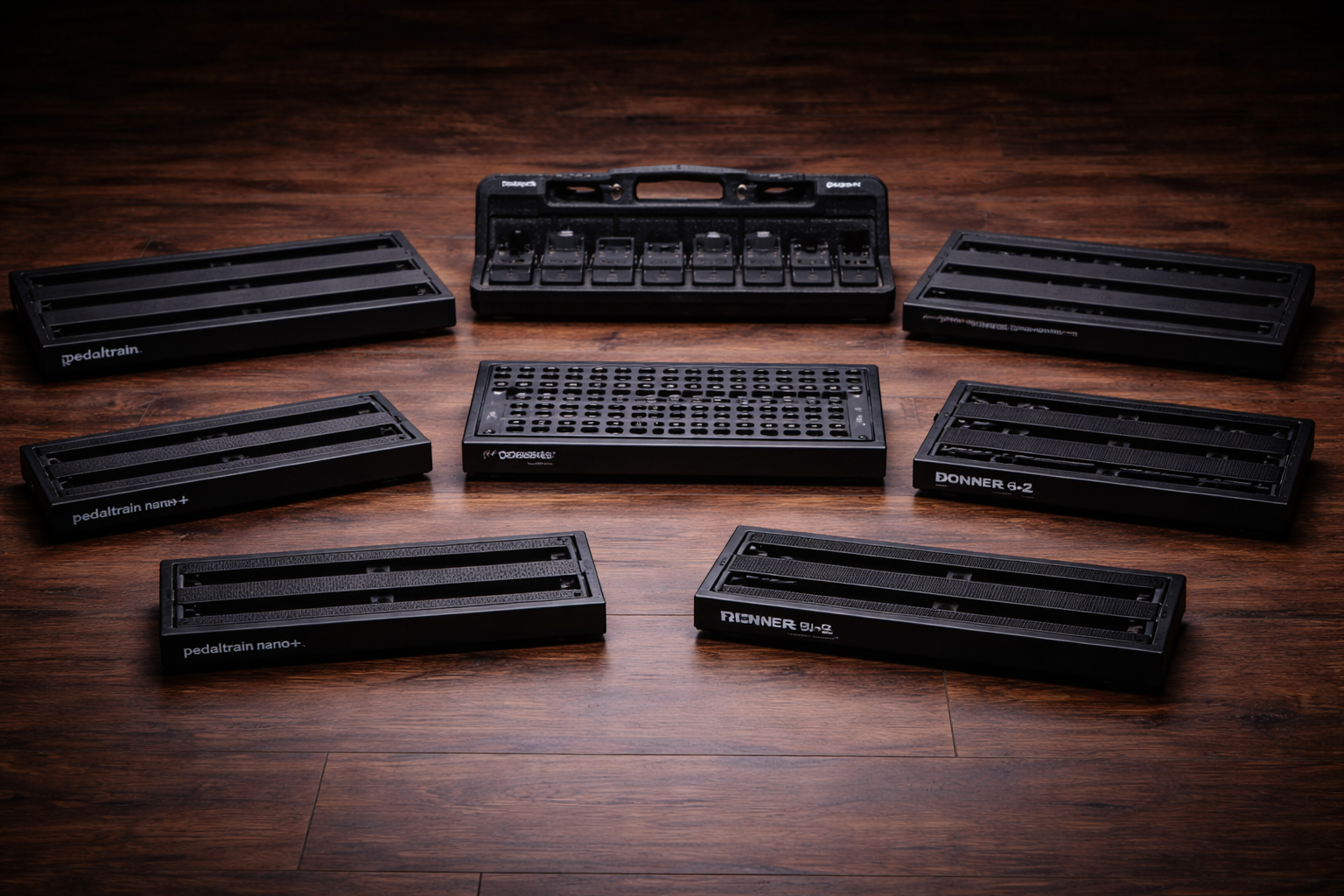
These seven boards cover everything from tight budget to modular premium designs, so you don’t have to dig through endless lists of best pedalboard options to find something that fits a normal rig.
Pedaltrain Nano+ (compact essential)
The Nano+ is a small, two-rail aluminium board that’s big enough for a few core pedals while staying extremely easy to carry. It’s one of the best guitar pedalboard choices if your rig is deliberately minimal.
- Model: Pedaltrain Nano+
- Type: Compact aluminium frame with soft case
- Best for: Home players, grab-and-go rigs, fly dates with a tiny setup
- Key features: Lightweight, simple rail design, works well with mini patch cables and small power supplies
- Price tier: Mid / affordable
- Skip if: You already own more than four or five pedals you want on the board at once
Pedaltrain Classic 2 (all-round workhorse)
Classic 2 is the modern mid-sized Pedaltrain many players land on as their main board. It has room for a typical drive section, modulation, delay, reverb and a couple of utilities without feeling oversized.
- Model: Pedaltrain Classic 2
- Type: Medium aluminium frame with soft or hard case options
- Best for: Main boards that live between home, rehearsal and small stages
- Key features: Angled slotted surface, under-board power mounting, established ecosystem of accessories
- Price tier: Mid
- Skip if: You know you’ll only ever run a handful of pedals or, at the other extreme, a very large rig
Boss BCB-90X (molded case with lid)
The BCB-90X is a molded plastic case-style board with a removable lid and internal patching channels. If you want something you can close, carry and drop on the floor without worrying too much, this is a practical option.
- Model: Boss BCB-90X
- Type: Molded case pedalboard with removable lid
- Best for: Players who travel with their board and value protection and quick setup
- Key features: Internal slots for cabling, fits Boss-style pedals well, includes patch cables
- Price tier: Mid / upper-mid
- Skip if: You want maximum flexibility with odd-sized pedals or non-standard layouts
Harley Benton Spaceship 40 (budget aluminium board)
The Spaceship series aims to give you a modern aluminium frame at a much lower price than many big brands. The 40-cm version is a sensible entry point if you want a cheap but usable board with a soft case included.
- Model: Harley Benton Spaceship 40
- Type: Aluminium rail board with soft case
- Best for: First serious pedalboard builds on a tight budget
- Key features: Slotted rails, basic cable routing options, decent amount of space for 5–6 pedals
- Price tier: Budget
- Skip if: You already know you want a long-term “buy once” board and don’t mind paying more
Temple Audio DUO 24 (modular and tidy)
Temple boards use a perforated deck and small mounting plates that bolt into place, so pedals are hard-mounted rather than stuck on with Velcro. Side modules handle jacks and power, which makes for clean wiring and easy tear-down.
- Model: Temple Audio DUO 24
- Type: Modular aluminium frame with side plates and optional cases
- Best for: Players who care a lot about tidy wiring and repeatable setups
- Key features: Modular pedal plates, side I/O modules, under-board power mounting
- Price tier: Upper-mid / premium
- Skip if: You constantly change pedals and don’t want to bother with mounting plates
RockBoard Tres 3.1 (mid-sized angled alternative)
RockBoard’s Tres 3.1 is an angled one-piece metal board with a slot pattern instead of separate rails. It’s a nice alternative if you want a mid-sized frame similar to a Classic 2 but with a slightly different layout and accessory ecosystem.
- Model: RockBoard Tres 3.1
- Type: Angled slot-pattern board with soft case
- Best for: 6–7 pedal rigs, or players who like the RockBoard accessories and patchbays
- Key features: Single-piece design, cable slots, optional patchbay integration
- Price tier: Mid
- Skip if: You need a very compact board, or you already own Pedaltrain-specific accessories
Donner DB-2 (ultra-budget starter)
The DB-2 is a simple budget rail board aimed at beginners who just want to get pedals off the floor without spending much. It’s not a forever solution, but it can be a practical way to learn what size you actually need.
- Model: Donner DB-2
- Type: Small aluminium rail board with basic bag
- Best for: First experiments with pedalboards, minimal home rigs
- Key features: Lightweight, straightforward to set up, low price
- Price tier: Budget / ultra-budget
- Skip if: You already know you’ll build a larger rig soon and want to avoid buying twice
How a pedalboard fits into your rig
A pedalboard doesn’t improve bad tones on its own. What it does is make a good rig easier to repeat. Where you use it – and how you monitor (amp, FRFR, headphones) – matters more than the logo on the frame.
Home and headphone practice
For home players, the most useful boards are often the smallest ones. A Nano-sized frame with a drive, ambience and maybe one utility pedal can feel far better than a half-empty monster board.
- Keep the layout simple so you can reach everything easily while seated.
- Pair the board with a practice amp or modeler you actually like listening to.
- If you’re fighting fizz and harshness, sorting out gain staging in gain vs volume vs master usually helps more than upgrading the frame.
If your core tones still feel rough at home, this breakdown of why your guitar can sound bad at home pairs well with this guide.
Rehearsal and live use
In a band mix, board layout and ergonomics matter as much as the pedals themselves. You want switches you can hit without thinking, and cabling that doesn’t fail when someone trips over a lead.
- Use a mid-sized board like Classic 2 or Tres 3.1 for typical 6–8 pedal rigs.
- Make sure the case or lid can handle being thrown into a car or van regularly.
- Leave some physical space between switches you hit often and those you rarely touch.
If you’re still planning which drives and ambience pedals to put on the board, it’s worth pairing this article with best overdrive pedal for guitar, best distortion pedal for guitar, best delay pedal for guitar and best reverb pedal for guitar.
Hybrid modeler + pedalboard rigs
If you use a floor modeler, you might only need a small frame to carry it and one or two extra pedals, or you might skip a board entirely and just use the unit’s built-in effects.
- Decide whether you really need extra drives or ambience outside the modeler.
- Pick a board that fits the unit footprint plus any essential pedals and power.
- Keep cabling tidy so setting up direct to PA or FRFR feels quick and repeatable.
For more on how individual pedals and modelers can share roles, the breakdown in overdrive pedal explained is a useful companion read.
When a pedalboard is overkill
Sometimes the best move is to delay buying a pedalboard and focus on the core rig first. You might be happier if you:
- Invest in one good amp or amp-sim setup and really learn its clean and driven sounds.
- Dial in a small set of pedals on the floor before committing to a fixed layout.
- Fix noisy power, bad cables and basic setup issues before adding more hardware.
If you’re still working through the fundamentals of gear and practice, these pieces help you build a sensible starting point before chasing bigger boards: beginner guitar checklist and guitar pedals for beginners.
Summary: which pedalboard should you buy now?
If you’re choosing a board today, start with your current pedals on the floor. Measure that layout, decide whether you’ll add one or two more boxes soon, and pick a frame that fits that footprint plus a little margin. For many players, a compact board like the Nano+ or a mid-sized workhorse like Classic 2 will cover most use-cases without feeling like overkill.
From there, think about how you travel, how hard the board will be treated and how tidy you want cabling to be. Case-style options like the BCB-90X and modular frames like the DUO 24 are brilliant when they match your life; a simple cheap pedalboard is often enough when you’re still experimenting. Whatever you pick, the board should feel like a tool that serves your playing, not an obligation to fill empty space with more pedals.
Pedalboard FAQ
Is it worth paying more for a premium pedalboard?
It can be, but only if your rig and schedule justify it. Premium boards usually offer better cases, stronger frames and cleaner cable management. If you mostly play at home with a few pedals, a solid mid-range or budget board will do the job just fine. If you travel a lot and your board is constantly moved and stepped on, better hardware and cases start paying for themselves.
How many pedals should fit on my first pedalboard?
A sensible starting point is room for 4–6 pedals: one or two drives, possibly a fuzz, one modulation and a delay or reverb. If you already know you’ll run more, size up, but avoid buying a board so large that it feels empty and awkward. It’s usually better to outgrow a slightly smaller board than to drag a huge half-empty one everywhere.
Is Velcro enough, or do I need special mounting hardware?
For most players, quality hook-and-loop tape on a clean surface is perfectly fine. Make sure both the board and pedal bases are clean and dry before applying it, and give it time to cure. Modular systems with plates and bolts are great if you tour, change pedals less often or want absolutely secure mounting, but they’re not mandatory for home and local gigs.
Should I choose a soft case or a hard case?
Soft cases are lighter, cheaper and easier to carry; they’re ideal for home use and gentle local travel. Hard cases or molded lids make more sense if you’re throwing the board into vans, storage and busy stages regularly. If you mostly move the board in your own car and handle it yourself, a good soft case is often enough.