Boss SD-1 Review: Classic Super Overdrive That Still Works in 2026
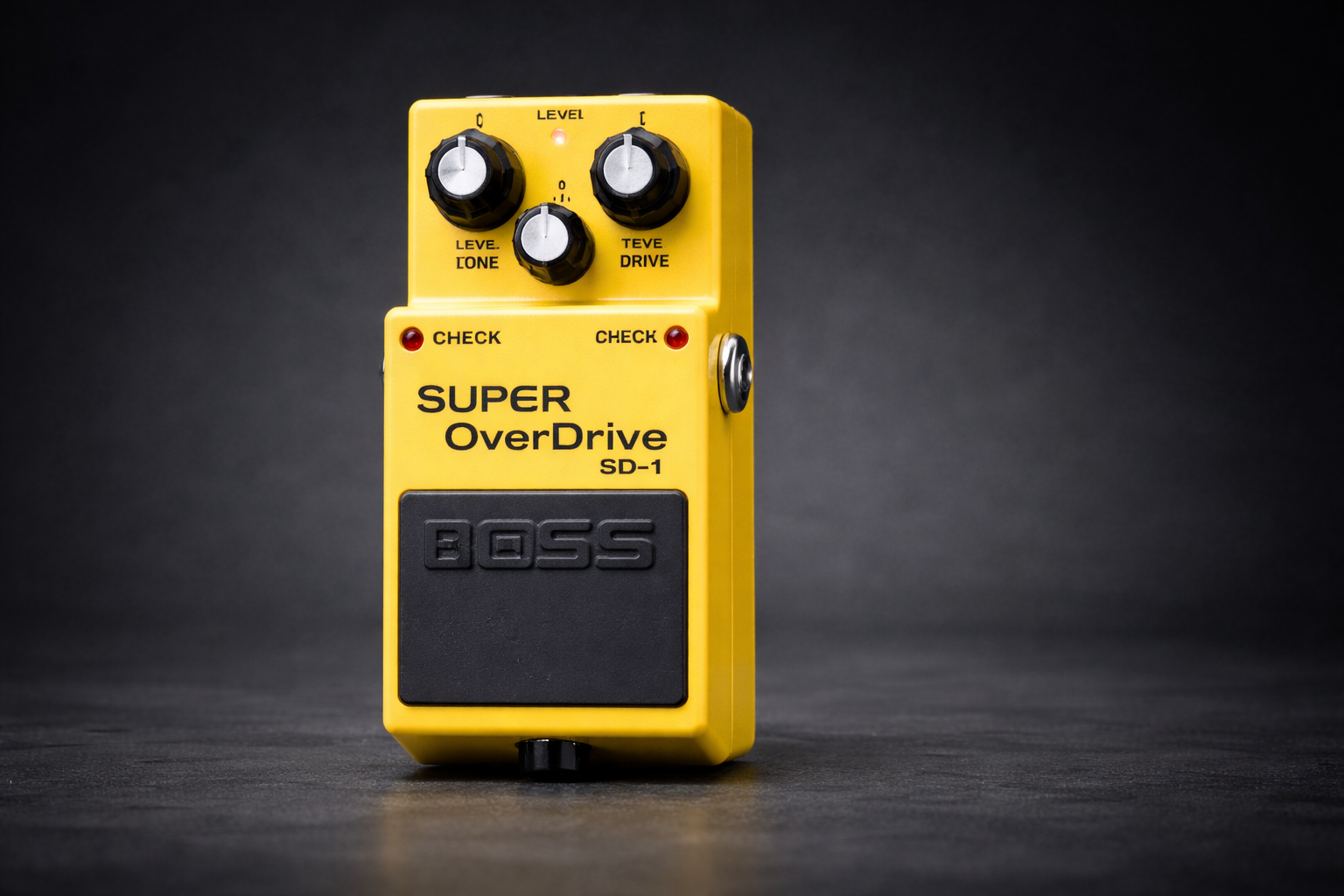
Some overdrive pedals come and go with trends. The Boss SD 1 Super Overdrive just quietly stays on people’s boards. Since the early 80s, this small yellow box has shown up on beginner setups, pub gigs and bigger stages as a simple way to get usable mid-focused drive and a tighter feel.
I’ve used this circuit as a first “real” drive into small practice amps, as a crunch sound into clean combos, and as a low-drive boost in front of Marshall-style rigs. It’s not the flashiest pedal, but it has a habit of still being there when fancier options have been bought and sold.
In this review the focus is simple: how this boss super overdrive behaves at home volume, in a loud band room, and on small stages. The question isn’t whether it’s a classic on paper, but whether it still earns a space on a modern board when you’re already spoiled for choice.
If you’re still working out which overdrive category you want first (mid-hump, bluesy, Klon-style, amp-like), start here: best overdrive pedal for guitar. Once you have that picture, it’s much easier to see where the Boss SD-1 Super Overdrive really fits.
What you’ll get from this guide:
- Who the SD-1 suits based on your amp, volume and playing style.
- Tone and feel in real rooms, not just close-mic’d demo clips.
- Copy/paste settings for rhythm crunch, solo lift and tight boosts.
- Stacking roles: SD1 pedal as a boost into other drives and high-gain amps.
- Boss SD-1 vs Tube Screamer and vs SD-1W Waza Craft in plain language.
- Price and value: where this boss sd 1 super overdrive pedal sits in 2026.
Pros and cons at a glance
Pros
- Mid-forward voice that cuts without needing extreme treble on the amp.
- Can be both a main rhythm drive and a focused boost into other gain stages.
- Affordable, easy to find new or used, and built in the usual sturdy Boss format.
- More responsive to picking and guitar volume than the price suggests.
- Buffered bypass and simple power make it easy to add to almost any board.
Cons
- If you dislike midrange push, this probably isn’t your sound.
- Not a transparent overdrive; it leaves its own fingerprint on your tone.
- On its own it won’t cover modern high-gain unless your amp is already doing a lot.
- Tone can feel harsh if you dial it for bedroom fun and then go straight to a loud gig.
Quick decision: is the Boss SD-1 right for your rig?
| Your situation | Verdict | Why |
|---|---|---|
| You want a cheap, reliable mid-hump overdrive for rock or bluesy crunch. | Strong fit | This is the lane the Boss SD 1 lives in: mild-to-moderate drive with focused mids and a tight low end. |
| You run a high-gain amp and need a boost to tighten lows and add cut. | Strong fit | The SD1 pedal is a classic “front of Marshall” style boost: more bite, more focus, less flub. |
| You want a transparent “amp but more” overdrive. | Maybe | It’s a voiced rock drive. A Klon-style or Blues Driver will feel more natural: Wampler Tumnus review, Boss BD-2 review. |
| You expect one pedal to turn a clean amp into tight, modern metal. | Look elsewhere | This boss super overdrive is better as a classic overdrive and booster than a full-blown distortion solution. |
Specs and what the Boss SD-1 is designed to do
| Model | Boss SD-1 Super OverDrive (standard yellow model). |
|---|---|
| Type | Mid-focused overdrive using Boss’s asymmetrical soft-clipping circuit. |
| Controls | DRIVE (gain), TONE, LEVEL (output volume). |
| Bypass | Buffered bypass with an always-on buffer. |
| Power | 9V battery or standard 9V DC center-negative supply. |
| Current draw | Around 10 mA, easy on any modern power brick. |
| Size and weight | 73 x 129 x 59 mm, roughly 360 g – standard compact Boss footprint. |
| Typical roles | Main rhythm drive, solo boost, tightener for high-gain amps, general mid-forward overdrive. |
| Best for | Players who want a simple overdrive that cuts in a band mix and doubles as a dependable boost. |
Boss SD-1 vs Tube Screamer
Compared with a Tube Screamer such as the Ibanez TS9, the Boss SD-1 Super Overdrive pedal lives in the same mid-pushed world, but its asymmetrical clipping and bass handling give it a slightly more aggressive, grainy feel and a touch more body than many classic TS-style circuits.
Who this pedal is actually for
When it makes a lot of sense
- First serious overdrive you can keep as the rest of your rig improves.
- Rock and blues crunch in the classic rock / blues-rock / 80s hard rock zone.
- High-gain boost when you already like your amp and just want it tighter and more focused.
- Pedalboard staple if you like the standard Boss footprint, switching and power format.
When it’s probably the wrong buy
- You really want a transparent “amp but more” sound with minimal mid-shaping.
- You prefer scooped, modern tones with less focus in the midrange.
- You expect one pedal to do modern metal on a totally clean amp without help.
- You mostly play at very low volume and want only soft, amp-like breakup.
How to dial the Boss SD-1 fast
60-second dial-in method
Step-by-step
- Start with DRIVE around 9–10 o’clock, TONE near 11, LEVEL at roughly the same loudness as bypass.
- Push LEVEL up until the sound feels a bit more “forward” in the room.
- Add DRIVE until you hit the amount of grit you’d actually use with a band.
- Adjust TONE last: back it off if the upper mids stab, or raise it slightly if your parts sink under the mix.
Fast fixes
- If it’s harsh: turn TONE down first, then look at amp treble and presence.
- If it’s boomy or flubby: lower amp bass slightly and avoid maxing DRIVE.
- If you disappear: push LEVEL before reaching for more DRIVE or TONE.
Tone and feel in the real world
Overall the boss sd 1 super overdrive sits in the “smooth-ish grit with a deliberate mid bump” camp. It doesn’t have the raw edge of some bluesier drives or the hi-fi clarity of a Klon-style pedal, but it gives you a controllable, slightly compressed crunch that keeps chords readable and single notes confident.
Rhythm and lead tones
As a main rhythm drive into a clean or edge-of-breakup amp, the SD-1 tightens the bottom, pushes the mids forward and lets the top end cut without extreme treble on the amp. For leads, keep DRIVE in the lower half of its range, bump LEVEL and you get a mid-pushed tone that steps out of the mix without needing loads of extra gain.
Boost into high-gain amps
In front of a high-gain amp the SD1 pedal is mostly about shape. With DRIVE low, LEVEL healthy and TONE around 10–11 o’clock, it trims low-end flub, sharpens pick attack and makes palm-muted riffs feel more controlled and percussive.
Build quality and noise
The housing and switching feel like any compact Boss pedal: metal enclosure, solid footswitch, side jacks and top power. Noise levels are typical of an analog overdrive, and with sensible gain settings and decent power it stays quiet enough for normal stage and home use. The buffered bypass is clean and can help keep longer boards from sounding dull.
Best Boss SD-1 settings (copy/paste presets)
| Scenario | DRIVE | TONE | LEVEL | Notes |
|---|---|---|---|---|
| Always-on crunch enhancer | 8–9 o’clock | 10–11 o’clock | Just above unity | Adds size and grit while still feeling like your amp. |
| Classic rock rhythm | 10–11 o’clock | 11–noon | Unity to a small boost | Punchy, mid-focused rhythm tone that stays clear when the band gets busy. |
| Solo lift into edge-of-breakup amp | 9–10 o’clock | 10–noon | Audible boost | Use just enough extra DRIVE for sustain and let LEVEL set how far above the band you sit. |
| Tight boost into high-gain amp | 8–9 o’clock | 9–11 o’clock | Healthy boost | Treat the SD-1 as a tone shaper: keep gain modest and let the amp supply saturation. |
Home, rehearsal and gig behavior
Home practice
At low volume many overdrives shrink and get fizzy. The Boss SD 1 behaves the same if you lean too hard on DRIVE and TONE, so think “a bit more feel” rather than “full stage sound” in a small room.
- Use modest DRIVE, let LEVEL make the sound feel larger, and keep TONE just under noon unless your amp is very dark.
Rehearsals and small gigs
In a band mix the SD1 pedal shines as a rhythm crunch and solo lift. The mid push that felt obvious at home now helps the guitar sit between cymbals and vocals without lots of amp treble.
- If you disappear, try a small LEVEL bump rather than jumping straight to the amp’s high end.
Stacking and pedalboard roles
On a small board the Boss SD-1 Super Overdrive can easily be the only drive you carry. On a larger board it often becomes a utility box that shapes other pedals and amps rather than stealing the spotlight, either first in line into a clean or edge-of-breakup amp, or as a front-end boost into higher-gain setups.
Simple stacking recipes
Before another drive (tighten and focus)
- Set SD-1 DRIVE low, LEVEL above unity and TONE around 10–11 o’clock.
- Use it to tighten and sharpen warmer, more open overdrives like a BD-2 or OCD.
After another drive (extra gain and level)
- Run the SD-1 after a lower-gain pedal and use DRIVE and LEVEL to lift solos.
- Pairs well with more transparent pedals such as a Tumnus or Blues Driver that supply the base tone.
If you’re building out a full gain and ambience chain, these guides help put the SD-1 in context: best overdrive pedal for guitar, best delay pedal for guitar and best reverb pedal for guitar.
Boss SD-1 vs SD-1W and other variants
| Model | What it is | Who it’s for |
|---|---|---|
| Boss SD-1 (standard) | The original mid-focused Super Overdrive with the classic circuit and layout. | You want the familiar sound at the lowest cost and don’t need extra modes. |
| Boss SD-1W Waza Craft | A Waza Craft take with upgraded components and a Custom mode for a smoother, fuller voice. | You like the SD-1 flavour but want a more refined feel and a bit more flexibility. |
| Boss SD-1 40th Anniversary | A limited version with inverted colours and cosmetic changes rather than a new sound. | Players who want the same tones in a special edition box. |
Price and value: is the Boss SD-1 still worth it?
In the current pedal market the Boss SD-1 sits in the “not much to think about” price bracket. New units usually cost less than many boutique overdrives or high-end clones, and used ones are everywhere, which is a big part of why this circuit has quietly stayed relevant.
- If you need a reliable overdrive you can throw on the floor at gigs, this is a low-stress choice.
- If you’re already deep into chasing specific flavours, it’s still a handy reference pedal and a solid boost to keep around.
- If your collection is mostly transparent or Klon-style drives, the SD-1’s mid push gives you a different option.
When you should skip the Boss SD-1
- You want heavy, compressed, modern metal tones with no help from your amp or other pedals.
- You prefer almost completely transparent overdrives and dislike a fixed mid bump.
- You already have several mid-hump drives and just need a neutral boost or EQ.
- You play mostly at whisper volume and need very clean, studio-style gain behaviour.
Summary: is the Boss SD-1 still a good buy?
If what you really want is transparent enhancement, extreme modern gain, or deep tweakability, you’ll probably be happier looking at other options like a Blues Driver, a Klon-style pedal or some of the higher-gain drives in the best overdrive pedal guide. If, on the other hand, you like focused mids, straightforward controls and a pedal that can survive a lot of gigs without drama, this boss sd 1 super overdrive pedal is still easy to recommend.
FAQ
What is the Boss SD-1 Super Overdrive?
It’s a compact, mid-focused overdrive pedal from Boss that uses an asymmetrical soft-clipping circuit to create smooth, tube-like drive. In searches you’ll see it called the Boss SD-1 Super Overdrive pedal, Boss Super Overdrive or simply SD1 pedal.
Is the Boss SD-1 true bypass or buffered?
The standard Boss SD-1 uses buffered bypass, like most classic compact Boss pedals. The internal buffer stays in the signal path even when the effect is off, which can help keep things clearer on longer cable runs and bigger boards.
What are good starter settings for the Boss SD-1?
A simple starting point is DRIVE around 9–10 o’clock, TONE near 11 and LEVEL slightly above unity. From there you can add just enough extra DRIVE for the amount of crunch you actually use, and adjust LEVEL so your parts sit where you want them in the mix.
Does the Boss SD-1 stack well with other overdrives and distortions?
Yes. Many players run the boss sd 1 super overdrive with low DRIVE, higher LEVEL and a moderate TONE setting in front of another overdrive or high-gain amp to tighten lows and add mid focus. It can also follow another drive as a mid-pushed solo lift if you keep the tone sensible for your rig and room.
Is the Boss SD-1 good for metal?
On its own the Boss SD-1 Super Overdrive is more of a classic overdrive than a dedicated metal distortion. Used as a boost into a high-gain amp, though, it’s very effective: keep DRIVE low, raise LEVEL, set TONE conservative and let the amp provide most of the saturation while the pedal tightens the response.