7 Best Electric Guitars Under $300 That Don’t Feel Cheap (Beginner Picks)
Electric guitars under $300 can be genuinely fun to play—if you prioritize what matters for real home practice: a comfortable neck, decent fretwork, and tuning stability that doesn’t make you hate the instrument.
You’ve probably noticed this already: the cheaper the guitar, the more the marketing tries to convince you it’s “just like a pro instrument”. Then you get it in your hands and it feels like a toy.
You Google “best electric guitars under $300”, open ten different listicles, and they all say the same thing. Same stock photos, same phrases, no one actually tells you what the neck feels like or whether the thing stays in tune for more than one song.
This guide is for the real situation most people are in: you’re playing at home. Maybe in a bedroom, maybe in a small living room. You don’t want a guitar that makes you fight for every chord. You want something that feels solid when you pick it in your hands, doesn’t go wildly out of tune, and actually sounds decent through a small combo or desktop amp.
If your tone also feels thin, harsh, or “boxed” at home, don’t blame the guitar too fast. Room + volume + EQ can be the real culprit. Start here: Why Your Electric Guitar Sounds Bad at Home (And How to Fix It).
Quick decision table (pick in 20 seconds)
| If you are… | Pick this type | Why it works under $300 |
|---|---|---|
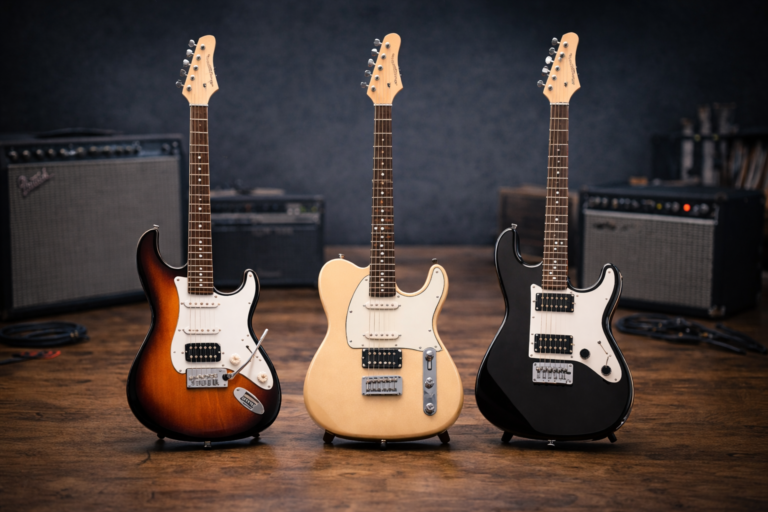
| “I want one guitar that covers most styles.” | Yamaha Pacifica (HSS) | Comfortable neck + solid QC + bridge humbucker for rock, singles for clean. |
| “I want classic clean / low gain Strat tones.” | Squier Affinity Strat (SSS) | That familiar Strat feel + positions 2/4; expect some hum under gain. |
| “I want simple controls and bright rhythm clarity.” | Squier Affinity Tele (SS) | No nonsense layout; bridge bite stays clear at home volume. |
| “I mostly play rock/metal with gain.” | Ibanez Gio / Jackson JS (HH/HSH) | Humbuckers = tighter under gain + less hum; often faster necks. |
| “I want the best value and I can return if needed.” | Harley Benton / house brands | Specs-per-money can be insane, but consistency varies → return policy matters. |
| “I want the best ‘feel’ for the money.” | Used market | Same budget can buy a higher-tier guitar if you inspect smart. |
What actually matters in a sub-$300 electric guitar
At this price you’re not buying a “forever guitar”. You’re buying your first real tool – the one that teaches your hands what playing the guitar actually feels like. A few details matter way more than fancy specs.
Neck feel
Pick the guitar up, close your eyes and wrap your hand around the neck. Does it feel like you’re grabbing a baseball bat, or a ruler, or something in between?
- If the neck is too chunky, small hands get tired quickly.
- If it’s too thin, you might clamp too hard and fight with chords.
- If the finish is sticky, sliding up and down the neck feels like dragging your hand over tape.
You want a neck that disappears in your hand. Not exciting. Just… comfortable.
Tuning stability
This is the difference between “I’ll just play for ten minutes” and “why do I even bother”. After you stretch the strings properly and tune up, you should be able to:
- Play a couple of songs
- Practice a few riffs
- Try some bends
- …without the tuner living in your hand the whole time
Cheap tuners, badly cut nuts and flimsy tremolos are the usual enemies. At this price you’re aiming for “stays in tune well enough for a practice session”, not “studio perfect”, and that’s fine.
Fretwork
Cheap fretwork is one of the main reasons budget guitars feel, well, budget. Common problems:
- Fret ends that feel like little razor blades along the neck
- Bends that sound gritty, like the string is scraping over sand
- Dead spots where notes choke out for no reason
You don’t need boutique-level polishing, but you do want a neck where your hand can move without catching on metal corners, and bends feel mostly smooth.
Pickups
Forget the “vintage-inspired, hand-wound tone” descriptions. In this price range the question is much simpler:
- Does the bridge pickup turn into fizzy icepick when you add some gain?
- Does the neck pickup sound like someone threw a blanket over the speaker?
You’re aiming for pickups that are honest and usable. Good enough to record a demo, practice with backing tracks and jam with friends. If you stay with guitar long enough, you can always upgrade pickups later. It’s not worth stressing about them on day one.
If you’re deciding between pickup layouts, this will help you choose quickly: HSS vs SSS vs HH Pickups: Which Setup Fits Your Style?
Hardware
Stable, boring hardware is your friend: a bridge that doesn’t rattle, tuners that turn smoothly, a jack that doesn’t cut out when you move.
Nobody has ever quit guitar because their instrument didn’t have enough “gold hardware” – but plenty of people have quit because their cheap guitar buzzed, rattled and refused to stay in tune.
In short: in a sub-$300 electric guitar, you’re not buying perfection. You’re buying something that lets you enjoy playing and actually make progress.
7 electric guitars under $300 that don’t feel cheap
1. Yamaha Pacifica 012 / 112J – Best all-rounder for beginners
If someone says “I want my first electric, I don’t know exactly what I’ll play yet”, the Yamaha Pacifica is one of the easiest recommendations you can make without feeling guilty.
| Best for | Pickups | Home practice fit | Watch out for |
|---|---|---|---|
| One-guitar-for-most-styles beginners | HSS | Flexible cleans + stronger bridge for rock | Still consider a basic setup if needed |
The neck is a slightly slim C-shape – not a shredder neck, not a baseball bat, just a comfortable middle ground. A lot of players with smaller hands or no previous experience pick it up and go “oh, this actually feels okay” within seconds. That’s exactly what you want.
Fretwork is usually better than it has any right to be at this price. Are there occasional rough spots? Sure. But the number of horror stories (“the frets were knives”) is lower with Pacificas than with many other budget guitars.
Tuning stability is also more than acceptable. Yamaha’s basic tuners look plain, but once the strings are stretched, they do their job without drama.
The HSS pickup layout gives you a lot of flexibility:
- Bridge humbucker for rock riffs and thicker rhythm tones
- Middle and neck single-coils for cleaner, warmer sounds
- Combined positions for that in-between sparkle
Who it’s for: You want one guitar that can do a bit of everything, you don’t have a fixed style yet, and you’d rather have something slightly “boring but solid” than flashy but frustrating.
2. Squier Affinity Stratocaster – Classic Strat feel on a budget
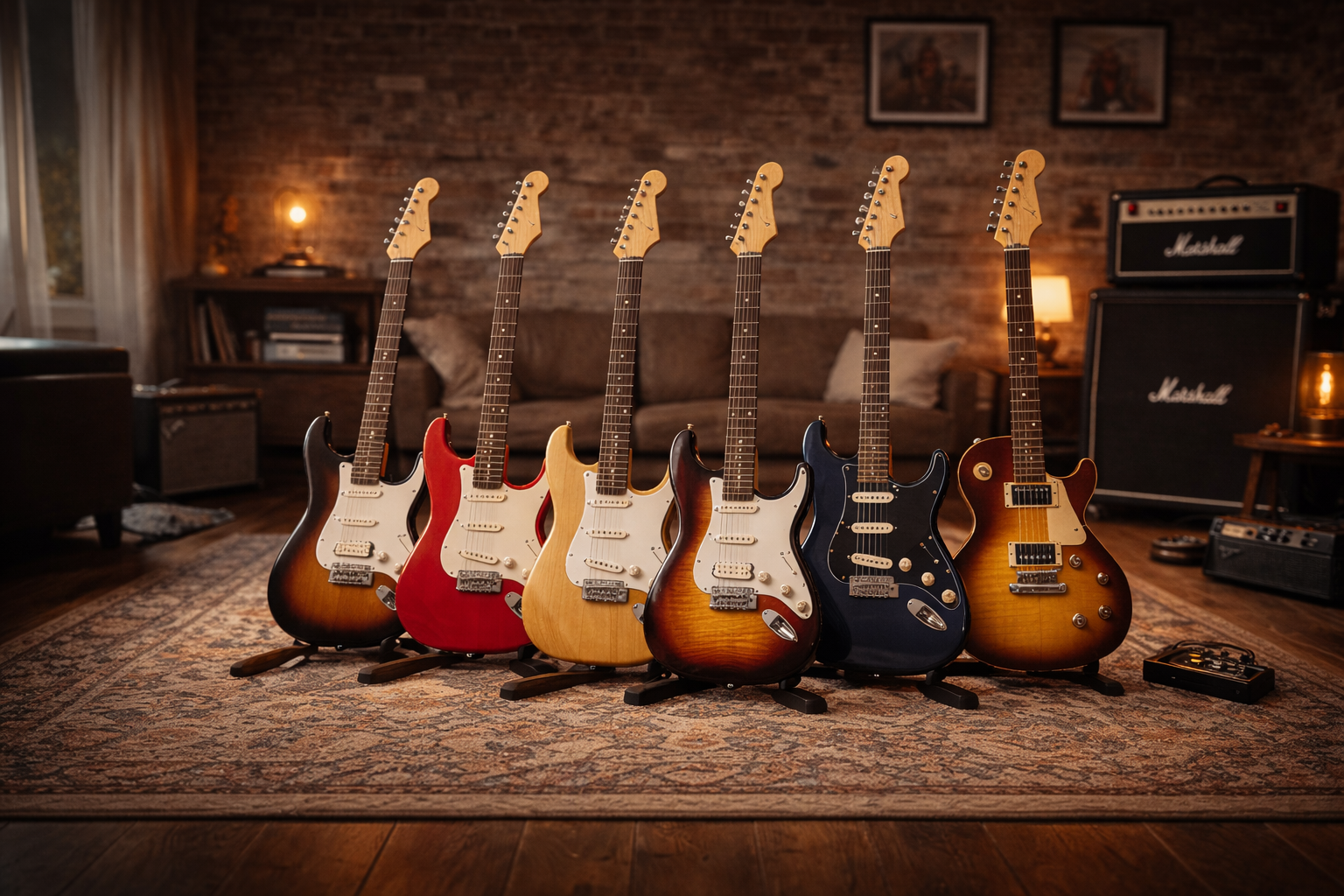
If the picture in your head when you think “electric guitar” is a Strat, the Affinity Stratocaster is probably the cheapest way to get something that actually feels like one without dropping into pure toy territory.
| Best for | Pickups | Home practice fit | Watch out for |
|---|---|---|---|
| Classic Strat feel, clean-to-crunch players | SSS | Great for clean/edge-of-breakup + positions 2/4 | Setup matters; hum under gain is normal |
The body shape is the familiar Strat contour that just works when you’re sitting down. It tucks against your body in a way that makes long practice sessions a lot more comfortable than some sharper shapes.
The neck is a modern C-profile – a fairly safe shape that most players can adapt to quickly. Even if this is your first electric, it usually doesn’t feel strange for very long.
Now, the honest part: Affinity Strats are very sensitive to setup. Out of the box they can be:
- A bit too high in action
- Slightly off on intonation
- A little scratchy on bends in some cases
But with a decent setup (even if it’s just a tech spending half an hour on it), they settle into a surprisingly playable instrument.
The three single-coils give you that familiar Strat palette:
- Neck pickup for glassy, round cleans
- Bridge for brighter, cutting parts
- Positions 2 and 4 for that quacky in-between sound
Who it’s for: You specifically want the look, feel and basic sound of a Strat, you’re planning to stick with cleaner or low-to-medium gain tones, and you’re okay with getting a proper setup done if needed.
3. Squier Affinity Telecaster – Simple, bright and tougher than it looks
The Telecaster is like the no-nonsense cousin of the Strat. Fewer curves, fewer things to tweak, more “shut up and play”.
| Best for | Pickups | Home practice fit | Watch out for |
|---|---|---|---|
| Bright rhythm clarity, simple controls | SS | Great pick attack + chord definition at home volume | Can get sharp with higher gain; EQ matters |
The Affinity Tele sticks close to that spirit. Two single-coils, a three-way switch, one volume, one tone. You don’t need a manual. You plug it in, turn some knobs and you’re making noise in 30 seconds.
The bridge pickup is the star here. It has that bright Tele bite that pushes you forward in the mix. Even through a small 10–20 watt amp at living-room volume, you can still hear the pick attack and chord definition.
Many players also feel like the Affinity Tele is a little more “solid” in the hands than its Strat sibling – something about the slab body and the way it hangs on a strap.
Tone-wise, it lives in the clean to edge-of-breakup world:
- Clean country-ish twang
- Indie and pop rhythms
- Worship and light rock
- Crunchy rhythm tones that still let the chords breathe
With higher gain it can get a bit sharp, but for home volumes and moderate distortion it’s very usable.
Who it’s for: You like simple guitars that don’t try to impress you with a thousand options. You want something that rewards good picking dynamics and touch. Your main world is clean, crunchy or slightly dirty tones – not saturated metal.
4. Ibanez Gio Series (GRX / GRG) – Modern rock and metal without killing your budget
If your Spotify is full of modern rock, hard rock and metal, and you know you’ll spend a lot of time with gain turned up, the Ibanez Gio series makes more sense than forcing yourself into a vintage-style guitar.
| Best for | Pickups | Home practice fit | Watch out for |
|---|---|---|---|
| Modern rock/metal, tighter gain tones | HH / HSH | Less hum + tighter palm-mutes at home volume | Some models’ trem setups can be finicky |
The necks on these are typically slim and fast. Whether you’re doing power chords, palm-muted chugs or faster runs, they’re built to make that kind of playing feel easy. If you’ve ever held a thicker neck and thought “my hand gets tired too fast”, you’ll probably find Gio necks more comfortable.
Pickup layouts are usually HH or HSH. Translation: plenty of humbucker power to keep things tight and controlled under distortion, with some single-coil flavour available on certain models.
The bodies have deep cutaways, so reaching the higher frets for solos doesn’t turn into a yoga pose.
On the clean side, they tend to sound more modern and hi-fi than “vintage blues”. That’s not a bad thing, just a different flavour.
Who it’s for: You mainly listen to rock, hard rock, metal or metalcore. You want tight palm-mutes, chugs and riffs more than you want glassy cleans. You don’t care if the guitar looks “traditional”; you want something that does the job under gain.
5. Jackson JS Series (JS11 / JS22) – Your first “looks like a metal guitar” guitar
The Jackson JS series is what you buy when you want your first guitar to look like the bands you’re listening to, not like the guitars in your dad’s record collection.
| Best for | Pickups | Home practice fit | Watch out for |
|---|---|---|---|
| Heavy riffs, high gain, “metal look” | HH | High-output pickups suit distortion easily | Clean tones aren’t the main appeal |
Pointy headstock, sharper body shapes, big logo. It’s not subtle, and that’s kind of the point.
Under the hood, you usually get:
- High-output humbuckers that hit distortion pedals and amp gain stages hard
- A flatter fingerboard radius that makes bends and faster lines easier to handle
- A very playable neck for heavier styles
Clean tones are… fine. They’re not the reason you buy this. These guitars want gain, and they sound more comfortable there than in softly picked jazz chords.
If your world is heavy riffs, breakdowns, fast alternate picking and big, sustaining leads, a JS model can scratch that itch without forcing you into a “serious mid-price” budget.
Who it’s for: You spend most of your time on the heavy side of things. You want your guitar to look obviously “metal”, and you care more about how it behaves with distorted tones than how it does at sparkling clean.
6. Harley Benton and similar house brands – Specs that look too good for the money
Depending on where you live, you might have access to house brands – Harley Benton is the obvious example in Europe – that can be surprisingly competitive around the $200–300 mark.
| Best for | Pickups | Home practice fit | Watch out for |
|---|---|---|---|
| Max features for minimum money | Varies | Can be incredible value if you get a good one | Consistency varies; return policy is crucial |
On paper, they often look better than big brands at the same price:
- Roasted maple necks on some models
- Modern bridges and locking-style tuners in certain lines
- Coil-splitting options, nicer finishes, etc.
The trade-off is consistency. One guitar can feel great, the next one out of the box might need more work. That doesn’t mean they’re bad, it just means you have to be a little more careful and make sure you understand the return policy before you click “buy”.
Who it’s for: You’re comfortable buying online and sending things back if needed. You enjoy the idea of getting maximum features for minimum money. You don’t panic at the idea of a setup or small tweaks to get everything dialed in.
7. Used market gems – Turning a mid-range guitar into a budget win
The last “option” is not a model, it’s a strategy. If your budget is around $250–300 and you’re patient, the used market can be the difference between “entry level that’s fine” and “mid-range that feels genuinely solid”.
| Best for | Pickups | Home practice fit | Watch out for |
|---|---|---|---|
| Maximum “feel” for the money | Varies | Often higher-tier guitar for the same budget | You must inspect carefully or buy with protection |
When someone buys a $500–600 guitar and then decides guitar isn’t for them, or their style changes, those instruments eventually show up as used deals.
You can often find:
- Mid-tier Yamaha Pacificas
- Squier Classic Vibe models
- Older mid-range Ibanez, LTD or Schecter guitars
- Region-specific brands that have good reputations but not much hype
The key with used is knowing what you’re looking at. You want to check:
- Neck straightness (sight down the neck and look for weird twists)
- Fret buzz all over the neck, not just in one spot
- Obvious hardware issues: bent tuners, cracked saddles, dead pickups
Who it’s for: You’re willing to wait for a good deal instead of buying the first thing on the wall. You’d rather have one better guitar with a bit of history than a brand-new one with more compromises. You don’t mind doing a little homework.
How to choose the right sub-$300 guitar for you
1. Where will you mostly play?
- Bedroom or apartment only
- Shared living room
- Occasional rehearsals or small jams
If you’re mostly at home, comfort, tuning stability and noise levels matter more than whether the guitar could survive a year-long tour. You don’t need something bulletproof, you need something that doesn’t annoy you.
2. What do you actually listen to?
- Blues, pop, classic rock → Pacifica, Affinity Strat, Affinity Tele
- Indie, worship, clean-ish stuff → Affinity Strat/Tele, some Harley Benton models
- Rock, punk, alt rock → Pacifica, Affinity Strat, Ibanez Gio
- Hard rock, metal → Ibanez Gio, Jackson JS, certain Harley Benton models
Matching the guitar to your playlist is more important than matching it to some abstract idea of what a “first guitar” should be.
3. Are you okay upgrading later?
If the idea of swapping pickups or tuners in a year or two doesn’t scare you, you can prioritize: neck feel, fretwork, overall build. If you never want to touch a screwdriver, pay more attention to guitars that have a reputation for decent stock pickups and hardware (and be ready to spend a bit more time choosing).
Don’t waste your money: 60-second pre-buy checklist
- Neck comfort: your hand shouldn’t fight the neck shape.
- Frets: no sharp fret ends; bends shouldn’t feel gritty.
- Tuning stability: after stretching strings, it should survive a practice session.
- Bridge type: if you hate tuning issues, avoid cheap floating trems.
- Return policy: under $300, this matters more than brand names.
If a guitar under $300 passes those tests, it’s no longer “just a cheap guitar”. It’s a tool that lets you focus on your playing instead of on what the guitar can’t do.
FAQ
Is it better to buy new or used under $300?
If you can inspect the guitar (or buy with buyer protection), used can get you a higher-quality instrument for the same money. If you want less hassle, new is simpler—just expect that some budget guitars benefit a lot from a basic setup.
Do I need humbuckers if I play with gain?
Not mandatory, but humbuckers are usually easier under gain: less hum, thicker bridge tone, tighter palm-mutes. If you’re unsure, compare pickup setups: HSS vs SSS vs HH Pickups.
What’s the #1 thing that makes cheap guitars feel cheap?
Usually fretwork and setup. A budget guitar with decent frets and a proper setup can feel shockingly good for the money.
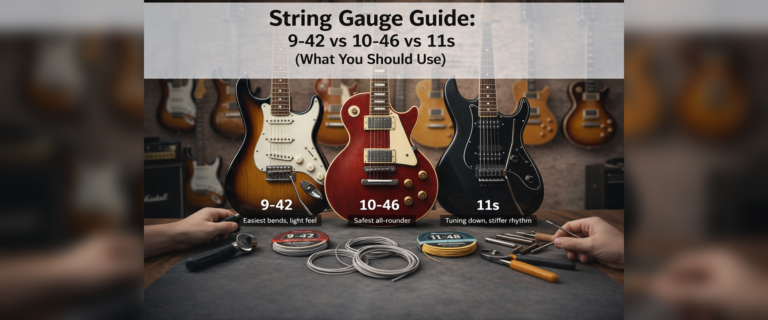
If my guitar feels hard to play, is string gauge the issue?
Sometimes. String gauge affects tension and comfort a lot. If bends feel like a workout or tuning feels unstable, check: String Gauge Guide: 9–42 vs 10–46 vs 11s.