FRFR Guitar Cabinet Explained: Do You Really Need One for Your Modeler?
Picture this: you finally grab an amp modeler, dial in a tone you love on headphones, then plug it into your little combo and everything suddenly sounds smaller and duller. That’s usually when people start talking about getting an FRFR guitar cabinet instead of using a normal amp. Some players swear it’s the only way to “hear your presets properly”, others keep using their regular combos and never miss it, so it’s not obvious which camp you should be in.
I’m in the same position as most readers here: I play mostly at home, test gear for this site, and I’ve run modelers into small practice amps, direct into interfaces, and into dedicated FRFR guitar cabinets. This guide is the honest version of what I wish I’d read earlier: what FRFR really is, what changes when you add an FRFR guitar cab, and when you’re better off staying with a simple amp or monitor setup.
- What an FRFR guitar cabinet actually does in a real rig, not just on paper.
- How it compares to using a regular guitar amp or basic monitors for home and live use.
- Clear criteria for deciding whether you personally need an FRFR guitar cab right now.
| Your situation | Best fit | Deep dive |
|---|---|---|
| Mostly play at home with an amp modeler, headphones and low-volume practice are the priority. | Good headphones or small FRFR speaker; a full FRFR guitar cabinet is optional. |
Bedroom tone guide Budget headphones for guitar practice |
| Play with a band, use a floor modeler and want consistent sound from rehearsal to stage. | Active FRFR guitar cabinet or wedge, fed from your modeler’s main outs. |
Amp sim vs practice amp vs modeler Gain vs volume vs master |
| You don’t own a modeler yet and just want better home tone than your first tiny amp. | Simple practice amp or “smart” modeling combo; skip FRFR cabs for now. |
Best guitar amps under $200 Why guitar sounds bad at low volume |
What is an FRFR guitar cabinet?
“FRFR” stands for full-range, flat-response. An FRFR guitar cabinet is basically a powered speaker. It covers a much wider frequency range than a traditional guitar cab and tries not to color the sound with its own EQ curve. Instead of being part of the tone like a 1×12 or 4×12, an FRFR cab is meant to reproduce whatever comes out of your modeler as accurately as possible.
A regular guitar cab is mid-focused, rolls off the top end, and has its own character baked in. That’s why IRs and cab sims try to imitate it. An FRFR cab is closer to a compact PA speaker with full-bandwidth, tweeter + woofer, often coaxial. When people say “what is an FRFR speaker and why do I need one?” they’re really asking:
- Do I want my modeler to sound like it would through a mic’d guitar cab in front-of-house?
- Or do I prefer the familiar feel and color of a normal amp in the room?
There’s no single correct answer. FRFR is best thought of as a tool: it lets your amp modeler present finished, mic’d tones at any volume, while a guitar cab turns your modeler into more of a traditional amp preamp. If you’re still not sure where a modeler itself fits, the amp simulator vs practice amp vs modeler guide is a good companion read.
How do FRFR speakers work for guitar players?
For most guitarists, the important part isn’t the electronics – it’s how FRFR changes the listening experience. A typical FRFR cabinet or FRFR amp has:
- A power amp section (built-in for active FRFR speakers).
- A full-range speaker system (woofer + tweeter) voiced to be as flat as practical.
- An enclosure designed more like a PA cab or studio monitor than a guitar cab.
- Inputs and outputs (XLR, TRS) aimed at modelers and mixers rather than tube heads.
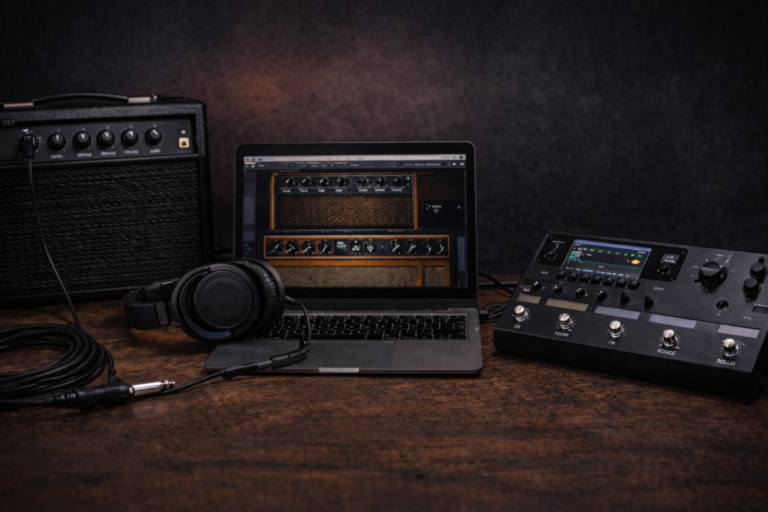
Your modeler becomes the “amp + cab + mic” and the FRFR speaker simply delivers that sound to your ears or the room. This is different from running a modeler into the front of a guitar amp, where the amp’s preamp, tone stack, and cab all reshape the sound. If your current problem is that your tone falls apart at low volume or at home, also check why your guitar sounds bad at home and the guitar EQ cheat sheet – FRFR alone doesn’t fix bad rooms or bad EQ, and good guitar tone amp settings still matter.
Who is an FRFR guitar cabinet actually for?
FRFR isn’t a magic upgrade for everyone. Some players will never need to touch an FRFR cab, others will wonder how they lived without one.
From testing compact modelers like the Harley Benton DNAfx Amp 20 and Hotone Pulze, and smart practice amps like the Positive Grid Spark GO and Blackstar ID:Core 10 V4, a pattern keeps coming up.
When an FRFR guitar cabinet makes sense
- You already own an amp modeler and want your live sound to match your recorded tones.
- You go direct to PA and need a consistent on-stage monitor that doesn’t fight your FOH mix.
- You play in different venues and want your presets to translate between rehearsal room and stage.
- You like hearing “mic’d cab” style tones rather than the colored sound of a traditional guitar cab.
When an FRFR guitar cabinet is probably overkill
- You mostly practice at home on headphones and rarely play loud with a band.
- You don’t own a modeler yet and are still figuring out your basic rig and tone preferences.
- You love the feel of a simple combo amp and don’t want to think about the PA / monitor side of things.
If your main struggle right now is just getting a great sound in a bedroom or living room, focusing on volume, EQ and technique will move the needle faster than buying another box. The bedroom tone guide and guitar buzz quick fixes are good places to start before you decide whether a dedicated FRFR guitar cab is worth it.
Main types of FRFR guitar cabinets and speakers
When players talk about FRFR speakers, they might mean a floor wedge, a vertical cab that looks like a guitar cabinet, or even a compact powered PA speaker. They all aim for the same “full-range, flat-response” goal but behave differently in real rooms.
FRFR guitar cabinet (amp-style box)
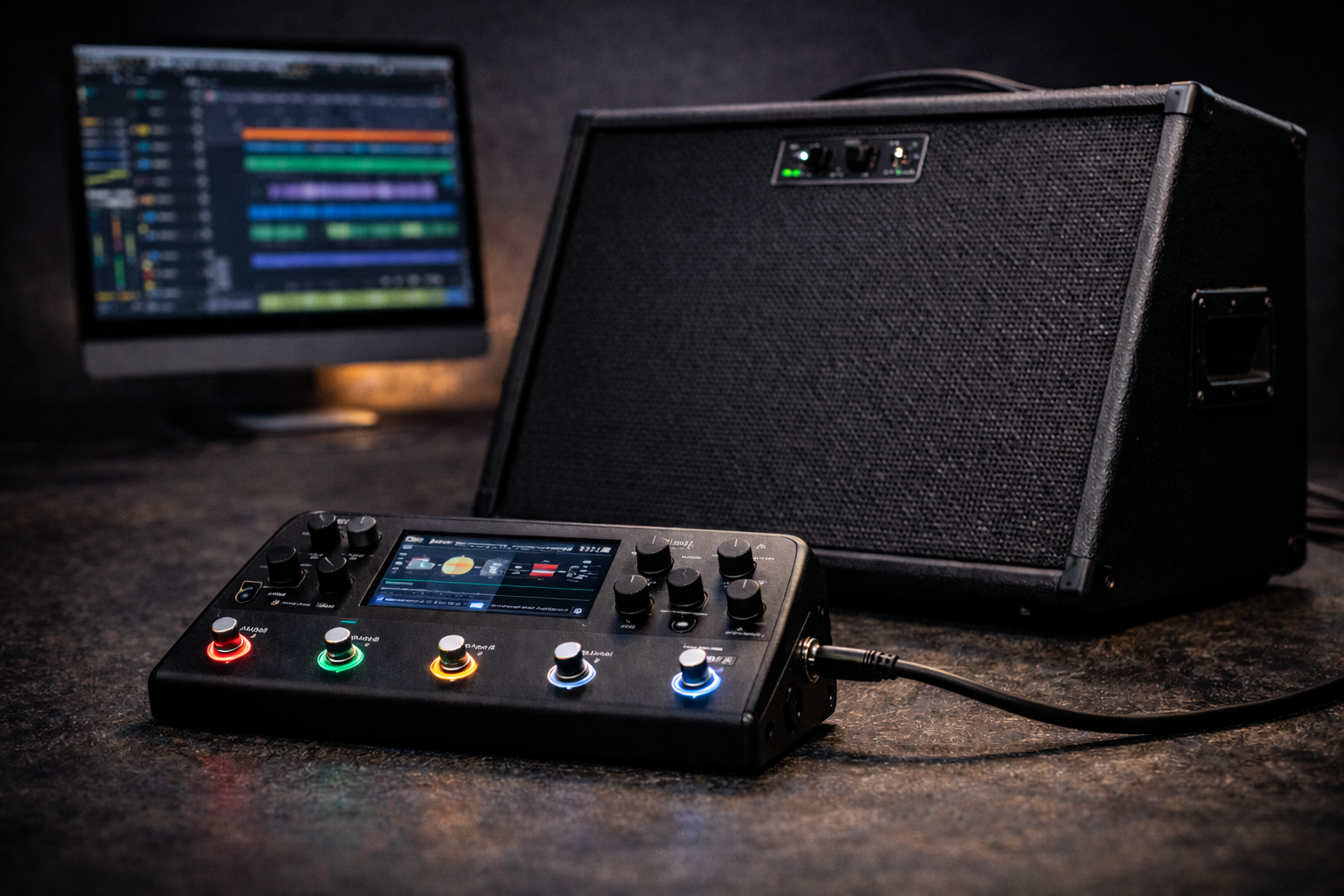
This is the classic FRFR guitar cabinet: it looks like a 1×12 or 2×12 cab, but inside it’s a full-range system with a tweeter and wide frequency response. Some are powered (active), some are passive and need a separate power amp.
- Familiar silhouette on stage; feels “normal” under and behind you.
- Voiced to work specifically with guitar modelers and cab sims.
- Easy swap from a regular cab if you’re used to a backline feel.
If you want a dedicated box for your modeler that still feels like standing in front of a cab, this is the most natural option. It’s also where a lot of “frfr cab vs 2×12” debates happen.
FRFR speakers / wedges
Many players simply use standard FRFR speakers or wedges – essentially compact PA speakers. These can be set as floor monitors or on stands, and don’t pretend to be guitar cabs physically.
- Very flexible: can double as vocal / PA speakers at small gigs.
- Often the most “honest” representation of your presets.
- Good choice if you already own a small PA or do your own sound.
For players searching “FRFR speakers for guitar” or “FRFR speakers vs guitar amp”, this is usually what they’re looking at – a general-purpose powered speaker that works well with a modeler.
Small FRFR speaker for home and practice
Not everyone needs a big 1×12 cab. A small FRFR speaker can be enough for bedroom levels, recording, and occasional jams, especially when paired with headphones.
- Takes less space than a full FRFR cabinet or big combo.
- Can sit on a desk or stand near ear level for better clarity.
- Usually cheaper and easier to move around.
If you mostly play at home and just want your modeler to sound like your recorded tones, the “small FRFR speaker + headphones” combo is often more practical than jumping straight to a big FRFR guitar cabinet.
Real-world tones: FRFR vs guitar amp feel
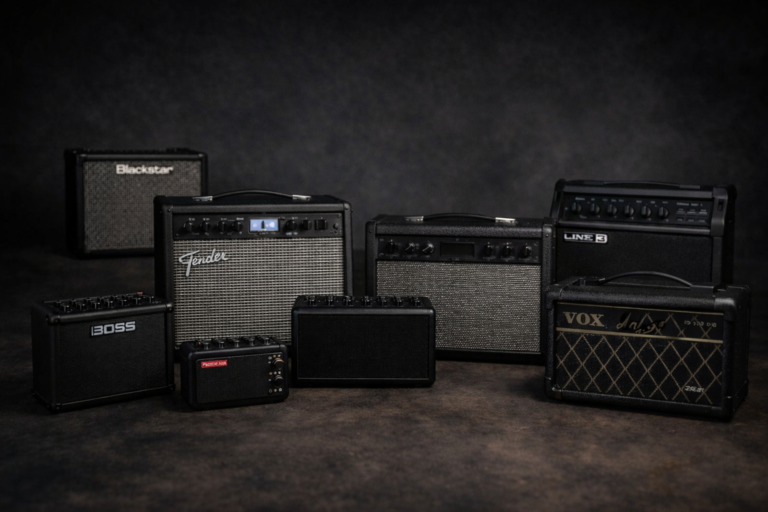
An FRFR cab doesn’t magically give you better tone, but it does change how your modeler’s presets translate between home, rehearsal and stage. Instead of hearing “amp in the room”, you’re hearing something closer to a miked cab in a mix. That can feel strange at first, especially if you grew up on small amps like the Boss Katana Mini, Line 6 Spider V 20 MkII or Vox Pathfinder 10.
Clean and edge-of-breakup tones
For clean and edge-of-breakup sounds, FRFR can actually make life easier: what you hear through your FRFR guitar cabinet is very close to what will appear on a recording or front-of-house mix. You can dial in subtle compression, reverb and delay knowing that you’re hearing roughly what the audience will hear.
If you’re chasing chimey, articulate cleans like the sounds in the John Mayer or David Gilmour tone guides, FRFR lets you hear the top end more clearly than many traditional cabs. Just remember that bright IRs and string choice also matter – the guides on guitar string gauges and pickup configurations still apply.
Crunch and classic rock
For crunch and classic rock, FRFR will feel a bit tighter and more controlled than a traditional cab. You’ll hear more of the exact IR and less of the room. The recipe is similar to what you might use with a real amp:
- Use a medium-gain amp model rather than the filthiest option.
- Put an overdrive in front for bite, like in the overdrive pedal explained guide.
- Shape the mids and presence so the sound sits in a mix, not just alone in the room.
If you like the way classic tones like Eddie Van Halen’s amp settings interact with a band, FRFR helps you get closer to that “finished” tone at more reasonable volumes.
High gain and metal
High-gain players searching for the “best FRFR guitar cab for metal” are usually trying to solve one of two problems: either their modeler sounds fizzy and harsh through studio monitors, or their regular amp’s cab is fighting the cab sims. In both cases, a good FRFR cabinet plus carefully chosen IRs can tighten things up.
- Use a tube-style overdrive in front to tighten the low end.
- Pick IRs that are darker than you expect; FRFR cabs reveal fizz quickly.
- Use a noise gate and pay attention to pick attack and palm-mute consistency.
If you’re already comfortable with stacking pedals (see overdrive vs distortion vs fuzz and distortion pedal basics), those same principles carry over to your modeler + FRFR setup.
How an FRFR guitar cabinet fits into your rig
Before spending money, it’s worth deciding where the FRFR box would actually live in your signal chain and what problem it’s supposed to solve: home practice, band rehearsals, recording, or all of the above.
Home and headphone practice
For pure home use, a full-size FRFR cabinet is rarely mandatory. Many players are happiest with:
- A modeler into headphones for late-night practice.
- A small FRFR speaker or studio monitors at low volume.
- A simple preset system so tones are repeatable day to day.
If you’re mostly at home, putting your budget into a good modeler and headphones often beats dropping it all on a cab. The guide on budget guitar headphones pairs well with this approach.
Rehearsals and live use
For band use, an FRFR guitar cabinet or wedge really starts to shine. Your modeler’s “main outs” can feed:
- A powered FRFR guitar cab behind you as your personal monitor.
- The PA, with your FRFR acting as a side fill or backup.
- A venue’s own FRFR speakers if backline is provided.
This “virtual amp + FRFR monitor” setup is different from a regular amp but can be more consistent from gig to gig. If you’re moving from small practice amps into this territory, the sim vs practice amp vs modeler article explains the bigger picture.
Alternatives to a full FRFR guitar cabinet
The good news: you don’t have to buy an FRFR cab to use a modeler. Common alternatives include:
- Running into the effects return of a clean combo amp.
- Going straight to an audio interface and using studio monitors.
- Headphone-only rigs, especially for late-night practice.
Smart practice amps like the Spark GO, Fender Mustang LT25 or ID:Core 10 V4 already blend modeling and speaker design in a closed box. For many home players, these are a better first step than jumping straight into the FRFR world.
When an FRFR guitar cabinet is overkill
It’s completely valid to decide that an FRFR rig isn’t for you, at least right now. You might be happier with:
- One good practice amp you really learn to dial in.
- A simple interface + amp sim plugin setup for recording.
- A small pedalboard into a clean amp if you love knobs and simplicity.
If you’re still working through the basics – chord changes, rhythm, timing – gear probably isn’t your bottleneck. The beginner guitar checklist, best electric guitars for beginners and electric guitars under $300 will help you assemble a sensible starter rig long before you need to think about FRFR.
Summary: should you buy an FRFR guitar cabinet?
An FRFR cabinet is worth considering if you:
- Rely on an amp modeler as your main rig.
- Play with a band or go direct to PA regularly.
- Want your monitor sound to match what the audience hears.
- Prefer the clarity of mic’d-style tones over the color of a traditional cab.
It’s probably not a priority if you:
- Mostly practice at home on headphones or at very low volume.
- Don’t own a modeler yet and are still exploring basic rigs.
- Love the simplicity of a small combo amp and a few pedals.
If your main issue is just that your guitar sounds bad at home, start with why your guitar sounds bad at home, the bedroom tone guide and the gain vs volume vs master article. Once you understand how volume, EQ and room acoustics affect your tone, you’ll know much more clearly whether an FRFR guitar cabinet, a regular amp, or just a smarter setup is the right next move.
FRFR guitar cabinet FAQ
What is an FRFR speaker for guitar?
An FRFR speaker is a full-range, flat-response powered cabinet designed to reproduce the sound of your amp modeler as accurately as possible. Instead of coloring the tone like a traditional guitar cab, it aims to deliver the sound of your chosen amp, cab and mic simulation at any volume.
What does FRFR mean in guitar terms?
In guitar terms, “FRFR” means a speaker that covers a wide frequency range with a relatively flat EQ curve, so you hear the sound of your modeler or amp sim rather than the strong mid hump and roll-offs of a normal guitar cab. It’s closer to a PA speaker or studio monitor than a 4×12.
Do I need an FRFR guitar cabinet for my amp modeler?
Not necessarily. You can use a modeler with headphones, studio monitors, a regular guitar amp (via the effects return), or straight to an audio interface. An FRFR guitar cabinet becomes more useful once you’re playing with a band, going direct to PA, and want your presets to sound consistent everywhere.
Can I use an FRFR speaker instead of a guitar amp?
Yes – as long as you have a modeler or amp sim providing the amp and cab tones. On its own, an FRFR cab is just a neutral powered speaker. With a good modeler, it can replace a traditional amp on stage or in rehearsal, but the feel and sound will be closer to a miked cab than an “amp in the room”.