Harley Benton DNAFX AmP20 Review – Budget 20W Modeling Combo with Bluetooth
This Harley Benton DNAFX AmP20 review is for players who want a modern practice amp with modeling, effects and Bluetooth, but do not want to pay Fender, Line 6 or Positive Grid money. The DNAFX AmP20 is a 20-watt Class-D combo with a single 8″ full-range speaker, eight amp voices, built-in DSP effects, Bluetooth audio, a tuner and six user presets you can recall with an optional footswitch. It borrows its sound engine from Harley Benton’s DNAfx pedals and puts it into a small, desk-friendly box that is clearly meant for home and rehearsal-room life.
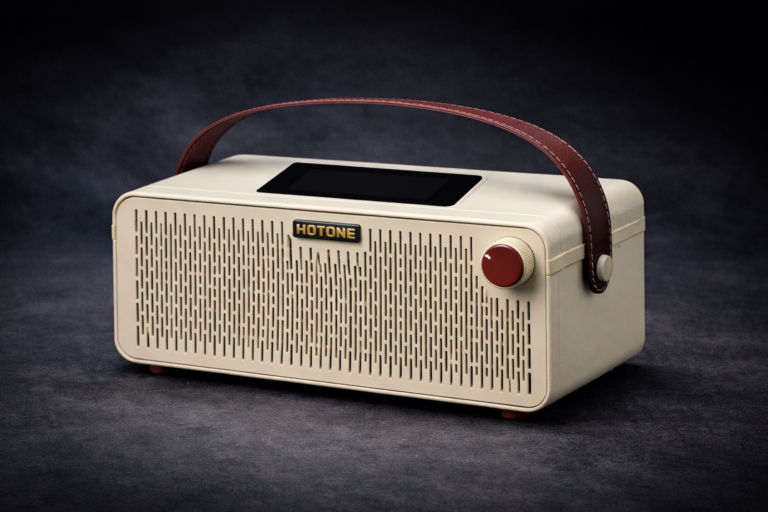
Price-wise it sits under a lot of brand-name modeling amps. In the same “small digital practice amp” lane you have the Fender Mustang LT25, stereo rigs such as the Blackstar ID:Core 10 V4, and smart desktop amps like the Hotone Pulze. The DNAFX AmP20’s pitch is simple: keep the interface old-school and knob-based, but give you enough amp types and effects that you do not immediately outgrow it.
Quick Specs
- Power: 20 watts Class-D
- Speaker: 1 x 8″ full-range driver
- Amp voices: 8 (from clean and country to brown, ultra and metal)
- Presets: 6 user memories, recallable with optional FSL-1 footswitch
- Effects: chorus, flanger, phaser, tremolo, spring reverb, delay, delay+reverb, roomier reverb
- Controls: Drive, Bass, Middle, Treble, Master, effect level/type, preset buttons, tap/tuner
- Connectivity: 1/4″ input, Bluetooth audio, aux in, headphone out, footswitch jack
- No USB audio, no FX loop, no external speaker out
- Approx. size/weight: around 33 × 34.6 × 20.2 cm, about 6 kg
On paper it reads like a “do most things” home amp: loud enough for a bedroom or rehearsal room, small enough for a desk, and full of features you normally have to buy a separate multi-FX for.
Design & Build
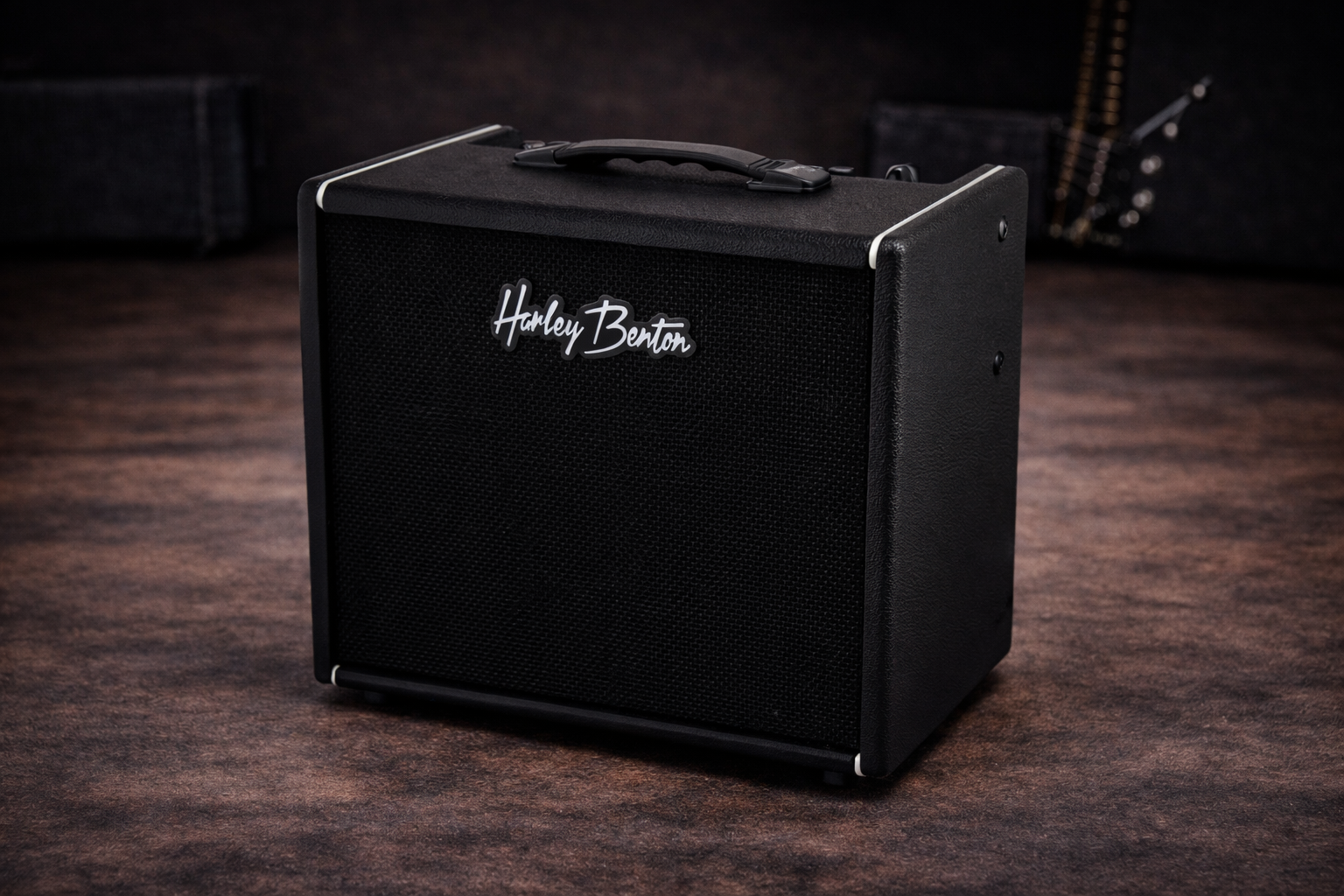
Visually the DNAFX AmP20 is modern and anonymous in a good way: black box, metal grille, simple top panel. It does not try to look vintage; it looks like a small piece of gear that lives happily next to a laptop or audio interface. At roughly 6 kg it is easy to carry with one hand, but the cabinet and grille feel more solid than typical tiny plastic practice amps.
The control layout is simple even if you have never used a modeling amp. Left to right you get Drive, a proper three-band EQ, Master Volume, then the effects and preset section. Amp voice and effect type are chosen with knobs and buttons and indicated by LEDs; there is no screen, no deep menu. All the I/O you actually touch (input, phones, aux) is on the front, so it works well on a desk where the back is against the wall.
Harley Benton DNAFX AmP20 Review: Amp Voices & Gain Range
The eight amp voices are arranged from low to high gain: Clean, Country, Blues, Rock, Lead, Brown, Ultra and Metal. The basic idea is obvious – you scroll until the guitar starts doing what you want – but the important part is how they behave at home volume.
The low-gain side (Clean, Country, Blues) is where the amp feels most natural. Clean and Country are bright and snappy; with the Drive control below noon and Bass around 11 o’clock you get a workable funk/pop clean that cuts without taking your head off. Blues and Rock add the familiar midrange push for classic rock and indie rhythm. They respond reasonably well to your volume knob, so you can ride from edge-of-breakup to crunchy chords without changing presets.
Lead, Brown, Ultra and Metal pile on more saturation. For tight modern rock and lighter metal rhythm the tones are totally usable, especially with the Master kept sensible and the Bass pulled back a bit so the 8″ speaker does not flub out. If you are expecting “half-stack in a room” low-end, you will obviously not get that from a single 8″, but for bedroom chugs and solo practice it holds together better than a lot of cheap practice amps.
Effects, Tap Tempo & Tuner
Effects are split into two blocks: modulation (chorus, flanger, phaser, tremolo) and ambience (spring reverb, straight delay, delay + reverb and a bigger room-style reverb). You are not swimming in parameters, but you can get from “totally dry” to “90s clean with chorus and delay” very quickly.
For everyday practice the effects do exactly what you need: chorus and tremolo work nicely with the mid-gain Blues/Rock voices, and the spring reverb setting adds just enough space to keep everything from sounding bone-dry. Delay plus tap tempo is handy for solos; you tap in roughly the song tempo and play – no menu diving, no app.
The built-in tuner lives on the same tap/tuner control. It is fine for “quickly get in tune and play”, but it is not as fast or precise as a dedicated clip-on or pedal. Most players will still keep a separate tuner around, but it is good to have a backup on the amp itself.
Bluetooth, Backing Tracks & Presets
Bluetooth audio is one of the big quality-of-life features here. Pair your phone, start a playlist, backing track or YouTube lesson, and the amp becomes your little full-range monitor. You can also connect a device with a cable via the aux in if you prefer. The headphone out mutes the speaker, so late-night practice with backing tracks is easy: guitar in, Bluetooth backing, headphones out, neighbours safe.
The preset system stores six of your own sounds – amp voice, gain, EQ and effect settings. On the amp you switch with buttons; with the optional Harley Benton FSL-1 footswitch you can recall them from the floor, which is great for simple verse/chorus/lead changes at rehearsal. For a budget combo that is already doing amps and effects, having footswitchable memories is a nice extra.
What you do not get is a USB interface or companion app. Everything you can do lives on the panel. If you like the idea of programming patches on a laptop or phone, this will feel limited; if you just want to turn knobs and play, it is refreshing.
At Home: Volume, Feel & Everyday Use
For typical home use the DNAFX AmP20 lands in a good spot. Twenty Class-D watts into an 8″ speaker is more than enough for a bedroom or living room; you are rarely past halfway on the Master. The full-range speaker plus internal cab sims give the amp a more “monitor-like” sound than an old-school 8″ guitar speaker – tighter, a bit more hi-fi, and less “woofy” if you keep the Bass under control.
It is not a gig amp. Against a loud drummer the 8″ speaker and 20 watts will hit a wall pretty fast. But for writing, practising to tracks and small jams with another guitarist or an electronic drum kit, it is totally workable. The footprint is small enough that you can park it on a sturdy desk and leave it permanently hooked up for “grab guitar, hit power, play for 15 minutes” sessions.
Who Is the Harley Benton DNAFX AmP20 For?
The DNAFX AmP20 makes the most sense if you:
- Want a cheap but flexible practice amp with multiple amp voices and built-in effects.
- Mostly play at home and care about Bluetooth play-along and headphone practice.
- Prefer physical knobs and LEDs over deep app menus.
- Like the idea of saving a handful of go-to presets and (optionally) switching them via footswitch.
It is not ideal if USB recording, stereo ambience or app-level editing is non-negotiable. In that case a modeling combo like the Fender Mustang LT25 or a stereo desktop amp such as the Blackstar ID:Core 10 V4 – or a more app-centric smart amp like the Hotone Pulze – will take you further.
Pros & Cons
Pros
- Very affordable for a 20W modeling combo with 8 amp voices, effects and Bluetooth.
- Real three-band EQ and simple front panel – easy to understand even for beginners.
- Six user presets plus optional footswitch support make it more gig- and rehearsal-friendly than many budget amps.
- Bluetooth and aux in make playing along with backing tracks effortless.
- Compact and light enough to move around the house without thinking about it.
Cons
- No USB audio interface or editor app – everything is done from the knobs.
- 8″ FRFR-style speaker can sound a bit boxy if you push heavy low end.
- Built-in tuner and Bluetooth are functional but not as slick as higher-priced competitors.
- No FX loop, no external speaker output if you want to expand the rig later.
Verdict: Is the Harley Benton DNAFX AmP20 Worth It?
From a Harley Benton DNAFX AmP20 review point of view, the question is not “does it beat a high-end smart amp?”. It obviously does not. The real question is whether it gives you enough tone and flexibility to practice seriously without spending much – and on that front it does well.
You get a usable spread of amp voices, enough effects to keep things interesting, Bluetooth for backing tracks, a headphone out for late-night sessions and six presets you can flip through like a very simple multi-FX. If you can live without USB and deep app control, it is a lot of practice amp for the money.
For beginners it is a solid first “all-in-one” – you plug in, try different amp types, add a bit of chorus or delay and figure out what you like. For more experienced players it works as a throw-around practice box that you will not be scared to leave at a rehearsal space, office or spare room but that still feels modern enough to be fun.
Harley Benton DNAFX AmP20 FAQ
Is the Harley Benton DNAFX AmP20 loud enough for band practice?
Not really. Twenty watts into a single 8″ full-range speaker is great for bedrooms, living rooms and small jams with controlled volume, but it will struggle against a loud acoustic drum kit. Treat it as a practice and small-room amp.
Can I record directly over USB with the DNAFX AmP20?
No. There is no USB audio interface. To record you either mic the speaker or run the headphone out into an external audio interface.
Can I change presets with a footswitch?
Yes. The amp has a dedicated footswitch jack and works with Harley Benton’s DNAFX AmP FSL-1 footswitch, which lets you step through the six user presets from the floor.
Does the DNAFX AmP20 have an effects loop or extension speaker output?
No. There is no FX loop and no output for an external cabinet. All pedals go in front of the amp, and you are limited to the built-in 8″ speaker or the headphone out.
Is the Harley Benton DNAFX AmP20 good for beginners?
Yes. The price is low, the layout is clear, and the eight amp voices plus effects cover most basic styles. Bluetooth backing tracks and headphones make it beginner-friendly in flats and shared houses, where volume is always a problem.