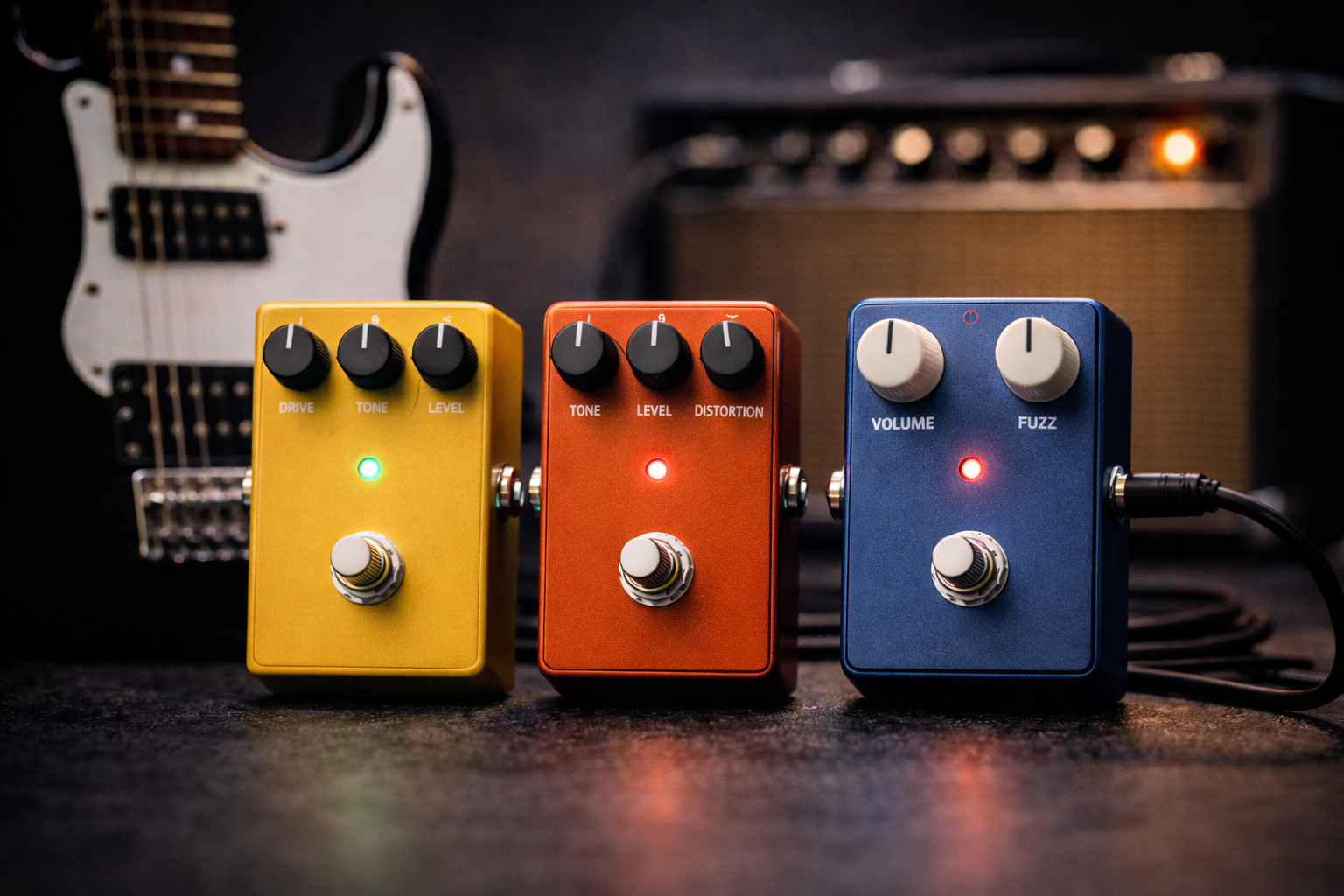
Overdrive vs Distortion vs Fuzz: Gain Pedals Explained for Electric Guitar
If you’ve ever tried to pick your first gain pedal and ended up with ten tabs open about overdrive, distortion and fuzz, you’re not alone. They all add drive and sustain, but the way they react under your fingers can be completely different at home volume.
This guide breaks down overdrive vs distortion vs fuzz in plain language: what each type really does, how it behaves with different amps and pickups, and how to choose the one that actually fits your rig instead of buying everything “just in case”.
If you only want the short version: overdrive feels like a pushed amp, distortion is tighter and more compressed, and fuzz is the wild, saturated sustain machine. The rest of the article shows where each one shines and where it will just turn into noise or mud.
One-sentence shortcut: start with overdrive for rock/blues/indie, distortion for heavier riffs, and add fuzz later as a texture pedal once your core sound is under control.
Overdrive vs distortion vs fuzz at a glance
Here’s the clean snapshot before we get nerdy. This table is based on how the pedals actually feel on electric guitar at realistic home volume, and it’s the fastest way to compare overdrive vs distortion vs fuzz in one place.
| Pedal type | How it feels | Best for | Beginner watch-out |
|---|---|---|---|
| Overdrive | Like your amp being pushed; responsive to picking and guitar volume | Rock, blues, indie, edge-of-breakup rhythm, “always-on” tone | Too much drive at home volume turns fizzy and tiring |
| Distortion | More gain and compression; tighter and more aggressive | Heavier rock, metal, saturated leads, tight palm-mute riffs | Stacked gain can get muddy and noisy very fast |
| Fuzz | Broken, saturated, sometimes glitchy; huge sustain and texture | Big sustaining leads, walls of sound, vintage or experimental tones | Very sensitive to pickups, volume, and pedal order; easy to lose clarity |
Overdrive: pushed amp feel and flexible crunch
Overdrive is the most “amp-like” of the three. A good overdrive pedal feels like your clean or edge-of-breakup amp being pushed harder – with more grit, but without completely flattening your dynamics.
If your main question is overdrive vs distortion, think of overdrive as the choice when you still want your picking and volume knob to matter. In most overdrive pedal vs distortion pedal comparisons, this is the real difference players feel at home volume.
What overdrive feels like
- Cleans up when you roll back your guitar volume.
- Still responds to picking dynamics (soft vs hard picking).
- Stacks well with amps that already have a little breakup.
Deep dive if you want it: if you want a full setup guide with tables and starter settings, use the dedicated breakdown: overdrive pedal explained.
When overdrive makes more sense than distortion or fuzz
- You mostly play rock, blues, indie, worship, or edge-of-breakup rhythm.
- You like using the guitar volume to go from cleanish to crunch.
- You want an “always-on” pedal that just makes everything feel nicer.
Distortion: tighter saturation and focused aggression
Distortion pushes clipping harder and usually filters the signal more aggressively. Compared with overdrive vs distortion, distortion aims for a more controlled, consistent wall of gain – especially useful if your amp is clean and you need the pedal to do the heavy lifting.
It’s the pedal people think of when they imagine tight palm-mutes, big rock choruses, and saturated leads that don’t rely on cranked tube amps. For many home players, this is where electric guitar overdrive vs distortion turns into a practical decision rather than theory.
What distortion feels like
- More sustain and compression than overdrive.
- Tighter, more focused low end (depending on the pedal).
- Less sensitive to small picking changes, more about consistent aggression.
Want the full distortion playbook? Use the main distortion guide with gain/EQ tables and troubleshooting tips: distortion pedal explained.
When distortion makes more sense than overdrive or fuzz
- You mainly want heavier riffs and modern rock/metal rhythm.
- You want leads that feel more compressed and “liquid”.
- Your amp is fairly clean and you need the pedal to do more of the heavy lifting.
Fuzz: extreme clipping, sustain, and texture
Fuzz is what happens when clipping stops pretending to be an amp. On the overdrive vs distortion vs fuzz spectrum, fuzz sits at the “we’re breaking the circuit on purpose” end.
It can sound like a huge, singing sustain machine or a swarm of angry bees – often depending on small changes in pickup choice, volume knob position, and pedal order. This is why fuzz usually isn’t the first answer when people ask about overdrive vs distortion pedal differences; it’s a different game.
What fuzz feels like
- Very soft pick attacks can bloom into big sustain.
- Rolling your guitar volume back can radically change the tone.
- Placement in the chain (often first) makes a big difference.
If you’re fuzz-curious: there’s a separate, practical breakdown that goes deeper into circuits, pickups, and order: how does a fuzz pedal work?
When fuzz makes more sense than overdrive or distortion
- You love big sustaining leads, psych/stoner/shoegaze walls of sound, or vintage tones.
- You enjoy “playing the volume knob” and don’t mind a wilder feel.
- You already have a solid overdrive or distortion and want a different flavor, not “more of the same”.
How to choose between overdrive, distortion, and fuzz for your rig
Instead of thinking “which is best?”, match the pedal type to your amp, volume, and music. Use this as a quick decision flow whenever you’re stuck on overdrive vs distortion vs fuzz.
1) Start with your amp and volume
- Clean practice amp or modeler at low volume: distortion usually covers more ground; overdrive can feel too subtle unless you stack it.
- Edge-of-breakup tube amp: overdrive shines, distortion can feel like too much, and fuzz depends heavily on placement.
- Already-high-gain amp: often you want overdrive as a tightening boost rather than more distortion.
2) Match the pedal to your main style
- Rock / blues / indie: overdrive first, then consider fuzz for texture.
- Modern rock / metal: distortion first; later add overdrive as a boost or fuzz for specialty sounds.
- Experimental / psych / shoegaze: fuzz plus a flexible overdrive is often the most fun pair.
3) Think about how much control you want from your hands
- Maximum dynamics + volume knob control: overdrive.
- Consistent, tight saturation: distortion.
- Extreme texture and interaction: fuzz.
Starter settings (one table for all three)
These are realistic starting points for a typical home rig: solid-state practice amp, small tube combo, or modeler into monitors/headphones. They work whether you’re testing overdrive pedal vs distortion pedal side by side or dropping fuzz into an existing board.
| Preset | Rig | Pedal type | Gain | Tone / EQ | Level |
|---|---|---|---|---|---|
| A | Clean amp, single-coils | Overdrive | Low → mid (stop before chords blur) | Middle → slightly brighter | Unity or small lift |
| B | Clean amp, humbuckers | Distortion | Low → mid (tight palm-mutes first) | Slightly darker (avoid fizz) | Slightly above unity |
| C | Edge-of-breakup amp | Overdrive or fuzz | Low (amp already has grit) | Conservative highs; keep low end tight | Just enough lift to feel exciting |
Quick reality check: if your tone is messy, reduce gain first. If it’s harsh, soften the top end. If it’s thin, match levels before adding more gain.
Can you stack overdrive, distortion, and fuzz?
Yes – but stacking is where many home tones fall apart. A few simple rules keep overdrive vs distortion vs fuzz stacks under control.
Simple stacking rules
- Most common: overdrive → distortion. Use overdrive as a low-gain boost into distortion for tighter, more focused saturation.
- Fuzz likes to see the guitar: many fuzzes behave best first in the chain, before buffers and some wah pedals.
- One “main” gain stage at a time: for most home rigs, let one pedal do the heavy lifting and keep the others in low-gain support roles.
Stacking sanity check: if you can’t tell which pedal is doing what, you’re probably using too much gain or too many stages at once.
FAQ
Is overdrive and distortion the same?
Technically they both create distortion (clipping), but they’re voiced differently. Overdrive usually aims to imitate a pushed amp, keeping more dynamics; distortion often goes for a more saturated, compressed sound that feels less “amp-like”. That’s the real core of the guitar overdrive vs distortion debate.
What is the difference between overdrive and distortion pedals?
In a typical overdrive vs distortion pedal comparison at home volume, overdrive keeps more of your picking and volume knob dynamics, while distortion gives you a thicker, more compressed wall of gain. Both can work on the same amp; the question is whether you want your hands to control the transition or let the pedal do most of the work.
Is fuzz just more distortion?
Fuzz is usually a different style of clipping altogether. Many classic fuzz circuits use transistors in ways that push the signal into extreme, often unstable distortion. The result is a different attack, feel, and clean-up behavior compared with typical distortion pedals.
Which pedal should beginners buy first?
If you’re completely new, overdrive is usually the safest first pedal because it works across more styles and teaches you a lot about dynamics. If you mainly play metal or heavy rock, a good distortion pedal might be the better first-gain move. Fuzz is best treated as a second or third flavor once you know what you like.
Can I use overdrive, distortion, and fuzz with modelers or amp sims?
Yes. Many players run real gain pedals into a clean or edge-of-breakup modeler patch. Just keep overall gain sensible and avoid stacking too many bright settings, or you’ll end up with fizz instead of clarity.
About this guide
- Who it’s for: home and small-room players comparing overdrive vs distortion vs fuzz for electric guitar and trying to build a first gain pedal chain that actually makes sense.
- How it’s built: real-world feel (dynamics, sustain, noise) first, then simple starter settings and decision rules you can test at home volume.
- What it’s not: a brand ranking or a “buy ten pedals” shopping list. The goal is to help you choose one or two gain pedals you’ll actually use.
- Last updated: 2026-01-02