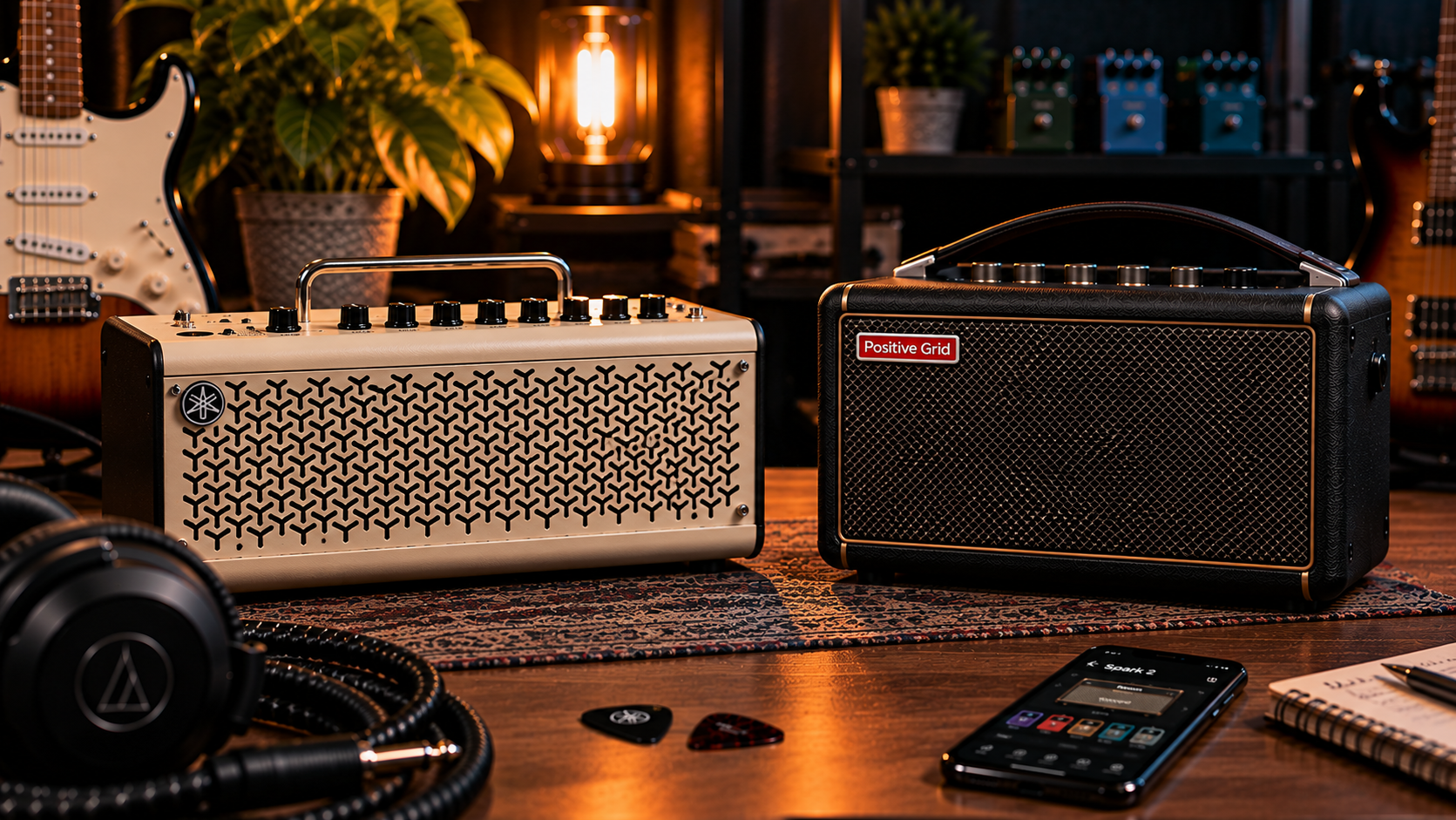
Yamaha THR10II vs Spark 2: Which Is Better for Home Practice?
The Yamaha THR10II vs Spark 2 comparison looks simple until you actually think about how these amps are meant to be used. Both are compact stereo modeling amps aimed at home players. Both handle Bluetooth audio, headphones and USB recording. Both can cover clean, crunch and high-gain tones without a traditional pedalboard.
But they solve the home-practice problem in very different ways. The THR10II is built around simplicity, low-volume sound and a front panel that still feels like an amp. Spark 2 is built around a larger practice ecosystem: a built-in looper, app tools, ToneCloud, Spark AI, more models and optional battery power. If you are choosing between them, the right question is not which one has more features. It is which workflow you are actually going to enjoy six months from now.
Quick Verdict: Yamaha THR10II or Spark 2?
Choose the Yamaha THR10II if you want a compact desktop amp that feels finished without depending on an app. Its physical controls, five memories and stereo low-volume design make it easier to treat like a normal amp that happens to be very good at home.
Choose the Positive Grid Spark 2 if you want the amp to do more than produce guitar tone. The 60-second looper, eight hardware presets, 33 amp models, 43 effects, Smart Jam, Auto Chords, ToneCloud and optional battery make it the stronger all-in-one practice platform.
For pure simplicity, THR10II has the cleaner workflow. For features and structured practice, Spark 2 does more.
Yamaha THR10II vs Spark 2: Key Differences
| Feature | Yamaha THR10II | Positive Grid Spark 2 |
|---|---|---|
| Power | 20W stereo | 50W RMS stereo |
| Speakers | 2 × 3.1-inch full-range | 2 × 4-inch full-range |
| Guitar amp models | 15 total with THR Remote | 33 total |
| Effects | Core modulation, delay, reverb, compressor and gate | 43 effects |
| Hardware presets | 5 user memories | 8 presets |
| Looper | No | Yes, up to 60 seconds |
| Bluetooth | Audio/MIDI | Bluetooth 5.0 |
| USB recording | Yes | Yes, 24-bit/44.1 kHz |
| Battery | No on standard THR10II | Optional Spark Battery |
| App dependency | Low after setup | Higher if using full feature set |
| Best for | Simple low-volume desktop use | Feature-rich home practice |
| Practice tools | Basic playback and presets | Looper, Smart Jam, Auto Chords, ToneCloud, Spark AI |
| App dependence | Low after setup | Moderate to high for the full experience |
| Traditional amp feel | Low; polished stereo desktop presentation | Low; full-range stereo smart-amp presentation |
| Value proposition | Pay for simplicity and low-volume refinement | Pay for a broader practice ecosystem and more features |
Specifications were checked against Yamaha’s official THR-II specifications and Positive Grid’s official Spark 2 specifications. Yamaha confirms 15 guitar amp models on the THR10II when the app is included, while Positive Grid lists 33 amp models, 43 effects and a built-in looper for Spark 2. The raw feature advantage belongs to Spark 2; the workflow advantage depends on whether those extra tools matter to you.
For the wider category context, compare both models in our best desktop guitar amps guide. If the real problem is that every amp sounds disappointing quietly, start with our low-volume guitar tone guide before changing hardware.
Yamaha THR10II vs Spark 2 Sound at Low Volume
The THR10II is fundamentally designed around close-range listening. Its two small full-range speakers and Yamaha’s stereo processing create a polished, wide presentation at desk distance. That is the core reason the THR line still feels distinct from normal small combos.
Spark 2 also uses a stereo full-range design, but it brings more amplifier power and larger 4-inch drivers. That gives it more headroom and a bigger sense of scale in a room. Positive Grid also uses Sonic IQ processing for bass enhancement, stereo widening and dynamic control.
Neither amp feels like a 1×12 guitar combo. Both are closer to compact full-range playback systems with guitar modeling built in. If you want actual guitar-speaker push, the Boss Katana 50 Gen 3 is a more relevant comparison.
Which feels better quietly?
The THR10II has the stronger case if your normal session happens at conversation level and you want to adjust tone from the front panel. Spark 2 can also sound convincing quietly, but more of its appeal comes from the entire practice ecosystem around the sound.
Controls and App Workflow: THR10II Is More Amp-First
The THR10II gives you gain, master, three-band EQ, modulation, delay/reverb, separate guitar and audio volumes, plus five memory buttons. Once your sounds are saved, you can largely ignore THR Remote.
Spark 2 also improved hardware independence compared with earlier Spark models. Eight onboard presets, physical amp controls and dedicated looper buttons mean you do not need the phone for every session. But the Spark app remains a much larger part of the product.
That app gives access to ToneCloud, Auto Chords, Smart Jam, Spark AI and deeper tone editing. If those tools sound useful, Spark 2’s software is a strength. If the idea of opening an app every time you want more control already annoys you, the THR10II is easier to live with.
Amp Models and Effects: Spark 2 Gives You Far More Choices
Yamaha gives the THR10II 15 guitar amp models when THR Remote is included in the workflow, plus bass, acoustic and flat voicings. That is enough to cover the important categories without turning preset choice into its own hobby.
Spark 2 goes much further with 33 amp models and 43 effects. Each preset can combine one amp model with up to three pre-amp effects and three post-amp effects.
If you enjoy building detailed virtual rigs, Spark 2 is clearly deeper. If you tend to use four sounds for 90 percent of your playing, the Yamaha approach may actually be more efficient.
For the full individual breakdowns, see our Yamaha THR10II review and Positive Grid Spark 2 review.
Looper and Practice Tools: This Is Where Spark 2 Pulls Away
The THR10II does not have a built-in looper. It also does not have an equivalent to Smart Jam, Auto Chords or Spark AI. It assumes that you already know what you want to practice and mainly need a good-sounding amp to do it through.
Spark 2 takes a much more active role. Its onboard looper records up to 60 seconds, and the app adds drum-based Groove Looper functions, Smart Jam, automatic chord display and a huge cloud library of community tones.
That difference matters more than the model count. A looper can change a daily practice session immediately: record a progression, switch tones, work on phrasing and hear your timing against your own rhythm part.
If you want your amp to help structure practice, Spark 2 is substantially more capable.
If silent practice is the priority rather than the speaker itself, our guitar headphone amp guide compares smaller headphone-first setups that may make more sense than either desktop amp.
USB Recording and Headphones: Both Work, Spark 2 Has More I/O
Both amps can record directly over USB, which makes them convenient for demos, riff capture and basic home recording. Both also provide headphone outputs for silent practice.
Spark 2 adds dedicated stereo 1/4-inch line outputs, which makes it easier to feed monitors, a mixer or another amplification system. The standard THR10II does not have dedicated line outputs.
If you already own a proper interface and use amp sims, neither amp replaces a serious recording rig. Our practice amp vs amp sim vs multi-FX guide explains where the overlap starts becoming redundant.
Portability: THR10II Is Lighter, Spark 2 Can Become Battery Powered
The standard THR10II weighs about 3 kg and is easy to move around the house, but it requires mains power. Yamaha offers a separate THR10II Wireless version if rechargeable battery operation matters.
Spark 2 is heavier at about 5.5 kg, but Positive Grid sells an optional 6000 mAh Spark Battery rated for up to 12 hours at moderate volume.
So the Yamaha is physically easier to carry; Spark 2 has the more flexible portable-power path without moving to a different amp model.
Price and Value: What Are You Actually Paying For?
Retail pricing changes by region and promotion, so the useful comparison is not a fixed dollar figure. The THR10II asks you to pay for a focused hardware experience: compact size, polished low-volume playback, physical controls and a workflow that does not need constant app involvement.
Spark 2 puts more of its value into features. The built-in looper, eight hardware presets, larger amp-and-effect library, Smart Jam, Auto Chords, ToneCloud, Spark AI and optional battery support replace several separate practice tools.
If you will use those tools, Spark 2 can deliver more functional value per box. If you mainly want a desktop amp that sounds good, stays simple and does not tempt you into endless preset browsing, the THR10II’s smaller feature set is not automatically worse value.
Pedals and External Gear: Which Amp Is Easier to Build Around?
Neither amp is really designed as a traditional pedal-platform combo, but there is still a practical difference in how external gear fits into the setup.
The THR10II works best when you treat the amp itself as the complete front end. Simple boosts, drives and modulation pedals can work in front, but there is no effects loop and no reason to build a large board around a small desktop amp unless you already own the pedals. Its strength is reducing the amount of gear between you and the guitar.
Spark 2 is similar in that respect, but its deeper internal ecosystem makes external pedals even less necessary. Between 33 amp models, 43 effects and multiple pre/post effect slots, most basic practice sounds can be built without anything on the floor. The dedicated line outputs also make it easier to integrate Spark 2 with monitors or another playback system if the setup grows.
If your long-term goal is a physical pedalboard and a conventional amp, neither is as natural a foundation as a 1×12 combo. If your goal is to avoid buying more gear, both succeed—but Spark 2 replaces more separate practice tools.
If Spark 2 appeals to you but you want a more traditional future upgrade path, the Spark 2 vs Boss Katana 50 Gen 3 comparison is the next useful decision page.
Which One Fits Your Playing Style Better?
For clean, blues and edge-of-breakup playing
The THR10II makes a strong case because the whole product is built around responsive, low-volume playing without a large feature layer getting in the way. If you mostly want to plug in, add a little reverb and work on touch dynamics, Yamaha’s simpler approach feels coherent.
For modern practice and learning
Spark 2 is clearly stronger. The looper, Auto Chords, Smart Jam and large tone library create more ways to turn a twenty-minute session into something structured rather than just cycling through riffs.
For high-gain experimentation
Spark 2 gives you more models and effects to explore. That does not automatically mean every high-gain preset will be better, but the larger routing and model library gives you more ways to shape a tight rhythm sound without external pedals.
For players who already use a laptop and interface
The THR10II may make more sense as the “no-computer” alternative because it stays simple. Spark 2 overlaps more heavily with what software already provides: tone libraries, practice tools, looping and deep preset management. If your laptop rig already does all of that, decide whether Spark 2 simplifies your life or merely duplicates it.
Who Should Buy the Yamaha THR10II?
- Players who want the simplest everyday desktop workflow.
- Apartment players who care more about low-volume tone than maximum features.
- Guitarists who want to edit presets once and then mostly ignore the app.
- Players who prefer five dependable sounds over a huge tone library.
- Anyone who wants a compact amp that also works well for Bluetooth playback and basic USB recording.
Who Should Buy the Positive Grid Spark 2?
- Players who want a built-in looper.
- Beginners who value guided practice tools and automatic chord features.
- Guitarists who enjoy exploring a large library of amps, effects and community tones.
- Songwriters who want looping, backing tracks and quick recording in one system.
- Players who want optional battery power and dedicated stereo line outputs.
Yamaha THR10II vs Spark 2 Verdict: Simplicity or a Full Practice Ecosystem?
The Yamaha THR10II vs Spark 2 decision comes down to what you want the amp to do when you are not actively turning knobs.
The THR10II is the cleaner object. It is compact, direct and focused. Once your five main sounds are saved, it gets out of the way and behaves like a small amp designed specifically for home use.
Spark 2 is the more ambitious system. It loops, teaches, searches, stores more presets, offers more models and can become battery powered. For players who use those tools, it provides considerably more value.
If your priority is plug in and play with minimum friction, the THR10II is the stronger fit. If your priority is practice features and maximum flexibility in one box, Spark 2 makes more sense.
Yamaha THR10II vs Spark 2 FAQ
Is the Yamaha THR10II better than Spark 2 for low-volume practice?
The THR10II has a particularly strong low-volume, desk-oriented workflow and requires less app involvement. Spark 2 is also designed for home use, but its bigger advantage is the wider feature set around practice.
Does the Yamaha THR10II have a looper?
No. The THR10II does not include an onboard looper. Spark 2 includes a 60-second looper with dedicated physical controls.
Which has more amp models, THR10II or Spark 2?
Spark 2. Positive Grid lists 33 amp models, while Yamaha provides 15 guitar amp models on the THR10II when THR Remote is used.
Can both amps record over USB?
Yes. Both can function as USB recording devices for basic direct guitar recording.
Which is better for someone who hates apps?
The THR10II. THR Remote adds depth, but the amp remains highly usable from its physical controls and five memory buttons without keeping the app open.