Spark 2 vs Boss Katana 50 Gen 3: Home Practice or Rehearsal?
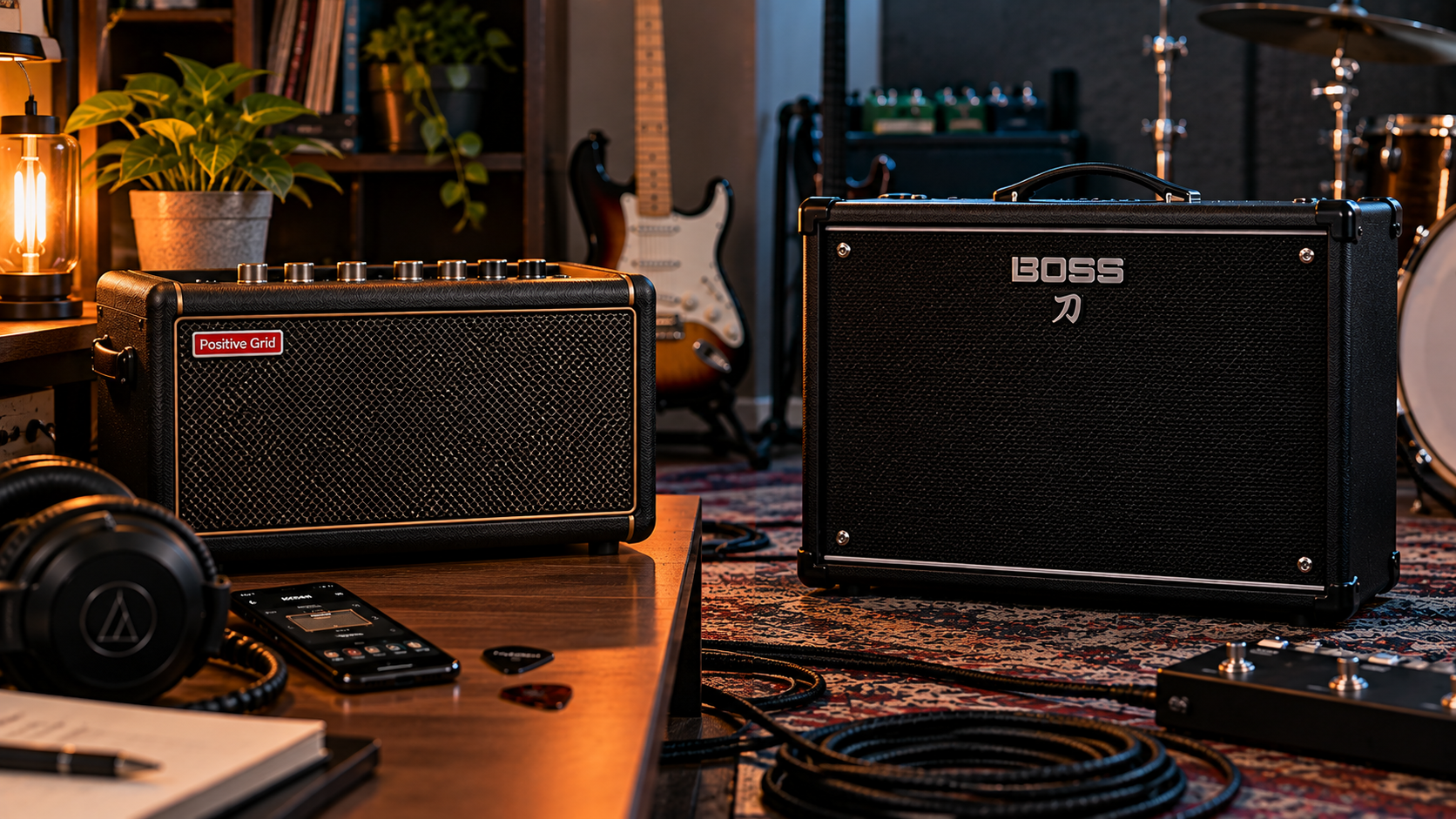
The Spark 2 vs Boss Katana 50 Gen 3 comparison is interesting because both amps can be described as 50-watt modeling combos, yet they are almost opposites in practice. Spark 2 is a stereo full-range smart amp built around home practice, looping, app tools and backing tracks. The Katana 50 Gen 3 is a conventional 1×12 guitar combo with digital modeling and effects layered onto a much more traditional amp architecture.
That means wattage tells you very little here. The real decision is whether you want a desktop practice system or a real guitar combo that can also behave at bedroom volume.
Quick Verdict: Spark 2 or Boss Katana 50 Gen 3?
Choose Spark 2 if your playing happens mainly at home and you want looping, backing tracks, app tools, Bluetooth and a compact stereo rig in one box.
Choose the Boss Katana 50 Gen 3 if you want the physical response of a 12-inch guitar speaker and an amp that can move naturally from bedroom practice into louder rehearsals.
Spark 2 is the stronger practice ecosystem. Katana 50 Gen 3 is the stronger traditional amplifier.
Spark 2 vs Boss Katana 50 Gen 3: Key Differences
| Feature | Positive Grid Spark 2 | Boss Katana 50 Gen 3 |
|---|---|---|
| Power | 50W RMS Class D | 50W |
| Speakers | 2 × 4-inch full-range stereo | 1 × 12-inch guitar speaker |
| Low-power mode | Master volume / digital control | 0.5W, Half, Max |
| Amp models | 33 | 6 amp characters + variations |
| Effects | 43 | 5 simultaneous sections; 60+ types via Tone Studio |
| Looper | Yes | No |
| Bluetooth | Built in | Optional BT-DUAL adapter |
| Battery | Optional | No |
| USB recording | Yes | Yes |
| Rehearsal role | Possible, but not its core strength | Much more natural fit |
| Best for | Home practice, looping and app tools | Traditional amp feel and a path to rehearsals |
| Practice tools | Looper, Smart Jam, Auto Chords, ToneCloud, Spark AI | Core amp/effects workflow; no onboard looper |
| App dependence | Moderate to high for the full ecosystem | Low for normal use; Tone Studio adds depth |
| Traditional amp feel | Low; 2×4 full-range stereo system | High; conventional 1×12 guitar speaker |
| Value proposition | More integrated practice functions | More long-term amplifier and rehearsal utility |
Specifications were checked against BOSS’s official Katana 50 Gen 3 specifications and Positive Grid’s official Spark 2 specifications. BOSS confirms a 50-watt output section, custom 12-inch speaker and 0.5W Power Control, while Positive Grid lists 50W RMS stereo power, dual 4-inch full-range speakers, 33 amp models, 43 effects and a built-in looper.
Spark 2 vs Boss Katana 50 Gen 3 Sound: 2×4 Full-Range vs 1×12
Spark 2 uses two 4-inch full-range speakers because it needs to reproduce modeled cabinets, backing tracks, Bluetooth audio and stereo effects. That makes sense for a desktop smart amp.
The Katana uses one 12-inch guitar speaker. It is larger, more directional and more physically familiar if you have played through conventional combos before.
For palm-muted rock and metal rhythms, the Katana’s speaker architecture has the more traditional amp-in-the-room feel. For stereo delay, ambient reverb and playing along with full-range backing tracks, Spark 2’s speaker system is more naturally suited to the job.
Neither design is universally better. They are optimized for different experiences.
For a broader view of compact home rigs, our best desktop guitar amps guide shows where Spark 2 sits, while our low-volume guitar tone guide helps separate amp choice from room and EQ problems.
Bedroom Use: Katana Has More Cabinet, Spark Has Less Friction
The obvious concern with Katana is volume. BOSS solves much of that problem with Power Control: Standby, 0.5W, Half and Max. The 0.5W setting makes the 50-watt combo genuinely usable at home.
Spark 2 needs no equivalent mode because its entire architecture is built around controlled home playback. It takes less floor space, is easier to place near a desk and works naturally as a Bluetooth speaker when the guitar is not plugged in.
If you want an amp that disappears into a home setup, Spark 2 wins. If you want a real combo that can behave at home without losing its future usefulness, Katana is stronger.
For more on the BOSS specifically, see our Boss Katana 50 Gen 3 review.
Looper, App and Effects: Spark 2 Wins Features, Katana Wins Pedalboard Logic
Spark 2 includes a built-in 60-second looper, eight hardware presets, Smart Jam, Auto Chords, ToneCloud and Spark AI. It is designed to keep an entire practice session inside one ecosystem.
Katana does not have an onboard looper. Instead, it focuses on amplifier and effects flexibility. Five effect sections—Booster, Mod, FX, Delay and Reverb—can run together, and BOSS Tone Studio opens access to more than 60 effect types and deeper routing control.
That means Spark 2 is better at practice functions; Katana is better at behaving like an amp plus integrated pedalboard.
If you already own external pedals, Katana’s more traditional front-end behavior may make more sense. If you want to avoid buying extra practice gear, Spark 2 is more self-contained.
Rehearsal and Band Use: Katana Is the Safer Bet
This is where the 12-inch speaker and conventional combo format matter. The Katana 50 Gen 3 is designed to function as an actual guitar amp in a room with other instruments. It has the projection and physical speaker behavior that make more sense when volume rises.
Spark 2 can get loud, but 50 watts through two 4-inch full-range speakers is not the same thing as 50 watts through a 12-inch guitar speaker. The power rating does not make the two amps equivalent in a band mix.
If you know the amp will stay at home, that difference may not matter. If there is a realistic chance of rehearsal or jam use, Katana has the clearer growth path.
If the decision is really about silent practice, our guitar headphone amp guide covers headphone-first alternatives that need far less floor space than the Katana.
Recording and Headphones: Both Are Modern, Spark Has Better Line-Level Flexibility
Both amps support USB recording and headphone practice. That makes either one practical for late-night use and quick DAW capture.
Spark 2 also provides dedicated stereo 1/4-inch line outputs. The base Katana 50 Gen 3 does not have a dedicated line out; direct use is handled through USB-C or the phones output.
Katana adds another useful option: Power Amp In, which lets an external modeler or preamp bypass the Katana preamp and use the combo’s power section and speaker.
If modelers interest you, our guitar amp modeler guide explains why that connection can matter later.
Portability: Spark 2 Is Much Easier to Treat Like Home Gear
Spark 2 weighs about 5.5 kg and has a compact desktop footprint. An optional battery can also provide up to 12 hours of use at moderate volume.
Katana 50 Gen 3 weighs about 11.6 kg and needs mains power. It is still a portable combo by normal guitar-amp standards, but it is not something you casually move from a desk to the kitchen.
This is not a small difference. If the amp will live permanently in one corner, Katana’s size may not matter. If you regularly move your rig around the house, Spark 2 is more convenient.
Price and Value: Practice Features or Long-Term Amp Utility?
Street prices move, so the better value question is what each amp replaces. Spark 2 bundles a looper, Bluetooth playback, app-based practice tools, a large tone library, USB recording and optional battery support into one compact system. If those features would otherwise require extra gear or software, the package can be efficient.
Katana 50 Gen 3 spends more of its value on the amplifier itself: a 12-inch speaker, 0.5W power control, a conventional pedal-friendly format and enough output for louder use. Power Amp In also gives it a useful role if you move to an external modeler later.
The base Katana does give up conveniences—no onboard looper, no built-in Bluetooth, no effects loop and no dedicated line out. Spark 2 gives up the physical speaker feel and rehearsal-oriented architecture. Value depends on which limitation you are less likely to outgrow.
Pedals, Modelers and Upgrade Path
The Katana has a clearer role if you expect your rig to grow. It behaves like a conventional guitar amp, accepts pedals naturally in front, and its Power Amp In lets an external preamp or modeler bypass the Katana preamp later.
The base Katana 50 Gen 3 does not have an effects loop, so players who rely heavily on the amp’s own distortion and want delay or reverb after the preamp should keep that limitation in mind. Even so, the overall architecture is much closer to a normal pedalboard-and-combo setup than Spark 2.
Spark 2 goes the opposite direction. Its internal amp and effect library is so broad that adding a physical pedalboard often defeats the point. You can still put pedals in front, but the product makes the most sense when most of the rig lives inside the amp and app.
If you think you may buy a dedicated modeler later, Katana’s Power Amp In gives it a useful second life. If you think you may buy fewer pedals because you want one integrated practice box, Spark 2 is the more economical concept.
Which Amp Fits Different Players Better?
For rock and metal rhythm
Katana has the more traditional physical response because the 12-inch speaker moves air in a way the Spark’s small full-range drivers cannot reproduce. That does not make Spark 2 weak for high gain, but the playing feel is fundamentally different.
For ambient and stereo effects
Spark 2 has the natural advantage. Stereo delay and reverb can spread across two speakers, while backing tracks and Bluetooth audio share the same full-range system. The Katana is mono and more conventional.
For beginners
Both can work, but the reason is different. Spark 2 offers more guidance and practice tools. Katana teaches you to live with something closer to a normal guitar amp and gives you a clearer path to rehearsals without changing equipment.
For players in small apartments
Spark 2 is physically easier to place and move. Katana’s 0.5W mode solves much of the volume problem, but it cannot solve the fact that a 1×12 combo occupies real floor space. If every square meter matters, Spark 2 is easier to justify.
Two other comparisons help triangulate the decision: Yamaha THR10II vs Spark 2 if app dependence is the concern, and NUX Mighty Space vs Spark 2 if wireless hardware, IR loading or re-amping matter more.
What You Give Up with Each Choice
Choosing Spark 2 means accepting that much of the value lives inside a software ecosystem. If Positive Grid’s app features, ToneCloud and smart-practice tools are things you will barely use, part of the purchase becomes wasted capability. You also give up the physical response and upgrade path of a conventional 1×12 combo.
Choosing the Katana means giving up some convenience. There is no built-in looper, Bluetooth requires the optional BT-DUAL adapter, battery power is not an option, and the base 50 lacks both an effects loop and a dedicated line out. In return, you get a more traditional amplifier that remains useful when the playing environment gets louder.
That trade-off is the heart of the decision: Spark 2 reduces the number of extra practice tools you need, while Katana reduces the chance that you will outgrow the amplifier itself.
Who Should Buy the Positive Grid Spark 2?
- Home players who want looping and backing-track tools.
- Players who value Bluetooth, app control and ToneCloud.
- Guitarists who want one compact box rather than an amp plus several accessories.
- Songwriters who want a quick idea and practice station.
- Players who care more about stereo desktop sound than traditional cabinet feel.
Read the full Positive Grid Spark 2 review for a deeper look at the app, looper and smart-practice side.
Who Should Buy the Boss Katana 50 Gen 3?
- Players who want a conventional 12-inch combo.
- Rock and metal players who care about physical speaker response.
- Beginners who want one amp that can grow into rehearsals.
- Pedal users who want a familiar amplifier platform.
- Players who might later use an external modeler through Power Amp In.
Spark 2 vs Boss Katana 50 Gen 3 Verdict: Practice System or Real Combo?
The Spark 2 vs Boss Katana 50 Gen 3 comparison is easier once you stop treating them as direct equivalents.
Spark 2 is a home-practice system with guitar amplification built into it. Katana 50 Gen 3 is a guitar amp with enough digital features to work extremely well at home.
If your normal use case is desk, bedroom, headphones, looping, backing tracks and app tools, Spark 2 fits naturally. If your use case includes physical amp feel, pedals, louder jams or future rehearsals, Katana is the more flexible long-term amplifier.
Spark 2 vs Boss Katana 50 Gen 3 FAQ
Which is better for bedroom practice?
Spark 2 is easier to integrate into a small home setup, but the Katana 50 Gen 3 is also very bedroom-friendly thanks to its 0.5W Power Control mode.
Which is louder, Spark 2 or Katana 50 Gen 3?
Both are rated around 50 watts, but the speaker systems are very different. The Katana’s 12-inch guitar speaker is much more naturally suited to rehearsal and band-volume use.
Does the Boss Katana 50 Gen 3 have a looper?
No. Spark 2 includes a built-in 60-second looper; the Katana does not include an onboard looper.
Does Spark 2 have better effects than Katana?
Spark 2 has a broad library of amp models and effects plus smart-practice tools. Katana offers fewer amp categories but a deep BOSS effects ecosystem with more than 60 types available through Tone Studio. The better system depends on whether you value practice tools or pedal-style editing.
Which is better for pedals?
The Katana is the more traditional pedal platform because it behaves like a conventional 1×12 combo. Spark 2 is more focused on its internal digital ecosystem.