Blackstar ID:Core 10 V4 Review: 10W Super Wide Stereo Practice Amp
This Blackstar ID Core 10 V4 review looks at how this 10W Super Wide Stereo practice amp behaves at real home volumes, with its 6 voices, 12 effects, USB-C recording and CabRig Lite speaker simulation.
Blackstar ID Core 10 V4 at a glance
- 10W stereo output (2 × 5W) with “Super Wide Stereo”.
- Two 3″ Blackstar full-range speakers.
- Six amp voices: Clean Warm, Clean Bright, Crunch, Super Crunch, OD1, OD2.
- 12 effects: 4 modulation, 4 delay, 4 reverb, all in stereo.
- Patented ISF control for shifting between more “British” and more “American” voicing.
- Power reduction switch down to 1W for late-night practice.
- USB-C audio interface with 4-channel recording and CabRig Lite speaker simulation.
- TRRS input/output for simple smartphone live-streaming.
- Architect software for deep editing and patch management.
On paper, it’s clearly aimed at the player who wants something more inspiring than a single-speaker starter amp, but who isn’t ready to dive into full floorboard modelers or separate interface + studio monitor setups yet.
Build quality and layout
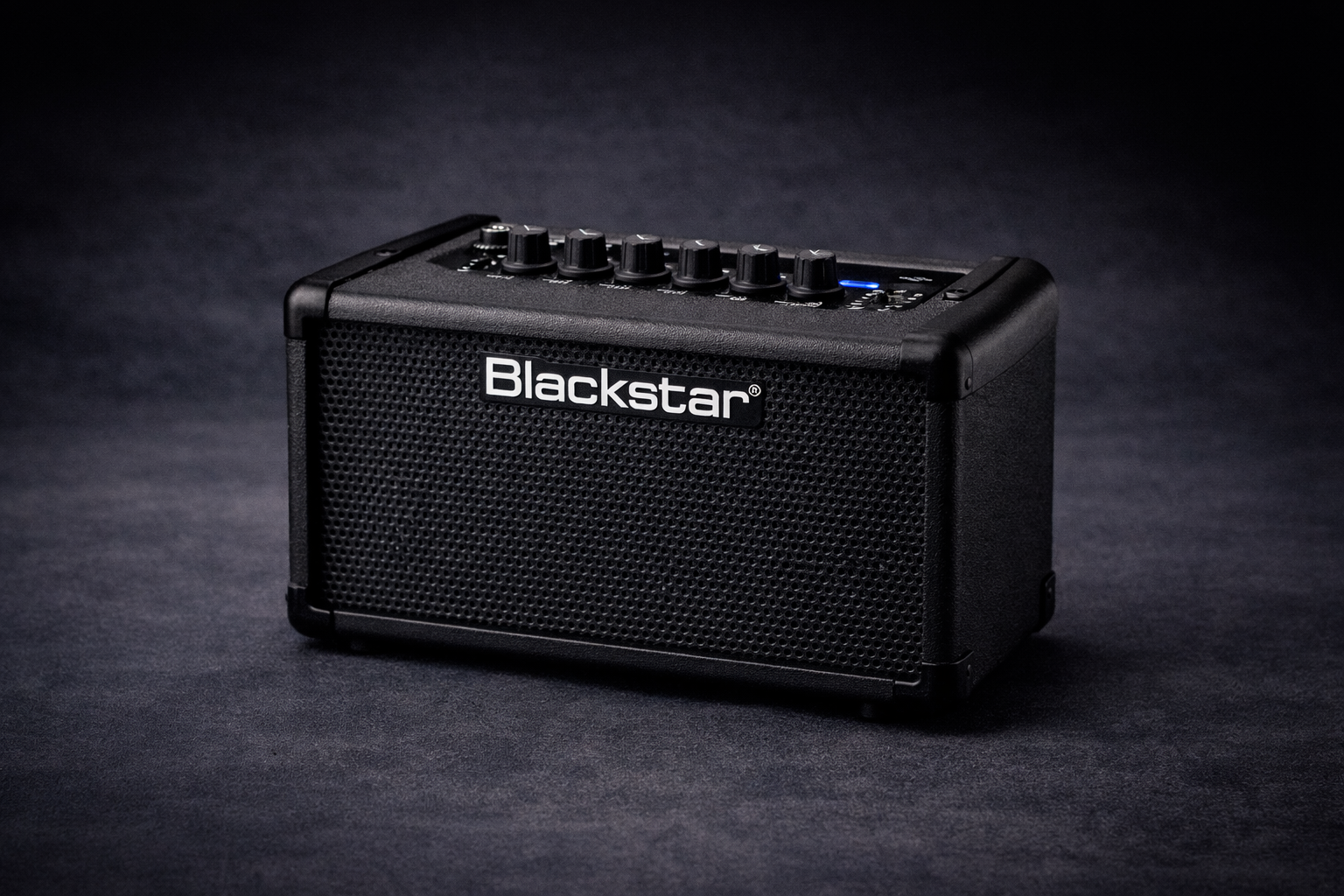
The ID:Core 10 V4 is a small, lightweight combo that still feels put together properly. The enclosure is compact enough to sit on a desk or low shelf, but big enough that the two 3″ speakers have some space to breathe. A recessed handle at the back makes it easy to grab with one hand and move between rooms without drama.
The top panel keeps controls simple: a Voice selector, Gain, Volume, ISF, an Effect level knob, and a few buttons for effect type, tap tempo, power reduction and options. It’s not a deep menu machine; most of the important decisions can be made from the front panel without touching software, which is exactly what you want from a practice amp.
Around the back you get the essentials: guitar input, line in/streaming jack, phones/CabRig output, USB-C, power and an input for the optional PB-1 power bank if you want to run away from wall power. There’s no speaker out and the 10 model is not footswitchable, which is worth noting if you plan to gig with it.
Six voices: from clean warm to OD2
The six core voices are the backbone of how the ID:Core 10 V4 behaves:
- Clean Warm: Round, forgiving clean that stays smooth even with humbuckers.
- Clean Bright: More top-end and definition, breaks up a little when pushed.
- Crunch: Classic low-to-medium gain rhythm sound, good for open chords and light rock.
- Super Crunch: Hotter version of Crunch with more midrange push.
- OD1: Singing lead or heavier rhythm tones, still reasonably tight.
- OD2: The most saturated option for modern high-gain riffs and solos.
Between the gain control and the ISF knob you can shape these into a lot of different flavours. ISF towards the “American” side gives a more scooped, percussive feel; towards “British” focuses the mids and softens the extreme highs. For home levels, being able to tilt the amp that far with one knob is genuinely useful.
Sound and feel at home volume
The strength of the ID:Core 10 V4 is that it doesn’t collapse into a thin, boxy sound as soon as you turn the master down. The twin 3” speakers and stereo processing mean delays, reverbs and modulation actually open up in the room rather than coming from a single point.
Clean Warm and Clean Bright are the standout voices for purely “amp-like” tone. Chords feel full, single-note lines stay clear, and the amp reacts reasonably well to pick intensity and volume knob changes. You won’t mistake it for a 1×12 valve combo, but for a 10W practice unit the cleans are musical rather than clinical.
Crunch and Super Crunch handle the bulk of everyday rock work. Palm-muted riffs feel tight enough, and power chords don’t instantly blur together. For classic rock and pop-rock tones at TV-friendly volume, these voices get you there quickly with very little fuss.
OD1 and OD2 cover higher-gain ground. For serious metal volumes you’ll still want a bigger rig, but for practising tight modern rhythm parts at home they’re more than acceptable. Keeping the bass and ISF under control stops the small speakers from flubbing out.
Super Wide Stereo effects
One of the reasons people like the ID:Core line is the way the stereo effects make even simple parts feel bigger. You get four modulation types, four delays and four reverbs, all designed to work in stereo:
- Modulation: chorus, phaser, flanger, tremolo.
- Delay: linear, analog-style, tape-style and multi-tap flavours.
- Reverb: room, hall, plate and spring.
You choose the effect family with a button, set the overall level with the Effects knob and adjust time via the tap-tempo button. It’s not as tweakable as a pedalboard full of single effects, but it’s fast and, importantly, hard to make sound bad. For most practice scenarios that’s ideal.
The “Super Wide Stereo” processing does actually help; standing in front of the amp you get a sense of width that makes stereo delays and reverbs feel much more immersive than on a narrow single-speaker combo.
USB-C recording, CabRig Lite and streaming
The ID:Core 10 V4 isn’t just a speaker in a box: it’s also a simple 4-channel USB-C audio interface. When you connect it to a computer you can record both a processed stereo signal and a dry DI, then reamp later using the CabRig Lite speaker simulator inside the amp.
CabRig Lite lets you choose virtual cabinets, mics and mic positions. It’s simpler than the full CabRig you’ll find on bigger Blackstar gear but still gives you enough control to find IR-style tones that sit well in a mix. For late-night headphone playing the phones/CabRig output uses the same simulation, so your recorded sound and headphone sound stay consistent.
There’s also a TRRS jack that can act as both input and output for a smartphone or tablet. With the right cable you can live-stream to apps that accept audio from the headphone jack while monitoring yourself through the speakers or headphones as usual.
Architect software and deep editing
Out of the box you can get plenty done from the front panel, but Blackstar’s free Architect software opens up a lot more control. Once connected over USB you can:
- Adjust detailed amp parameters, noise gate and response.
- Fine-tune modulation, delay and reverb settings beyond the single Effects knob.
- Save and organise patches, including backups and different set lists.
- Access CabRig Lite and build virtual cab/mic combinations for recording.
Architect is not mandatory, and that’s a good thing; but if you enjoy dialing in “your” sound rather than living on stock presets, it’s worth spending an evening with it and saving a few go-to patches for clean, crunch and lead.
Everyday practice and usability
In normal use, the ID:Core 10 V4 does exactly what a practice amp should: it makes playing easy to start and hard to stop. The power-reduction switch down to 1W is genuinely helpful in an apartment or late-night situation; you can still get the amp “working” without waking anyone up.
The full-range speakers mean it doubles as a small media speaker. Plug a phone or laptop into the line in, or on the Bluetooth version stream audio wirelessly, and you can play along with songs or lessons without juggling multiple devices. If you prefer a more “desktop hi-fi” style unit with touchscreen, IR loading and a stronger focus on USB audio, you can check out our Hotone Pulze review as an alternative direction.
Who is the ID:Core 10 V4 for?
Realistically, this amp is ideal for:
- Beginners who want to grow into their first amp rather than replace it in a year.
- Intermediate players who mostly play at home and need good tones at sensible volumes with minimal setup time.
- Anyone who wants an all-in-one practice and quick-recording solution without buying a separate interface and monitors.
If you’re already running a dedicated USB interface, studio monitors and a full plugin setup, the ID:Core 10 V4 becomes more of a convenience amp than a core tool. And if you mainly play loud gigs with a drummer, you’ll want something bigger or a modeler into the PA.
Pros and cons
Pros
- Genuinely wide stereo sound from a very compact combo.
- Six voices cover a lot of ground from clean to high gain.
- 12 built-in stereo effects are simple to use and hard to dial in badly.
- USB-C audio, CabRig Lite and Architect make it useful beyond pure practice.
- Power reduction to 1W makes late-night playing much easier.
Cons
- 10W through 2 × 3″ speakers will never feel like a full-size combo in the room.
- No footswitch support on the 10 model, so it’s not ideal as a gigging amp.
- High-gain voices are good for practice but won’t satisfy players chasing huge live metal tones.
- You need Architect to unlock the deepest editing; front panel remains intentionally simple.
Alternatives and competition
In real life the Blackstar ID Core 10 V4 usually sits on the same radar as very small practice amps rather than big gigging combos. People who look at it often also consider ultra-compact models that live on a desk or shelf and stay at sensible volume all the time.
- Boss Katana Mini: 7W battery-powered mini amp with three basic voices and a simple delay. It is more portable and can run without mains power, but it is mono, has less low-end and no USB recording. Great as a grab-and-go box, less “wide” and feature-rich than the ID Core 10 V4.
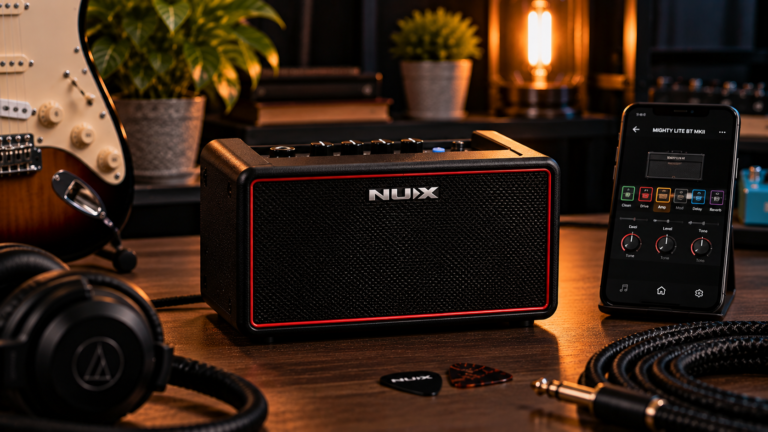
- Nux Mighty Lite BT MkII: Tiny stereo practice amp with Bluetooth audio, drum patterns and app control. Super portable and fun on a desk, but the speakers are even smaller and it doesn’t feel as full or as open in the room as the ID Core’s Super Wide Stereo when you want a bit more air and spread.
- Blackstar Fly 3 Bluetooth: Blackstar’s own micro-amp option. Very compact, can run on batteries and works nicely as a low-volume companion, but it is more of a “micro rig” for travel and sofa playing. The ID Core 10 V4 is the step up when you want more stereo width, more voices and USB recording on top.
If you realise you actually want something that is less “little combo on the floor” and more “desktop hi-fi box with touchscreen and IRs”, then a unit like the Hotone Pulze becomes the alternative route rather than a direct rival to the ID Core 10 V4.
Verdict: is the Blackstar ID:Core 10 V4 worth it?
The ID:Core 10 V4 isn’t here to replace a full stage rig or a pro studio. It’s built to live in bedrooms, flats and small practice spaces, where volume is always a negotiation and space is limited.
In that environment it does a lot right: stereo sound that actually feels wide, a sensible spread of amp voices, easy-to-use effects, proper USB-C recording and a genuinely useful 1W mode. If what you want is a small combo that makes you plug in more often and also lets you record ideas without extra gear, the Blackstar ID:Core 10 V4 is an easy amp to live with.
FAQ: Blackstar ID:Core 10 V4
Is the Blackstar ID:Core 10 V4 loud enough for rehearsals?
At 10W through two 3″ speakers, the ID:Core 10 V4 is designed primarily for home use. It can work for very low-volume rehearsals if the drummer and other players keep things sensible, but for typical band practice levels a larger amp or PA-based solution will be more comfortable.
Can I record directly with the ID:Core 10 V4?
Yes. The amp includes a 4-channel USB-C audio interface that lets you record stereo processed tones and dry DI tracks into a DAW. CabRig Lite provides speaker simulation, and Architect software lets you fine-tune cab and mic settings and save presets for recording sessions.
What makes the ID:Core 10 V4 different from basic starter amps?
Compared to many entry-level amps, the ID:Core 10 V4 offers stereo sound with 12 effects, a wider range of amp voices, USB-C recording, a proper cab simulator and deep editing via Architect software. It’s still beginner-friendly, but it has enough headroom and flexibility that you don’t immediately outgrow it after the first year of playing.
Does the ID:Core 10 V4 support Bluetooth?
The standard ID:Core 10 V4 does not have Bluetooth; there is a separate ID:Core 10 V4 Bluetooth model which adds wireless music streaming on top of the same core amp features. If playing along to tracks from your phone without cables is a priority, it’s worth specifically looking for the Bluetooth version.
Is there a footswitch option for changing patches?
No, the 10W model is not footswitchable. Patch changes are done from the top panel or via software. If you need footswitch control for live use, one of the larger ID:Core V4 models designed with footswitch support will be a better fit.