Boss MT-2W Metal Zone Review: Surgical High-Gain Control Without the Fizzy Trap
This boss mt 2 metal zone review answers a blunt question: is the MT-2W a practical high-gain tool in real rigs—or is it still the pedal people dial badly once, then blame forever?
I’m not judging it by one extreme setting. The point of this design is control, so I’m focusing on how it behaves across common real-life contexts: bright home volume, louder rehearsal levels, and clean-to-edge-of-breakup platforms where the pedal has to do most of the heavy lifting. If you want the broader landscape first, this guide to the best distortion pedal for guitar helps you see where an EQ-heavy metal distortion sits compared to simpler classics and amp-style distortions.
Decision first below, then the details that change outcomes: EQ logic, tightness, mid focus, and how to avoid harshness while staying aggressive.
- Who this pedal fits—and who should avoid it.
- How to dial the EQ so it sounds like metal, not fizz.
- Before/after scenarios for stacking and real-world fixes.
| Your situation | Verdict | Why |
|---|---|---|
| You want tight, aggressive high gain and you’re willing to dial EQ properly. | Strong fit | The EQ is the entire point; you can shape bite, mids, and tightness more than most pedals. |
| You want “set-and-forget” distortion that sounds good with knobs at noon. | Maybe not | This design rewards deliberate EQ choices; neutral settings often aren’t the best sound. |
| You mostly play quietly at home and hate fizzy top end. | Mixed | It can work well, but you must reduce harsh frequencies instead of boosting “clarity.” |
| You want classic rock grind or amp-style distortion feel. | Look elsewhere | This is a sculpting tool for metal-focused gain; it’s not aiming for classic raw character. |
- Huge EQ range for shaping tightness, bite, and mid focus.
- Can be very mix-ready once you identify the harsh band and control it.
- Works well as a dedicated metal voice on a small board.
- Great for players who enjoy “surgical” tone shaping.
- Can deliver aggressive tones at lower volumes if dialed conservatively.
- Easy to dial badly; neutral knob positions can sound harsh or artificial.
- At home volume, too much high end can read as fizz instead of bite.
- Players who dislike EQ will find it frustrating.
- Not the right tool for classic rock character or amp-in-a-box feel.
- Stacks poorly if you pile gain on top of gain without defining roles.
In other words: it’s not “bad” or “good.” It’s a powerful EQ-first distortion. If you like controlling mids and top-end intentionally, it can be excellent. If you want effortless, it can feel like a trap.
Specs and variants at a glance
| Model | Boss MT-2W Metal Zone |
|---|---|
| Type | High-gain distortion with a wide EQ range (parametric mid shaping is central to the design). |
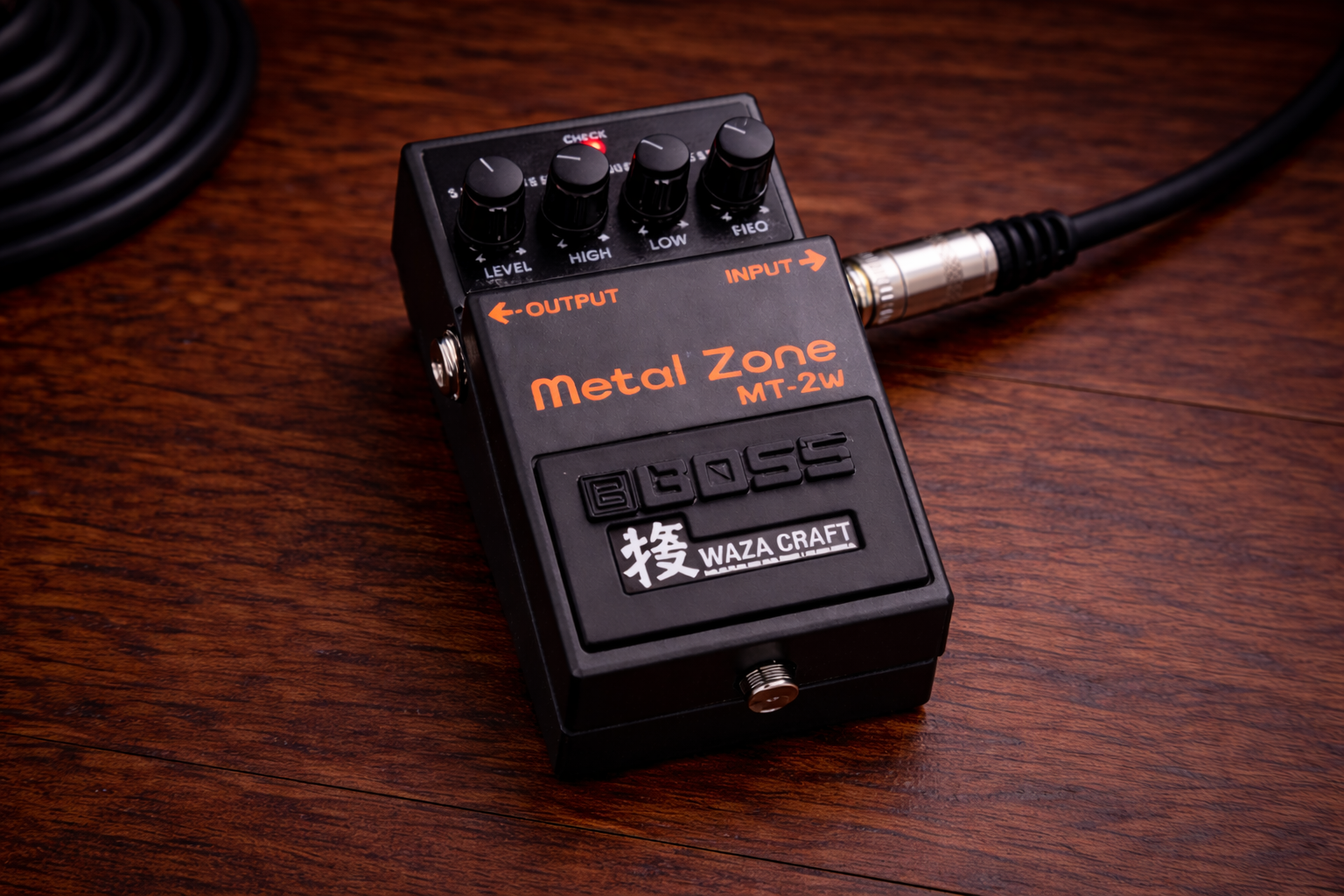
| Controls | Level, Distortion, Low, High, plus a parametric Mid section (frequency + level), and mode switching. |
| Power | Standard 9V DC (center-negative typical) or battery where supported. |
| Typical role | Dedicated metal distortion voice; aggressive rhythm with controlled mids; EQ-first high gain. |
| What it replaces on a small board | A full metal channel when you want the boss mt 2 metal zone guitar effects pedal to provide the core voice. |
Who this pedal is actually for
This is for players who want control. If you hear “harsh” or “fizzy” and your first instinct is to shape specific frequency areas, you’ll get along with it. If you prefer distortions with one baked-in voice and minimal decision-making, you’ll probably fight it.
It also makes sense if you’re on a clean platform amp or a modeler patch and you want the pedal to provide the metal character. If you’re chasing more classic grind, a reference like the Pro Co RAT 2 review can clarify whether you prefer raw mid-forward texture over surgical sculpting.
Real-world use cases
When it makes a lot of sense
- You want tight metal rhythm and mix control from one pedal.
- You enjoy shaping mids intentionally rather than relying on “knobs at noon.”
- You need a dedicated heavy voice into a clean platform or modeler.
- You want to solve harshness by subtracting, not by adding more gain.
When it’s probably the wrong match
- You want amp-like channel feel more than EQ sculpting.
- You dislike dialing and want quick good sounds at any volume.
- You’re chasing classic rock distortion rather than metal-focused aggression.
- You want your first distortion to be simple and forgiving.
If you want a more amp-channel distortion feel instead of EQ-first metal sculpting, the JHS Angry Charlie v3 is a strong contrast in how the distortion is structured under your hands.
How it compares to related models
The easiest way to understand this pedal is to compare EQ-driven metal sculpting to two other approaches: classic fixed-voice distortions and modern EQ-flexible distortions that feel less extreme.
| Reference | What changes in feel | Best for |
|---|---|---|
| Classic simple distortion | Less EQ decision-making; more baked-in character; easier day-one. | Players who want a fast, familiar distortion voice. |
| EQ-flexible modern distortion | More shaping without a steep learning curve; easier to adapt to amps. | Players who want flexibility with less “extreme” behavior. |
| Parametric mid metal sculpting | Very powerful but easy to overdo; rewards subtractive EQ thinking. | Players who want precise control over cut and harshness. |
If you want EQ flexibility with a more general-purpose approach, the MXR Super Badass is a useful comparison point.
For a simple classic baseline—useful for understanding how much control this design adds—the Boss DS-1 gives you a more straightforward reference for what “less control, more fixed voice” feels like.
Tone and feel: boss mt 2 metal zone in the real world
The core sound is aggressive and focused, but it’s not “one sound.” This pedal is defined by the mid section. If you choose the wrong mid frequency and boost it, you’ll get the infamous nasal harshness. If you choose wisely and cut where it hurts, you can get tight rhythm that feels much more mix-ready than people expect.
Pick response and tightness
When it’s dialed with controlled low end and sensible mids, the attack can feel very tight—especially on palm-mutes. The impression of heaviness often comes from mid placement and controlled top end rather than pure bass.
- Tight rhythm: keep lows controlled; place mids for definition.
- Chug clarity: reduce harshness before adding more distortion.
- Lead separation: pick the mid frequency first, then adjust level.
EQ logic in plain English (fast fixes)
The fastest path to usable tone is subtractive thinking: remove the ugly stuff first, then add only what you need. The parametric mid control is the difference between “legendary” and “unusable.”
- Too fizzy: reduce High first; then check if mids are boosted in an abrasive band.
- Too nasal: lower Mid level or move the mid frequency away from honk.
- Not cutting: add mids gently, then use Level for lift.
- Too boomy: reduce Low before touching distortion.
Where it shines most
It shines when you want a specific metal voice and you’re willing to dial it for your rig. It’s not trying to mimic an amp channel; it’s giving you a sculptable metal distortion module.
Home, rehearsal and small gigs
At home, the temptation is to boost highs and scoop mids for excitement. That’s exactly how you end up with fizz and harshness. At rehearsal volume, the same settings can either smooth out—or become painfully sharp—depending on your speaker and how you set mids.
Home and headphone practice
Start conservative: less distortion, less high end, and a mid setting that avoids honk. The goal is “tight and controlled,” not “brighter equals clearer.”
Rehearsals
Rehearsal is where you find out whether your mids are helping or hurting. If you disappear, you probably scooped too hard. If you hurt ears, you likely boosted the wrong mid frequency or pushed High too far.
Small gigs
On small stages, keep your EQ disciplined. Rooms can be bright and reflective. A slightly darker top end with controlled mids often sounds heavier and more professional than a bright, fizzy “metal at home” setting.
Stacking and pedalboard roles
This pedal can work as a dedicated metal channel, but stacking must be role-based. If you pile gain on top of gain, you’ll get noise and fizz faster than you get useful heaviness.
As a practical board role, the boss mt 2 metal zone guitar pedal works best when it is clearly “the voice,” while another pedal (or your amp) handles tightening or level changes.
| Scenario | Before (common problem) | After (what to change first) |
|---|---|---|
| Boost in front | More gain, more fizz; palm-mutes lose definition. | Lower distortion a bit, tighten lows, then place mids for attack instead of boosting High. |
| Second-stage lead | Lead gets louder but thin, or thick but disappears. | Use Level for lift; add gentle mids at a sensible frequency; keep lows controlled. |
| Two-gain stack | Noise and harshness rise faster than usable heaviness. | Assign roles: one pedal tightens, this pedal defines the voice; avoid high gain on both. |
If you want a budget contrast to understand how different voicings stack, the Donner Morpher is a useful reference point for “modern aggression” versus EQ-driven sculpting.
Buying checklist vs alternatives
At the decision level, treat this as an EQ-first high-gain tool. If you want a more “finished” heavy voice with less risk of harshness, compare what you’re looking for against a smoother option like the Wampler Sovereign.
If your target is specifically a dedicated metal module, the boss mt 2 metal zone distortion pedal approach makes sense only if you are comfortable shaping mids deliberately.
- Do you enjoy dialing mids (frequency + level), or do you want set-and-forget?
- Is your rig bright? If yes, plan to keep High conservative and avoid harsh mid boosts.
- Will you rehearse/gig soon? If yes, prioritize mix cut over solo scooped excitement.
- Are you stacking gain? If yes, define roles (tighten vs voice) to avoid fizz.
| If you want… | Set this first | Avoid doing this |
|---|---|---|
| Tight rhythm that cuts | Mid frequency + gentle mid level, lows controlled | Hard scoops + high boosts for “clarity” |
| Less fizz at home | Lower distortion, High conservative, small moves | Extreme gain + bright top end at whisper volume |
| Lead that stays audible | Level for lift, gentle mids | Adding more distortion instead of managing mids |
If what you really want is touch-sensitive breakup that cleans up easily, maybe what you want is actually an overdrive. This guide to the best overdrive pedal for guitar points you to pedals designed for that feel.
When this pedal is overkill or the wrong choice
- If you want classic rock character or amp-like feel, you’ll likely enjoy a different voicing more.
- If you hate dialing EQ and want instant gratification, it can be frustrating.
- If your rig is already harsh and bright, you may fight it unless you’re comfortable with subtractive EQ.
- If you only play quietly, you may never hear its real advantage: controlled mids in a mix.
Summary: is it still worth it?
At its best, it’s a controllable metal distortion module: the EQ is not decoration, it’s the instrument. If that matches how you think about tone, the boss mt 2 metal zone effects pedal can be a surprisingly practical long-term choice.
Pedal FAQ
Why do people say the Metal Zone sounds bad?
Because it’s easy to dial badly. Extreme mid scoops and bright highs can sound fizzy and artificial, especially at low volume. Used with subtractive EQ and sensible mids, it can be much more mix-ready than its reputation.
What’s the fastest way to get a usable tone?
Start with lower distortion than you expect, keep High conservative, then set the mid frequency and mid level so it cuts without honk. Small moves beat big boosts.
Is it usable at home volume?
Yes, but the EQ matters more at home. Avoid hard scoops and avoid bright highs. A tighter, slightly darker setting often sounds heavier and more realistic at low volume.
Does it stack well with other gain pedals?
It can, but stacking must be role-based. Use another pedal to tighten or push slightly; don’t pile heavy gain on heavy gain. Otherwise, noise and fizz increase faster than usefulness.
Is the MT-2W worth it compared to other distortions?
It can be, if you want a dedicated metal voice with strong EQ control. If you want classic rock character or amp-in-a-box feel, other distortions may be a better match.