Wampler Sovereign Review: Is This Boutique Distortion Still Worth It?
The Wampler Sovereign is not the kind of distortion pedal you buy because you want the cheapest way to get loud. It is a more control-heavy, boutique-style distortion box aimed at players who want a polished main gain sound with enough EQ and voicing options to work across different guitars, amps and rooms.
This Wampler Sovereign review is written for players comparing it against more obvious distortion choices: the Boss DS-1 for cheap classic distortion, the Pro Co RAT 2 for character, the MXR Super Badass Distortion for flexible all-round use, the JHS Angry Charlie V3 for amp-like rock gain, and the Boss MT-2W Metal Zone for modern metal control.
The Sovereign can make sense if you want one serious distortion pedal to act as your main gain stage. It makes less sense if you want a cheap first pedal, a simple three-knob stompbox, or a modern metal machine that practically dials itself. If you are still comparing the whole category, start with the main hub: best distortion pedal for guitar.
In this Wampler Sovereign review, the real question is not “is it boutique?” but whether its extra controls actually help your rig or just give you more ways to overthink distortion.
What you’ll get from this guide:
- Who the Wampler Sovereign distortion pedal is actually for.
- Why the controls matter more than the boutique label.
- Best Wampler Sovereign settings for rock rhythm, lead, modern gain and bright rigs.
- Clear alternatives if you need cheaper, simpler, tighter or more amp-like distortion.
- A practical verdict on whether the Wampler Sovereign is still worth buying.
Wampler Sovereign: pros and cons at a glance
Pros
- Very flexible for rock, hard rock and higher-gain lead tones.
- Mid Behavior and Tone controls give more shaping power than simple one-tone-knob pedals.
- Even/Bright and Standard/Boost switches make it easier to adapt to different rigs.
- Good fit if you want one main distortion sound rather than several cheap dirt boxes.
- Works well as a premium comparison point inside a distortion pedal cluster.
Cons
- More expensive and harder to justify than a simple budget pedal.
- Not as immediate as a classic three-knob distortion like the Boss DS-1.
- Can be more control-heavy than some players need for home practice.
- Availability may be less straightforward because the model has appeared as discontinued/out of stock on official and retailer pages.
Wampler Sovereign review: quick verdict
The Wampler Sovereign is worth considering if you want a serious, flexible distortion pedal that can cover classic rock crunch, heavier rhythm tones and smooth lead sustain without sounding like a bargain-bin dirt box. It is less compelling if you need the cheapest usable distortion, a very specific amp-in-a-box flavor, or a tight modern metal pedal with ultra-obvious EQ moves.
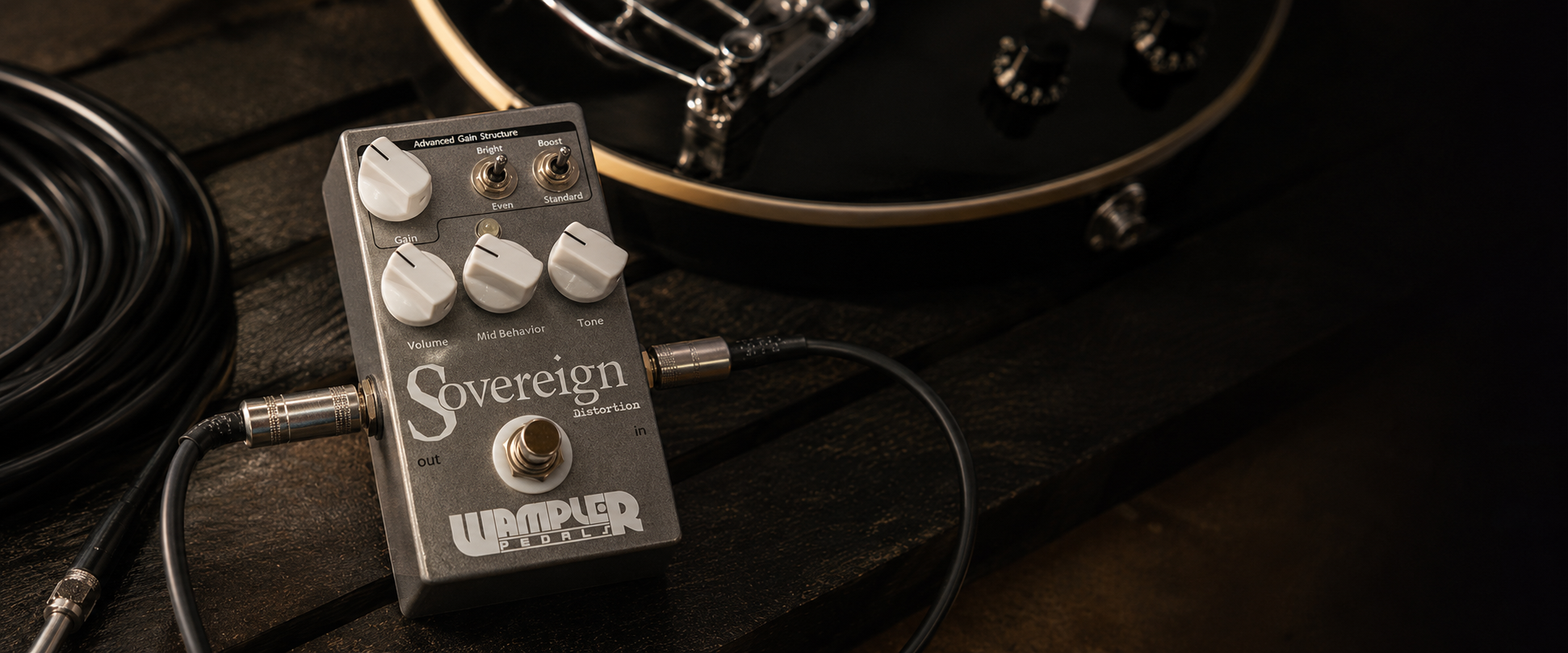
The big appeal is control. The Wampler Sovereign pedal gives you Gain, Volume, Tone, Mid Behavior, an Even/Bright voicing switch and a Standard/Boost gain-structure switch. That makes it more adjustable than most simple distortion pedals, but it also means the best results come from dialing with intention instead of just cranking gain.
Who the Wampler Sovereign distortion pedal is actually for
The Sovereign is for players who already know they want distortion to be a main sound, not just a cheap effect they kick on twice per practice. It sits best in the hands of someone who cares about midrange, pick attack, lead sustain and how the pedal behaves through different amps.
Buy the Wampler Sovereign if…
- You want one premium distortion pedal to cover most rock and hard-rock gain needs.
- You need more EQ control than a DS-1 or RAT-style pedal gives you.
- You like the idea of shaping mids instead of just turning a tone knob brighter or darker.
- You play through multiple amps and need a pedal that adapts.
- You want both lower-gain crunch and thicker boosted distortion from one box.
- You are building a serious pedalboard and want a main gain stage, not a novelty pedal.
Skip the Wampler Sovereign if…
- You want the cheapest good distortion pedal for a first board.
- You prefer simple three-knob pedals with almost no learning curve.
- You mainly play modern metal and want very tight low-end control immediately.
- You want a very specific Marshall-style amp-in-a-box flavor.
- You mostly practice at whisper volume through a harsh small amp.
- You are not sure yet whether you need overdrive, distortion or fuzz.
If you are still working out the difference between gain types, this comparison helps: overdrive vs distortion vs fuzz. If your home tone is the real problem, start with the bedroom guitar tone guide.
| Your situation | Verdict | Why |
|---|---|---|
| You want a boutique distortion pedal as your main rock gain stage. | Strong fit | The Sovereign has enough gain, EQ and voicing control to act as a serious main distortion. |
| You use different guitars or amps and need more shaping control. | Strong fit | Mid Behavior, Tone and voicing switches help adapt the pedal to brighter or darker rigs. |
| You want a cheap first distortion pedal. | Maybe not | The DS-1 or RAT 2 is easier to justify if you are still learning what distortion you like. |
| You want a direct Marshall-style amp-in-a-box sound. | Maybe not | The JHS Angry Charlie V3 is the more obvious amp-like rock distortion comparison. |
| You want tight modern metal with deep mid sculpting. | Compare first | The Boss MT-2W may be more focused for metal-specific EQ and tightness. |
Wampler Sovereign specs and controls at a glance
| Model | Wampler Sovereign Distortion. |
|---|---|
| Type | Boutique-style distortion pedal with flexible gain structure and EQ shaping. |
| Main controls | Gain, Volume, Tone, Mid Behavior. |
| Switches | Even/Bright and Standard/Boost. |
| Bypass | Relay true bypass with soft switch. |
| Best use case | Main rock/hard-rock distortion, polished lead gain and flexible high-gain rhythm. |
| Main limitation | More expensive and more involved than simple budget distortion pedals. |
Wampler’s own materials describe the Sovereign as a versatile distortion with two gain stages, mid contour, a bright switch and tone control. The official manual groups Gain, Even/Bright and Standard/Boost as the pedal’s “Advanced Gain Structure,” with Volume, Mid Behavior and Tone used for output and tonal shaping.
For official product details, see the Wampler Sovereign Distortion product page.
How this Wampler Sovereign review was judged
This Wampler Sovereign review is based on the pedal’s official controls, Wampler’s product information, the published manual, and realistic guitar rig scenarios: home practice, rehearsal volume, amp sims, clean platforms and gain-stacking setups.
This is not presented as a long-term hands-on test. Instead, the focus is on what the Sovereign’s control layout is designed to do, how those controls are likely to affect real-world tones, and how the pedal compares with similar distortion options like the Boss DS-1, Pro Co RAT 2, MXR Super Badass, JHS Angry Charlie V3 and Boss MT-2W.
What the Wampler Sovereign controls actually do
The Sovereign is not hard to understand, but it rewards a different mindset than a basic Tone/Level/Gain pedal. The switches make bigger character changes; the knobs fine-tune how the pedal sits with your amp.
Control map
Advanced gain structure
- Gain: sets the distortion amount and interacts with both switches.
- Even/Bright: Even gives a more balanced foundation; Bright adds more top-end emphasis.
- Standard/Boost: Standard covers lower-to-strong gain; Boost pushes into thicker, more commanding distortion.
Tone shaping
- Volume: sets output level; adjust after the gain structure is close.
- Mid Behavior: shapes the midrange relationship and how the guitar sits in a mix.
- Tone: controls high-end bite and harmonic edge.
Tone and feel in real-world rigs
The Wampler Sovereign distortion voice is best understood as flexible, polished and mid-aware rather than cheap, raw or one-dimensional. It can move between classic crunch and heavier gain, but its real strength is letting you tune how aggressive, bright or mid-forward the distortion feels.
What the Sovereign does well
- Main rock gain: strong rhythm distortion without needing several dirt pedals.
- Lead sustain: enough gain and mid shaping for smoother lead voices.
- Different rigs: more adaptable than simple one-tone-knob pedals.
- Polished distortion: more refined than most cheap distortion pedals.
Where it can be the wrong fit
- First pedalboards: price and control depth may be more than a beginner needs.
- Raw character: RAT-style pedals have a more obvious personality.
- Simple home use: budget players may not need this much control.
- Modern metal: dedicated metal pedals can be easier for tight low-end sculpting.
If you want more gritty character, compare it with the Pro Co RAT 2. If you want a more direct all-round distortion with 3-band EQ, compare it with the MXR Super Badass Distortion.
Best Wampler Sovereign settings (fast starting points)
These Wampler Sovereign settings are starting points, not rules. The pedal has enough range that your amp, pickups and volume level matter a lot. Start with Mid Behavior and Tone near noon, choose the gain-structure switches first, then fine-tune output and brightness.
| Scenario | Switches | Gain | Mid / Tone | Notes |
|---|---|---|---|---|
| Classic rock crunch | Standard + Even | 9–11 o’clock | Mid noon–1, Tone 10–noon | Good first setting for rhythm parts and open chords. |
| Hard rock rhythm | Standard or Boost + Even | Noon–2 o’clock | Mid 1–2, Tone 10–noon | Keep mids present; avoid too much top end through bright amps. |
| Lead sustain | Boost + Even | Noon–2 o’clock | Mid 1–3, Tone noon | Use Volume for lift; do not rely only on more gain. |
| Dark rig clarity | Standard + Bright | 10–noon | Mid noon, Tone 11–1 | Bright mode can help if the amp or pickups are naturally dark. |
| Bright rig control | Standard + Even | 9–noon | Mid 1–2, Tone 9–10 | Stay out of Bright mode if your amp already has sharp highs. |
| Heavier rhythm | Boost + Even | 1–3 o’clock | Mid noon–2, Tone 10–noon | Works better with controlled amp bass and present mids. |
60-second dial-in method
Start here
- Set Mid Behavior and Tone around noon.
- Choose Standard mode first unless you know you need more saturation.
- Start in Even mode before trying Bright.
- Set Gain low-to-medium and bring the pedal to unity with Volume.
Then adjust
- If it feels too polite, try Boost before maxing Gain.
- If it gets harsh, lower Tone and stay in Even mode.
- If it gets buried, raise Mid Behavior before adding more treble.
- If the low end feels loose, fix amp bass before blaming the pedal.
Home, rehearsal and recording use
Bedroom volume
At low volume, the Sovereign’s flexibility helps, but it does not break physics. If your amp is tiny, bright and quiet, high-gain distortion can still become fizzy. Start with Standard/Even, keep Gain moderate, and use Mid Behavior for fullness before adding top end.
- Keep Tone lower than you expect through small bright amps.
- Use less Gain and more mid presence for clarity.
- Do not use Bright mode just because the tone feels small; fix placement and EQ first.
If your bedroom tone keeps turning fizzy, read why your guitar sounds bad at low volume.
Rehearsal volume
In a band mix, the Sovereign’s mid control is the main advantage. You can keep the guitar present without cranking treble or adding too much gain.
- Use mids to sit above bass and below vocals.
- Keep low end tighter than you would alone.
- Use Boost for lead lift or heavier sections, not as the default if Standard already works.
Recording and amp sims
Into amp sims or IRs, the Sovereign can work like a preamp-style distortion layer, but cab choice matters. A too-bright cab can make even a good boutique distortion pedal sound sharp.
- Choose a cab/IR before over-tweaking the pedal.
- Use Even mode first, then Bright only if the track lacks cut.
- Keep the Mid Behavior control active in the mix, not just soloed.
For the bigger digital rig decision, this helps: amp simulator vs practice amp vs modeler.
Using the Sovereign with overdrive, EQ and amp gain
The Wampler Sovereign pedal can be your main gain sound, but it also works inside a more complete gain structure. The key is not to stack too much gain. Use one pedal to shape or push, and let the Sovereign do the heavy lifting.
Simple Sovereign signal chain ideas
Sovereign alone into clean amp
- Best if you want one main distortion voice.
- Use Standard mode for rhythm and Boost for heavier sounds.
- Keep amp mids present and bass controlled.
Overdrive into Sovereign
- Use a low-gain overdrive as a tightening stage.
- Keep overdrive gain low and level slightly up.
- Useful if you need more focus without pushing Sovereign Gain too high.
Sovereign into amp gain
- Use lower Gain and set Volume for push.
- Better when the amp already has a usable crunch voice.
- Watch total noise if both amp gain and pedal gain are high.
Sovereign with EQ after it
- Use EQ to fine-tune highs and mids for recording/headphones.
- Good when the pedal sounds strong but the rig is too bright or congested.
- The guitar EQ cheat sheet is useful here.
If you are building a full board, this broader guide helps: guitar pedals for beginners. If you are comparing gain categories, use overdrive vs distortion vs fuzz.
Wampler Sovereign vs alternatives
The Sovereign is a premium distortion choice, but not every player needs that level of control. Use the table below to choose the direction that fits your rig and budget.
| If you want… | Better direction | Why |
|---|---|---|
| Cheap classic distortion | Boss DS-1 | Much cheaper and simpler if you only need basic rock/punk distortion. |
| Gritty character and fuzz-adjacent sustain | Pro Co RAT 2 | More obvious personality and a classic alternative-rock voice. |
| Flexible all-round distortion with 3-band EQ | MXR Super Badass Distortion | More straightforward EQ layout and easier all-purpose comparison. |
| Marshall-style rock amp feel | JHS Angry Charlie V3 | More direct amp-in-a-box direction for hot British rock tones. |
| Modern metal and aggressive EQ control | Boss MT-2W Metal Zone | More focused for metal-specific gain, tightness and mid sculpting. |
When the Wampler Sovereign is the wrong choice
The Sovereign is a strong boutique distortion pedal, but it is not the best answer if your actual need is budget simplicity, modern metal specificity or basic tone repair.
- Do not buy it if you mainly need a cheap first distortion pedal.
- Do not buy it if you hate tweaking mids, tone and voicing switches.
- Do not buy it expecting one exact amp model in a box.
- Do not buy it to fix a harsh amp or bad monitoring setup.
If your guitar itself feels hard to control, do not ignore setup basics. String gauge, fret buzz and pickup choice can change how satisfying distortion feels: guitar string gauges, guitar buzz causes and quick fixes, and HSS vs SSS vs HH pickups.
Summary: is the Wampler Sovereign worth it?
The honest verdict: the Sovereign makes the most sense as a main gain pedal for players who already know they want distortion to be a central part of their sound. Its extra controls are useful when you understand what they are doing. If you just want a cheap orange box or a gritty classic character pedal, other choices are easier.
That is the practical Wampler Sovereign review verdict: strong, flexible and premium-feeling, but best for players who will actually use the extra control instead of ignoring it.
Wampler Sovereign FAQ
Is the Wampler Sovereign still worth it?
Yes, if you want a flexible boutique distortion pedal with more control than a simple budget stompbox. It makes the most sense for rock, hard rock, lead tones and players who want a main gain stage with adjustable mids and voicing.
What controls does the Wampler Sovereign have?
The Sovereign has Gain, Volume, Tone and Mid Behavior controls, plus Even/Bright and Standard/Boost switches. The switches make bigger voicing and gain-structure changes, while the knobs fine-tune output, mids, highs and distortion level.
What are the best Wampler Sovereign settings?
A safe starting point is Standard mode, Even mode, Gain around 10–noon, Mid Behavior around noon to 1 o’clock, Tone around 10–noon, and Volume at unity. Use Boost for more saturation and Bright only if your rig is naturally dark.
Is the Wampler Sovereign good for metal?
It can cover heavier gain sounds, but it is not the most direct modern metal pedal. If you want tight low end and aggressive mid sculpting specifically for metal or metalcore, compare it with the Boss MT-2W first.
Is the Wampler Sovereign discontinued?
Wampler’s official product page has listed the Sovereign Distortion under discontinued products, so availability can depend on remaining new stock or the used market. Check current availability before treating it like a normal always-in-stock pedal.
What should I buy instead of the Wampler Sovereign?
Choose the Boss DS-1 if you want cheap classic distortion, the Pro Co RAT 2 for gritty character, the MXR Super Badass for flexible all-round distortion, the JHS Angry Charlie V3 for amp-like rock tones, or the Boss MT-2W for modern metal.