Guitar Noise Gate: Threshold, Decay, Placement & 4-Cable Method
A guitar noise gate can make a high-gain rig feel dramatically tighter, but only if the gate is solving the right problem. It can mute hiss between notes. It can stop a noisy distortion chain from roaring in the gaps. It can make palm-muted rhythm feel cleaner.
What it cannot do is remove noise that exists underneath a sustained note, repair a bad power supply, fix a ground loop, shield single-coil pickups, or magically distinguish “good sustain” from “unwanted noise” when both sit at the same signal level.
The useful way to understand a noise gate pedal is as a level-dependent control system: detect the guitar signal, compare it with a threshold, then attenuate the path when the signal falls below that threshold. Everything else — decay, loop routing, key inputs, 4-cable methods — is about making that decision more accurate and more musical.
A gate does not remove noise. It decides when to attenuate the signal path.
What a guitar noise gate actually does
Imagine the signal level falling after you stop playing. The gate watches that level. Above the threshold, the path stays open. Below the threshold, the gate begins attenuating the signal. A hard gate can feel almost binary. A noise suppressor or expander-style circuit may reduce the signal more progressively.
That distinction matters because the words gate and suppressor are often used loosely in guitar gear. The practical question is not the label on the enclosure; it is how the device behaves around the threshold and how much control you have over the closing behavior.
BOSS describes the NS-2 in similar functional terms: Threshold sets the level where suppression begins, while Decay controls how long the signal takes to fade after dropping below the threshold. See BOSS’s current NS-2 documentation.
Hiss, hum, buzz and pickup noise are not the same problem
Broadband hiss
Common with high gain, compression, boosts and noisy preamp stages. A gate can hide it effectively between notes, but the hiss still exists while the gate is open.
50/60 Hz hum
Often related to grounding, electromagnetic pickup, power interactions or mains environments. A gate can mute it during silence but does not solve the electrical cause.
Single-coil pickup noise
Environmental electromagnetic noise can be part of the pickup system itself. Gate it between notes if necessary, but do not confuse gating with shielding or hum-cancelling pickup design.
Digital whine / switching noise
Can come from shared power or a problematic digital device. Fixing the pedal power architecture is better than hiding preventable noise with a gate.
Threshold: the most important noise gate setting
Threshold is the level boundary between “keep the path open” and “start suppressing.” Set it too low and the gate never fully controls the noise. Set it too high and it starts treating the end of your notes as if they were noise.
The fastest way to set threshold is to stop playing, listen to the idle noise, and raise the threshold only until that noise is controlled. Then play soft notes, sustained notes and harmonics. If they disappear too early, back the threshold down.
A setting that feels brutally tight on hard-picked riffs may chop clean passages, feedback, harmonics and long sustain. Test the quietest musical signal you actually intend to keep.
Decay / release: why a gate can sound natural or obviously chopped
Decay — sometimes called release — controls how quickly attenuation happens after the signal falls below threshold. Short decay gives the fastest stop. That can feel excellent for modern metal rhythm where silence between notes is part of the groove.
Longer decay lets the tail fade more naturally. It is usually better for leads, chords and parts where note length matters. The cost is that some hiss remains audible for longer after you stop playing.
BOSS specifically recommends increasing Decay for a more natural fade. That is a useful general principle even though different gate designs expose the control differently.
Where to put a noise gate in the pedal chain
The answer depends on where the noise is created.
| Noise source | Gate position to test first | Why |
|---|---|---|
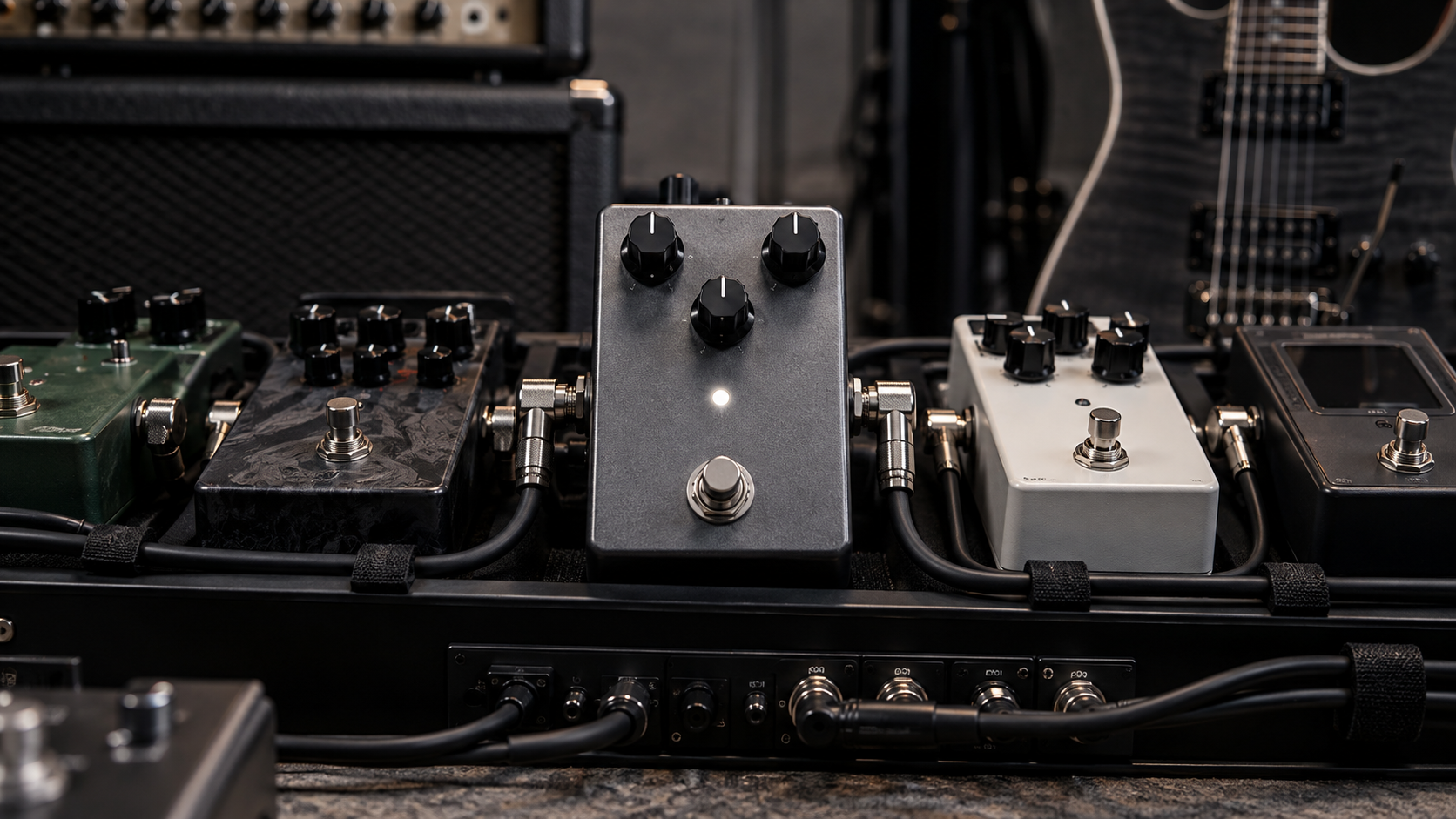
| Noisy guitar / boost / drive pedals | After the noisy gain section | The gate attenuates the noise those pedals have already generated. |
| High-gain amp preamp | FX loop or keyed/loop method | A gate only in front of the amp cannot directly attenuate noise generated later by the preamp. |
| Delay / reverb tails | Usually before time-based effects | Putting the gate after them can chop repeats and reverb decay. |
| Mixed noisy pedalboard | Use loop/keyed architecture if available | Detection can stay responsive while attenuation happens after noisy stages. |
For the broader order of gain, modulation and time-based effects, see guitar pedals for beginners and the delay and reverb order guide.
Why send/return noise suppressors are smarter than “gate after everything”
A gate with a send/return loop can separate detection from noise suppression. The detector can listen to the relatively clean guitar input, while noisy drive pedals sit inside the loop. That means the gate knows when you are actually playing before distortion and compression have raised the noise floor.
BOSS explicitly recommends placing noisy overdrive and distortion pedals inside the NS-2 send/return loop. The circuit can monitor the input while suppressing noise generated in the loop as those pedals switch on and off.
This is more accurate than putting a conventional gate after a heavily compressed distortion signal and asking it to infer your picking from a signal whose dynamics have already been flattened.
4-cable noise gate method: controlling pedal noise and amp-preamp noise together
If the amplifier’s preamp is a major noise source and the amp has an effects loop, a loop-equipped noise gate can be routed with four signal cables so the gate detects the guitar early but applies suppression after the noisy preamp stage.
The exact jacks and supported method depend on the gate and amplifier. Some products use send/return loops; others use a dedicated key/trigger input. Follow the device manual rather than assuming every four-jack gate is wired internally the same way.
The engineering advantage is straightforward: the detector sees a clean, dynamic version of your playing, while the attenuation stage can control the hiss created by the high-gain preamp later in the chain.
High-gain noise gate settings without killing sustain
Tight modern rhythm does not require setting the threshold as high as possible. It requires the threshold to sit just above the idle noise floor while the release behavior matches the part.
- Build the gain tone first. Set amp and pedals without the gate.
- Reduce avoidable noise. Check cables, power, pedal levels and unnecessary gain stacking.
- Set threshold from the noise floor. Raise it until idle noise is controlled.
- Test your quietest real playing. Soft picking, harmonics and sustaining notes should remain intact.
- Shorten decay only as much as the style needs. Fast stops are useful; chopped musical tails are not.
High-gain rigs amplify everything. If you are stacking fuzz, distortion and boosts, it helps to understand where the noise is being created. Our overdrive vs distortion vs fuzz guide covers how those gain stages behave differently.
What a guitar noise gate cannot fix
A gate is a level controller, not a repair tool.
- Bad power: shared-ground whine or an underpowered digital pedal should be fixed at the supply.
- Ground loops: the gate can mute the symptom between notes, not remove the loop.
- Microphonic hardware: squeal from pickups, tubes or components needs diagnosis.
- Noise under sustained notes: if the gate is open, the noise passes with the music.
- Excessive gain staging: using far more gain than the tone needs increases the noise floor before the gate even enters the picture.
Fast diagnostic workflow: find the noise before deciding where to gate it
| Test | What it tells you |
|---|---|
| Guitar straight into amp, clean channel | Baseline pickup + amp noise. |
| Add gain pedals one at a time | Identifies which pedal or stage raises the noise floor. |
| Use amp high-gain channel with pedals bypassed | Separates preamp hiss from pedal noise. |
| Power suspect digital pedals separately | Tests whether shared power is contributing whine. |
| Gate before vs after gain | Shows whether you need better detection or later attenuation. |
| Move time effects after the gate | Checks whether delay/reverb tails are being chopped. |
A good pedalboard is easier to gate because the noise sources are already controlled. If power is part of the problem, start with the guitar pedal power supply guide before buying another suppressor.
Guitar noise gate FAQ
Should a noise gate go before or after distortion?
If distortion is the main noise source, placing attenuation after the noisy stage is usually more effective. A loop-equipped gate can do even better by detecting the guitar before distortion while suppressing the noisy section afterwards.
Will a noise gate reduce sustain?
It can if threshold is too high or release/decay is too short. The gate cannot know whether a low-level signal is “musical sustain” or “noise” except through its detection design and settings.
Should a noise gate go in the FX loop?
If a high-gain amp preamp creates much of the noise, the FX loop is often the place where attenuation becomes useful. A keyed or 4-cable method can preserve better detection at the guitar input.
Can a noise gate remove hum?
It can mute hum when the signal falls below threshold. It does not remove hum while the gate is open and does not fix the electrical source of the hum.
What is the 4-cable noise gate method?
It routes the gate so its detector receives the guitar early in the chain while the gate’s suppression path can sit after noisy gain stages, including an amp preamp when the equipment supports that routing.
How this guide was built: the threshold/decay and send/return behavior is cross-checked against BOSS’s current NS-2 documentation. Routing concepts are explained generically because loop-equipped gates and amplifier FX loops differ; always verify the manual for the specific hardware.