Electric Guitar Bridge Types: Hardtail, Tremolo & Floyd Rose
The bridge decides far more than whether your guitar has a whammy bar
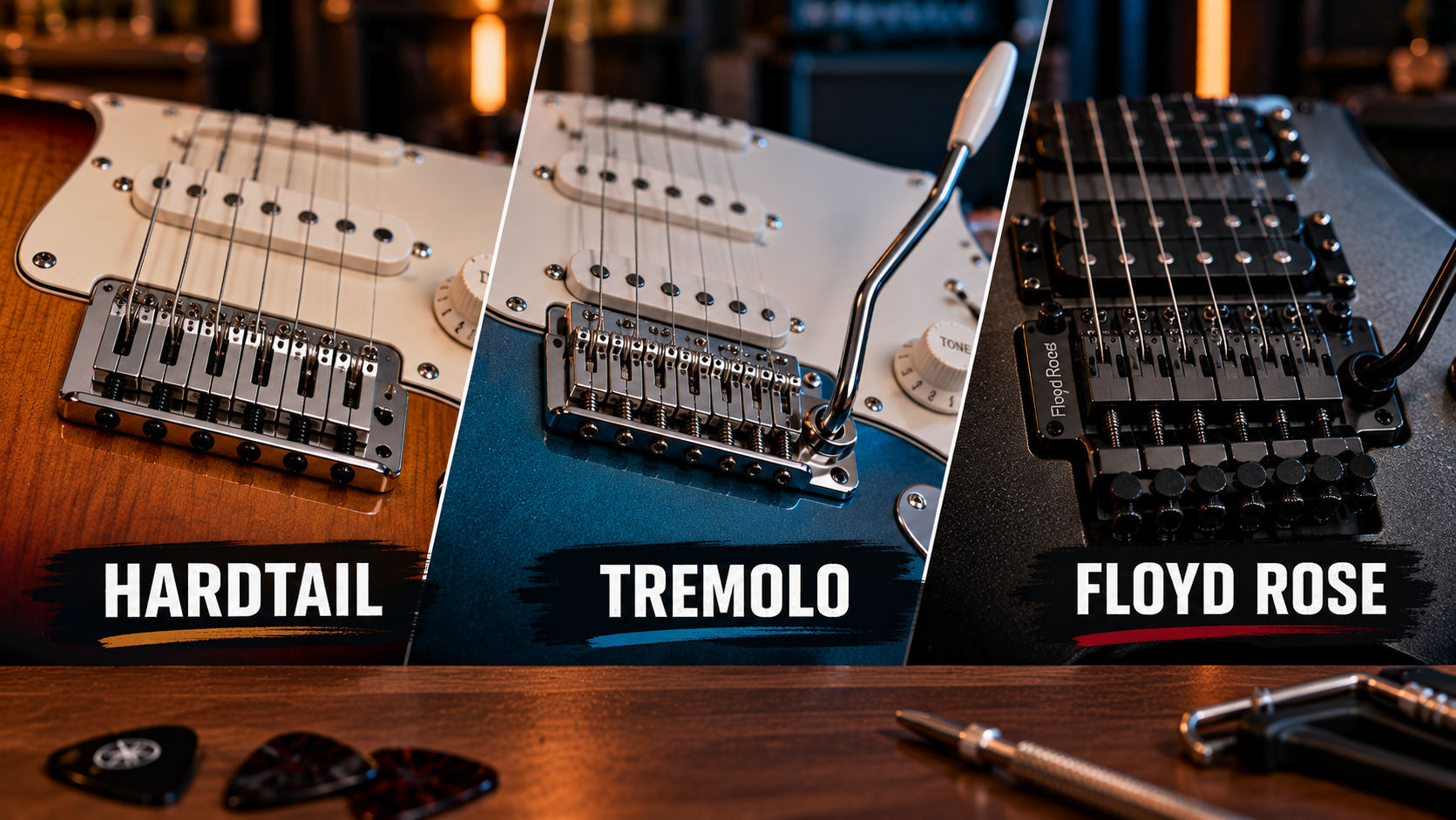
Different electric guitar bridge types change the way a guitar tunes, intonates, changes strings, handles alternate tunings and responds to pitch effects. A fixed bridge can make setup almost boring. A floating double-locking tremolo can make dramatic pitch movement possible, but every string becomes part of a tension-balanced system.
There is no universally “best” choice among electric guitar bridge types. The right bridge creates the trade-offs you want to live with.
Electric guitar bridge types: quick comparison
| Bridge type | Pitch movement | Setup difficulty | Alternate tuning flexibility | Main strength |
|---|---|---|---|---|
| Hardtail / fixed saddle | None | Low | High | Simple, stable, predictable |
| Tele 3- or 6-saddle | None | Low | High | Simple geometry; classic feel |
| Tune-o-Matic + stopbar | None | Low | High | Easy global action adjustment |
| Wraparound | None | Low–medium | High | Minimal hardware, direct feel |
| Vintage 6-screw tremolo | Moderate | Medium | Medium | Classic Strat pitch movement |
| 2-point tremolo | Moderate | Medium | Medium | Smoother pivoting and modern feel |
| Floyd Rose / Edge | Wide | High | Low without setup changes | Extreme pitch effects + locking stability |
| Bigsby-style | Subtle | Medium | Medium | Expressive shimmer rather than dive bombs |
| EverTune | Not a tremolo | Specialized | Requires system setup | Constant-tension tuning stability |
Bridge type and setup: what actually changes?
If you are changing more than one variable at a time, use the Guitar Setup Order first. It keeps bridge height, relief, intonation and pickup height from turning into a circular adjustment session.
If the bridge itself is unfamiliar, use our how to set guitar action guide before turning hardware blindly.
All adjustable electric guitar bridge types still interact with the same fundamentals: action, intonation, string gauge and neck relief. The difference is how many variables move when you touch one of them.
A hardtail lets you change a saddle and move on. A floating tremolo asks you to think about the entire tension balance. That does not make one better. It changes how much mechanical involvement comes with the musical feature.
Fixed vs floating: the mechanical difference that changes everything
A fixed bridge anchors string length without intentionally moving during performance. A floating bridge sits in equilibrium between string tension and spring tension, so changing one part of the system moves the rest.
This distinction between electric guitar bridge types explains most of the ownership difference. On a hardtail, bending the G string does not detune the other five strings through bridge movement. On a floating tremolo, the extra tension from the bend pulls the bridge forward slightly, so the unbent strings can drop in pitch while the bend is held.
Neither behavior is “wrong.” It is a consequence of the mechanism.
Hardtail bridge designs: top-load, string-through and modern fixed bridges
Modern hardtails appear in several forms. Some anchor strings through the body, some load through the rear of the bridge plate, and some use proprietary baseplates or separate anchor systems.
Across fixed electric guitar bridge types, the practical similarities matter more than internet arguments about which one has “more sustain”:
- the bridge does not intentionally move under pitch effects
- each string can usually be intonated independently
- alternate tunings are easy to access
- a broken string normally does not detune the remaining strings through bridge movement
- action work is mechanically straightforward
String-through construction changes the path and break angle, but it does not automatically make a guitar objectively better-sounding. The entire instrument contributes to the result.
Vintage Tele bridge: three saddles vs six saddles
A vintage Telecaster bridge commonly uses three saddles, each carrying two strings. The appeal is historical feel and simple hardware; the limitation is shared intonation.
A six-saddle bridge gives every string independent length and often independent height adjustment. Compensated three-saddle designs split the difference by offsetting the two contact points on each saddle so the pair can intonate more accurately.
This is a useful example of bridge design creating a real trade-off rather than a simple “old vs new” ranking.
Tune-o-Matic geometry: bridge, stopbar and break angle
On a typical Tune-o-Matic/stopbar system, the bridge handles action and intonation while the stopbar anchors the strings behind it. The two parts do different jobs.
Overall bridge height is changed at the posts or thumbwheels. Individual saddles handle compensation. The stopbar changes the string path behind the bridge and therefore the break angle over the saddles.
Lowering the stopbar to the body is not a universal rule. If the strings strike the rear edge of the bridge heavily, raising the tailpiece can create a cleaner path while maintaining secure saddle contact.
Wraparound bridges: simple does not mean crude
Early wraparound designs use one piece of hardware as both bridge and tailpiece. Traditional versions have limited individual intonation adjustment, but modern compensated wraparounds and adjustable versions solve much of that limitation.
Players who like minimal hardware often appreciate the direct layout. The downside is that adjustment range depends heavily on the specific design, so a generic wraparound setup guide can be misleading.
Six-screw Strat tremolo: why setup quality matters more than screw count
A traditional Strat bridge pivots around six front screws while springs in the rear cavity counteract string tension. The bridge can be decked against the body or floated. Fender’s current setup guide is a useful reference for the relief, saddle-height and tremolo-balance relationship on this style of system.
Tuning stability depends on the entire string path. A perfectly adjusted bridge cannot compensate for strings catching in nut slots, poorly installed strings, excessive friction at string trees or worn pivot surfaces.
If a six-screw bridge returns sharp after tremolo use, the bridge may not be the only suspect. If it returns flat, friction and bridge movement are still part of the diagnosis. Treat the system as a path rather than a single component. If the symptom is buzzing rather than tuning drift, use our Fret Buzz Guide before assuming the bridge itself is faulty.
Two-point tremolos: what the posts actually change
A two-point tremolo pivots on two studs instead of six front screws. This reduces the number of pivot contacts and is common on modern Strat-style instruments.
The posts can also establish the overall bridge height on many designs, but they are not generic “turn while fully loaded as much as you want” controls. Hardware and knife-edge design vary, so substantial height changes should follow the manufacturer’s procedure.
Once the bridge is balanced, individual saddles still handle intonation and—on many non-locking systems—string height/radius.
Floyd Rose: why double-locking works
The Floyd Rose system reduces two major sources of tuning movement by clamping the strings at the nut and locking them at the bridge saddles. Fine tuners on the bridge provide small pitch corrections after the nut is locked. Floyd Rose’s own setup instructions also make the spring/string balance explicit: the baseplate should return to its intended neutral position at pitch.
The bridge itself remains spring-balanced when floating. That means the locking system improves return-to-pitch behavior during large tremolo movement, but it does not eliminate the underlying equilibrium physics.
Floyd Rose’s own troubleshooting material emphasizes correct baseplate position, secure nut/string clamps and tight saddle hardware before blaming the bridge design. Damaged knife edges can also prevent reliable return.
Floyd Rose radius and saddle shims
Individual string height is not adjusted like a normal Strat saddle. Traditional Floyd setups can use individual saddle shims to alter the bridge radius, but that is no longer the only route. Floyd Rose now offers radius-specific Original saddle sets in multiple curvatures, specifically to match different fretboards without individual shims. Older hardware and custom combinations may still use shimming, so check the exact bridge and saddle set before changing the radius.
Ibanez Edge, Lo-Pro Edge and Edge-Zero are not one bridge
“Ibanez tremolo” is too broad to be a setup instruction. The original Edge and Lo-Pro Edge are double-locking floating systems related in concept to the Floyd Rose, while Edge-Zero variants can use different hardware and stabilization systems.
Ibanez publishes separate manuals for Edge, Lo-Pro Edge, Edge-Zero II, Edge-Zero with ZPS and other locking and non-locking bridges. That matters because spring adjustment, neutral position, intonation access and stabilization details are not identical across the family.
If you own an Ibanez, identify the bridge visually or by model documentation before turning anything. “It looks like a Floyd” is not enough for precision setup work.
What changes when you block or deck a floating tremolo?
Limiting rearward movement changes the behavior of the whole guitar.
Up and down pitch travel
Maximum expressive range, but bends and broken strings affect the pitch of the remaining strings through bridge movement.
Downward pitch only
The bridge rests against or stops at a fixed reference in one direction, which makes bends and tuning changes less disruptive.
Floyd Rose currently sells a tremolo stop specifically to create a dive-only configuration, citing easier string changes and better pitch behavior during bends or if a string breaks. Similar principles can be achieved with other bridge-specific blocking systems.
Bigsby setup: the bridge is only half the tuning story
A Bigsby changes pitch by rotating a spring-loaded string bar rather than floating an entire Strat-style bridge plate. The amount of travel is typically subtler, but the strings still move across nut and bridge contact points.
That means smooth slots, sensible break angle and low-friction contact surfaces matter enormously. A Bigsby can be stable when the entire string path is working; it can also reveal every sticky contact point when it is not.
Do not evaluate Bigsby tuning stability using Floyd Rose expectations. They are designed around different ranges and feel.
EverTune: constant tension instead of a conventional fixed saddle
EverTune looks like a fixed bridge from the player’s perspective, but each saddle uses a spring-and-lever mechanism that maintains target string tension through an active operating range.
EverTune’s current quick-start documentation calls this active range Zone 2. Once a saddle is activated in Zone 2, tuning is performed at the bridge with a hex key. The headstock tuner is then used to position the saddle within Zone 2 and set bend sensitivity.
Bend sensitivity is adjustable per string
Near the boundary between Zone 2 and Zone 3, a string can bend more like a conventional guitar. Deeper in Zone 2, the mechanism resists pitch change caused by finger pressure or hard picking. EverTune allows this behavior to be set separately for each string.
That means a player can, for example, keep low rhythm strings strongly stabilized while allowing the B and high E to bend normally.
Action and intonation are still adjustable
EverTune’s current instructions include separate adjustments for string length and string height. After either operation, the desired bend-sensitivity position has to be reset because the saddle has moved within its active range.
So EverTune is not “no setup required.” It is a different setup architecture with a specific operating sequence.
Electric guitar bridge types for alternate tunings
If you switch from E standard to Drop D between songs, a fixed bridge is the easiest environment because the bridge itself does not rebalance. A decked or dive-only tremolo can also tolerate quick changes better than a fully floating system.
On a fully floating Floyd Rose, Edge or Strat tremolo, changing one string’s tension moves the bridge and therefore affects every other string. You can absolutely use alternate tunings, but each stable tuning becomes its own balance point unless the bridge is mechanically constrained.
Bridge choice for heavy rhythm playing
A hardtail or Tune-o-Matic is appealing for aggressive rhythm because palm pressure cannot accidentally move a floating bridge sharp and the tuning remains mechanically independent between strings. If you are also choosing strings around lower tunings, our Guitar String Gauges guide covers the other half of that tension equation.
A floating bridge is still perfectly usable for metal rhythm, but technique matters. Resting a heavy picking hand on the bridge can change pitch slightly if enough force is applied. Some players adapt instantly; others prefer the fixed reference of a hardtail.
Bridge choice for lead and tremolo effects
For subtle chord shimmer and gentle pitch movement, a non-locking Strat tremolo or Bigsby may provide all the range you need. For deep dives, flutter and large upward pulls, a double-locking floating bridge is the purpose-built option.
That extra range comes with more setup coupling. The correct choice depends on whether the musical feature is worth the maintenance trade-off to you.
Maintenance and wear points by bridge type
| Bridge family | Wear / maintenance areas to watch |
|---|---|
| Hardtail / Tele | Saddle screws, intonation screws, corrosion, loose mounting hardware |
| Tune-o-Matic | Saddle slots, bridge posts, retaining hardware, excessive string contact on rear edge |
| Strat tremolo | Pivot screws/posts, saddles, springs, claw screws, nut/string-tree friction |
| Floyd / Edge | Knife edges, studs, locking blocks, nut clamps, fine tuners, saddle screws, springs |
| Bigsby | Pivot/bearing movement, spring, string path friction, bridge/nut condition |
| EverTune | Follow manufacturer service guidance; each saddle is a mechanical module with dedicated adjustment points |
Which electric guitar bridge type should you choose?
Choose a hardtail if
You want easy tuning changes, simple restringing, straightforward action/intonation work and no need for pitch effects.
Choose a Strat-style tremolo if
You want expressive vibrato and moderate pitch movement without committing to a locking system.
Choose a Floyd Rose or Edge if
Wide pitch travel and aggressive tremolo use matter more than fast tuning changes and simple maintenance.
Choose Tune-o-Matic if
You like fixed-bridge simplicity and the feel/geometry common to Les Paul- and SG-style guitars.
Choose a Bigsby if
You want subtle vintage-style movement and accept that friction points need careful setup.
Choose EverTune if
Your priority is resisting unwanted pitch change and you are comfortable learning a specialized constant-tension system.
A bridge should match your tolerance for setup, not your ego
There is nothing “beginner” about choosing a hardtail because you do not want a floating system. There is also nothing irrational about accepting a longer setup process because a Floyd Rose lets you perform techniques a fixed bridge cannot.
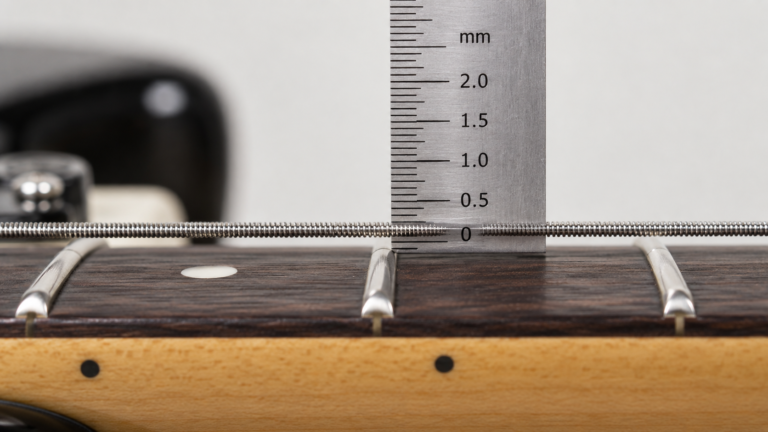
Understanding electric guitar bridge types is really about choosing which compromises disappear into the background once you start playing. The useful question is not which bridge looks more advanced. Once you start adjusting one, a Guitar Action Gauge gives you a repeatable way to track the string-height changes the bridge creates.
FAQ
Is a hardtail more stable than a tremolo?
It is mechanically simpler and less sensitive to whole-system tension changes. A well-set-up tremolo can also be stable, but it has more variables that must work correctly.
Is a Floyd Rose hard to maintain?
It is not difficult once the balance concept makes sense, but it is slower to restring, retune dramatically and intonate than a simple fixed bridge.
Can I change tuning easily on a floating tremolo?
Small changes may be manageable, but large tuning changes alter string tension and therefore bridge angle. Fixed bridges are much friendlier if you switch tunings constantly.
Is a two-point tremolo better than six-screw?
Not universally. Two-point systems offer a different pivot geometry and are common on modern guitars; six-screw systems deliver the traditional Strat architecture. Setup quality matters more than declaring one design categorically superior.
Does bridge type affect intonation?
Every bridge must provide enough compensation range for the chosen strings and tuning. The difference is how independently and conveniently the saddles can be moved.