How to Intonate a Guitar: Fix Sharp and Flat Notes
If open strings are in tune but fretted notes drift, the saddle position is the variable to check
A guitar is not perfectly compensated by placing every saddle exactly at the nominal scale length. Fretting stretches the string slightly, and different strings need different amounts of extra length to keep fretted notes close to pitch. That correction is guitar intonation.
The procedure is simple once the rest of the setup is stable. If you are learning how to intonate a guitar, remember one rule first: compare the tuned string with its 12th-fret reference, then move the saddle in the direction that corrects the error.
Before you learn how to intonate a guitar
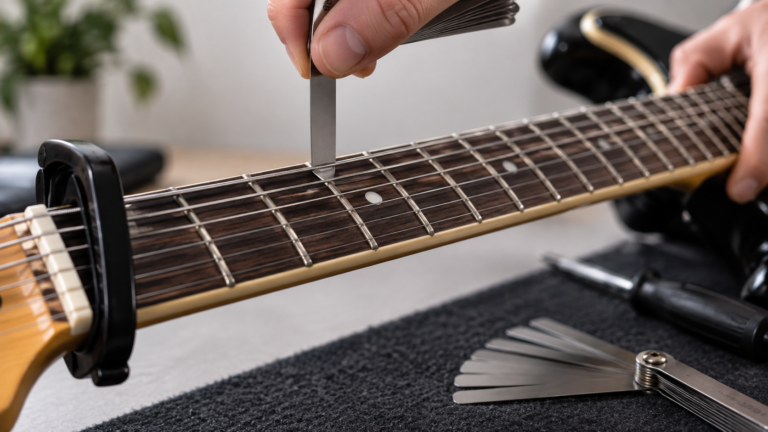
Intonation should be one of the last mechanical steps in a setup. Set the string gauge and tuning, establish reasonable neck relief, stabilize a floating bridge if you have one, and finish the action first.
If that order feels arbitrary, it is not. Changing action changes how far the string is pressed before it contacts the fret. Changing bridge angle on a floating tremolo changes the reference position again. Our Guitar Setup Order guide lays out the setup sequence.
Use healthy strings
Old strings can produce unstable or inconsistent intonation readings. Wear, corrosion and flattened contact points alter how a string behaves. If you are doing a complete setup, intonate with the set you actually plan to keep on the guitar.
Use an accurate tuner
A high-resolution digital or strobe-style tuner makes the job easier. You are comparing small pitch differences repeatedly, so a tuner that jumps around can turn a simple process into guesswork.
How to intonate a guitar at the 12th fret
StewMac’s current setup guidance uses the same core rule: fretted 12th sharp means lengthen the string; fretted 12th flat means shorten it.
How bridge type changes the procedure
Once you know how to intonate a guitar on a standard adjustable saddle, the pitch logic stays the same across bridge types. What changes is how the hardware lets you move the saddle.
Strat / hardtail saddles
Each saddle moves along a screw. The physical rule matters more than memorizing screw direction because hardware orientation can vary: sharp goes away from the neck; flat goes toward the neck.
Tune-o-Matic
Each saddle moves inside the bridge. Some bridges are installed with the screw heads facing different directions, so again watch the saddle itself instead of relying on “clockwise means back.”
Vintage three-saddle Tele
Two strings share each saddle, which makes perfect independent compensation impossible with a straight traditional saddle. Compensated saddles angle the contact points to improve the compromise.
Floyd Rose / locking tremolo
The principle is identical but the workflow is slower. Many Floyd-style saddles must be loosened before repositioning. A dedicated intonation tool can make controlled movement much easier while the bridge remains balanced.
For a broader mechanical comparison, see Electric Guitar Bridge Types.
Fretting pressure can make a good guitar look badly intonated
If you press the string harder than you normally would, especially on tall frets, you stretch it farther and the tuner reads sharp. Intonation should reflect real playing pressure.
This is also why action matters. Higher strings travel farther before contacting the fret, creating more fretting stretch. If you change action significantly, check intonation again. Our How to Set Guitar Action guide should come first.
Why intonation sometimes refuses to settle
Old or defective string
Replace the string before redesigning the guitar around one inconsistent reading.
Saddle at the travel limit
Check string gauge, bridge position, saddle orientation on applicable bridges and the rest of the setup before modifying hardware.
Floating bridge still moving
Intonation cannot be stable while bridge angle changes with every tuning correction.
Excessive action
More fretting stretch can make notes read sharper and increase the required compensation.
Why open chords can still sound sharp after perfect 12th-fret intonation
Bridge intonation does not solve every pitch problem on a fretted instrument. If first-position chords sound noticeably sharp while the upper neck checks out, nut-slot height deserves attention.
A high nut forces the string to travel farther to reach the first few frets. That extra displacement stretches the string and can pull the note sharp. Moving the bridge saddle to compensate may improve one area while making another worse.
Guitars also use fixed frets and equal temperament, so “perfect everywhere” is not a realistic expectation. The goal is a musically useful compromise across the neck.
Why string gauge and tuning changes affect intonation
Different gauges have different stiffness and tension characteristics. A major gauge change can also alter neck relief or floating-bridge position. Lower tunings change tension again.
That is why StewMac recommends rechecking intonation after changes that affect string length or bridge position, including string gauge, tremolo spring tension, bridge height and significant tuning changes.
If you move from a light E-standard setup to a heavier drop-tuned set, treat intonation as part of the new setup rather than assuming the old saddle pattern remains ideal. Our Guitar String Gauges guide covers the tension and feel changes that usually come with that move.
How accurate does guitar intonation need to be?
Knowing how to intonate a guitar is partly about knowing when the tuner is showing a meaningful problem and when you are simply chasing the limits of a fretted instrument.
A tuner can show differences smaller than you can meaningfully hear in normal playing, so intonation work can turn into an endless chase for a perfectly centered display. The goal is not mathematical perfection at every fret. A conventional fretted guitar cannot deliver that because fret positions are fixed and equal temperament is itself a compromise.
A better standard is repeatability. Tune the open string accurately, fret the 12th with normal pressure, and get the two references as close as your tuner and hardware allow. Then check familiar chords and intervals around several parts of the neck. If the 12th-fret reading is excellent but open-position chords still sound wrong, investigate the nut or fretting pressure instead of continuing to move the saddle.
Harmonic vs fretted note: what are you actually comparing?
The 12th-fret harmonic sounds at half the vibrating string length and provides a clean octave reference without pushing the string down to a fret. The fretted 12th does require displacement, so it reveals the pitch increase caused by fretting and the amount of compensation the saddle needs.
The harmonic itself is not “intonated” by moving the saddle in the same way the fretted note is. When you move the saddle, you are changing the speaking length so the fretted note agrees with the octave reference under real playing geometry.
You can also compare the tuned open string directly with the fretted 12th using a reliable tuner. The key is to retune the open string every time the saddle moves.
Why intonation should be checked at more than one fret
The 12th fret is the standard setup reference because it is convenient, repeatable and sits at the octave. If you are also measuring string height during the same setup, use a repeatable method such as the one in our Guitar Action Gauge guide. A finished guitar should also sound musically sensible elsewhere.
After setting the 12th fret, check:
- open-position major chords
- fretted notes around the 5th–7th frets
- octaves around the 12th fret
- upper-register notes around the 15th–17th frets
If the 12th fret is right but the first few frets are consistently sharp, a high nut or heavy fretting pressure is more likely than a bridge problem. If the error grows strangely toward the upper frets, recheck action, string condition and saddle position.
Three-saddle Telecaster intonation: why it is a compromise
A vintage three-saddle Tele bridge puts two strings on each saddle. That means one physical saddle position has to serve two strings whose ideal compensation lengths are not identical.
Traditional straight brass saddles therefore require a compromise: set the pair so neither string is badly wrong, rather than trying to make both perfect independently. Compensated Tele saddles angle or offset the two string contact points so each string gets a more appropriate effective length while preserving the three-saddle layout.
A six-saddle Tele bridge removes that shared-compensation problem because every string gets its own saddle position.
Detailed Floyd Rose intonation workflow
The core rule for how to intonate a guitar does not change on a Floyd Rose; the extra work comes from the way the saddle is clamped to the bridge.
Floyd Rose’s official intonation procedure is mechanically different from a Strat saddle screw because the saddle is clamped to the bridge plate rather than continuously moved by a rear intonation screw.
- Leave the nut clamps released while setting intonation.
- Tune the guitar accurately.
- Compare the 12th-fret harmonic and fretted note.
- If the fretted note is sharp, the saddle must move away from the nut. If flat, it must move toward the nut.
- Loosen the string until it is slack.
- Loosen the saddle attachment screw while controlling the saddle position.
- Move the saddle a small amount and retighten it.
- Retune and check again.
- Repeat until the string is compensated, then lock the nut after the setup is complete.
Floyd Rose notes that the saddle attachment screw can use alternate holes in the bridge plate when extra forward or rearward travel is required. Dedicated tools such as The Key can make saddle positioning easier, but the underlying sharp/flat rule does not change.
Floating tremolo intonation: why one string affects the rest
On a fully floating tremolo, tuning one string changes total string tension. That can tilt the bridge slightly, which changes the tuning of the other strings. That circular feeling usually means the bridge is not yet balanced.
Work iteratively. Keep the bridge at its intended neutral angle, tune across all strings, set one saddle, then bring the whole guitar back to equilibrium before judging the final result. The farther the bridge moves during the process, the less trustworthy a single-string reading becomes.
If the bridge is badly tilted forward or backward, fix spring balance first. Floyd Rose’s own troubleshooting guidance says the baseplate should sit in its intended level position and spring tension should be corrected before treating tuning return as a separate fault.
What if the saddle runs out of intonation travel?
Do not immediately drill, reverse parts or blame the scale length. Work through the simple causes first.
Replace the suspect string
A damaged, kinked or old string can intonate badly even when the hardware is correct.
Check the setup
Very high action or an unstable floating bridge can increase the compensation you are trying to dial out.
Check saddle orientation
Some Tune-o-Matic saddles can be reversed to gain usable travel, depending on the bridge design.
Check the actual tuning and gauge
Very unusual strings or tunings can move the ideal saddle position significantly compared with the factory setup.
If every string wants to sit beyond the bridge’s available range in the same direction, that points toward a larger geometry or bridge-placement issue rather than six independent saddle problems.
Why high action makes fretted notes sharper
To fret a note, you push the string down until it contacts the fret. The farther it has to travel, the more the string is stretched. That additional tension raises pitch.
This is why excessive action can create a guitar that appears to need unusually large intonation compensation. Check the Electric Guitar Action Height first, then intonate. Otherwise you are compensating the bridge for a string height you may later change.
If buzz was the reason you raised the bridge in the first place, diagnose it separately with our Fret Buzz Guide before using intonation to compensate for a temporary action setting.
Can perfect intonation fix a badly cut nut?
No. Bridge compensation mainly controls the effective speaking length of fretted strings. A high nut creates excessive stretch in the first few positions. If you move the saddle to make those first-position notes flatter, you can make the middle and upper neck worse.
The diagnostic clue is location: if the error is strongest close to the nut and becomes less obvious farther up the neck, check nut height before continuing to chase the saddles.
Intonation after alternate tunings and string-gauge changes
If you already know how to intonate a guitar in one tuning, a new tuning or string gauge does not change the method—it changes the setup around it and the saddle positions you end up with.
A major tuning or gauge change can alter more than one part of the guitar. Relief may move, a floating tremolo may change angle, action may shift and the strings themselves require different compensation.
For fixed bridges, the process is straightforward: let the neck settle, check relief/action, then re-intonate. For floating bridges, establish the new spring balance first. If you constantly move between radically different tunings, a fixed bridge or a mechanically constrained tremolo is much easier to live with than a fully floating system.
EverTune intonation is mechanically different
EverTune saddles operate in an active constant-tension range, so the bridge has its own setup sequence. EverTune’s current quick-start guide says the saddle should first be placed in Zone 2, the string tuned at the bridge, and bend sensitivity set before intonation.
For the current EverTune system, a sharp 12th-fret note is corrected by lengthening the string with the intonation screw; a flat note is corrected by shortening it. After changing intonation, the saddle’s desired bend-sensitivity position must be reset because the adjustment changes where the saddle sits within its operating zone.
This is a good example of why “all bridges intonate the same way” is only partly true. The pitch logic is the same, but the mechanical sequence can be completely different.
Why you should tune the whole guitar repeatedly during intonation
On a fixed bridge, moving one saddle mostly affects one string, but even there you should retune the reference string before every comparison. On a floating tremolo, the need is stronger because changing one string’s tension can shift the bridge and slightly move the other five strings.
Work in passes rather than trying to perfect one string in isolation. Get all six close, retune the guitar, then make a second pass. The final corrections are smaller and more reliable once the system has settled near its intended equilibrium.
What about compensated nuts and temperament systems?
Some guitars use compensated nuts or proprietary temperament systems to improve pitch behavior in areas where a conventional nut-and-fret layout is a compromise. These systems can be useful, but they do not make normal bridge intonation irrelevant.
If your guitar uses a specialized nut or fret system, follow that manufacturer’s setup method before applying generic assumptions. Conventional 12th-fret intonation remains a useful reference, but the intended pitch relationships may be designed around additional compensation elsewhere on the instrument.
FAQ
Should I compare the 12th-fret harmonic or the open string?
Either can serve as a reference with a good tuner. The useful comparison is between the intended octave reference and the normally fretted 12th-fret note. Be consistent.
How to intonate a guitar if the 12th-fret note is sharp?
Away from the neck. You are lengthening the vibrating string.
Which way if the note is flat?
Toward the neck. You are shortening the vibrating string.
Do I need to intonate after every string change?
Not necessarily when replacing the same gauge with the same tuning, but it is worth checking. A substantial gauge, tuning, action or bridge change is a stronger reason to reset it.
Why are my saddles not in a straight line?
Because different strings need different compensation. A staggered saddle pattern is normal and functional.