Guitar Action Gauge: Measure String Height Without Guessing
A guitar action gauge is one of the simplest setup tools you can buy, but it is also one of the easiest to misuse. The problem is not reading the little numbers. The problem is measuring from the wrong reference, at the wrong fret, in the wrong order, then treating the result as if it proves what the guitar needs.
This guide treats action as a measurement problem first and a setup decision second. You will learn exactly where the ruler goes, why 12th-fret and 17th-fret numbers are not interchangeable, how bass-side and treble-side measurements should be recorded, and why a low action number cannot tell you whether a buzz comes from neck relief, fret level, nut height, or picking technique.
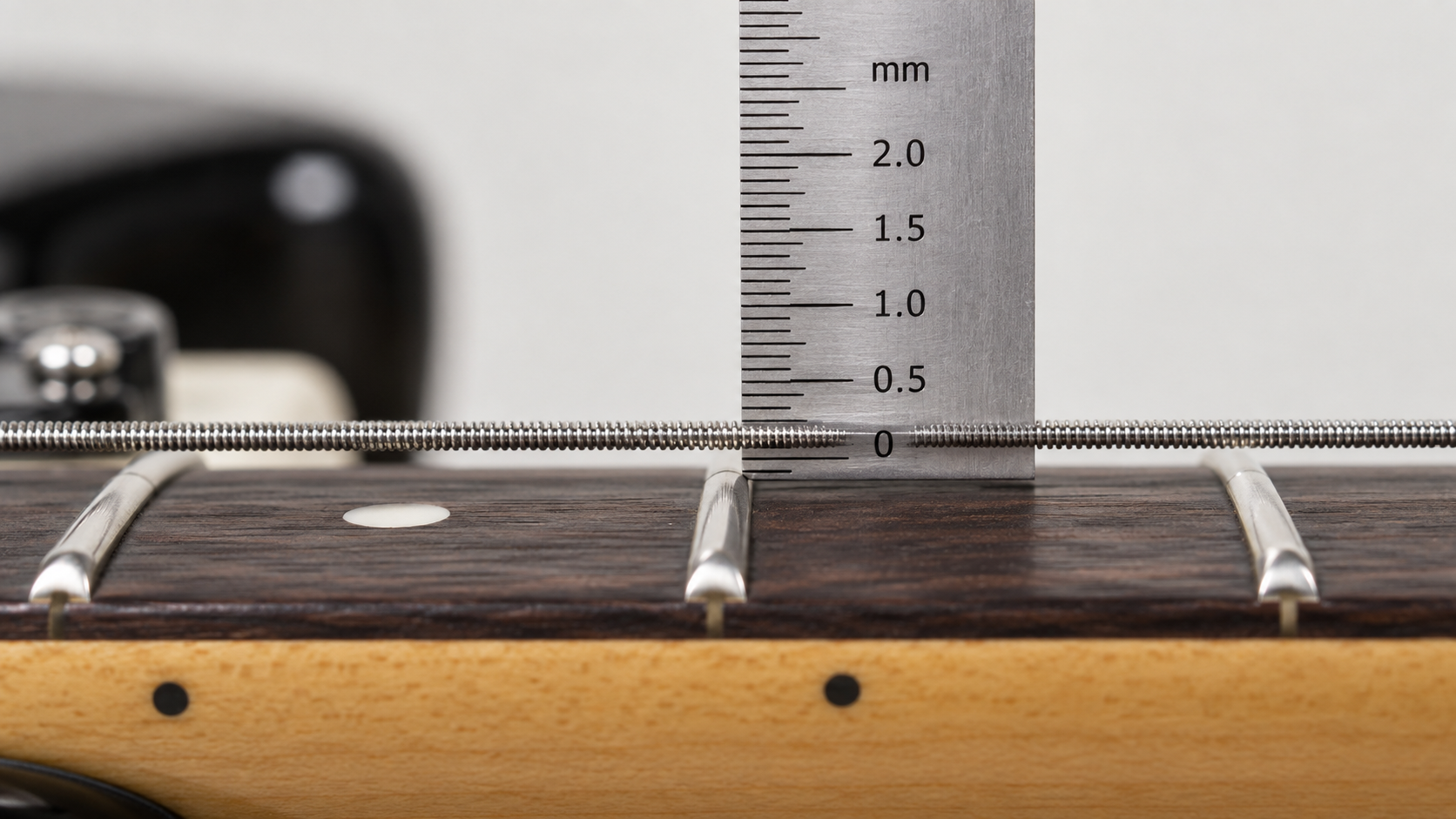
Action is the vertical gap from the top of the fret to the bottom of the string
Not from the fingerboard. Not from the top of the string. And not from wherever the printed lines on the gauge happen to look easiest to read.
What a guitar action gauge actually measures
Most action gauges are small stainless-steel rulers with metric and imperial markings close to a true zero edge. That zero edge is the important part. A normal household ruler often has a dead margin before the first marking, which makes it awkward for measuring a gap of only a couple of millimeters.
The tool measures string height above a fret. It does not directly measure neck relief, nut slot height, fret height, saddle radius, or the amount of buzz a player will tolerate. Those are related setup variables, but they are different measurements.
Action gauge / string-height ruler
Use it vertically on a fret to measure the gap from fret top to string bottom. This is the right tool for action.
Feeler gauge
Use calibrated thin blades for tiny gaps such as neck relief. It solves a different measurement problem.
Before you measure: control the variables
A measurement is only useful when you can reproduce it. Before putting a ruler under a string, tune the guitar to the tuning you actually use, install the string gauge you intend to keep, and make sure the neck has settled after any major string or tuning change.
Measure the guitar in a normal playing orientation when practical. A neck is a loaded beam under string tension; supporting the instrument differently can slightly change what you see on a very precise setup. You do not need a laboratory fixture, but you do want consistency.
A 12th-fret measurement and a 17th-fret measurement are both valid. They are not the same measurement, so the numbers should not be compared as if they came from the same location.
How to measure guitar action with an action gauge
If you are measuring because the guitar buzzes, read our fret buzz diagnosis guide before raising every saddle. Action is only one possible cause.
12th fret vs 17th fret: both are valid, but they answer different reference systems
Many guitar technicians and setup guides quote action at the 12th fret because it is easy to find, near the middle of the scale length, and convenient for comparing guitars. Fender’s published factory setup procedure for electric guitars, by contrast, checks string height at the 17th fret.
That does not mean one method is correct and the other is wrong. It means the target number must travel with its measurement location. If somebody says “my action is 1.5 mm” without telling you the fret, the information is incomplete.
| Reference | Why people use it | Main caution |
|---|---|---|
| 12th fret | Common technician/reference point; easy to compare and repeat. | Do not compare directly with a factory spec measured elsewhere. |
| 17th fret | Used in Fender’s published electric-guitar setup procedure. | Expect a different number from a 12th-fret reading on the same guitar. |
Fender’s current factory setup documentation explicitly instructs players to check electric-guitar string height at the 17th fret after neck relief has been checked. That sequence matters as much as the number. See Fender’s factory setup specs for the manufacturer-specific method.
Action gauge conversion: millimeters, inches and 64ths
Guitar setup discussions mix metric measurements with fractions of an inch. The fastest way to create confusion is to mentally round too aggressively. The table below is a conversion reference, not a target-action chart.
| Millimeters | Decimal inches | Approx. 64ths |
|---|---|---|
| 1.00 mm | 0.039 in | 2.5/64 |
| 1.25 mm | 0.049 in | 3.1/64 |
| 1.50 mm | 0.059 in | 3.8/64 |
| 1.75 mm | 0.069 in | 4.4/64 |
| 2.00 mm | 0.079 in | 5.0/64 |
| 2.25 mm | 0.089 in | 5.7/64 |
| 2.50 mm | 0.098 in | 6.3/64 |
Use the scale printed on the gauge whenever possible instead of converting repeatedly. Conversion is most useful when comparing two sources that use different units.
Bass side vs treble side: why one number is not enough
The low strings move through a wider vibration envelope than the high strings, especially when picked hard. That is one reason many setups end up with slightly more clearance on the bass side. The exact difference depends on scale length, string gauge, tuning, fret condition, playing attack, and how much acoustic buzz the player accepts.
Record at least the low E and high E. On a very precise setup, checking the intermediate strings is also useful because one saddle can be out of line even when the two outside measurements look sensible.
If you change from 9–42 to 10–46 or 11s, do not assume the old action numbers will produce the same feel. Tension and vibration behavior change with the string set. Our guitar string gauge guide explains the practical differences.
Fingerboard radius, saddle height and the trap of “perfectly matching the radius”
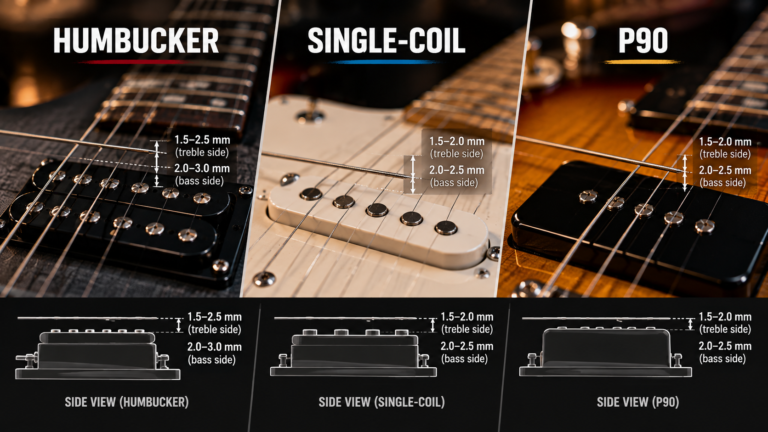
On bridges with individually adjustable saddles, the string heights generally form a curve that follows the fingerboard radius. But “follow the radius” does not mean every string should be exactly the same distance from the frets.
The outer strings define the broad height relationship, while the middle saddles create the arc. A radius gauge can help as a sanity check, but action should still be verified at the strings themselves. The playing requirement is clearance over frets, not geometric obedience to a plastic radius template.
What an action measurement can — and cannot — diagnose
Action is high everywhere
Bridge height may be high, but excess neck relief can also raise the middle of the playing surface. Measure relief before lowering saddles aggressively.
Buzz appears on several lower/middle frets
Too little relief or back-bow may be involved. Action alone does not isolate it.
One note buzzes in one local area
A high fret, loose fret, worn fret or local geometry problem is more plausible than “the whole action is too low.”
Open strings buzz
Nut-slot height, neck geometry, or hardware can be involved. Raising bridge saddles is a poor first response.
Two guitars can show the same string height and behave completely differently because fret level, relief, nut work, scale length, strings, and playing attack are different.
The setup order that keeps measurements meaningful
A reliable electric-guitar setup is a sequence. Changing one variable can move another measurement, so random adjustment wastes time.
If you are new to this, the beginner guitar checklist gives the broader maintenance context.
Guitar action gauge FAQ
Do I measure guitar action from the fretboard or the fret?
From the top of the fret to the bottom of the string. Measuring from the fingerboard adds fret height to the reading and makes comparison numbers meaningless.
Should I measure guitar action at the 12th or 17th fret?
Use the fret specified by the setup method you are following. Both locations are used in practice. What matters is not mixing a target from one reference with a measurement from another.
Is a string action gauge the same as a feeler gauge?
No. A string action gauge is a ruler for string height. A feeler gauge uses thin calibrated blades for much smaller gaps such as neck relief.
Can I fix fret buzz by raising the action?
Sometimes, but not always intelligently. A local high fret, incorrect relief, low nut slot or hardware vibration may still be the real cause.
What is a good guitar action?
There is no single universal number. Start from a manufacturer or technician reference measured at the correct fret, then adjust for the player’s touch, strings, tuning and fret condition.
How this guide was built: measurement logic is based on repeatable setup practice and cross-checked against Fender’s published electric-guitar factory setup procedure. The goal is not to prescribe one magic action number; it is to make your measurements comparable and diagnostically useful.