Guitar Pickup Height Guide: Humbucker, Single-Coil & P90
Pickup height is a tone control you adjust with a screwdriver
Guitar pickup height changes more than output. Move a magnetic pickup toward the strings and you can change attack, compression, bass response, perceived brightness and the balance between pickups. Move it too close and magnetic pull can interfere with how the string vibrates. Move it too far away and the guitar can sound weak or disconnected.
The goal is not to chase one universal measurement. It is to start from a safe, repeatable distance and then balance the guitar by ear.
How to measure guitar pickup height
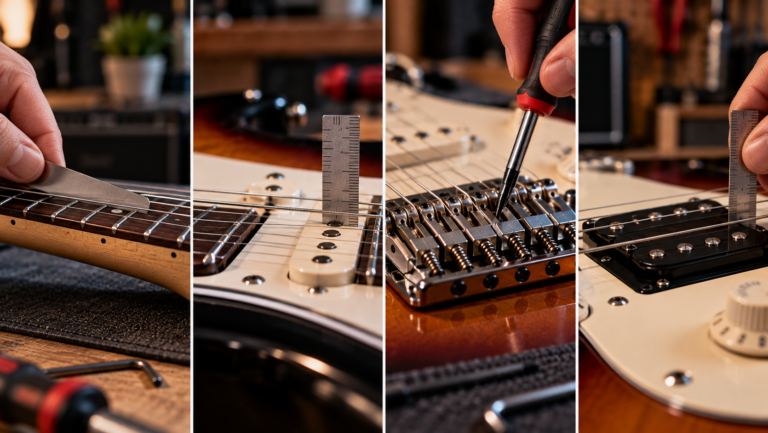
Seymour Duncan’s current pickup-height guidance uses a simple repeatable method: hold the low E at the last fret, measure from the underside of the string to the top of the corresponding pickup pole or surface, then repeat on the high E. If you want a repeatable small-gap ruler for setup work, our Guitar Action Gauge guide explains how to read one without introducing measurement error.
- Tune the guitar normally.
- Fret the low E at the last fret.
- Measure the gap from the string underside to the pickup’s magnetic reference point.
- Repeat on the high E.
- Adjust the pickup in small increments.
- Remeasure after moving either side because one adjustment can slightly tilt the pickup.
Do this only after your action is basically final. If you lower the strings by 1 mm after setting the pickups, you have effectively raised the pickups 1 mm relative to the strings. That is why pickup height belongs near the end of the guitar setup order.
Practical guitar pickup height starting points
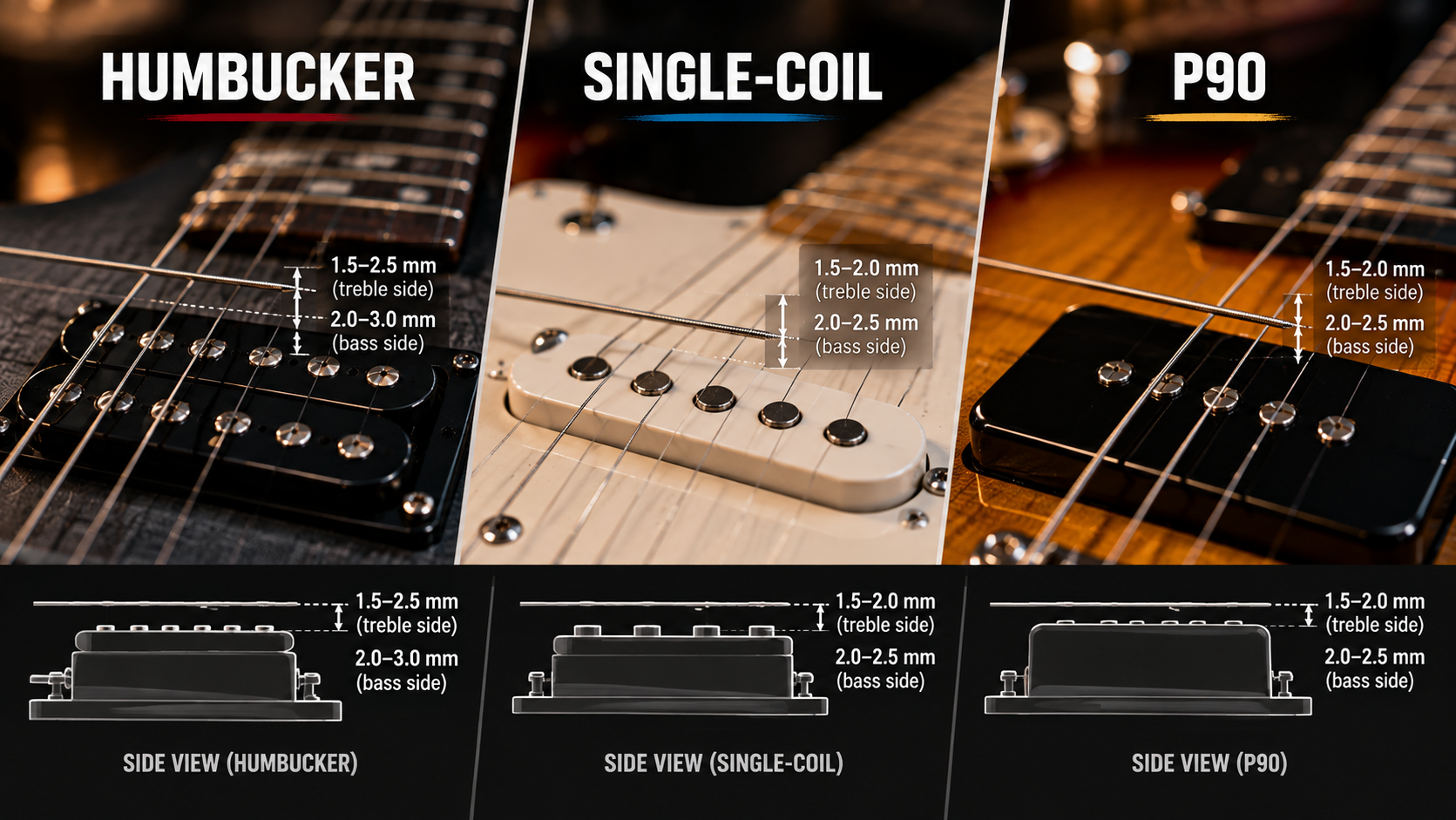
There is no one correct spec for every pickup. Magnet type, output, construction and manufacturer recommendation matter. Seymour Duncan’s current guidance suggests roughly 3/32 inch (2.38 mm) as a broad starting point for many pickups, while also noting model-specific exceptions.
| Pickup type | Useful first move | What to watch |
|---|---|---|
| Passive humbucker | Start around the maker’s spec or roughly 2–3 mm | Compression, bass thickness, bridge/neck level |
| Strat-style single-coil | Start conservatively, especially on the bass side | Magnetic pull, warble, open high-end |
| P90 | Use maker spec when available; adjust whole pickup or poles depending on design | Midrange density, bass thickness, string balance |
| High-output / rail / specialty | Use model-specific manufacturer guidance | General rules can be misleading because magnetic structures differ |
Those are setup starting points, not a promise that every pickup sounds best at the same distance. The final adjustment is tonal.
What happens when pickups are too high or too low?
Too high
- stronger output but less dynamic room
- overly thick or congested bass
- harsh attack on some pickups
- reduced sustain if magnetic pull becomes excessive
- pitch warble or “wolf-tone” behavior, especially with strong single-coil magnets
Too low
- weaker signal
- less low-frequency authority
- large volume mismatch between pickup positions
- cleaner, more open response that may or may not be desirable
- reduced drive into the amp compared with the same pickup set higher
Seymour Duncan’s current guidance specifically warns that pickups set extremely close can interfere with string vibration and tuning behavior, while pickups set too far away lose output and fullness.
Humbucker pickup height: output vs openness
Passive humbuckers often tolerate being relatively close to the strings, which makes it tempting to raise them until the guitar becomes as loud as possible. That is not always where they sound best.
Raise a humbucker and you generally increase signal strength and push the front of an amp or modeler harder. Lower it and you can gain some dynamic space and clarity. Seymour Duncan describes lower passive humbuckers as often feeling more responsive to picking dynamics, while higher settings can sound brighter, dirtier and more forceful.
Set the bridge pickup first
The bridge position sees less string excursion than the neck position, so it is a good reference for the guitar’s main output level. Dial in the bridge pickup for attack and body, then switch to the neck pickup and balance it against that reference.
Use clean tones while balancing. Heavy distortion compresses level differences and can hide a neck pickup that is much louder than the bridge.
Single-coil pickup height: respect magnetic pull
Traditional Strat-style single-coils use magnetized pole pieces close to the strings. If the bass side sits too high, magnetic pull can create strange overtones and warbling that players sometimes mistake for intonation or fret problems.
Seymour Duncan’s published Strat guidance recommends keeping the bass side farther away than the treble side in several positions. The exact distance depends on the pickup, but the diagnostic principle is useful: if a single-coil guitar develops odd low-string pitch behavior, lower the pickup before rebuilding the setup.
If you are comparing pickup layouts rather than adjusting them, our HSS vs SSS vs HH guide covers the bigger tonal choice.
P90 pickup height: whole-pickup adjustment vs pole pieces
P90 hardware varies. Soapbar versions can often be raised or lowered using the mounting arrangement and material underneath the pickup. Traditional dog-ear P90s usually do not offer the same simple whole-pickup height adjustment, so spacers and individual pole-piece adjustment become more important.
That is why a generic “P90 must be X millimeters” rule is weak advice. Start with the manufacturer’s recommendation when available, then listen for output, bass thickness and string-to-string balance.
Adjustable pole screws are best treated as a fine-balancing tool. Set the overall pickup relationship first, then correct an individual string that consistently sits too loud or too quiet.
How to balance neck and bridge pickups by ear
- Set the bridge pickup to a sensible measured height.
- Play clean chords and single notes.
- Raise or lower both sides until output and attack feel right.
- Switch to the neck pickup and match the useful volume relationship.
- Fine-tune bass and treble sides separately.
- Only then touch individual pole pieces if one string needs correction.
Do not force every pickup to identical meter output. A useful guitar can have a slightly softer neck or a stronger bridge if that serves how you actually switch sounds. The goal is controlled transition, not laboratory equality.
Guitar pickup height after changing action or strings
If you make a meaningful action change, revisit pickup height. The physical distance changed even if the pickup screws did not. If you are still deciding where the strings should sit, settle the electric guitar action height before fine-tuning the pickups.
Changing string gauge can also alter output balance and feel. Heavier strings do not automatically require a pickup-height change, but they are enough reason to listen again after the setup settles. See our string gauge guide if you are changing the mechanical setup at the same time.
Passive vs active pickups: why the same height rule does not always apply
Passive pickups depend on a magnetic field inducing voltage in the coil, so distance from the string strongly affects output and magnetic interaction. Active pickups use onboard electronics and often have different recommended working distances.
Do not assume that the broad 3/32-inch starting point is correct for every active design. EMG, Fishman and other active systems publish model-specific guidance, and their construction can tolerate or prefer distances that differ from traditional passive humbuckers.
The safe rule is simple: manufacturer spec first, generic starting point second.
Why guitar pickup height changes tone even when volume is matched later
If you raise a pickup and then reduce amp volume to compensate, the result is not necessarily identical to leaving the pickup lower. The pickup itself sees a different magnetic coupling with the string.
Closer positioning can produce a stronger transient and a more compressed, immediate feel. Lower positioning often gives the note more room to breathe dynamically. The exact change depends on magnet structure, coil design and pickup position, which is why height is worth treating as a voicing control rather than a simple volume trim.
Bridge vs neck pickup: why equal measurements rarely give equal output
A string vibrates with much greater amplitude near the neck pickup than near the bridge. That is one reason bridge pickups are often wound hotter or use a stronger magnetic structure.
If you set both pickups to the same physical distance and call the job finished, the neck can still overwhelm the bridge. Balance the bridge pickup first, then bring the neck into a useful relationship.
There is no requirement that they be identical in level. Some players deliberately keep the neck a little lower for cleaner chords and a stronger bridge for rhythm or lead work.
String-to-string balance: when to use pole pieces
Adjustable pole screws are useful after overall pickup height is already close. They are not a substitute for setting the whole pickup.
A practical order is:
- set bass-side and treble-side pickup height
- balance neck and bridge pickup levels
- listen across all six strings clean
- adjust individual pole pieces only where a real imbalance remains
Small changes are enough. Extreme stair-step pole patterns can create a new imbalance rather than solving one.
Staggered-pole Strat pickups and modern strings
Vintage-style Strat pickups may use staggered pole heights originally associated with older string construction and fingerboard assumptions. Modern string sets commonly use a plain G string, and modern fretboards may have a flatter radius than early Fender designs.
That means the visible pole stagger is not a command to force every string to match the pole physically. Set the overall pickup height and listen. If one string is too prominent, the solution may be overall tilt, pickup choice or a model with a different stagger—not an extreme global height change.
Rail pickups and blade pickups
Blade-style pickups replace individual exposed pole pieces with a continuous magnetic rail or blade. This can reduce sensitivity to lateral string position and is especially useful for wide bends.
Height still matters. Measure to the blade surface using the manufacturer’s reference point and adjust bass/treble sides for balance. Because there are no individual pole screws, string-to-string correction usually comes from overall tilt and the pickup’s inherent design rather than six separate adjustments.
Guitar pickup height and high-gain rigs
High gain can hide volume differences because the amp or modeler compresses the signal heavily. It can also magnify unwanted low-end thickness and pick attack.
When setting pickups for metal or high-gain playing, audition them through both a clean sound and your normal driven tone. Clean reveals raw output balance; gain reveals whether the bridge pickup becomes too congested, whether palm mutes stay defined and whether the neck pickup turns woolly.
A hotter signal is not automatically tighter. Sometimes lowering a high-output humbucker slightly improves definition because the front end receives a less compressed, less bass-heavy hit.
Guitar pickup height for drop tunings
Drop tuning usually means one or more strings vibrate more widely unless heavier gauges restore tension. That can make very close pickup settings less forgiving, particularly on the bass side.
If a drop-tuned guitar sounds muddy or develops strange low-string warble after a setup change, try lowering the bass side of the pickup slightly before replacing hardware or changing electronics. The adjustment is fast and reversible.
Diagnosing magnetic pull vs normal fret buzz
Magnetic pull often sounds like
A pitchy warble, beating, odd overtone or unstable note—commonly more obvious on lower strings and higher frets near a strong neck single-coil.
Fret buzz often sounds like
Mechanical rattle linked to a specific fret region, picking intensity or insufficient string-to-fret clearance.
If lowering the pickup makes the strange pitch behavior disappear without changing the action, you have learned more than another round of saddle adjustment would have told you. If the noise is mechanical rather than pitch-like, use the Fret Buzz Guide to separate pickup pull from fret clearance problems.
How far should you move a pickup at a time?
Use small, symmetrical changes and count screw turns. Half a turn can be enough to hear a difference, especially close to the strings. If you make a large change and lose your reference, you can return to the recorded baseline.
Keep notes for pickups you like. A simple record such as “bridge: 2.0 mm bass / 1.6 mm treble, last fret held” is far more useful than trying to remember where the screws looked months later.
Guitar pickup height after changing the bridge or neck angle
Any setup work that changes the final string plane changes pickup distance. This includes action adjustment, neck shimming, some bridge replacements and major relief corrections. If the neck itself has moved, check Guitar Neck Relief before rebalancing pickup height.
That is why pickup height should be the last tonal/mechanical step in a complete setup. Finish setting the guitar action first; the pickups can only be balanced meaningfully after the strings stop moving relative to the body.
A clean-tone pickup-height test protocol
- Use a clean amp or model with minimal compression.
- Set the guitar volume fully open.
- Play the same chord and single-note phrase on the bridge pickup.
- Switch to the neck without changing picking strength.
- Listen for level, bass bloom, attack and high-end clarity.
- Repeat using low notes and high notes separately.
- Make one small adjustment and repeat.
Once the clean balance works, verify it through your normal overdrive or high-gain tone. That gives you a setup that works musically rather than only on a ruler.
Pickup tilt: level is not always the goal
A pickup does not need to sit perfectly parallel to the body. Bass-side and treble-side distances are often intentionally different, so a slight tilt across the strings is normal.
What you do want to avoid is uncontrolled front-to-back rocking or a pickup that cannot hold its setting. Mounting springs, surgical tubing, foam and pickup-ring hardware can all lose tension over time. If the pickup moves when you rest your hand near it, solve the mounting problem before trying to fine-tune millimeter differences.
Direct-mounted pickups vs pickup rings and pickguards
The adjustment concept is the same regardless of mounting style, but the hardware feels different. Pickguard- and ring-mounted pickups usually ride on screws with springs or tubing. Direct-mounted pickups may use screws into the body with foam underneath to provide upward pressure.
If a direct-mounted pickup will not rise when the screw is loosened, compressed foam may be the reason. Do not keep backing the screw out until there is almost no thread engagement. Restore the support material so the pickup can be adjusted securely.
Record both sides, not one “pickup height” number
A note such as “bridge humbucker 2 mm” is incomplete. Record bass and treble sides separately and state that the string was held at the last fret. That gives you a reproducible setting instead of a vague memory.
This becomes especially useful when testing a new pickup. You can compare it at the same physical starting distance before deciding whether the pickup itself or simply the height change caused the tonal difference.
FAQ
What is the best guitar pickup height?
There is no universal best number. Use the pickup manufacturer’s spec when available, or a broad starting distance such as roughly 3/32 inch for many designs, then adjust for output, clarity and magnetic interaction.
Does raising a pickup increase gain?
It increases the pickup’s signal output, which can drive the next stage of your rig harder. That may create more apparent gain in an overdriven amp or modeler, but the pickup itself is not adding amplifier distortion.
Why is the bass side often lower?
The low strings generate strong low-frequency energy and, with traditional magnetic pole designs, can be more sensitive to magnetic pull. Lowering the bass side can improve balance and reduce muddiness or warble.
Can pickup height affect sustain?
Yes. If magnetic pull becomes strong enough, it can damp or disturb the natural vibration of the string. Extremely low pickups can also feel weak because output falls.
Should I set pickup height before action?
No for the final adjustment. Finish the major geometry first, then set pickup distance relative to the strings in their final position.