MXR Super Badass Review: Flexible High-Gain Distortion That Actually Cuts
I wrote this super badass distortion review to answer one practical question: can a single distortion stay usable across different amps, volumes, and guitars without turning harsh or disappearing in a mix?
Instead of judging it on a single “sweet spot,” I evaluated the mxr super badass in the situations most players actually face: clean-to-edge-of-breakup platforms, bright practice tones, and louder rehearsal-style levels. The point is not hype—it’s repeatable outcomes: tightness, pick response, EQ behavior, and how easily you can keep clarity when gain goes up.
If you’ve ever bought a distortion that sounded huge alone but fell apart in real use, this is where the 3-band EQ on the mxr super badass distortion pedal becomes the real story. Below is the fast decision first, then the details that change whether you’ll actually enjoy it long-term.
- Who it fits, and who should skip it.
- What the gain range feels like at real volumes.
- How to dial EQ and stacking without harshness or mud.
This super badass distortion review focuses on practical questions: how it feels under your picking hand, how it behaves at different volumes, and whether it works as your main gain stage. If you’re still exploring the landscape, I’d also skim this guide to the best distortion pedal for guitar to see where this type of “shapeable distortion” sits versus more fixed-voice classics.
In my testing, it made the most sense on clean-to-edge-of-breakup platforms (tube, solid-state, and modelers) where you want one pedal to cover multiple rooms. I’ll keep it decision-first, then zoom into the exact parts that change your outcome: EQ behavior, tightness, and mix placement.
- Who it suits, and who should skip it to avoid wasted money.
- What the gain feels like across low, medium, and heavier settings.
- How it behaves at home volume, rehearsal volume, and when stacked.
| Your situation | Verdict | Why |
|---|---|---|
| You want one main distortion for rock-to-heavier rhythm on a mostly clean pedal platform. | Strong fit | The EQ makes it easier to stay tight and audible across different amps. |
| You already love your amp gain and only need a light push or tightening. | Maybe | It can do it, but it’s voiced more like a full gain stage than a pure boost. |
| Most of your playing is quiet at home on a bright setup. | Mixed | It rewards restraint; too much gain and treble can sound fizzy at low volume. |
| You want instant ultra-tight modern metal from the pedal alone into any amp. | Look elsewhere | It gets heavy, but your rig still matters for “modern tight” results. |
Pros
- Real flexibility: the 3-band EQ makes it easier to fit different amps and speakers.
- Wide usable gain range that can cover crunchy rhythm and heavier parts.
- Mid control helps you stay audible in a band mix without relying on harsh top-end.
- The mxr super badass distortion pedal can work as a “main channel” on a simple board.
- Good value if you want shaping, not just “more gain.”
Cons
- Not fully plug-and-play on bright rigs; EQ choices matter more than on simpler pedals.
- Bedroom-volume fizz is possible if you crank distortion and treble together.
- It won’t automatically create ultra-tight modern metal without a supportive rig.
- Easy to over-scoop mids and disappear when the band gets loud.
- Stacking high-gain on high-gain can get spiky unless you manage the top end.
If you like dialing for the room, it’s easy to make it work. If you hate tweaking and want one fixed voice, the flexibility can feel like friction.
Specs and variants at a glance
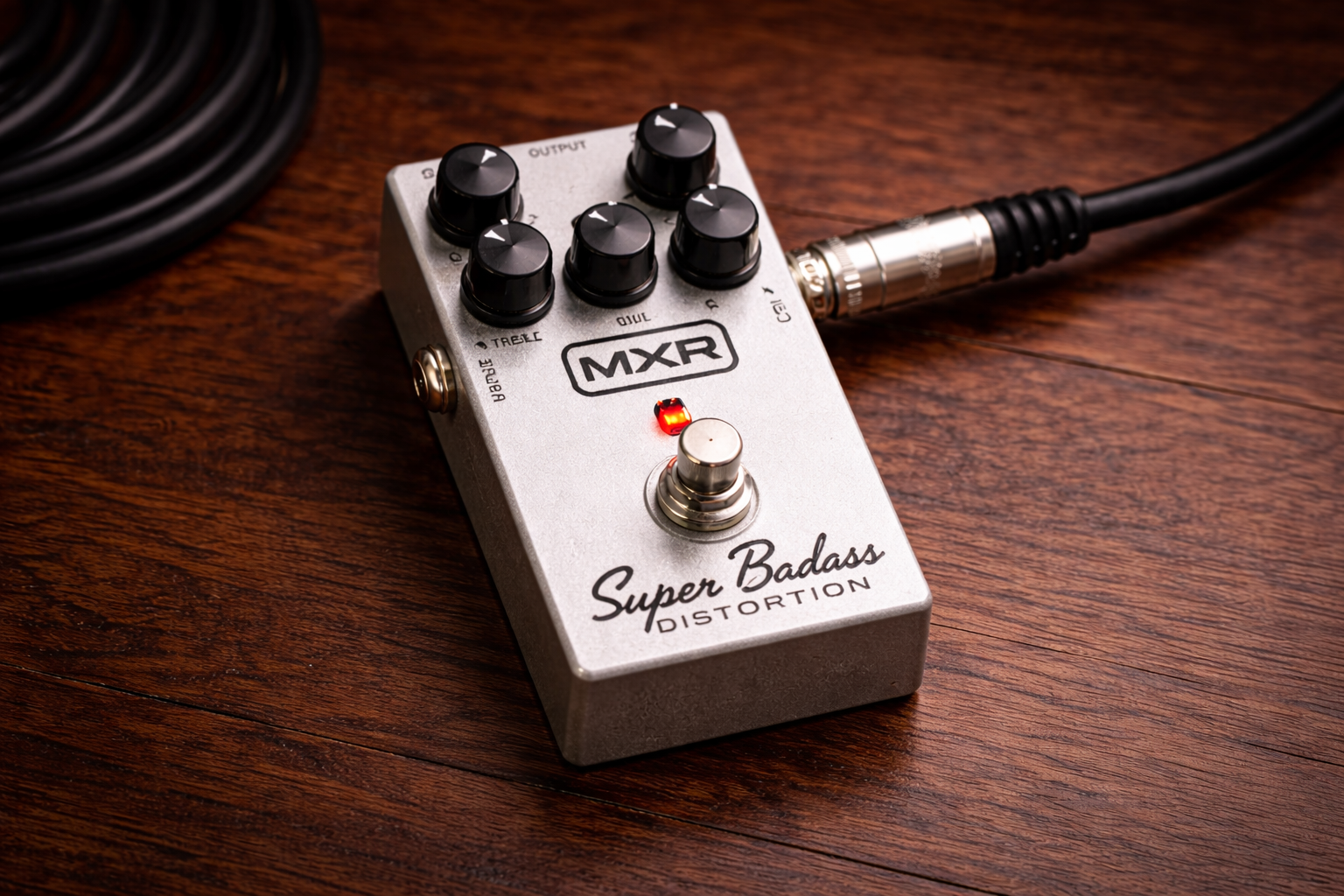
| Model | MXR Super Badass Distortion (M75). |
|---|---|
| Type | Analog distortion with wide gain and a practical 3-band EQ. |
| Controls | Output, Distortion, Bass, Mid, Treble. |
| Bypass & I/O | True bypass; standard mono in/out on 1/4" jacks. |
| Power | 9V battery or 9V DC (center-negative). |
| Best role | Main distortion stage or a heavier second gain step. |
Who this pedal is actually for
This is for players who want one distortion they can adapt to different guitars and amps without buying multiple “flavor” pedals. If you swap between single coils and humbuckers, or you play different rooms, that flexibility saves time and frustration.
It’s also for anyone who’s been burned by the “huge alone, gone in the mix” problem. The best results come when you treat EQ as part of the distortion circuit, not as an afterthought.
Real-world use cases
When it makes a lot of sense
- You need one gain pedal to cover rock through heavier rhythm without swapping gear.
- Your amp is mostly clean and you want the pedal to supply the main gain texture.
- You care about mix placement and want a mid control that is actually useful.
- You want to tighten lows without relying on more distortion.
When it’s probably overkill right now
- You only need mild edge-of-breakup and prefer riding your guitar volume.
- You play very quietly and you’re extremely sensitive to fizz or sharp top-end.
- You want set-and-forget tones and you dislike tweaking EQ.
- Your amp gain already nails your sound and you only need a small push.
A simple rule: set the amp first, then set level, then set gain, then shape with EQ. If you crank gain first, you’ll spend the rest of the time “repairing” the tone.
How it compares to related models
In the “Badass” family, this is the shapeable EQ-driven distortion option: broad range, adjustable mid focus, and enough control to fit different rigs. It’s less about cloning one famous circuit and more about being a practical workhorse that you can tune.
| Model | General character | Best for |
|---|---|---|
| MXR Custom Badass '78 Distortion (M78) | More fixed “hot-rodded” feel with faster dial-in and less shaping. | Players who want a strong core voice and fewer decisions. |
| MXR Super Badass Distortion (M75) | Wide gain with Bass/Mid/Treble that changes how it sits and cuts. | One main distortion you can fit to different amps and rooms. |
| MXR Custom Badass Modified O.D. (M77) | More overdrive-oriented and better for stacking without taking over. | Boosting, edge-of-breakup, and layered gain setups. |
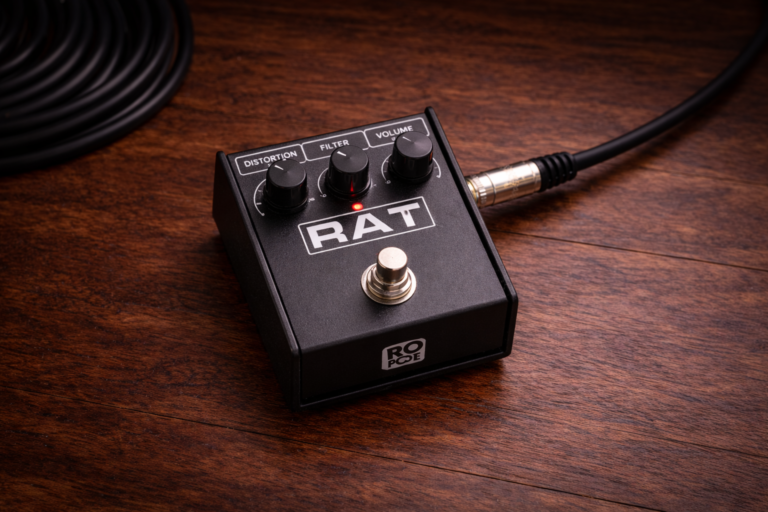
If you prefer a more raw, mid-forward grind that can feel less “EQ-dependent,” the Pro Co RAT 2 is a very different kind of answer. It’s not “better,” but it’s a good reference point for how much you value shaping versus a strong baked-in voice.
Tone and feel in the real world
The feel is best described as “big distortion with control.” Your attack and tightness depend heavily on how you set bass and mids, because those two knobs decide whether the response stays punchy or turns congested.
Low gain and always-on use
At low gain, it behaves more like gritty drive than a transparent boost. Chords stay readable, but the texture still feels like “distortion grit” rather than smooth OD.
The easiest win is keeping gain modest and using mids for clarity. Treat treble like a finishing knob, not the main way to create presence.
Medium gain rhythm sounds
This is where the mxr super badass distortion feels most natural, and where it can cover the widest ground. You can keep palm-mutes defined if you don’t flood the clipping with too much low end.
If you want a more “amp-like” bite that leans into hot-rodded British rhythm, the JHS Angry Charlie v3 is a useful comparison for feel and mid character.
- If the top-end feels sharp, pull treble first and add mids back for cut.
- If the low end feels loose, trim bass and use output for feel before adding gain.
Lead boost and pushing an amp
Into an already-crunchy amp, it can add sustain and thickness, but it will also shift how the amp EQ feels. Mids are the clean way to step forward for leads without relying on extra volume.
- Start with gain lower than you think, then set output so your “on” level is consistent.
- If your amp is bright, keep treble conservative and let mids do the clarity work.
Home, rehearsal and small gigs
This pedal changes more with volume than many people expect. At home volume, the top end can feel exaggerated; at rehearsal volume, the same settings often smooth out and sit better.
Home and headphone practice
At very low volume, less gain usually sounds better. You’ll get more clarity by controlling treble and keeping mids present than by chasing excitement with extra saturation.
If your goal is extreme, surgical high-gain voicing rather than flexible shaping, the Boss MT-2W is a more specialized route.
- Pitfall: turning up distortion and treble together to make it feel “alive” at low volume.
- Better move: trim bass for tightness, then use output to add feel and sustain.
Rehearsals
In a full band mix, mid control is what keeps you present without becoming harsh. If you start disappearing, add mids back and reduce bass slightly before touching treble.
That one move fixes the “huge alone, gone with the band” problem more often than any gain change.
- Tip: avoid over-scooped amp EQ, especially if the drummer is loud.
Small gigs
On small stages, it works well as a main gain sound because you can adapt quickly to unknown backline amps. The best results come from pushing an already decent core tone, not trying to rescue a bad speaker.
- Tip: adjust mids for clarity first, then use treble sparingly for edge.
Stacking and pedalboard roles
A super badass distortion pedal can be your foundation gain, a heavier second stage, or a lead thickener into amp crunch. It behaves best when you give it one clear job and dial EQ around that role.
On a clean platform, set output first, then gain, then shape. If you stack another drive in front, keep the front pedal lower gain and use it for feel or tightening rather than adding more saturation on top.
If you want a simpler, more classic “throw it on and go” distortion to pair with a flexible EQ pedal like this, the Boss DS-1 is a good reference point for how much convenience you gain (and shaping you lose).
Buying checklist: this pedal vs alternatives
You’re not just buying gain—you’re choosing how you want distortion to behave in your rig for the next few years. This checklist keeps you honest about what you actually need, not what looks impressive on paper.
- Is your amp bright or thin? Plan to keep treble conservative and use mids for clarity.
- Do you want one flexible gain sound, or multiple fixed “flavors” for different jobs?
- Will you rehearse or gig soon? If yes, mid control often matters more than extra gain.
- Do you want tight low end or a bigger looser feel? Bass control helps, but your amp sets the baseline.
If your “ideal distortion” is really touch-sensitive breakup that cleans up like an amp, that overdrive might actually be what you want. This guide to the best overdrive pedal for guitar will point you toward pedals designed for that feel from the start.
If you’re shopping on a budget and you want a modern, surprisingly usable distortion that’s easy to live with, the Donner Morpher is worth knowing about as a contrast in price and “plug-in-and-play” expectations.
When this pedal is overkill or the wrong choice
More control isn’t always better if you don’t need it. In a few common scenarios, your money is better spent elsewhere.
- If your core tone problems come from setup issues (old strings, pickup height, harsh amp EQ), fix those first.
- If you only play quietly and you’re extremely sensitive to fizz, a smoother, simpler voicing may feel better.
- If you hate tweaking, a strong fixed-voice distortion can be more enjoyable day one.
- If you want a refined, “finished” distortion voice with less reliance on EQ decisions, the Wampler Sovereign is a good example of that approach.
Summary: is it still worth it?
The reason it holds up is control: you can keep lows tight, put mids where you need them, and manage top-end without losing definition. That’s why the mxr super badass can be a long-term “main gain” pedal instead of a short-term novelty.
If you enjoy dialing for the room, it’s easy to recommend. If you want a single fixed voice with minimal adjustment, you’ll likely be happier with something simpler or more specialized.
Pedal FAQ
Is this a good first distortion for beginners?
It can be, but it rewards learning basic EQ. If you tend to crank gain and treble at low volume, you may think it’s harsh when it’s really a settings issue. Start moderate and let mids handle clarity.
Does it work well with solid-state amps and modelers?
Yes, especially because the EQ helps you match different voicings. The main trick is restraint at low volume: moderate gain, controlled treble, and enough mids to keep definition. Keep output consistent so it feels less “jumpy.”
What’s the fastest way to dial it in without overthinking?
Set output first, then set gain, then shape with bass/mids, and touch treble last. If it feels fizzy, reduce treble and gain before you start scooping mids. Small moves usually beat extreme settings.
Is it better as a main distortion or as a second stage?
It works as both, but it’s easiest as a main stage on a clean platform. As a second stage, keep bass controlled and avoid doubling top-end with another bright pedal. Give each pedal a job and you’ll keep the rig predictable.
Is it still worth buying compared to newer options?
Yes if you value flexibility and you actually use EQ to fit your rig. The feature set still makes practical sense, especially for players who move between different amps or rooms. If you want a fixed voice that always sounds “finished,” newer specialized pedals can feel easier.