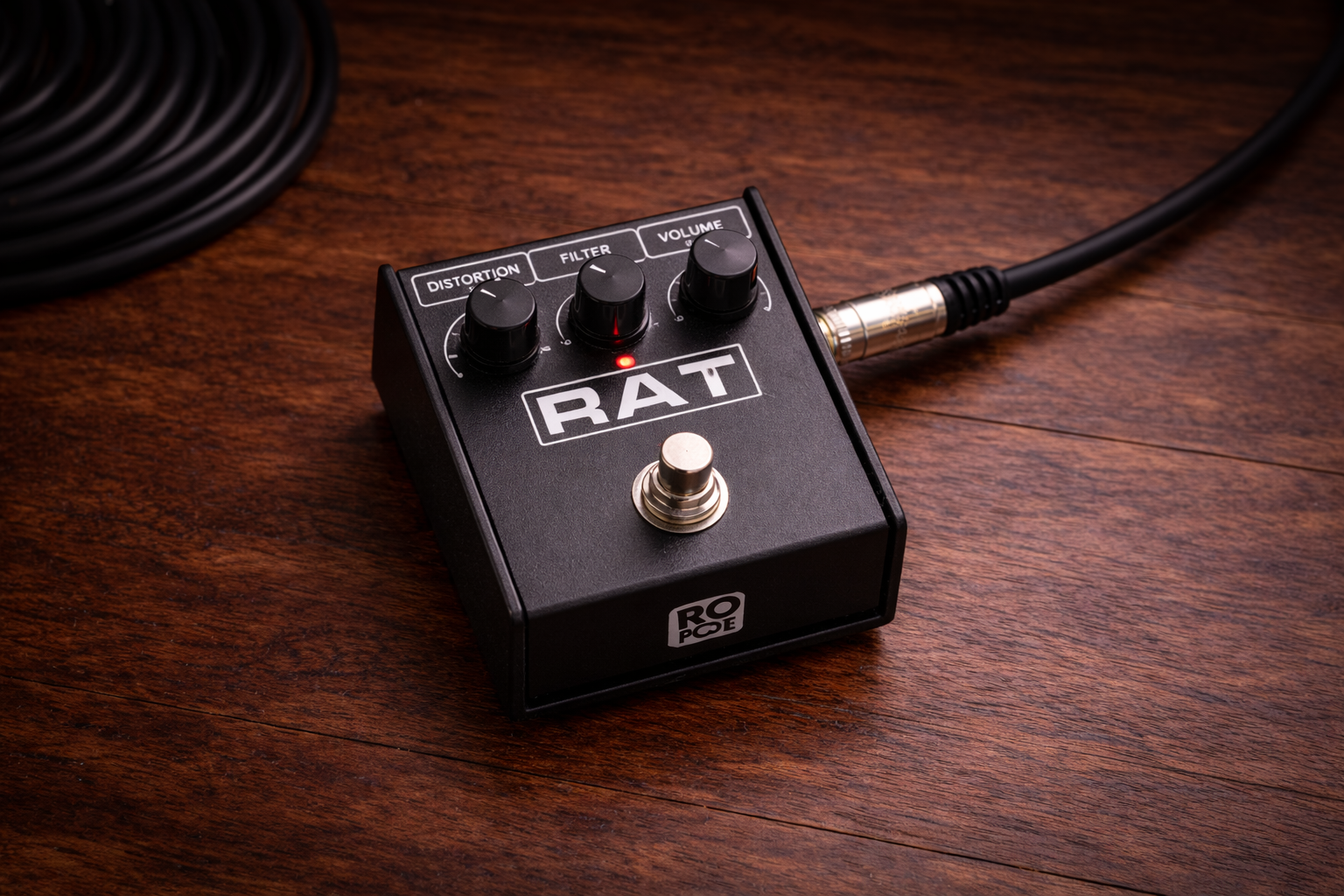
Pro Co RAT Distortion Pedal Review: RAT 2 Tone, Feel, and Real-World Use
This pro co rat distortion pedal review answers one practical question: will the classic RAT grind still work in your rig today—without turning brittle at home volume or getting lost once the band gets loud?
I’m not judging it by a single sweet spot. I looked at how the Pro Co RAT 2 behaves across clean-to-edge-of-breakup platforms, different room volumes, and typical real-life use (quick dialing, stacking, and staying audible in a mix). If you’re comparing options broadly, this guide to the best distortion pedal for guitar helps you map where a pro co rat-style voice sits versus more modern or more flexible distortions.
Below you’ll get the decision first, then the details that actually change the outcome: pick response, mids, tightness, and how to keep clarity without turning spiky.
- Who the pro co rat is actually for—and who should skip it.
- What the gain range feels like for rhythm and leads at real volume.
- How to use the Filter and stacking so the tone stays usable.
| Your situation | Verdict | Why |
|---|---|---|
| You want a distortion that naturally cuts for rock rhythm and gritty leads. | Strong fit | That mid-forward grind sits above bass and drums without needing extreme volume. |
| You prefer smooth, polished high-gain that feels modern and compressed. | Maybe | The RAT texture is more raw and grainy; your amp/speaker matters more. |
| You mostly play quietly at home on a bright clean platform. | Mixed | At low volume it can read sharper unless you treat Filter as a high-cut. |
| You want tight modern metal from the pedal alone into any amp. | Look elsewhere | It can get aggressive, but it’s not the most direct tool for “finished” modern tightness. |
- Natural mid presence that stays audible in a band mix.
- Great bite and articulation for riffing without needing extra boosts.
- Wide usable range for gritty rhythm and cutting leads.
- Simple control set—once you understand Filter, dialing is fast.
- Works well as a character distortion into clean platforms.
- Intentionally raw texture; not everyone wants that grain.
- Bright rigs can get sharp fast if you dial Filter the wrong way.
- Very high gain settings can get fizzy on top-end-heavy speakers.
- Not the easiest “one-box modern metal” solution without rig support.
- Some players will miss deeper EQ control than a single Filter can give.
If you want classic grind that cuts, pro co rat 2 delivers it quickly. If you want distortion that stays smooth and “finished” everywhere with minimal adjustment, you may end up fighting the voicing.
Specs and variants at a glance
| Model | Pro Co RAT 2 |
|---|---|
| Type | Distortion with classic RAT-style mid-forward grind and a Filter control for managing bite. |
| Controls | Distortion, Filter, Volume. |
| Power | 9V battery or standard 9V DC supply (center-negative typical). |
| Typical use | Main distortion voice for rock; cutting lead sound; character gain into clean or edge-of-breakup amps. |
Who this pedal is actually for
This is for players who want a distortion that feels immediate and unapologetic—more grind and cut than smooth saturation. If you’ve ever felt “present at home, gone at rehearsal,” the pro co rat family is often a surprisingly practical answer because it naturally emphasizes mix-friendly mids.
It’s also a good fit if you like working your picking dynamics and guitar volume as part of the gain control. If you’d rather have a refined, polished distortion that behaves the same at every volume, you may prefer a modern EQ-driven design.
Real-world use cases
When it makes a lot of sense
- You want a classic rock/alt distortion voice that naturally cuts.
- You’re on a clean-to-edge-of-breakup amp and want the pedal to supply character.
- You like gritty texture and pick attack more than smooth compression.
- You want one pedal that can cover rhythm and leads without stacking multiple gain stages.
When it’s probably the wrong match
- You only need mild edge-of-breakup and mainly play quietly at home.
- Your rig is already bright and you hate managing top end.
- You strongly prefer modern, compressed, “finished” high gain.
- You want full EQ shaping rather than a single Filter control.
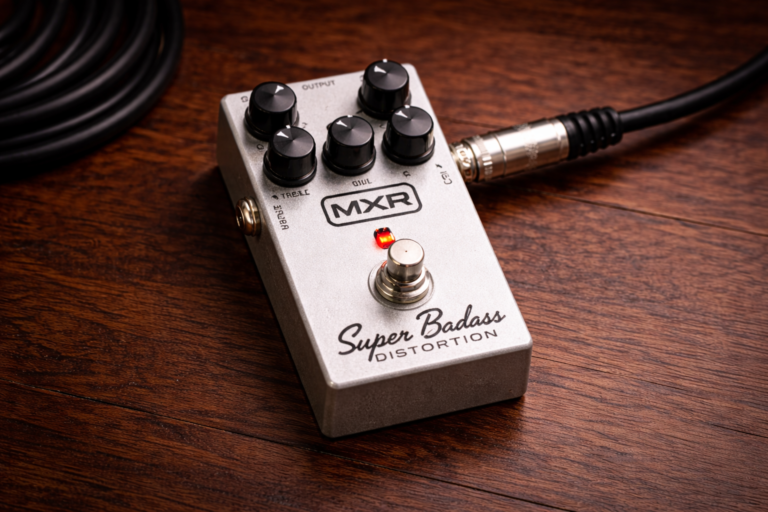
If you value flexible EQ shaping more than a fixed classic voice, compare the general approach with an EQ-driven distortion like the MXR Super Badass.
How it compares to related models
The RAT lineage has many eras and component changes, but the practical identity is consistent: mid-forward grind with a Filter that manages bite. In real use, your amp and speaker will change the result more than small revision trivia.
| Reference | What changes in feel | Best for |
|---|---|---|
| Classic “simple distortion” baseline | Often easier day-one, sometimes less mix cut depending on voicing. | Fast dial-in and familiar distortion texture. |
| RAT-style grind | More raw texture with stronger mids; Filter acts like a high-cut. | Band mix presence, gritty leads, and character rhythm. |
| Amp-like “hot-rodded” distortion | More channel-like mid character; often feels less grainy. | Players chasing amp-flavored distortion feel. |
For a simple, classic comparison point, the Boss DS-1 is useful to understand how different a more scooped, familiar voice feels next to a mid-present grind box.
Tone and feel: pro co rat distortion pedal in the real world
The feel is bitey and articulate with a grainy texture that holds together when you dig in. That’s the heart of pro co rat: it can sound aggressive without needing extreme volume, and it often stays readable when the band gets loud.
Low gain and always-on use
At low gain it’s less “transparent” and more “edge with attitude.” The cleanest results come from setting Volume first, then adding just enough Distortion for grit, and finally using Filter to shave harshness rather than to add sparkle.
If you want a gain voice that feels more like an amp channel, the JHS Angry Charlie v3 is a strong contrast in character.
Medium gain rhythm sounds
This is where pro co rat 2 shines: crunchy rhythm, clear chord edges, and enough aggression for modern rock without turning into a wall of fizz. If your rig is bright, a slightly darker Filter setting usually sounds bigger and more “real” than chasing brightness.
- If it feels sharp, increase Filter (more high-cut) before you lower gain.
- If it feels small, raise Volume slightly and let your amp handle the low end.
Lead sounds
For leads, the mid focus helps you stay on top of the mix. This is where the pro co rat2 distortion pedal reputation makes sense: it can be loud and audible without getting ice-picky if you keep the Filter under control.
Home, rehearsal and small gigs
Like most gritty distortions, it changes with volume. At home it can feel sharper if you dial for excitement; at rehearsal volume it often sounds thicker and sits more naturally because the speaker and room are doing more work.
Home and headphone practice
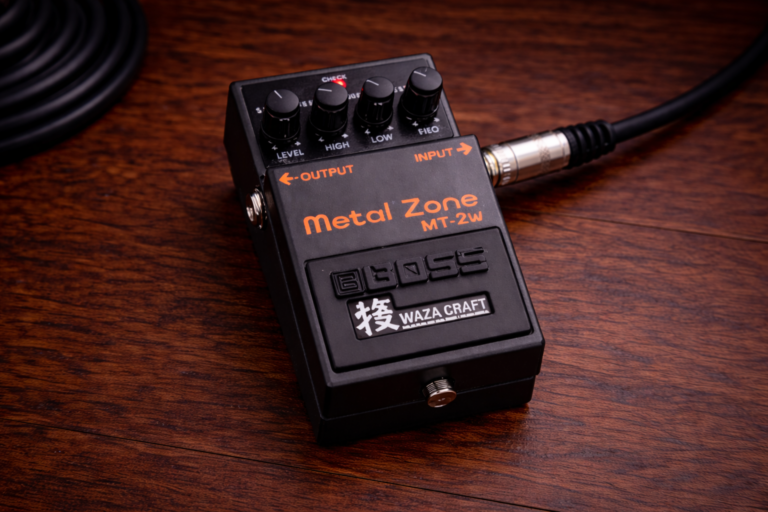
At low volume, start with less Distortion than you think and use Filter to control fizz. If your goal is surgical EQ-heavy high gain, a specialized tool like the Boss MT-2W is simply a different category of solution.
Rehearsals
This is where it earns its name: mid presence helps you stay audible. Avoid scooping your amp EQ; use Filter for brightness control and keep the voice centered so chords remain readable.
Small gigs
On small stages, it can be a reliable single-pedal distortion voice into a good clean platform. Bright rooms usually want more high-cut, not more gain.
Stacking and pedalboard roles
This pedal stacks best when each gain stage has a clear job: one for push/tightening, one for the main voice. If you try to stack full distortion on full distortion, you’ll often get harshness and noise before you get “more usable gain.”
In a simple board setup, the pedal proco rat 2 can be your main distortion while a lighter drive in front is used for feel. If you want a budget-friendly alternate flavor to compare stacking behavior, the Donner Morpher is a helpful reference point.
Buying checklist: this pedal vs alternatives
This is a “feel” purchase as much as a tone purchase. Answer these fast and you’ll know whether the RAT voice fits your real use, not just a demo clip.
- Is your rig already bright? If yes, commit to using Filter as a high-cut from the start.
- Do you want raw character and mix cut, or a smoother finished distortion feel?
- Will you rehearse/gig soon? If yes, prioritize mix presence over bedroom sparkle.
- Are you stacking multiple gain stages? If yes, define clear roles per pedal.
Also, be honest with the goal: if what you really want is touch-sensitive breakup that cleans up easily, maybe what you want is actually an overdrive. This guide to the best overdrive pedal for guitar points you to pedals designed for that feel.
If you want a more refined, smoother distortion voice that still covers heavier territory, the Wampler Sovereign is a strong counterpoint.
When this pedal is overkill or the wrong choice
- If your harshness problems are mostly setup-related (strings, pickup height, amp EQ), fix those first.
- If you only play at whisper volume and hate managing top end, you may fight it more than enjoy it.
- If you strongly prefer modern, smooth, compressed high gain, you’ll likely want a different voicing.
- If you expect instant modern-metal tightness into any amp, a more specialized solution will be less frustrating.
Summary: is it still worth it?
The pro co rat distortion pedal still matters because it solves a real problem: staying audible without relying on harsh treble. Once you treat Filter like a high-cut, it becomes easier to keep the bite controlled across rooms.
If you want a distortion that feels direct and characterful, pro co rat 2 remains a great long-term choice. If you want polished, “finished” gain everywhere with minimal management, you’ll likely be happier with a smoother voicing.
Pedal FAQ
Is this a good first distortion for beginners?
It can be, as long as you learn the Filter behavior. If you dial it like a normal treble boost, it can get harsh fast—especially at low volume. Start moderate and make small moves.
Is the Filter knob basically a tone control?
Yes, but it behaves more like a high-cut than a typical “tone boost.” Turning it up generally removes more top end, which helps match bright amps and speakers.
Does it work well with solid-state amps and modelers?
Yes. Keep gain sensible and use Filter to control fizz. On modelers, tighter settings often sound more realistic and sit better than extreme saturation.
Is it better as a main distortion or as a second stage?
Both can work. As a main distortion, it’s straightforward and characterful. As a second stage, it works best when the first pedal is a low-gain push rather than another full distortion.
Is it still worth it compared to newer options?
Yes if you want classic character and mix cut. If you mostly play quietly at home and prefer smoother, more controlled gain, newer designs can feel easier day one.