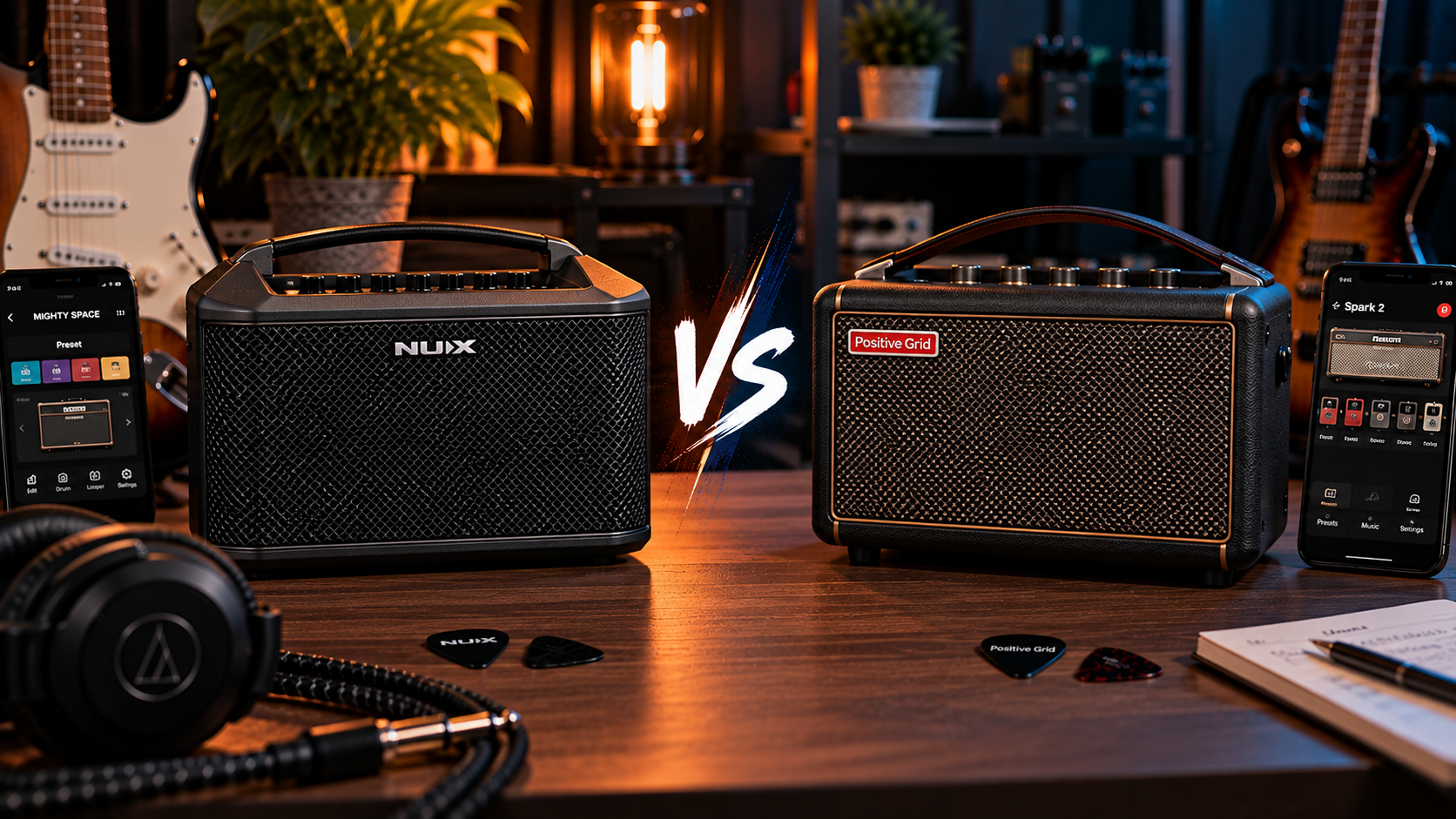
NUX Mighty Space vs Spark 2: Wireless Rig or Smart Practice?
The NUX Mighty Space vs Spark 2 comparison is one of the more interesting smart-amp decisions because both products are feature-heavy home rigs, but they spend their complexity in different places.
NUX focuses on modeler-style flexibility: included guitar wireless, built-in battery, third-party IR loading, reorderable effect blocks, dry USB output, re-amping and loopback. Positive Grid focuses on practice and ecosystem: a 60-second looper, Smart Jam, Auto Chords, ToneCloud, Spark AI, 33 amp models and 43 effects.
In other words, Mighty Space behaves more like a compact modeler with speakers. Spark 2 behaves more like a smart practice platform with deep guitar modeling.
Quick Verdict: NUX Mighty Space or Spark 2?
Choose the NUX Mighty Space if you want built-in wireless, rechargeable battery power, third-party IR loading and serious USB routing. It is the better fit for players who already understand modelers, signal chains and recording workflows.
Choose Spark 2 if you want the stronger practice ecosystem, larger tone community and a more guided smart-amp experience. Its looper, Smart Jam, Auto Chords, ToneCloud and Spark AI make it easier to use the amp as an everyday practice station.
Mighty Space is deeper on routing. Spark 2 is stronger on ecosystem.
NUX Mighty Space vs Spark 2: Key Differences
| Feature | NUX Mighty Space | Positive Grid Spark 2 |
|---|---|---|
| Power | 30W | 50W RMS |
| Speakers | 2 × 4-inch coaxial | 2 × 4-inch full-range |
| Wireless guitar | Included transmitter + built-in receiver | No built-in guitar wireless system |
| Battery | Built in, around 7 hours | Optional, up to 12 hours |
| IR loading | Yes, 20 user slots | No third-party IR workflow |
| Looper | Yes | Yes, up to 60 seconds |
| Drums / practice tools | Drum machine + looper | Looper, Smart Jam, Auto Chords, ToneCloud, Spark AI |
| USB routing | Normal, Dry Out, Re-amp, Loopback | 1-in/2-out recording |
| Presets | 7 | 8 |
| App focus | Editing and routing | Editing, learning, tones and practice |
| Best for | Wireless/modeler-minded players and home recording | Guided practice, easy preset discovery and app features |
| Preset workflow | 7 presets with deeper manual editing and IR control | 8 hardware presets plus a large ToneCloud ecosystem |
| App dependence | Moderate for deep routing and IR management | Moderate to high for the full practice ecosystem |
| Included hardware value | Wireless transmitter, battery and footswitch included | Battery optional; strongest value is software/practice features |
| Value proposition | Replaces more separate hardware | Replaces more practice software and content workflows |
Specifications were checked against NUX’s official Mighty Space specifications and Positive Grid’s official Spark 2 specifications. NUX lists 30W output, dual 4-inch coaxial speakers, 34 factory IRs plus 20 user slots, an included wireless transmitter, seven-hour battery life and multiple USB routing modes. Positive Grid lists 50W RMS, dual 4-inch speakers, 33 amp models, 43 effects, eight presets and an optional battery rated for up to 12 hours at moderate volume.
Wireless and Portability: Mighty Space Is More Complete Out of the Box
Mighty Space includes a NUX wireless guitar transmitter and has the receiver built into the amp. It also includes a rechargeable 5000 mAh battery rated for roughly seven hours.
That gives it a very clean everyday workflow: guitar, transmitter, amp. No guitar cable and no wall outlet required for a normal practice session.
Spark 2 has Bluetooth for audio and app control, but not an equivalent built-in guitar wireless receiver. Battery operation is available through the optional Spark Battery, which Positive Grid rates for up to 12 hours at moderate volume.
If you want a true grab-and-play wireless guitar rig without buying extras, Mighty Space has the advantage.
In the broader NUX Mighty Space vs Spark 2 decision, Mighty Space behaves more like a compact modeler than a normal practice amp. Our best desktop guitar amps guide provides the wider category context, while the guitar amp modeler guide explains the routing concepts behind the NUX approach.
Modeling and IRs: Mighty Space Is the More Technical Platform
NUX uses its TS/AC-HD white-box amp modeling and gives Mighty Space a modeler-style signal chain with Gate, Compressor, EFX, Amp, IR, EQ, Mod, Delay and Reverb blocks. The blocks can be reordered through MightyAmp or Mighty Editor.
The cabinet section is even more distinctive. Mighty Space supports 512-sample IR processing, ships with a large factory IR library and provides 20 user slots for third-party IR files.
Spark 2 does not pursue that kind of open IR workflow. Instead, it provides 33 amp models and 43 effects inside Positive Grid’s own ecosystem. That is simpler for players who want lots of tones without managing external cabinet files.
If you already know why changing an IR can completely reshape a high-gain tone, Mighty Space gives you more control. If you do not want to think about IR libraries at all, Spark 2 is less technical.
Our full NUX Mighty Space review goes deeper into the IR and routing side.
NUX Mighty Space vs Spark 2 Tone and Presets: Easy Results or Deeper Control?
This is where the two products feel most different even before you compare raw amp-model counts. Mighty Space gives you more control over the cabinet and routing side of the tone. Third-party IR loading, reorderable blocks and editor-level signal-chain control reward players who already know what they want to change.
Spark 2 makes preset discovery easier. ToneCloud gives you a huge pool of community tones, while the Spark app and Spark AI can get you close to an artist, song or general style without first deciding which IR or signal-chain order you need.
For fast preset results
Spark 2 is the easier system. Search, load, adjust and save. That is particularly useful for beginners or players who want to move quickly between recognizable styles without learning the technical reason each preset works.
For high-gain and cabinet experimentation
Mighty Space has the more interesting ceiling. High-gain tone is heavily shaped by the cabinet stage, so being able to load third-party IRs gives experienced users a direct way to tighten lows, reshape upper mids or change the overall feel of a virtual rig.
Neither approach guarantees better tone. Spark 2 lowers the effort required to find usable presets; Mighty Space gives experienced users more control over why a preset sounds the way it does.
Looper and Practice Tools: Spark 2 Has the Bigger Ecosystem
Both amps can loop, so this is not a simple yes-or-no feature comparison.
Mighty Space combines its looper with drum functions and the included NMP-2 Lite footswitch. That makes it useful for rhythm practice without touching the amp during recording.
Spark 2 adds a dedicated 60-second looper and then builds a much larger software layer around it: Groove Looper functions, Smart Jam, Auto Chords, ToneCloud and Spark AI.
For someone who wants the amp to create backing material, suggest tones and make practice feel more interactive, Spark 2 is the more developed platform.
For someone who wants drums and looping but does not want the entire experience tied to a cloud ecosystem, Mighty Space may feel more focused.
If you mainly care about quiet playing rather than re-amping, our guitar headphone amp guide covers simpler headphone-first rigs that may be better value.
USB Recording and Re-Amping: Mighty Space Has the More Serious Routing
This is one of the clearest differences.
Spark 2 works as a straightforward 1-in/2-out USB interface at 24-bit/44.1 kHz. That is enough for recording the modeled guitar signal and playing audio back from a computer.
Mighty Space adds Normal, Dry Out, Re-amp and Loopback modes. Dry Out lets you record an unprocessed DI signal. Re-amp lets you send that performance back through the amp processing later. Loopback simplifies streaming and content-creation setups where computer audio and guitar need to be captured together.
If your practice amp may also become a lightweight recording or content-creation tool, Mighty Space is substantially more flexible.
Speakers and Room Sound: Similar Size, Different Processing Priorities
Both amps use dual 4-inch speaker systems, so neither should be confused with a conventional 1×12 combo.
Mighty Space uses coaxial drivers and places a lot of emphasis on modeler-style cabinet processing and stereo delay/reverb. Spark 2 uses full-range drivers with angled horns and Sonic IQ computational audio, including stereo widening, bass enhancement and automatic EQ behavior.
Both designs make sense for close-range home use, backing tracks and modeled cabinet tones. If you want a more traditional speaker experience, compare either one with the Boss Katana 50 Gen 3.
NUX Mighty Space vs Spark 2 App Workflow: Rig Editing vs Practice Ecosystem
The difference between the apps is philosophical.
NUX MightyAmp and Mighty Editor are primarily there to edit the rig: reorder effects, adjust parameters, manage IRs and configure USB behavior.
The Spark app also edits tone, but then expands into practice content, community tones, chord tools and AI-assisted search.
That means Mighty Space feels more like hardware controlled by software. Spark 2 feels more like hardware that is one part of a larger software platform.
If you enjoy technical editing, that distinction favors NUX. If you want the app to actively give you things to play, it favors Spark.
How Much Extra Gear Does Each Amp Replace?
Mighty Space is unusually aggressive here. The included wireless transmitter replaces a separate guitar-wireless system, the built-in battery removes the need for mains power during normal practice, the included NMP-2 Lite gives the looper and drums practical foot control, and the USB routing can cover jobs normally handled by a small recording interface.
Spark 2 replaces a different set of things. Its looper, Smart Jam, Auto Chords, ToneCloud and app ecosystem reduce the need for separate practice software, chord tools and backing-track workflows. The optional battery can make it portable, but that capability is not included in the base package.
This distinction matters for value. Mighty Space is more likely to replace hardware. Spark 2 is more likely to replace practice software and content.
If your room is already full of modelers, interfaces and wireless gear, Mighty Space may duplicate functions you own. If you already have a polished practice workflow on a laptop or tablet, Spark 2 may duplicate that instead.
Which One Fits Different Use Cases Better?
Which Is Better for Metal and High-Gain Tones?
Mighty Space has the more interesting toolkit because third-party IR loading lets you change the cabinet side of the tone directly. For players who already know how much a V30-style IR, oversized 4×12 or tighter cabinet capture can alter a high-gain sound, that is a meaningful advantage.
For beginners and casual home players
Spark 2 is easier to understand as a complete product. You choose tones, use the looper, open practice tools and play. Mighty Space exposes more technical decisions—IRs, routing and signal-chain order—that are powerful but not always necessary.
For content creation and home recording
Mighty Space has the edge because Dry Out, Re-amp and Loopback create workflows that normally require more deliberate interface routing. Capturing a clean DI while monitoring a processed sound is particularly useful if you want to change the tone after recording.
For someone who just wants to practice for twenty minutes
The answer depends on what “simple” means to you. Mighty Space becomes extremely simple once wireless and battery operation are set up: pick up the guitar and play. Spark 2 becomes simple when the app is part of your routine: load a tone, start a loop or backing tool and begin. One reduces cable friction; the other reduces practice-content friction.
Price and Value: Included Hardware vs Software Ecosystem
Ignore temporary sale prices for a moment and look at what is included. Mighty Space ships with the guitar wireless transmitter, has a rechargeable battery built in and includes the NMP-2 Lite footswitch. Its USB routing can also cover jobs that would otherwise require a separate interface workflow.
Spark 2 puts more of the value into the software and practice experience: ToneCloud, Smart Jam, Auto Chords, Spark AI, the onboard looper and a larger preset ecosystem. Battery operation is available, but the Spark Battery is an optional purchase.
That makes Mighty Space unusually strong if you would otherwise buy wireless hardware, portable power and foot control separately. Spark 2 is stronger if the app ecosystem and practice tools are the things you would otherwise assemble from multiple apps or devices.
You can also compare Spark 2 against two different philosophies: THR10II vs Spark 2 for simplicity versus ecosystem, and Spark 2 vs Boss Katana 50 Gen 3 for desktop convenience versus traditional combo feel.
What You Give Up with Each Choice
Mighty Space gives you more technical control, but that control creates more decisions. IR management, effect-order editing and USB routing are valuable only if you actually use them. For a player who mainly wants three or four dependable tones, much of that flexibility can become setup overhead.
Spark 2 simplifies those technical decisions but locks more of the experience into Positive Grid’s own ecosystem. You get a larger tone community and stronger practice tools, but you do not get the same third-party IR workflow, included wireless guitar system or re-amping flexibility.
In practical terms, Mighty Space asks you to understand the rig more deeply. Spark 2 asks you to buy into the platform more deeply. Neither is a problem if that matches the way you already like to work.
Who Should Buy the NUX Mighty Space?
- Players who want wireless guitar included in the box.
- Guitarists who value built-in battery power without buying an accessory.
- Modeler users who understand third-party IRs.
- Home recordists who want DI capture and re-amping.
- Content creators who can use USB loopback.
- Players who prefer technical routing flexibility over a large social tone ecosystem.
Who Should Buy the Positive Grid Spark 2?
- Players who want the strongest all-in-one practice ecosystem.
- Beginners who value Auto Chords and guided app features.
- Guitarists who like discovering community presets through ToneCloud.
- Players who want a simple looper with deeper Groove Looper options in the app.
- Anyone who values eight hardware presets and dedicated stereo line outputs.
See our full Positive Grid Spark 2 review for the deeper app and practice-tool breakdown.
NUX Mighty Space vs Spark 2 Verdict: Routing Depth or Practice Ecosystem?
The NUX Mighty Space vs Spark 2 decision is less about sound quality than about what kind of complexity you want.
Mighty Space spends its complexity on signal chain, IRs, wireless hardware, battery operation and recording routing. Spark 2 spends its complexity on practice tools, app features, community tones and a broader smart-amp ecosystem.
For technically minded players, amp-sim users and home recordists, Mighty Space is unusually capable. For players who want the amp to make practice easier and more interactive, Spark 2 is the more polished system.
NUX Mighty Space vs Spark 2 FAQ
Which amp includes wireless guitar?
The NUX Mighty Space. It ships with a compatible wireless transmitter and has the receiver built into the amp.
Which has better battery support?
Mighty Space includes a rechargeable battery rated for roughly seven hours. Spark 2 can run on the optional Spark Battery, which Positive Grid rates for up to 12 hours at moderate volume.
Can Spark 2 load third-party IRs?
Spark 2 does not offer the same third-party IR-loading workflow as Mighty Space. Mighty Space provides 20 user IR slots.
Which is better for recording?
Both support USB recording, but Mighty Space has the more advanced routing because it adds Dry Out, Re-amp and Loopback modes.
Which is better for beginners?
Spark 2 is generally easier to recommend to beginners who want structured practice features, community tones and automatic chord tools. Mighty Space is more attractive to players who already understand modeling, routing and IRs.