NUX Mighty Space Review: Wireless Desktop Rig or Feature Overload?
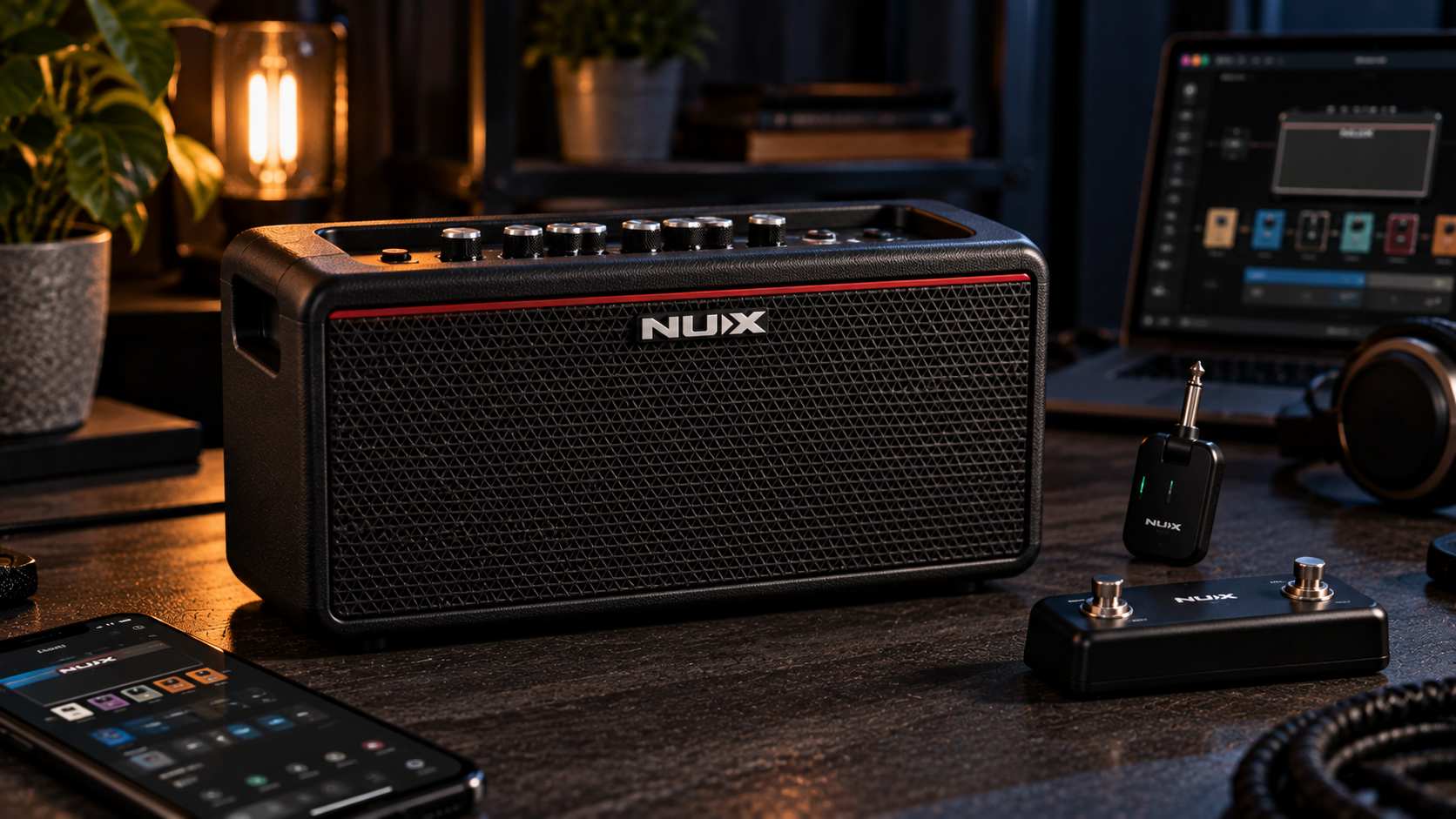
The NUX Mighty Space takes the desktop-practice-amp idea further than most competitors. It is a rechargeable 30-watt stereo modeling amp with an included guitar wireless transmitter, two 4-inch coaxial speakers, movable effect blocks, third-party IR loading, a drum machine, looper and unusually flexible USB-C recording modes.
That makes this NUX Mighty Space review less about whether the amp has enough features—it clearly does—and more about whether those features form a coherent daily rig. Mighty Space is most interesting for players who want a desktop amp to behave like a compact modeler, wireless practice system and recording tool at the same time.
Quick Verdict: Is the NUX Mighty Space Worth It?
Yes—if you want a wireless practice amp that behaves more like a compact modeler than a basic desktop combo. The included guitar transmitter, built-in rechargeable battery, third-party IR loading, reorderable effects, looper, drum machine and USB-C re-amping give Mighty Space unusually deep routing for home use. It is overkill for players who want three knobs and one dependable sound, but unusually complete for players who would otherwise buy several separate pieces of gear.
NUX Mighty Space Pros and Cons
Pros
- Included NUX wireless transmitter and built-in receiver create a genuinely cable-light practice setup.
- Rechargeable 5000 mAh battery is rated for about seven hours of playing time.
- 30W stereo output through dual 4-inch coaxial speakers gives a wider, more desktop-friendly presentation than a small mono combo.
- TS/AC-HD amp modeling and 512-sample IR processing provide a modeler-style signal chain.
- Thirty-four factory IRs plus 20 user IR slots allow much deeper cabinet customization than most practice amps.
- Effect blocks can be reordered instead of being locked into one fixed chain.
- USB-C supports Normal, Dry Out, Re-amp and Loopback routing.
- Drum and looper functions are controllable with the included NMP-2 Lite footswitch.
- Very low quoted system latency of 1.2 ms keeps the digital chain suitable for direct playing.
Cons
- The depth of routing, IRs and editor options can be unnecessary for players who want a simple plug-in-and-play amp.
- Seven onboard presets are less immediate than a larger bank of hardware-accessible memories.
- Two 4-inch speakers still cannot reproduce the physical punch of a conventional 1×12 guitar combo.
- Third-party IR management adds another layer of tweaking that many home players do not actually need.
- The product sits closer to a compact modeler with speakers than to a traditional amp, which will not suit every player.
- NUX’s software ecosystem is capable, but it does not have the same community tone-library scale as Positive Grid’s Spark platform.
NUX Mighty Space Specs: 30W Stereo, Wireless, Battery and IR Loading
- Output: 30W
- Speakers: 2 × 4-inch coaxial speakers
- Modeling: NUX TS/AC-HD white-box amp modeling
- IR processing: 512-sample resolution
- IR library: 34 factory IRs and 20 third-party user slots
- Effect blocks: Gate, Compressor, EFX, Amp, IR, EQ, Mod, Delay and Reverb, with flexible order
- Presets: 7, with selectable Active preset behavior
- Wireless: included NUX transmitter with onboard receiver
- Battery: 11.1V/5000 mAh rechargeable, approximately 7 hours
- USB: USB-C audio with Normal, Dry Out, Re-amp and Loopback routing
- Sampling: 48 kHz/32-bit internal specification
- System latency: quoted at 1.2 ms
- Dimensions: approximately 363 × 171 × 171 mm
- Weight: approximately 4.06 kg
NUX publishes the current hardware, IR and routing details on the Mighty Space product page. The standout point is how many of these features normally belong to a floor modeler rather than a desktop amp.
NUX Mighty Space Wireless Guitar System: Why the Included Transmitter Matters
Mighty Space ships with a NUX wireless transmitter and has the receiver built into the amp. That sounds like an accessory detail until you think about how most short practice sessions actually start.
With a normal setup, you find a guitar cable, plug into the guitar, route it around the chair, then unplug everything when you are done. With the Mighty Space, the intended workflow is closer to picking up the guitar and turning the transmitter on.
That reduction in friction fits the whole product. A desktop amp is valuable because it is always ready. Wireless makes “always ready” more literal. It is especially useful if the amp lives across the room rather than directly on the desk.
The included system also supports both passive and active guitar or bass pickups according to NUX, so it is not limited to a specific instrument type.
This NUX Mighty Space review makes more sense when Mighty Space is viewed as part of the wider desktop category rather than as a normal small combo. Our best desktop guitar amps guide shows how its wireless and IR-heavy approach differs from the simpler alternatives.
NUX Mighty Space IR Loading and Amp Modeling
NUX uses its TS/AC-HD white-box modeling platform for the amp section. The company’s design goal is to model circuit behavior and dynamic response rather than provide only static EQ curves and gain stages.
The more distinctive feature is the cabinet section. Mighty Space uses 512-sample IR processing and includes a large factory library covering guitar cabs, bass cabs and acoustic-guitar simulation profiles. It also provides 20 user slots for third-party WAV IRs, with the Mighty Editor handling conversion.
That matters because cabinet choice can change a distorted guitar tone as dramatically as the amp model itself. A player who understands IRs can use Mighty Space almost like a compact recording modeler with built-in speakers.
It can also become a trap. If you are still learning what gain, mids and speaker choice do, loading twenty third-party IRs may create more confusion than improvement. Start with the factory cabinets, learn what changes, and only then add external files.
Mighty Space Effects and Signal Chain: Reorderable Blocks Like a Modeler
Mighty Space provides Gate, Compressor, EFX, Amp, IR, EQ, Mod, Delay and Reverb blocks. Through the MightyAmp mobile app or Mighty Editor on Mac/Windows, those blocks can be reordered.
That freedom matters in practical ways. A compressor before a drive behaves differently from one later in the chain. EQ before an amp model shapes what gets distorted; EQ after the cabinet is closer to mix processing. Modulation and time-based effects can be placed where they make sense for the sound instead of living in one permanent factory order.
For a beginner, this is more control than necessary. For a player who already understands pedal order and amp-sim routing, it makes Mighty Space much less restrictive than the average practice amp.
If signal-chain order still feels abstract, our first pedalboard setup guide explains the same logic in a physical-pedal context.
NUX Mighty Space Looper, Drum Machine and Presets
Mighty Space includes drum and looping functions, and NUX bundles the NMP-2 Lite footswitch to make them practical without reaching for the amp during a take.
That combination is more useful than a long preset list. A drum groove gives timing practice an immediate reference. The looper lets you record a rhythm part, switch tone and work on lead playing. It also exposes timing problems very quickly because your own rhythm keeps repeating back at you. If you want the same brand in a much simpler format, our NUX Mighty Lite BT MKII review shows how far the workflow can be stripped back.
The amp stores seven presets, and NUX allows you to choose which of those are Active when cycling from the hardware preset switch. That is a small but clever workflow feature: if you only use four sounds, you do not need to step through three irrelevant presets every time.
NUX Mighty Space Battery Life and Portable Practice
Unlike the standard Yamaha THR10II and unlike Spark 2 without its optional battery, Mighty Space includes rechargeable battery operation as part of the base design. NUX rates the 5000 mAh battery for roughly seven hours of playing time.
That makes the amp useful outside the normal desk scenario. You can move it to another room without relocating a power adapter, take it to a lesson, use it as a backstage warm-up rig or practice somewhere without convenient mains power.
At just over 4 kg, it is portable without feeling like a tiny novelty speaker. The combination of battery and included guitar wireless is one of the clearest reasons to choose Mighty Space over a more conventional desktop amp.
The recording side is also central to this NUX Mighty Space review. If you are new to modeler-style routing, our guitar amp modeler guide gives the broader context for IRs, direct signals and re-amping.
NUX Mighty Space USB-C Recording, Re-Amp and Loopback
Many practice amps include USB recording as a checkbox feature. Mighty Space goes further with multiple routing modes: Normal, Dry Out, Re-amp and Loopback.
Dry Out
A dry-output option is useful because it lets you capture an unprocessed guitar signal. You can keep the performance and change the amp or effects later.
Re-amp
Re-amping sends a previously recorded dry performance back through the Mighty Space processing chain. That is a studio-style workflow normally associated with interfaces and software modelers, not compact practice amps.
Loopback
Loopback is useful for streaming or recording content where computer playback and guitar need to arrive together. It simplifies video, livestream and lesson workflows that otherwise require more complex audio routing.
If recording is the main reason you are considering the amp, compare this with a dedicated interface in our silent guitar rig guide and the broader practice amp vs amp sim vs multi-FX comparison. Mighty Space is convenient, but an interface remains more expandable.
Dual 4-Inch Coaxial Speakers Prioritize Range and Stereo Over Cabinet Punch
The speaker system tells you what Mighty Space is trying to be. Two 4-inch coaxial drivers need to reproduce modeled guitar cabinets, effects, drums, backing tracks and general audio. That demands a wider frequency response than a conventional guitar speaker.
The benefit is obvious at home: stereo delay and reverb can spread, backing tracks stay intelligible, and IR-based tones are not immediately recolored by a strongly voiced guitar cabinet.
The limitation is equally obvious. If you want the mechanical push and low-mid weight of a 12-inch guitar speaker in the room, no amount of IR flexibility changes the physical size of the drivers. In that case a Katana 50 Gen 3 is solving the more relevant problem.
Who Should Buy the NUX Mighty Space?
- Home players who want guitar wireless and battery operation included rather than added later.
- Amp-sim and modeler users who already understand IRs and want that workflow without opening a laptop.
- Players who want a looper, drums and foot control inside one compact practice rig.
- Songwriters and content creators who can use dry recording, re-amping and loopback.
- Guitarists who want one compact unit for electric guitar, bass and experimentation with different cabinet responses.
It is less compelling for players who prefer three knobs and one good sound, anyone who dislikes editor software, or guitarists who want a traditional large-speaker combo experience.
A practical NUX Mighty Space review has to compare the workflow, not just the spec count. Our NUX Mighty Space vs Spark 2 comparison covers the direct smart-amp decision, while the Spark 2 review goes deeper into the competing app ecosystem.
Mighty Space Has Few Direct Rivals Because It Combines Several Categories
Positive Grid Spark 2
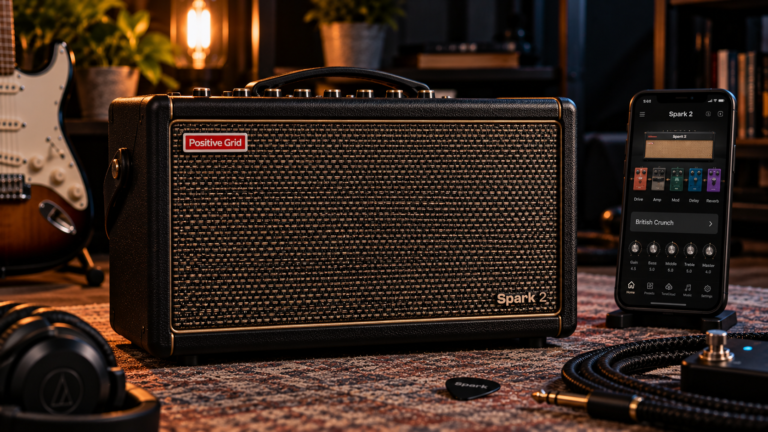
Spark 2 has the stronger smart-practice ecosystem, larger community tone library, AI search and an extremely polished app experience. Its battery is optional, and its signal-chain philosophy is less focused on third-party IR experimentation.
Yamaha THR10II Wireless
The wireless THR10II offers battery operation and compatible guitar wireless in a much simpler package. It is a better fit if low-volume sound and straightforward operation matter more than routing depth.
Boss Katana 50 Gen 3
The Katana is the answer if you want a 12-inch speaker, a more conventional amp feel and a clearer path to loud rehearsal use. It is far less portable and does not offer the same built-in wireless/battery concept.
The conclusion of this NUX Mighty Space review is strongest for players who will actually use wireless, IR loading or advanced USB routing rather than paying for technical depth they never touch.
NUX Mighty Space Review Verdict: A Wireless Desktop Amp for Modeler-Minded Players
The NUX Mighty Space looks excessive if you judge it as a normal practice amp. Third-party IR slots, re-amping, loopback, reorderable effects and wireless recording are far beyond what is needed to play a few riffs after work.
But that is the wrong comparison. Mighty Space is closer to a compact modeler, stereo practice amp, wireless rig and recording interface living in the same enclosure. For a player who actually uses those workflows, the integration is the point.
The best reason to buy it is not that it has more features than a THR10II. It is that the included wireless transmitter, built-in battery, looper, footswitch and flexible USB routing remove several pieces of separate gear from the room. If you want simplicity, buy something simpler. If you want one small box to cover a surprisingly technical home rig, Mighty Space makes a strong case.
That is the core buying logic behind this NUX Mighty Space review: the amp is compelling because several separate pieces of gear are folded into one desktop rig.
NUX Mighty Space FAQ
How powerful is the NUX Mighty Space?
Mighty Space is rated at 30 watts and uses two 4-inch coaxial speakers for stereo playback.
Does the NUX Mighty Space include wireless guitar?
Yes. NUX includes a compatible wireless transmitter, and the receiver is built into the amp.
Can the Mighty Space load third-party IRs?
Yes. NUX lists 20 user IR slots in addition to 34 factory IRs. Mighty Editor can import WAV IR files and convert them for the amp.
How long does the Mighty Space battery last?
NUX rates the built-in 11.1V/5000 mAh rechargeable battery for roughly seven hours of playing time, depending on use.
Can the NUX Mighty Space re-amp recordings?
Yes. Its USB-C routing includes Normal, Dry Out, Re-amp and Loopback modes, giving it much more flexible recording behavior than a basic practice-amp USB output.
Is the NUX Mighty Space worth it for home practice?
Yes, if you will use its wireless transmitter, rechargeable battery, IR loading, looper or USB routing. If you only need a few core amp sounds at a desk, a simpler practice amp may be easier to live with.