Donner Yellow Fall Review: Cheap Analog Delay That Actually Works?
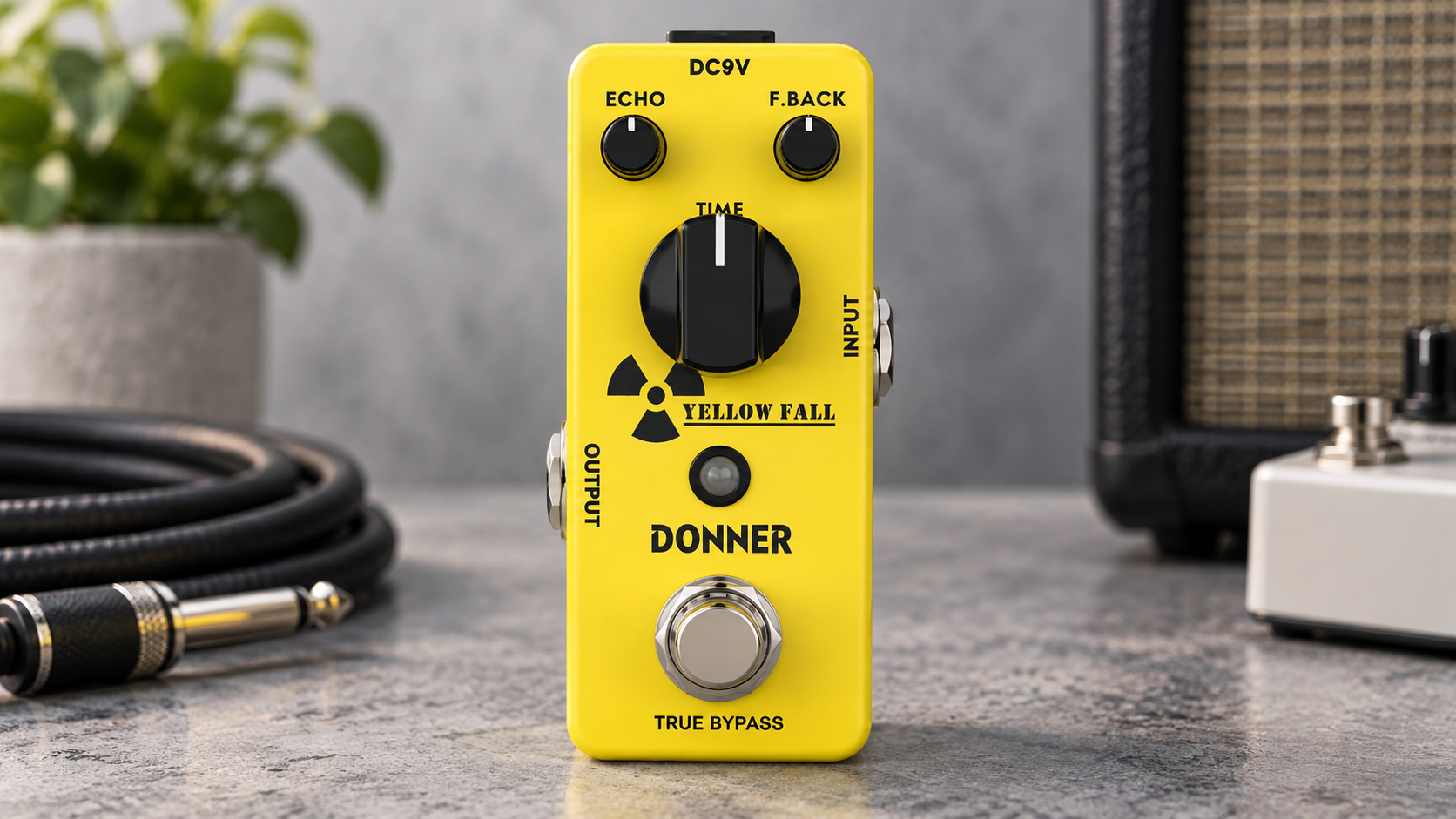
The original mini Donner Yellow Fall is an inexpensive way to try warm delay. Three controls and a small enclosure keep the first steps simple: set the time, choose the repeats, adjust the wet level and play. There are no modes, subdivisions or software to learn.
Its low price should still be weighed against switching, pedalboard power, noise and how the repeats sit with the dry guitar. The Yellow Fall is aimed at slapback, short ambience and lead support; it does not promise the control range or refinement of larger pedals.
It makes sense as a first experiment or a small-board utility. If delay is central to your playing and you already need tap tempo, longer repeats or easier live adjustment, buying a more suitable pedal first is the better call.
Donner Yellow Fall review: who should buy it?
Buy it if…
- You want to try delay without committing serious money.
- Slapback, short ambience and basic lead support cover your needs.
- A mini enclosure is useful and you already have suitable 9V power.
- You value immediate controls more than tap tempo, stereo or multiple modes.
Skip it if…
- Delay is central to your live sound and switching reliability is critical.
- You need long, clean repeats or exact tempo synchronization.
- Your power supply is noisy or you expect battery operation.
- You already know you want a full-featured delay and would only replace this later.
Pros and cons
| What works | What you give up |
|---|---|
|
|
The three controls and their budget limits
| Area | What it means in a real rig |
|---|---|
| Delay character | Simple analog/analog-voiced warm repeats intended for conventional delay use rather than multiple algorithms. |
| Controls | Time, Feedback and Mix-style level controls. |
| Format | Mini enclosure saves space but reduces knob size and labeling room. |
| Routing | Mono input and mono output. |
| Tempo | No tap tempo or subdivision selection. |
| Power | External 9V center-negative supply; no practical battery option in the mini enclosure. |
The simplicity is the real product
A beginner does not need eleven delay types to learn the relationship between time, feedback and wet level. The Yellow Fall exposes exactly those decisions. Short time creates doubling and slapback; more feedback extends the tail; the level decides whether the delay is texture or a clearly audible echo.
That directness can improve practice because adjustments are fast. It also means there is nowhere to hide if the one basic delay voice does not suit the amp.
Where the budget shows
The main compromises are not necessarily dramatic tone failures. They are smaller knobs, less physical space around the switch, fewer routing options and less confidence about years of hard stage use. A quiet home board may never reveal the difference. Regular transport and shared power are harder tests.
Noise should be judged with the pedal powered from a known isolated output before blaming the circuit. Mini budget pedals often get paired with the cheapest daisy chain, which makes diagnosis unfair and difficult.
Do not buy it as a temporary version of the wrong pedal
If your actual goal is dotted-eighth rhythm, stereo ambience or several saved delay sounds, buying a Yellow Fall first does not teach you much about that workflow. It only postpones the correct purchase.
If your goal is to discover whether a little echo makes clean parts, rockabilly lines or leads more enjoyable, it is exactly the kind of low-risk tool that makes sense.
What the Yellow Fall does with different guitars and amps
The Yellow Fall’s warm repeat character is easiest to use when the dry guitar has enough attack. Bridge single-coils, P-90s and moderately bright humbuckers leave a clear front edge while the delay sits behind it. A dark neck humbucker through a bass-heavy practice amp can produce the opposite result: the first note already occupies a lot of low-mid space, and multiple repeats make simple chords feel slow and blurred. Reduce Feedback first, then shorten Time, and keep the wet level lower than the dry guitar.
At home, many users will run the pedal into a small solid-state or modeling amp. Begin with the amp’s own delay and reverb bypassed so you can hear what the Yellow Fall is actually adding. If the amplifier preset already contains ambience, the extra pedal can sound muddy even at conservative settings. Build a dry or lightly driven base tone, dial the Yellow Fall, and only then decide whether a small amount of amp reverb is still necessary.
After a basic overdrive, the pedal works well for leads because the repeats copy the finished gain sound and soften as they decay. Before distortion, every repeat is clipped again; this can be fun for rough garage textures but is harder to control. With high-gain amp channels, try the effects loop if one is available. The Yellow Fall will remain a simple warm delay, yet its repeats will be more readable when they are not being pushed repeatedly through the preamp’s distortion.
How to test a budget delay fairly
Before judging the Yellow Fall, remove avoidable variables. Power it from a known, correctly rated isolated 9V output, connect it with short cables and begin with a clean amp. Set Feedback near minimum, Mix low and move the Time control across its range. Listen for sudden jumps, clock noise, loss of dry level and scratchy controls. Then increase Feedback gradually and confirm that the repeats decay predictably.
This matters because a low-cost mini pedal is often tested on the noisiest part of a beginner board: a daisy chain shared with digital effects, long patch cables and an already high-gain amp. That setup can create hum or hiss that no single pedal caused. The pedal power supply guide explains the voltage, current and isolation checks that should happen before a return or replacement.
After the clean test, place the Yellow Fall after the main drive pedal. If the trail becomes too thick, lower Feedback before lowering Mix. A very low Mix can hide the problem without solving it; fewer repeats usually preserve the warm character more effectively. If the pedal passes these basic tests and one general setting covers practice, there is no rule saying a more expensive delay is automatically necessary.
Donner Yellow Fall settings that make sense
These are starting points, not magic coordinates. Set the amp clean or only slightly breaking up, match the bypassed volume first, and adjust the mix in the room where you actually play.
| Use | Starting point | What to listen for |
|---|---|---|
| Slapback | Short time; feedback nearly minimum; low-to-moderate level | Hear one quick repeat, not a trail. |
| Practice lead | Time around the middle; 2–3 repeats; low level | The line should feel longer without obvious echo between notes. |
| Warm wash | Longer time; feedback below oscillation; level under noon | Chords must remain identifiable when several repeats overlap. |
What a budget mini delay can cover
At home
This is where the Yellow Fall is most convincing. Its limitations matter less, adjustments are easy and a warm trail can make low-volume practice feel less dry. Use isolated power if hiss appears.
At rehearsal
The lack of tap tempo and small controls become more obvious. Set one general-purpose sound and leave it alone rather than trying to retime the pedal between songs.
Recording
It can be a useful texture when the warm repeat is part of the performance. For maximum flexibility, record a dry path as well; the pedal does not provide the routing or recall of a studio-oriented delay.
When the small saving stops making sense
| Alternative | Choose it instead when… |
|---|---|
| Boss DD-3T | You want a durable, clear digital delay with tap tempo and predictable live use. |
| MXR Carbon Copy | The warm analog character matters enough to justify stronger construction and modulation. |
| Flashback 2 Mini | You need mini size but want TonePrint flexibility and more sophisticated digital control. |
| Your amp’s built-in delay | It already provides adequate time, feedback and level control without extra power or cabling. |
Is the Donner Yellow Fall worth it?
The Yellow Fall succeeds when expectations match its purpose. It is an inexpensive, understandable way to add one warm echo sound to a home rig or small board, rather than a miniature delay workstation.
Spend more when delay becomes structurally important to the music. If one simple setting works and a particular unit stays quiet and reliable in your rig, upgrading may solve nothing.
For the wider context, start with what a delay pedal actually does, compare the full shortlist in the best delay pedals for guitar, and use the delay and reverb pedal guide when placing it in a complete signal chain.
Donner Yellow Fall FAQ
Is the Donner Yellow Fall a good first delay pedal?
Yes, if you want to learn basic time, feedback and level controls and do not need tap tempo or multiple delay types.
Can the Yellow Fall run on a battery?
Its mini enclosure is designed around external 9V power rather than an internal battery.
Does it have tap tempo?
No. Delay time is adjusted manually with the control.
Why is my Yellow Fall noisy?
Test it with an isolated, correctly rated 9V output and short known-good cables. Shared daisy-chain power can create noise that is not caused by the delay alone.