MXR Carbon Copy Review: Warm Analog Delay Without the Clutter
The MXR Carbon Copy is a delay for depth behind the guitar. Its progressively darker repeats avoid competing with the dry note, a useful quality for leads and driven parts. That voicing is a specific choice, not a universal improvement over clearer delay.
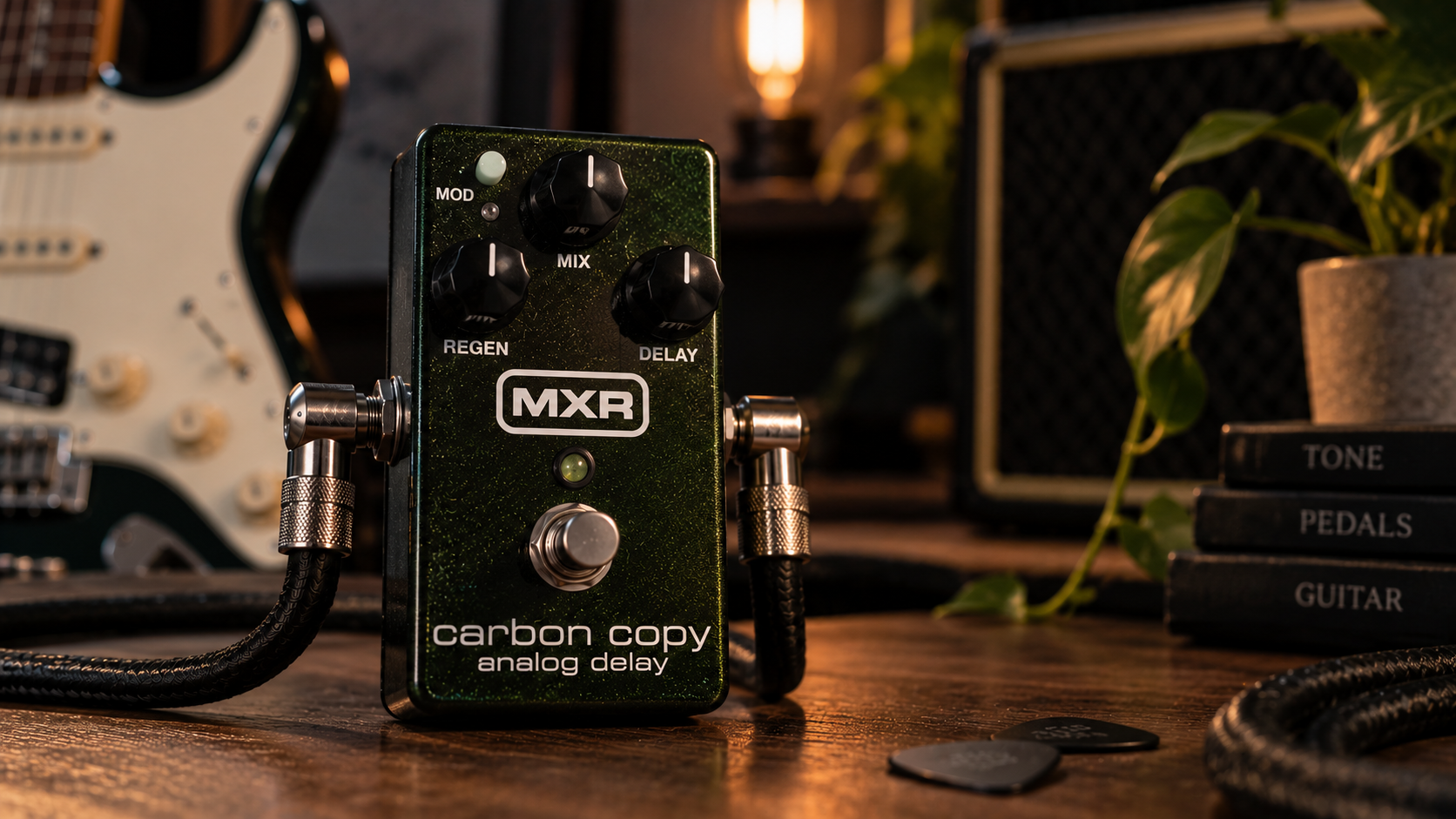
The combination of an analog bucket-brigade circuit, up to 600 ms of delay, three main controls and optional modulation keeps its purpose clear. Analog circuitry alone is not the reason to buy it; the way the repeats soften and recede is.
The same soft repeats can blur precise rhythmic parts. There is no tap tempo, stereo output or preset system. Choose the Carbon Copy for its particular place behind the guitar rather than expecting it to cover every delay job.
MXR Carbon Copy review: who should buy it?
Buy it if…
- You want delay to sit behind the dry note rather than announce itself.
- Your main use is lead support, subtle depth, slapback or warm ambience.
- You play through bright amps or gain sounds that make clean digital repeats feel sharp.
- You prefer three controls and a broad musical sweet spot.
Skip it if…
- You need tap tempo or exact song-synced subdivisions.
- You want pristine repeats that remain clear for complex rhythmic parts.
- Stereo operation, presets or multiple delay types are essential.
- You dislike opening the pedal to adjust modulation trim controls.
Pros and cons
| What works | What you give up |
|---|---|
|
|
What the analog circuit and controls allow
| Area | What it means in a real rig |
|---|---|
| Delay engine | Fully analog bucket-brigade delay with naturally degrading repeats. |
| Maximum delay | Up to approximately 600 ms, enough for common lead and ambient settings but shorter than many digital pedals. |
| Controls | Delay, Mix and Regen on the top panel; modulation on/off switch. |
| Modulation | Rate and width are adjustable with internal trim controls rather than normal front-panel knobs. |
| Routing | Mono input and mono output. |
| Power | 9V adapter or battery operation. |
Why the dark repeats work
A clear digital repeat occupies much of the same frequency space as the note that created it. The Carbon Copy progressively removes top-end detail, so the first repeat supports the phrase and later repeats dissolve into texture. That makes moderate feedback feel larger without every pick attack stacking on top of the next.
This is especially useful with a bright clean amp, a bridge pickup or a driven rhythm sound. The repeats soften the edges instead of creating another layer of fizz. With a dark amp and neck humbucker, however, the same voicing may feel too buried.
Modulation is subtle until it is not
The Mod switch adds pitch movement to the repeats, creating a tape-like or lightly chorused trail. At conservative internal settings it keeps long repeats from feeling static. Pushed too far, it can make chords seasick and leads noticeably detuned.
The internal trims preserve the simple front panel, but they also mean experimentation requires removing the back. Set them once for gentle movement and the design makes sense; change modulation depth song by song and it becomes inconvenient.
The 600 ms limit defines the pedal
Six hundred milliseconds is enough for a wide lead sound, medium rhythmic echoes and restrained ambient parts. It is not built for very long looping textures or huge cinematic gaps between repeats.
The lack of tap tempo matters most with a drummer. For free-time leads and general depth, adjusting by ear is easy. For tightly synchronized rhythmic guitar, a digital pedal with tap tempo is simply the better tool.
Matching the Carbon Copy to pickups, amps and gain
The Carbon Copy’s dark voice is not equally dark in every rig. A bright bridge pickup, a small open-back combo and a clean channel leave plenty of upper-mid information in the dry note, so the softened repeats feel warm without disappearing. A neck humbucker into a dark speaker starts with much less definition. Add several analog repeats and the low mids can accumulate into a cloudy layer. In that rig, use fewer repeats, less Mix and a shorter delay before deciding that the pedal itself is unusably muddy.
Single-coils generally make the Carbon Copy’s modulation easier to hear because the dry attack remains crisp against the moving trail. Humbuckers produce a thicker lead sound, but high Regen settings can blur fast phrases and low-tuned riffs. The pedal is most convincing when the dry guitar supplies the articulation and the delay supplies size. Asking the repeats to remain as detailed as the original note works against the circuit’s character.
Gain placement changes the texture dramatically. After an overdrive pedal, the Carbon Copy repeats the driven sound and lets each copy decay darker. Before a gain stage, the repeated notes hit the clipping circuit again and compress together. The second arrangement can feel organic for vintage leads, but it becomes messy with modern high gain. If an amplifier’s preamp is doing most of the distortion, try the effects loop. The Carbon Copy will not suddenly become a pristine digital delay, but the repeats will retain more shape because they no longer pass through the saturated preamp.
How Mix, Regen and Delay interact on the Carbon Copy
The Carbon Copy’s controls are simple, but they do not act independently. Longer delay times make the analog degradation more obvious. Higher Regen sends that darker signal through the circuit repeatedly, which removes more definition and raises the chance of oscillation. Mix then determines whether that soft trail stays behind the note or becomes the main event.
That means the cure for mud is rarely “turn up the Mix so I can hear the delay.” Begin by reducing Regen. If chords still smear, shorten Delay. Raise Mix last. This order preserves the reason to use an analog delay—the repeat should support the dry guitar—without allowing several dark copies to accumulate under every chord.
Placement is equally straightforward. After overdrive, the Carbon Copy repeats the finished gain sound and usually feels smooth. Before a heavily driven amp, every repeat is distorted again by the preamp and can become dense. Players using amp distortion should compare the effects loop where available. The pedal can run from a battery, but a stable isolated output from a pedal power supply is easier to manage on a permanent board.
MXR Carbon Copy settings that make sense
These are starting points, not magic coordinates. Set the amp clean or only slightly breaking up, match the bypassed volume first, and adjust the mix in the room where you actually play.
| Use | Starting point | What to listen for |
|---|---|---|
| Short slapback | Delay 8–9 o’clock; Regen minimum; Mix 9–10 o’clock | You should feel extra size more than hear a separate echo. |
| Warm lead | Delay around noon; Regen 10–11 o’clock; Mix 10–11 o’clock | Repeats should lengthen phrases without softening the dry attack. |
| Modulated wash | Longer delay; Regen 1–2 o’clock; Mix below noon; Mod on | Keep feedback below runaway oscillation and listen for pitch movement on held chords. |
Where dark repeats help or disappear
At home
The Carbon Copy sounds flattering at low volume because it does not add aggressive high-frequency repeats. Small rooms can make feedback seem stronger, so begin with Regen lower than expected.
At rehearsal
Its dark trail leaves space for vocals and cymbals, but the repeats may disappear if the entire band is dense and mid-heavy. Raise Mix carefully rather than adding excessive feedback.
Recording
The pedal can create a finished lead ambience on the way in, but its mono output and fixed analog character reduce flexibility later. Print it when the sound is part of the performance, not merely because delay might be useful.
When a clearer or cheaper delay fits better
| Alternative | Choose it instead when… |
|---|---|
| Boss DD-8 | You need tap tempo, stereo routing or clear rhythmic repeats alongside analog-style options. |
| Boss DD-3T | You want a simpler digital delay with more repeat definition and easy tempo control. |
| Carbon Copy Deluxe | You love the core voice but need tap tempo, longer delay and more external control. |
| Carbon Copy Mini | Board space matters and the additional Bright option suits your rig. |
If you mainly want to explore warm repeats at a much lower price, my Donner Yellow Fall review explains what you gain and give up before stepping up to the Carbon Copy.
Is the MXR Carbon Copy worth it?
The Carbon Copy’s lasting appeal is how it makes delay feel like depth behind the guitar rather than another instrument competing with it. That is a musical advantage when warm, receding repeats suit the part.
Look elsewhere for exact tempo control, stereo routing or pristine rhythmic repeats. For leads, slapback and warm movement, its limited interface can make a useful setting quick to reach.
For the wider context, start with what a delay pedal actually does, compare the full shortlist in the best delay pedals for guitar, and use the delay and reverb pedal guide when placing it in a complete signal chain.
MXR Carbon Copy FAQ
Is the MXR Carbon Copy fully analog?
Yes. Its delay path uses analog bucket-brigade technology, which contributes to the darker and progressively degraded repeats.
What is the maximum delay time?
The standard Carbon Copy provides up to approximately 600 ms of delay.
Does the Carbon Copy have tap tempo?
No. Delay time is set with the knob. The larger Carbon Copy Deluxe adds tap-tempo features.
Why does my Carbon Copy sound too dark?
The voicing is intentionally warm. Reduce feedback, raise the mix only slightly, try a brighter amp or pickup setting, or consider the Mini with its Bright option or a digital delay.