NUX Mighty Lite BT MKII Review: Tiny Amp, Serious Practice Tool?
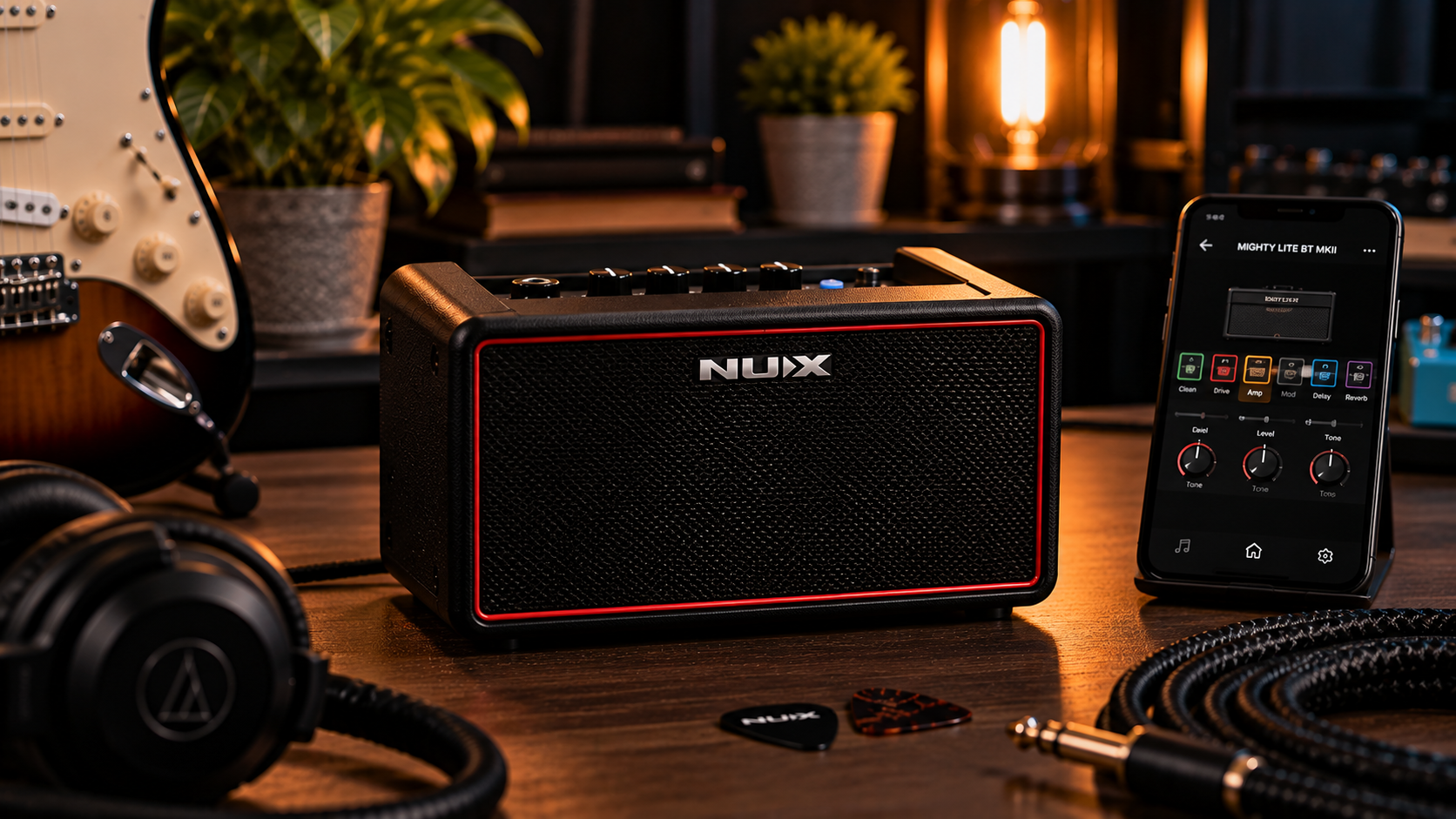
The NUX Mighty Lite BT MKII looks like the kind of miniature practice amp that should be convenient but forgettable. It is only a 3-watt box with a single 3-inch speaker, yet it packs in amp models, cabinet IRs, effects, seven presets, Bluetooth audio, a drum machine and USB recording.
After living with one, I think its real value is not that it replaces a proper combo. It is that it removes nearly every excuse not to play. I can leave it on a desk, connect a guitar, start a backing track and be playing within a minute. This NUX Mighty Lite BT MKII review focuses on that everyday experience: how it sounds at realistic home volume, where the small speaker gets in the way, whether the app is worth using and who should buy something else.
Pros and Cons
Pros
- It is genuinely quick to start playing.
- The modeling, effects and IR options are deeper than the physical size suggests.
- Seven hardware-accessible presets make app-free daily use realistic.
- Headphone sound is more satisfying than the tiny speaker implies.
- Bluetooth tracks, drums and USB audio turn it into a complete personal practice station.
- Three power options make it easy to move and travel with.
Cons
- The single 3-inch speaker cannot deliver real cabinet weight.
- High-gain presets become congested when gain and bass are pushed.
- The app is capable but not completely frictionless.
- Six AA batteries feel dated compared with a built-in rechargeable pack.
- Deep editing can distract from practice if you treat every session as tone-design time.
Specs & Feature Overview
- Power and speaker: 3 watts, single 3-inch 4-ohm speaker
- Presets: Seven onboard presets with selectable active slots
- Signal blocks: Gate, EFX, amp, IR, modulation, delay and reverb
- Cab section: 34 factory IRs plus 20 user IR slots
- Practice tools: Bluetooth audio, AUX input, drum machine, tap tempo and headphones
- Power options: 9V adapter, USB power or six AA batteries
Build & Controls
The hardware and software details below are cross-checked against NUX’s official Mighty Lite BT MKII specifications, including its 3-watt output, 3-inch speaker, seven presets, USB-C audio and third-party IR support.
The enclosure is small and light enough to move around without thinking about it. It does not feel luxurious, but mine has never felt like a disposable novelty either. The knobs and switches are logically arranged, and the amp stays planted reasonably well unless a stiff guitar cable pulls against it.
The top panel gives you gain, tone, volume, reverb/delay mix, drum level, preset selection and tap controls. That is enough for normal use. I do not need to open the app every time I want to play, which matters more than a long feature list. Once I saved several usable presets, the amp became almost plug-and-play.
Sound: Amp Models and Speaker Limits
Clean and edge-of-breakup tones
Clean sounds are the easiest place to appreciate what the modeling engine can do. At desk volume, the amp produces enough clarity for chord work, arpeggios and technique practice without the brittle, fizzy character common to older mini amps. Adding a short room or plate reverb makes the single speaker feel less exposed.
Edge-of-breakup tones are even more useful. Keeping the gain controlled lets pick attack remain audible, and rolling the guitar volume back produces a meaningful change instead of simply making the preset quieter. With my Cort G300 Pro, lowering the output slightly gives the models more breathing room than driving every preset as hard as possible.
Crunch and classic-rock gain
Medium gain is the NUX’s practical sweet spot. Power chords stay readable, simple lead lines sustain and the noise gate does not need to work aggressively. A common mistake is to add too much bass and gain because the cabinet sounds small. That usually makes it muddier rather than larger.
I get better results by reducing gain, trimming low end in the app and letting the IR and reverb create space. The same principle appears in our guitar EQ cheat sheet: a convincing guitar sound is not the one with every frequency turned up.
High gain and modern metal
The amp can produce usable high-gain sounds, but this is where the 3-inch speaker establishes the ceiling. Through the speaker, heavy rhythm presets can become congested if the gain, bass and ambience are all pushed together. Palm mutes have definition, but they do not have the physical weight of a larger cabinet.
Through decent headphones, the same presets make much more sense. The cabinet IR is no longer being squeezed through a tiny driver, stereo effects open up and high-gain detail becomes easier to hear. I would call the speaker good for practicing metal parts, while the headphone output is the better way to judge and enjoy the actual preset.
If your home tones routinely become fizzy or muddy, the fixes in our bedroom guitar tone guide apply directly: less gain, less bass, more useful mids and less ambience than you initially expect.
App, Presets & Effects
The physical panel keeps the amp approachable, but the MightyAmp app is where the product becomes a modeler rather than a three-knob mini combo. It exposes the full chain: gate, drive/effect, amp, cabinet IR, modulation, delay and reverb.
The useful part is not endlessly browsing models. It is being able to correct what the little speaker exaggerates: reduce low end, choose a better cabinet, control delay feedback, set the noise gate sensibly and balance preset levels. Patch-level adjustment is important because otherwise a high-gain sound can jump dramatically above a clean preset.
Cabinet IRs
NUX includes 34 cabinet IRs and provides 20 slots for third-party files. That is unusually generous for a compact practice amp. An IR will not make the physical speaker larger, but it strongly affects the perceived brightness, low-end shape and midrange character.
Headphone Practice
The headphone output is one of the strongest reasons to own the Mighty Lite. Plugging in automatically mutes the speaker, and the modeled cabinet plus stereo effects are preserved. The result feels wider and more complete than the front speaker, particularly with delay and reverb.
Headphone quality still matters. Consumer headphones with heavily boosted bass can make high-gain presets sound woolly, while very bright models can expose digital fizz. Our guide to headphones for practicing guitar covers the practical choices without assuming you need expensive studio equipment.
The NUX also avoids Bluetooth instrument latency because the guitar itself remains wired. Bluetooth is used for backing audio and app control; you should still connect normal wired headphones to monitor your guitar.
Bluetooth, Backing Tracks & Drums
Bluetooth playback is straightforward and makes the amp far more useful than a conventional mini combo. I can play a song, lesson or backing track from a phone and hear it alongside the guitar without another speaker. Separate guitar and playback levels would always be welcome, but adjusting the phone and amp is easy enough.
The built-in drum machine is not glamorous, yet it improves practice. Starting a groove is faster than finding a backing track, and tap tempo removes enough friction that I actually use it. The app is required to change styles, while the panel handles start, stop, tempo and level.
USB Recording & Desktop Use
The USB-C port supports editing, firmware updates and USB audio. On Windows, NUX provides an ASIO driver; on macOS, the amp supports Core Audio. That makes the Mighty Lite useful for quickly recording an idea without setting up a microphone.
I would treat it as a convenient sketching interface, not a replacement for a full studio interface. A dedicated unit offers better monitoring control, more inputs and a cleaner long-term recording workflow. But if the alternative is not recording the riff at all, the NUX does the job.
Who the Mighty Lite BT MKII Suits Best
The Mighty Lite is best understood as a friction-reduction device. A larger practice amp can sound fuller, and a good interface with plugins can be much more powerful, but both can demand more space and setup. The NUX sits between those worlds.
- Bedroom players: It sounds useful at genuinely quiet levels and does not need power-tube volume to wake up.
- Beginners: The physical controls are simple enough to start immediately, while the app leaves room to explore later.
- Experienced players who want a second rig: It works well for five-minute sessions, warmups and learning parts away from the main setup.
- Apartment players: Headphone support, low-volume control and backing-track playback make more sense than chasing a large combo at whisper volume.
If you are still deciding between hardware and software, our practice amp vs amp sim vs multi-FX guide explains the larger trade-off. The NUX wins on immediacy; plugins win on depth and studio flexibility.
Alternatives to Check Out
- Positive Grid Spark GO: You value the larger preset community, polished smart-practice ecosystem and rechargeable portability.
- Hotone Pulze: You want a larger stereo desktop system, touchscreen editing and a more substantial all-in-one desk rig.
- Boss Katana Mini: You want simple physical controls and fewer software features.
- Blackstar ID:Core 10 V4: You have room for a larger combo and want more convincing speaker spread and low-end response.
Verdict: A Capable Desk Amp With a Small Speaker
Yes—for the right job. The Mighty Lite BT MKII is not a tiny replacement for a full-size amp, and its speaker cannot create the depth or physical response of a proper cabinet. What it can do is provide credible modeled tones, useful effects, backing audio, drums, headphones and basic recording in a box small enough to leave within arm’s reach.
That convenience has real value. An impressive rig that takes ten minutes to start often gets used less than a modest rig that is always ready. I reach for the NUX when I want to practice immediately without opening a computer or filling the room with sound.
Buy it if you want a flexible personal practice amp and accept that headphones reveal more of its potential than the built-in speaker. Skip it if your priority is loud rehearsal, authentic cabinet punch or a completely app-free analog experience.
FAQ
Is the NUX Mighty Lite BT MKII loud enough?
It is loud enough for personal practice in a bedroom, office or hotel room. It is not designed to compete with a drummer or serve as a normal band-rehearsal amp.
Can I use it without the MightyAmp app?
Yes. Gain, tone, volume, ambience, drums, tap tempo and seven saved presets are accessible from the amp. The app is needed for choosing models, detailed effects editing, IR management and preset organization.
Does Bluetooth work for wireless guitar?
No. Bluetooth handles audio playback and app communication. The guitar still connects through the normal quarter-inch input, which avoids the latency of standard Bluetooth instrument audio.
Is it better through headphones?
For detailed high-gain tones and stereo effects, usually yes. Headphones remove the physical limitation of the 3-inch speaker and make the cabinet IRs easier to hear.