TC Electronic Hall of Fame 2 Review: Versatile Without Getting Huge
This TC Electronic Hall of Fame 2 review is about whether flexibility is still useful when it depends partly on an app and editor.
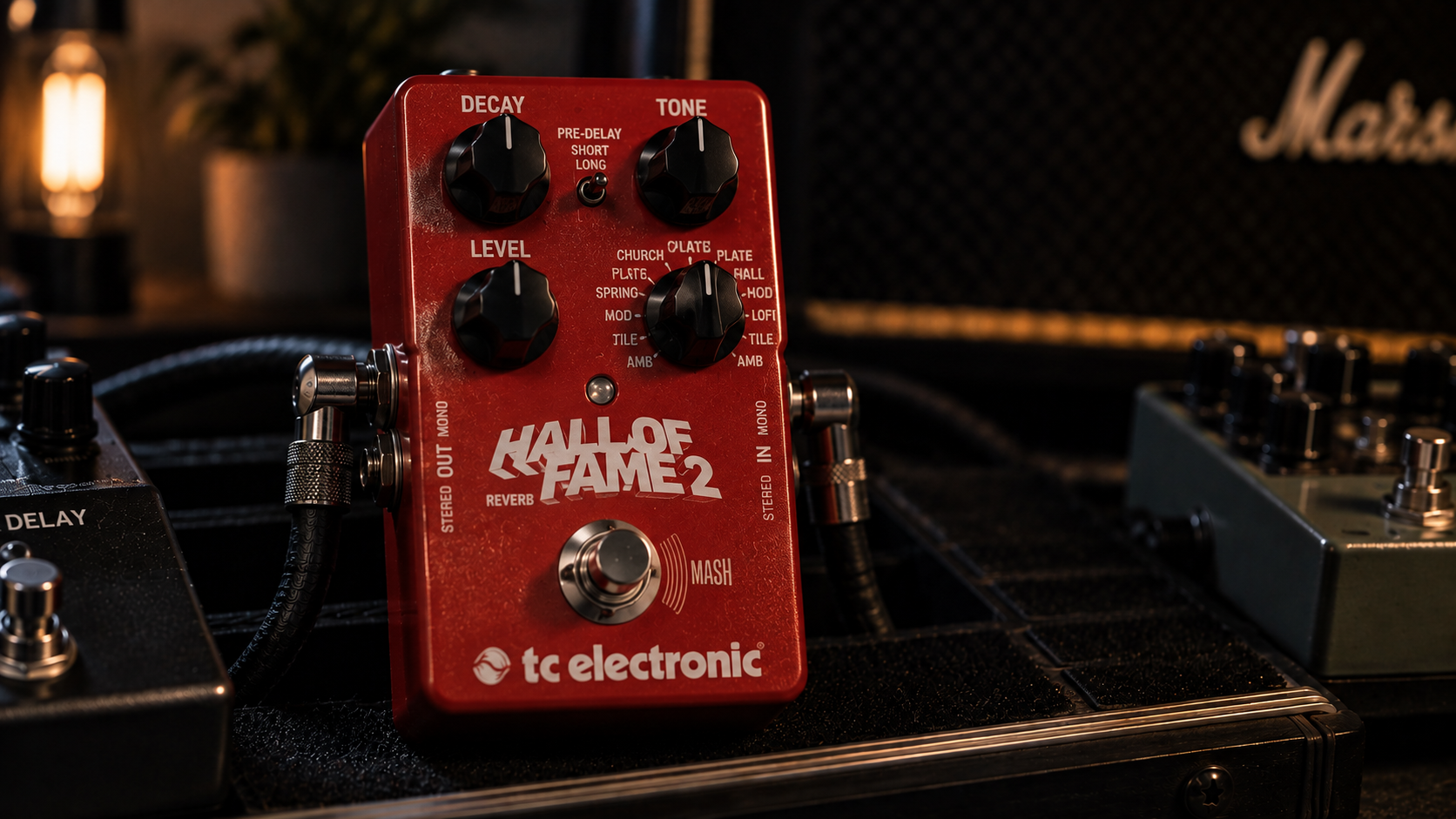
On the pedal itself, the Hall of Fame 2 is straightforward: Decay, Tone, Level and a mode selector. Underneath that simple layout you get eight built-in reverb types, three dedicated TonePrint slots, stereo I/O, selectable true or buffered bypass, Kill-Dry, analog-dry-through and the pressure-sensitive MASH footswitch.
That split personality is the reason to buy it and the reason some players will skip it. You can ignore TonePrint and use the pedal like a normal multi-mode reverb, or treat the software layer as a way to build custom sounds without filling the enclosure with more knobs. If you dislike apps on principle, a simpler TC Electronic reverb pedal workflow may not appeal. If you want customization without moving up to a large preset workstation, the Hall of Fame 2 occupies a useful middle ground.
TC Electronic Hall of Fame 2 review: who should buy it?
| Your situation | Fit | Why |
|---|---|---|
| You want several reverb types in one normal-sized pedal. | Strong fit | Eight built-in types cover most standard uses. |
| You like customizing effects from software. | Strong fit | Three TonePrint slots can store custom or artist sounds. |
| You want expressive control without a separate expression pedal. | Strong fit | MASH turns foot pressure into a controllable effect parameter. |
| You want every important parameter on physical knobs. | Mixed | The deeper layer lives in TonePrint rather than on the enclosure. |
The cleanest reason to skip the Hall of Fame 2 is not that it lacks range. It is that you may not need its second layer at all. If you know you will never use TonePrint, MASH or stereo, a simpler pedal can give you a faster workflow with fewer features sitting idle. The HOF2 makes the most sense when at least one of those extras solves a real problem in your rig.
Pros and cons
- Eight built-in reverb types plus three TonePrint slots.
- MASH adds expression-style control through the footswitch.
- Stereo inputs and outputs.
- Analog dry-through.
- Choice of true bypass or buffered bypass plus Kill-Dry.
- Compact enough for normal boards despite the feature set.
- Deep editing depends on the TonePrint ecosystem.
- Three front-panel tone-shaping knobs cannot expose everything the algorithms can do.
- Players who never use MASH or TonePrint may be better served by a simpler pedal.
- No onboard display or conventional preset bank for rapid song-by-song recall.
We look at the Hall of Fame 2 as two products layered together: the immediate stompbox and the deeper TonePrint platform. That means checking signal-path choices, built-in mode range, what MASH adds in real use, how much customization actually requires software, and whether the front-panel workflow still works when you ignore the app. Specs are cross-checked against TC Electronic’s current Hall of Fame 2 documentation, with reputable demonstrations and short shop or demo-room checks when available used as practical cross-checks rather than long-term-use claims.
Hall of Fame 2 Reverb specs and architecture
| Built-in reverb types | Eight |
|---|---|
| TonePrint slots | Three |
| Controls | Decay, Tone, Level, mode selector |
| MASH | Pressure-sensitive footswitch control |
| Stereo | Stereo in/out |
| Dry path | Analog-dry-through |
| Bypass options | True or buffered bypass; Kill-Dry available |
That feature list sounds more complicated than the physical pedal feels. If you stay on the built-in algorithms, the Hall of Fame 2 behaves like a normal reverb box. TonePrint only becomes part of the workflow when you want it.
TonePrint reverb: useful customization or another app to manage?
TonePrint is the defining feature if you are the kind of player who wants deeper control without a larger pedal. TC lets you load signature sounds or edit your own parameters in software, then save them to the three TonePrint positions.
The upside is obvious: the enclosure stays simple while the hidden parameter set can be much deeper than Decay, Tone and Level suggest. The downside is equally obvious: you cannot see or edit all of those parameters from the board itself.
If you enjoy building a few sounds at home and then leaving them alone, TonePrint is elegant. If you constantly tweak on the floor during rehearsal, a pedal with more physical controls such as the Empress Reverb is easier to understand at a glance.
MASH: more useful than a normal momentary trick
MASH measures pressure on the footswitch and maps that pressure to an effect behavior. In practical terms, it gives you expression-style movement without adding a separate pedal to the board.
That can mean increasing the wet level, changing decay or emphasizing a special behavior depending on the selected sound. The value is not that you will hold the footswitch on every chord. It is that one compact pedal can move between a normal base sound and a more dramatic moment under your foot.
Rhythm to lead without another pedal
One of the most practical uses is keeping a fairly dry rhythm sound as the default, then leaning into MASH for a wetter lead phrase. That lets the same preset stay restrained most of the time while still opening up when the arrangement has more space.
Temporary swells and dramatic tails
MASH also makes sense for one-off transitions. Instead of saving a separate ambient sound, you can push the footswitch harder for a longer or more prominent tail, then release it and return to the base sound. That is especially useful on a compact board where adding a separate expression pedal would defeat the point.
When MASH is mostly wasted
If you use reverb as a fixed always-on effect and rarely change it while playing, MASH may never matter. In that case, do not count it as a reason to pay for the pedal. It is a performance feature, not an automatic improvement in sound quality.
Spring, plate, hall, shimmer and the normal sounds
The Hall of Fame 2 would be a weak all-rounder if the ordinary reverbs existed only to make room for TonePrint. They do not. The built-in family covers the same basic jobs as the Boss RV-6: small-space depth, broader halls, smoother plates, spring character and brighter or more ambient modes.
For most players, the best workflow is to identify one dry-ish everyday sound and one larger effect sound before touching the software. If you cannot get those two jobs right from the panel, more editing will not save the rig.
If the categories themselves are still confusing, our reverb pedal explainer covers spring, plate, hall and room in practical guitar terms.
Built-in modes vs TonePrint: when the software layer is actually worth using
The Hall of Fame 2 is easiest to understand if you separate the stock side from the programmable side. The built-in modes should solve your normal jobs first. TonePrint only becomes valuable when you can name something specific that the front panel cannot quite do.
| Need | Built-in mode is enough | TonePrint adds value |
|---|---|---|
| Simple always-on room or hall | Yes | Usually unnecessary |
| Lead plate with a specific decay/tone balance | Often | Useful if the stock response is close but not exact |
| Custom modulation or unusual parameter mapping | Limited | Strong use case |
| Artist-style or highly specific sound | Maybe | One of the main reasons the platform exists |
The mistake is treating TonePrint as homework. If a stock Hall or Plate already works in your rig, there is no prize for rebuilding it in software. The better workflow is to stay on the front panel until you encounter a real limitation, then use TonePrint to solve that exact problem.
Hall of Fame 2 settings to start with
Always-on room or hall
- Mode: Room or Hall
- Decay: low to medium
- Tone: near noon, darker on bright rigs
- Level: low
Start here before loading custom TonePrints. A good base reverb should work without software.
Lead plate
- Mode: Plate
- Decay: medium
- Tone: slightly dark if the guitar already has a sharp top end
- Level: low to medium
Keep the initial note clear and let the reverb support the sustain after the attack.
Shimmer moment
- Mode: Shimmer
- Decay: medium to high
- Level: medium
- MASH: use for temporary emphasis rather than leaving maximum effect on all the time
Bright octave content stacks quickly with bright amps, so Tone usually matters more than adding more Level.
Stereo, bypass and board integration
Stereo I/O matters most if the rest of the rig can preserve stereo width. Into one combo, the pedal remains fully useful, but part of the architecture is unused. With a modeler, stereo return, interface or two amps, the reverb has more space to spread.
True bypass vs buffered bypass
True bypass is the simplest choice on a short board when you do not need the pedal to preserve trails after bypass. Buffered bypass makes more sense when the pedal is part of a longer chain or when you prefer the behavior of a buffered signal path. Neither option is automatically “better”; the useful part is that the Hall of Fame 2 lets you choose based on the board rather than forcing one architecture.
Kill-Dry: niche at home, useful in parallel rigs
Kill-Dry removes the dry component from the pedal’s output so the unit can provide only the wet reverb signal. That is rarely necessary in a basic guitar → pedals → amp setup. It becomes much more useful in parallel routing, mixers, some wet/dry rigs and recording situations where another path already carries the dry guitar.
When stereo is actually worth caring about
Stereo matters when there are two real output paths to reproduce the width: dual amps, stereo effects returns, two monitors or an interface. If everything collapses into one speaker, stereo on the spec sheet does not improve the sound by itself. Buy the feature because the rig can use it, not because “stereo” sounds more premium.
Front of amp vs FX loop: where the Hall of Fame 2 belongs
If your main distortion comes from pedals into a mostly clean amp, putting the Hall of Fame 2 after your gain section and before the amp input is the straightforward setup. The reverb sees the already-shaped guitar tone and adds space around it without another major gain stage afterwards.
If most of your distortion comes from the amp’s preamp and the amplifier has an effects loop, the loop is usually the cleaner starting point. Reverb after the preamp keeps the distorted guitar inside the reverb instead of heavily distorting the entire wet tail. The difference becomes more obvious as preamp gain rises.
Reverb before gain is still a valid creative choice for shoegaze, smeared ambience and deliberately unstable textures. It is simply not the default when clarity is the goal. If delay is also on the board, the delay and reverb order guide covers the broader chain logic.
Home, rehearsal and recording: where the HOF2’s features actually matter
At home
The temptation is to explore TonePrint and MASH before you know what problem you are solving. Start simpler. Pick Room, Hall or Plate, set Level low, and make sure the dry guitar already works. If the base tone is harsh or thin, fix that first with the bedroom guitar tone guide instead of asking reverb to hide it.
At rehearsal
The room itself already adds reflections, so lower Level before changing Decay or Tone. This is also where MASH becomes more useful: a restrained base sound can stay out of the band’s way, while temporary extra wetness can be added only when the arrangement opens up.
For recording
Stereo I/O and Kill-Dry matter more here than they do on a single-combo practice rig. If you are printing the effect, stay conservative unless the reverb is intentionally part of the performance. A heavily printed wet signal leaves fewer mix options than a dry or lightly processed take.
Hall of Fame 2 vs Boss RV-6 vs MXR M300
These three pedals overlap heavily, but they solve the problem with different priorities rather than forming a simple ranking.
| Priority | Hall of Fame 2 | Boss RV-6 | MXR M300 |
|---|---|---|---|
| Front-panel simplicity | Easy until you enter TonePrint | Very easy | Very easy |
| Deep customization | Strong through TonePrint | Limited | Limited |
| Performance control | MASH | Expression controls effect level | Expression morphs between knob setups |
| Stereo | Yes | Yes | Yes |
| Best fit | Compact customization | Safe all-rounder | Direct controls with strong routing flexibility |
Choose the Hall of Fame 2 if software-assisted customization is genuinely useful to you. Choose the Boss RV-6 if you want a compact all-rounder with almost no ecosystem around it. Choose the MXR M300 if you want a similarly direct pedal but prefer its six-mode architecture and expression-morph approach.
Hall of Fame 2 vs the obvious alternatives
- Want fewer software dependencies and direct simplicity? See the MXR M300 review.
- Want the familiar compact Boss workflow? The Boss RV-6 is the clean alternative.
- Want much deeper presets, MIDI and physical control? The Empress Reverb is the step up.
- Want ambient texture rather than broad versatility? Read the Walrus Slö review.
For the wider category, see our best reverb pedal guide.
Is the TC Electronic Hall of Fame 2 worth it?
The best version of this pedal is not “use every feature.” It is “build the few sounds your rig actually needs, then enjoy having more range available without dedicating more board space.” That is where TonePrint and MASH stop being gimmicks and become useful architecture.
Hall of Fame 2 FAQ
How many reverb types does the Hall of Fame 2 have?
TC Electronic lists eight built-in reverb types plus three dedicated TonePrint slots.
What is MASH on the Hall of Fame 2?
MASH is a pressure-sensitive footswitch system that can control effect parameters based on how hard you press the switch.
Is the Hall of Fame 2 stereo?
Yes. It has stereo inputs and outputs.
Does the Hall of Fame 2 keep the dry signal analog?
Yes. TC Electronic specifies analog-dry-through.
Do I need the TonePrint app to use the pedal?
No. The built-in modes work normally from the front panel. TonePrint is an optional deeper customization layer.