Boss FZ-1W Review: Vintage Fuzz Feel Without Vintage Headaches?
The Boss FZ-1W is what happens when you take the things people love about vintage fuzz — cleanup, touch response, ragged texture — and deliberately remove some of the things people tolerate rather than love: temperature sensitivity, unpredictable units, awkward signal-chain behavior and limited EQ.
That makes it a slightly unusual fuzz. It is not a clone of one famous circuit, and it is not trying to sound as chaotic as possible. Instead, Boss built two related voices around stable silicon circuitry: a Vintage mode for the more reactive, classic side of fuzz, and a Modern mode with more gain, more mid focus and a fatter response.
This Boss FZ-1W review is about whether that compromise actually makes sense. If you want an old-school fuzz that fights you a little, there are more purist options. If you want vintage-style interaction without designing the entire pedalboard around it, the FZ-1W starts looking much more interesting.
Boss FZ-1W review: who should buy this Waza fuzz?
| Your situation | Fit | Why |
|---|---|---|
| You want vintage-style cleanup but use a normal modern pedalboard. | Strong fit | The FZ-1W is far less fussy about placement and buffering than a traditional Fuzz Face. |
| You want one fuzz for classic rock and more modern lead tones. | Strong fit | Vintage and Modern modes genuinely cover different jobs. |
| You want a huge scooped wall of Muff-style fuzz. | Mixed | The FZ-1W is more mid-present and dynamic than that. |
| You want the weirdness and inconsistency of old germanium circuits. | Probably not | Consistency is part of the design goal here. |
Pros and cons
- Excellent guitar-volume cleanup in Vintage mode.
- Modern mode adds useful midrange and extra sustain instead of just “more fuzz.”
- Stable silicon circuit avoids the temperature and unit-to-unit drama associated with vintage fuzz.
- Boss buffer makes it easier to place on a real pedalboard.
- Tone control is more useful than the simple brightness roll-off found on many fuzzes.
- It can feel more refined than players chasing unstable, spitty vintage fuzz want.
- It does not have the giant scooped compression of a classic Big Muff Pi.
- Waza pricing puts it above basic fuzz options.
- Only three knobs and a mode switch: there is no dedicated bias/gate control for extreme textures.
We come at pedals like engineers rather than catalogue writers: circuit behavior first, then what the controls and modes are really changing, then how that translates into a normal rig. For the FZ-1W, the key checks are input sensitivity, cleanup, Vintage vs Modern voicing, buffer behavior and boost use. Hard specs and mode behavior are cross-checked against BOSS’s current FZ-1W documentation, then compared with published demos and established fuzz behavior. Brief shop or demo-room time, when available, is useful as a sanity check, but we do not present it as long-term ownership.
Boss FZ-1W specs and controls at a glance
| Circuit | All-analog silicon fuzz |
|---|---|
| Modes | Vintage / Modern |
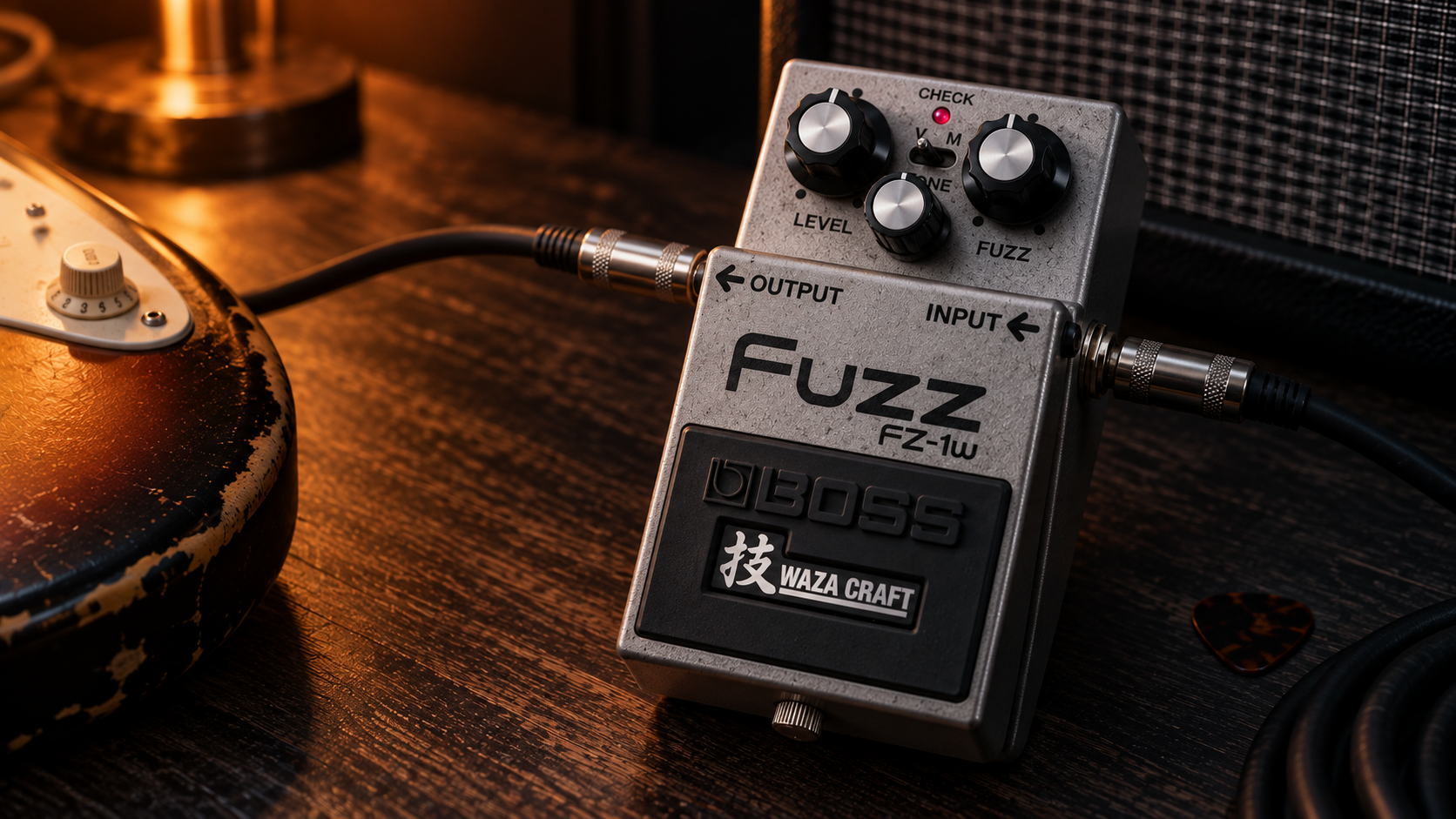
| Controls | Fuzz, Tone, Level, Mode switch |
| Bypass | Buffered Boss bypass |
| Power | 9V battery or Boss PSA adapter |
| Current draw | 16 mA |
The layout is simple enough that you can learn the pedal in one session. The important control is not Fuzz — it is the mode switch, because Vintage and Modern are voiced differently enough that the same knob positions do not mean the same thing.
Boss fuzz pedal in Vintage mode: why the FZ-1W feels different
Vintage mode is the more interactive side of the FZ-1W. Boss tuned it for an assertive, raspy fuzz voice that responds strongly to input level. With the guitar volume wide open, it gets into saturated classic-fuzz territory. Roll back and it moves through crunch toward a surprisingly clean sound.
That makes Vintage mode useful for players who want one fuzz left on for a whole song while the guitar does the switching. The feel is not identical to a specific Fuzz Face or Tone Bender — Boss explicitly treats the FZ-1W as its own design — but the interaction is clearly from that world.
The Tone control also matters here. Vintage fuzz can get harsh quickly when paired with bright pickups or small speakers. The FZ-1W gives you enough tonal range to tame that without flattening the entire character.
Modern mode: more gain, more mids, less nostalgia
Modern mode is not simply Vintage with extra saturation. The midrange is more focused and the overall feel is fatter. Push the Fuzz control past roughly three o’clock and the pedal moves into a smoother, singing sustain that makes much more sense for contemporary leads than for strict vintage recreation.
This mode is also the safer choice if your band mix is swallowing a more scooped fuzz. The stronger mid focus helps the guitar stay present without needing a separate EQ pedal. If you mainly want thick leads and straightforward rock rhythm, Modern mode may end up being the one you use most. If you are still sorting out where fuzz sits beside other gain types, our overdrive vs distortion vs fuzz guide gives that wider context.
Guitar-volume cleanup: one of the FZ-1W’s strongest tricks
Many fuzz pedals get quieter when you roll the guitar volume down. The better ones actually change character. The FZ-1W belongs in the second group, especially in Vintage mode.
| Guitar volume | Vintage mode result | Use |
|---|---|---|
| 4–5 | Bright clean / light grit | Chords and verses |
| 6–8 | Crunchy fuzz-drive | Main rhythm |
| 9–10 | Full fuzz | Leads and heavy sections |
If this interaction is the main thing you are shopping for, also read our fuzz pedal explainer. It will make more sense why certain fuzz designs respond so dramatically to input level.
Boss FZ-1W settings to start with
Vintage cleanup rig
- Mode: Vintage
- Fuzz: 2–3 o’clock
- Tone: noon
- Level: slight boost above bypass
- Guitar volume: use 5–10 for the real gain control
Modern lead sound
- Mode: Modern
- Fuzz: 3–4 o’clock
- Tone: 11–1 depending on amp brightness
- Level: small lead boost
Fuzz as a dirty boost
- Mode: either
- Fuzz: low
- Level: high
- Tone: set for the amp or next gain pedal
Boss specifically designed the pedal to work this way, and it gives the FZ-1W a useful second job on smaller boards.
Home, rehearsal and recording
Home and headphones
Vintage mode can sound a little raspy if you combine high Fuzz with a very bright amp or IR. Keep Tone slightly conservative and use the guitar volume control instead of adding more saturation. If the whole rig feels thin at low level, fix the amp, speaker or IR side before simply adding more Fuzz.
Rehearsal and small gigs
Modern mode becomes especially useful here because the focused mids make it easier to stay audible. If the guitar disappears, add mid presence via the mode choice before simply raising Level.
For recording, the two modes give you an easy way to separate layered parts. A raspier Vintage rhythm and smoother Modern lead can occupy different spaces without requiring two fuzz pedals.
Boosting, stacking and signal-chain placement
This is one of the areas where the FZ-1W is easier than a traditional Fuzz Face. Boss designed it to work reliably in normal modern chains, so you are not forced to put it first just to preserve the basic sound. If you want the broader signal-flow logic, see our guitar pedalboard guide.
You can still put it early if you want, but a buffered tuner before it is not automatically a disaster. That matters if your board already has Boss pedals, wireless gear or another always-on buffer.
Stacking is also straightforward. Low Fuzz + high Level can push another drive. Or you can run a light overdrive before the FZ-1W to tighten the response. If that second role is new to you, the key idea is that low-gain shaping often works better than adding another full layer of clipping. Just avoid maxing gain on both pedals — fuzz saturation stacks into noise and blur much faster than it stacks into “more tone.”
Boss FZ-1W vs the obvious alternatives
- Fuzz Face: more historically pure and more sensitive to the guitar/chain; less convenient.
- Big Muff Pi: thicker, more compressed and more sustain-heavy; less dynamic cleanup.
- JHS 3 Series Fuzz: more willing to do gated/spitty sounds via the Bias control.
- EarthQuaker Devices Hoof: better if your priority is Muff-style weight with adjustable mids.
If you want the wider map instead of choosing from four isolated reviews, use the best fuzz pedal guide.
Is the Boss FZ-1W worth it?
The strongest argument for the FZ-1W is not that it sounds “more authentic” than vintage fuzz. It is that you get the useful parts — cleanup, dynamics, rasp and sustain — without turning pedal placement, temperature and component inconsistency into part of the hobby.
Boss FZ-1W FAQ
Is the Boss FZ-1W a Fuzz Face clone?
No. Boss describes it as an original design inspired by the behavior of classic fuzz circuits rather than a reproduction of one specific pedal.
What is the difference between Vintage and Modern mode?
Vintage mode is more reactive and old-school, with strong guitar-volume cleanup. Modern mode has more gain, fatter tone and a stronger mid focus.
Does the FZ-1W need to go first in the signal chain?
No. Unlike many traditional vintage fuzz circuits, the FZ-1W is designed to work reliably in normal buffered pedalboard chains.
Can the FZ-1W be used as a boost?
Yes. Turn Fuzz down, raise Level, and use Tone to shape what hits the amp or next gain stage.
Is the FZ-1W good for bedroom volume?
Yes. Keep Tone and Fuzz under control on bright speakers or headphones, and use the guitar volume knob to move between cleaner and heavier textures.