JHS 3 Series Fuzz Review: Simple Fuzz with More Range Than It Looks
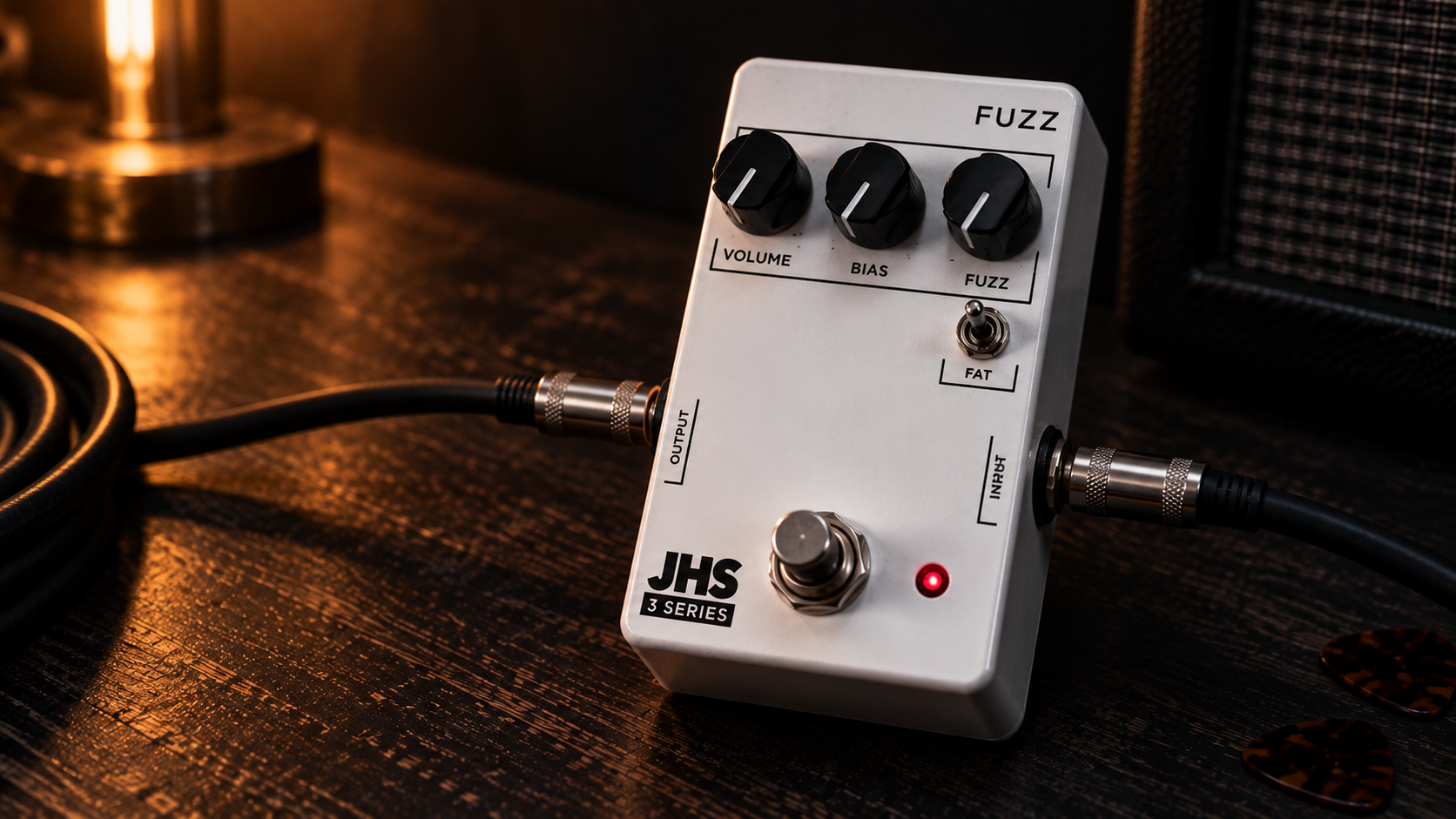
The JHS 3 Series Fuzz looks almost too simple to be interesting: three knobs, one Fat switch, plain white box. That is exactly why it is easy to underestimate. The useful trick is the Bias control, which changes the voltage hitting the final gain stage and lets the pedal move from smoother fuzz into gated, sputtery textures without turning the whole thing into a novelty box.
The other surprise is range. JHS designed the Fuzz control to stay usable across the sweep, so this is not a pedal where the bottom half is dead and the top half is “the real sound.” With the Fuzz backed down it can edge toward dirty boost or distortion-like grit; pushed harder, it becomes much more obviously fuzz.
This JHS 3 Series Fuzz review is about whether that flexibility makes it a smart first fuzz, or whether you are better off buying a more character-specific circuit like a Fuzz Face or Big Muff.
JHS 3 Series Fuzz review: who should buy it?
| Your situation | Fit | Why |
|---|---|---|
| This is your first fuzz and you do not know which classic family you prefer. | Strong fit | It covers smoother, heavier and gated textures without a complicated interface, making it easier to explore fuzz before committing to a more specific Fuzz Face-style voice. |
| You want intentional sputter and gated fuzz. | Very good fit | Bias directly lets you starve the gain stage for broken-up, gated sounds. |
| You want huge Muff-style sustain and a strong built-in mid shape. | Mixed | It can get thick, but that is not its main personality. A Big Muff Pi is the more direct route to that kind of sustain. |
| You want a historically specific vintage recreation. | Look elsewhere | The 3 Series is intentionally flexible rather than period-correct. |
Pros and cons
- Bias control creates genuinely different textures rather than tiny EQ changes.
- Fuzz control is useful from low grit to heavy saturation.
- Fat switch adds low-end weight without adding another knob to manage.
- Cleans up reasonably well from the guitar volume knob.
- Simple enough for a first fuzz, flexible enough not to outgrow immediately.
- No tone knob, so the amp and Fat switch carry more of the EQ job.
- Bias can move from interesting to thin and unusable quickly on bright rigs.
- Not the strongest choice if you want one iconic, instantly recognizable fuzz family.
- No battery operation; it requires 9V DC power.
We come at pedals like engineers rather than catalogue writers: what the circuit is doing, what each control changes, and which behaviors should survive a change of guitar or amp. For the 3 Series Fuzz, that means paying most attention to the Bias control, the usable Fuzz range, the Fat switch and cleanup rather than just listing three knobs. Specs and control behavior are cross-checked against JHS’s current product documentation, then compared with published demos and familiar two-transistor fuzz behavior. Brief shop or demo-room impressions, when available, are treated as spot checks—not as long-term ownership.
JHS 3 Series Fuzz specs and controls at a glance
| Controls | Volume, Bias, Fuzz |
|---|---|
| Toggle | Fat bass boost |
| Power | 9V DC center-negative |
| Current draw | 9 mA |
| Dimensions | 4.42 × 2.38 × 1.22 in |
| Typical role | Flexible main fuzz, gated texture pedal, or low-gain dirty push |
The control layout is one of the reasons the pedal works. Volume and Fuzz are obvious. Bias is the interesting part. The Fat switch is deliberately crude in a useful way: if the normal setting feels too lean, flip it and get more low-end weight without spending five minutes rebuilding the EQ.
What the Bias control actually does
Bias controls the voltage feeding the final gain stage. Turn it one way and the fuzz behaves more smoothly and openly. Turn it the other and the circuit starts starving, breaking notes into a gated, sputtery texture that can sound almost broken on purpose.
This is not just a “more/less fuzz” control. It changes the envelope of the sound. Notes can decay normally at one setting, then choke and spit at another. That makes the Bias knob much more useful than it sounds on paper. If you want the circuit-level reason fuzz behaves this way, see how a fuzz pedal works.
How to use Bias without ruining the sound
- Start around noon: get the basic Fuzz and Volume balance first.
- Move slowly toward gated territory: the useful range can be narrow depending on guitar and amp.
- If it gets thin: try the Fat switch before adding more Fuzz.
- For leads: keep enough sustain that notes do not choke before bends finish.
What the Fat switch changes
The Fat switch adds a bass boost. That sounds basic, but it changes how usable the pedal is with different guitars. A bright single-coil bridge pickup can feel much more complete with Fat on. A dark humbucker into a bass-heavy amp may already have enough low end with Fat off.
Because there is no separate Tone control, this switch becomes the main quick EQ decision. Think of it less as “normal vs better” and more as “tighter vs fuller.”
JHS fuzz pedal tone and feel: more than one personality
Low Fuzz settings
Back the Fuzz control down and the 3 Series starts leaning toward dirty boost and rough overdrive. It still has fuzz texture, but the attack stays clearer and you can use Volume to push an amp harder without turning every note into a saturated blob.
Medium Fuzz settings
This is the broadest sweet spot. Chords retain enough structure, single notes sustain, and Bias can move the feel from relatively smooth to intentionally ragged. If you want one setting that works for normal rock rhythm and leads, start here.
High Fuzz + high Bias
This is the weird side: compressed saturation plus gated decay. It can be brilliant for broken-sounding riffs, garage textures and short, percussive lines. It is less useful when you need long legato notes or smooth bends.
Guitar-volume cleanup
It cleans up better than many heavily compressed fuzzes, which gives it some of the interactive feel people associate with older two-transistor circuits. It is not as focused on that trick as a dedicated Fuzz Face, but it is enough to make the guitar volume knob useful rather than decorative.
JHS 3 Series Fuzz settings to start with
| Goal | Fuzz | Bias | Fat |
|---|---|---|---|
| Dirty boost / rough OD | 9–11 o’clock | 10–noon | Off first |
| Main rock fuzz | 1–3 o’clock | Around noon | To taste |
| Gated sputter | 2–max | Raise until notes choke musically | Often on |
| Single-coil lead | 2–4 o’clock | 10–1 | On |
Volume depends too much on the amp to prescribe one clock position. Set it after the fuzz texture is right, not before.
Home, rehearsal and recording
Home practice
The pedal is easy to use quietly because you can keep Fuzz moderate and let Bias add character. If low volume makes the sound feel thin, try Fat before adding more saturation. If low volume still makes the sound feel thin, fix the amp, speaker or IR side before compensating with more fuzz.
Rehearsal
Without a dedicated mid control, your amp EQ matters more. If the pedal disappears, reduce low-end excess and avoid pushing Bias so far that the note loses body.
For recording, the 3 Series is useful because the gated side can create a second texture without needing a second pedal. One smoother rhythm track and one more broken, biased layer can sound wider than simply doubling the same fuzz twice.
Stacking and pedalboard placement
The 3 Series Fuzz is less precious about signal-chain order than a traditional Fuzz Face, so normal placement near the front of the gain section works. Start with tuner → fuzz → overdrive/distortion → modulation → delay → reverb, then experiment. Our guitar pedalboard guide covers that full chain in more detail.
A low-gain overdrive after the fuzz can add mids and tighten the sound. An overdrive before the fuzz can make it more compressed and push it harder. If you are not sure what the drive stage is contributing, keep the extra gain low enough that you can hear whether it is adding mids, compression or simply more clipping. Neither order is universally right; the useful move is giving each pedal one job instead of maxing both.
If you are still learning how different gain types interact, the overdrive vs distortion vs fuzz guide gives the broader context.
What to buy instead
- Want classic cleanup and guitar interaction? Fuzz Face family.
- Want thick, smooth sustain? Electro-Harmonix Big Muff Pi.
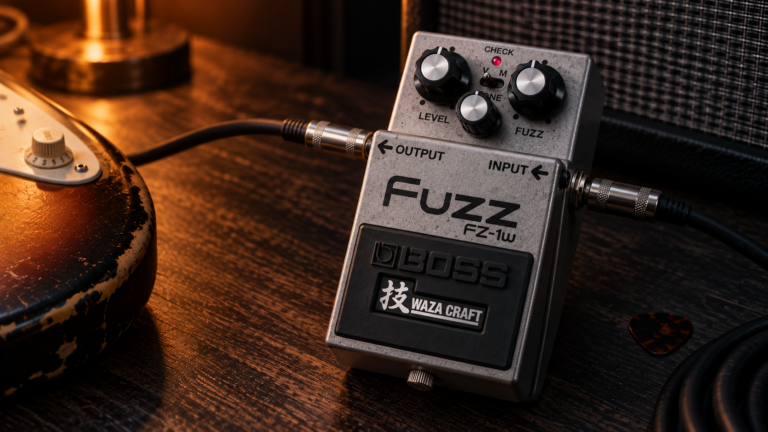
- Want modern stability plus vintage/modern switching? See our Boss FZ-1W review.
- Want Muff weight but more control over mids? See our EarthQuaker Devices Hoof review.
The 3 Series wins when you are not yet sure which one of those personalities you want. It loses when you already know exactly which classic fuzz family you are chasing.
Is the JHS 3 Series Fuzz worth it?
The appeal here is not boutique mystique. It is that the controls make sense. Fuzz changes saturation, Bias changes behavior, Fat changes weight. You can hear what each decision does, which makes the pedal unusually easy to learn.
For more options across different fuzz families, see the best fuzz pedal guide.
JHS 3 Series Fuzz FAQ
What does the Bias knob do on the JHS 3 Series Fuzz?
It changes the voltage feeding the final gain stage. Turning it toward the gated side makes the fuzz more sputtery and causes notes to choke off more aggressively.
What does the Fat switch do?
It adds bass, giving the pedal a fuller and heavier response. It is especially useful with bright single coils or thinner amp settings.
Does the JHS 3 Series Fuzz clean up with guitar volume?
Yes. It responds well enough to make guitar-volume cleanup useful, although a traditional Fuzz Face is still the stronger choice if that is your main priority.
Can the JHS 3 Series Fuzz sound like distortion?
At lower Fuzz settings it can move into rough overdrive/distortion territory rather than full saturated fuzz, which is one of the pedal’s more useful tricks.
Is it a good first fuzz pedal?
Yes. The controls expose several important fuzz behaviors without making the pedal complicated, so it is a good way to learn what kind of fuzz texture you actually prefer.