Jackson JS22 Review: The Budget Dinky That Gets the Important Stuff Right
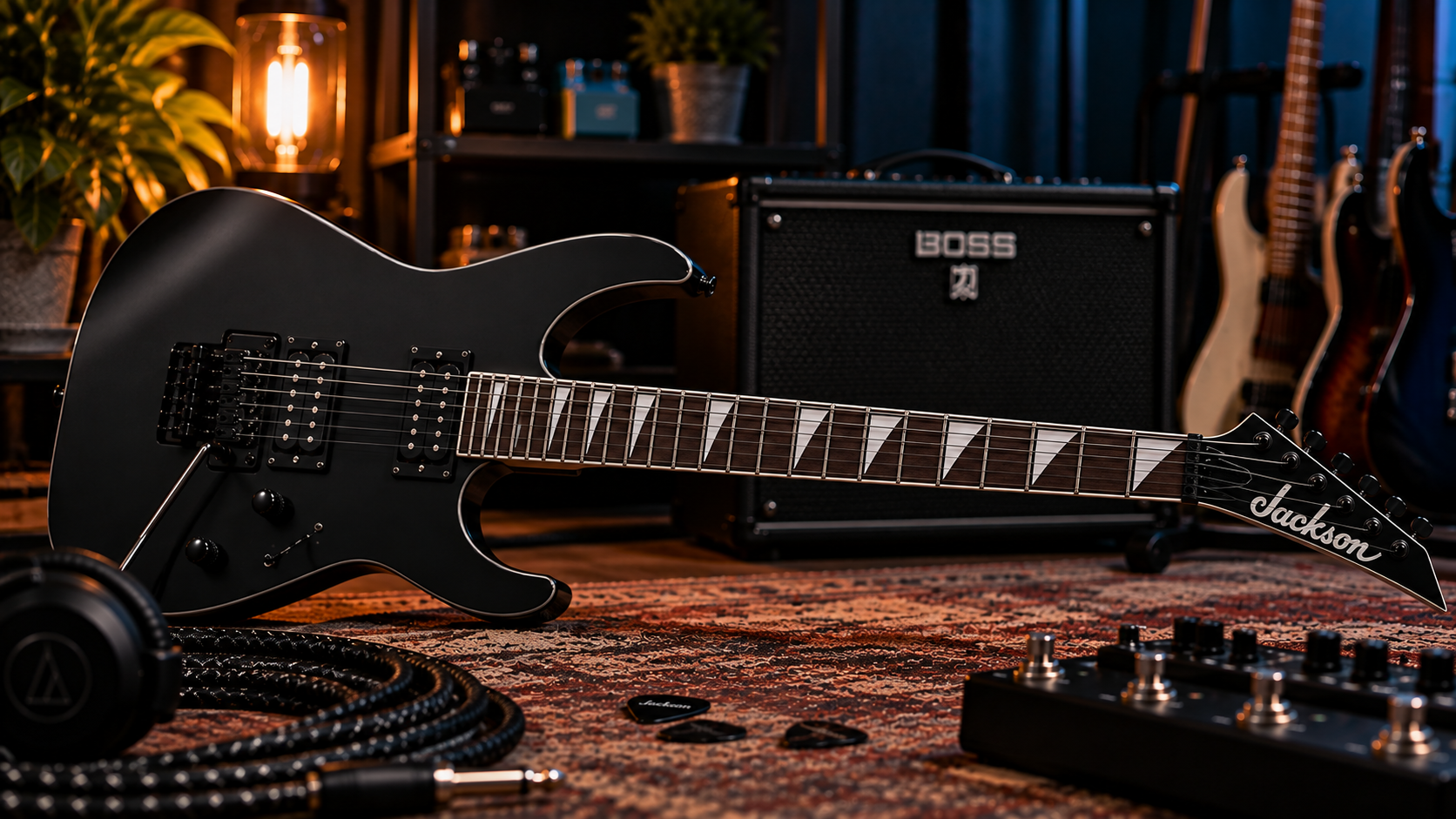
The Jackson JS22 sits in the sweet spot where an entry-level guitar begins to feel purpose-built rather than merely inexpensive. I have played the JS22 alongside other affordable guitars, and its appeal is easy to understand: a slim speed-oriented neck, 24 jumbo frets, a compound-radius board and a compact Dinky body give it a clear metal identity. It also remains a budget instrument with simple electronics, a non-locking tremolo and meaningful sample variation. This Jackson JS22 review separates the genuinely useful specifications from the marketing and looks at what living with the guitar is actually like.
Model note: This review covers the six-string Jackson JS22 DKA with the arched-top Dinky body. It does not cover the longer-scale JS22-7 seven-string or the Monarkh JS22.
Pros and Cons
Pros
- Compound-radius neck and 24 frets make upper-register playing easier.
- Light arched-top Dinky body balances comfort with a clear metal feel.
- Bridge pickup stays useful for tight riffs when gain and bass are controlled.
- A worthwhile step up from the JS11 when the price difference is modest.
Cons
- Setup and fretwork should be checked on the exact guitar before buying.
- Non-locking tremolo is a poor fit for repeated dives or frequent tuning changes.
- Stock pickups and hardware still reflect its budget price.
- A full set of upgrades rarely makes financial sense.
Specs & Feature Overview
- Body: Poplar arched-top Dinky
- Neck: Bolt-on maple with graphite reinforcement
- Scale: 25.5 inches
- Fingerboard: Amaranth, 12–16-inch compound radius
- Frets: 24 jumbo
- Pickups: Jackson high-output ceramic humbuckers
- Bridge: Two-point fulcrum tremolo
- Controls: Master volume, master tone, three-way switch
Build & Design
Jackson’s official JS22 DKA specifications are the reference point for this six-string model, including its 24 frets, 12–16-inch compound radius and two-point tremolo. The seven-string JS22-7 is a different instrument.
The arched-top Dinky body gives the JS22 more visual depth than the flatter JS11 while remaining compact and comfortable. Sitting down, the guitar balances without forcing the picking shoulder upward. Standing, its low weight suits longer practice sessions. Upper-fret access is strong because the neck joint and cutaways do not obstruct the hand.
Budget construction is visible in the plain hardware and finishing detail, yet the core design does not feel like a toy. The important checks are practical: bridge posts should be straight, the neck should align with the strings, and sharp fret ends should not catch the hand. Small finish marks are far less important than those fundamentals.
Neck, Frets & Playability
The 12–16-inch compound radius is the JS22’s most meaningful advantage. The board feels moderately curved near the nut for chord work and progressively flatter higher up, supporting bends and lower action. I find it easy to move between rhythm playing and lead lines without the neck demanding a different hand position. Twenty-four frets also provide a full two-octave range on every string.
A specification cannot compensate for poor fret leveling, so the individual guitar still matters. On a good example, the jumbo frets and slim profile make legato, vibrato and position shifts accessible. Beginners should avoid crushing the strings; tall frets reward a relaxed touch. For a broader buying framework, see what electric guitar is best for beginners.
Setup and Fretwork
My strongest advice is to evaluate the setup before judging the model. Shipping, humidity and fast factory work can leave excessive relief, high action or imperfect intonation. Those are adjustable. Persistent dead notes, a twisted neck or severe fret-height differences are reasons to exchange the guitar rather than immediately pay for major repair.
A normal setup can transform the JS22 because the underlying neck geometry is capable of comfortable action. Check every fret on every string, bend the high strings above the twelfth fret and listen for choking. Our fret-buzz troubleshooting guide explains which noises are normal setup issues and which deserve closer attention.
Pickups & Sound
The ceramic humbuckers are voiced to deliver output and aggression. The bridge pickup has a firm upper-mid attack that helps riffs speak through distortion, while the neck pickup gives a rounder lead voice. For practice and early recording they are entirely usable. They also reject the hum that can make high-gain single-coil rigs frustrating.
The limitation is refinement. Complex chords can blur when gain and bass are high, and clean sounds lack the openness of better pickups. Before replacing them, lower their height a little and rebalance the amp. Small changes informed by the guitar EQ cheat sheet often recover more clarity than expected.
Clean, crunch and high-gain tones
Clean tones are best with the neck pickup or middle position, moderate volume and a brighter amp voice. They are serviceable for practicing chords, chorus-heavy parts and ambient sounds, but this is not the JS22’s defining strength. Crunch is more convincing: the bridge pickup’s attack suits punk, hard rock and classic metal.
High gain is where the guitar feels at home. Palm mutes remain articulate when the amp’s bass is controlled, and the long scale keeps standard and modest drop tunings reasonably firm. Too much gain flattens dynamics and exaggerates the pickup’s coarse top end. The practical settings in our bedroom tone guide help the JS22 sound larger without becoming fizzy.
Tremolo & Tuning Stability
The two-point tremolo is suitable for vibrato and small pitch dips, not repeated extreme dives. I get the best results when the nut slots are clean, strings are installed neatly and the bridge is not floating excessively. Every friction point matters because the system does not lock the strings at the nut or bridge.
Players who constantly change tunings should consider decking the bridge or choosing a fixed-bridge guitar. That is not specific to Jackson; it is the nature of a basic floating tremolo. Locking tuners speed string changes but do not cure nut binding, so diagnose before buying parts.
JS22 vs JS11
Compared with the Jackson JS11, the JS22 commonly adds two frets, a compound-radius board and the arched-top body. I prefer the JS22 when the price difference is modest because those are features the player touches rather than decorative upgrades. The upper neck feels more naturally suited to lead playing.
The JS11 can still be the better purchase if it is the better individual instrument or leaves room in the budget for a competent amp and setup. Both share the same basic value proposition and similar hardware limitations. Do not sacrifice the complete playing experience to move one line higher in a catalogue.
JS22 vs Other Beginner Guitars
Against a traditional Strat-style beginner guitar, the JS22 offers a flatter, faster board and quieter high-gain pickups but less convincing single-coil clean character. Against a short-scale or thicker-neck guitar, it feels more precise and stretched. Preference matters more than a universal ranking.
It earns a place among electric guitars under $300 because its design has a clear purpose. A Yamaha or Ibanez HSS can cover more genres; the Jackson makes a stronger emotional and ergonomic case for a player who already knows heavy music is the goal.
Are Upgrades Worth It?
Start with setup work, not pickups. A correctly cut nut, level frets and stable jack improve every sound. After that, a bridge pickup upgrade may be worthwhile if the amplifier is already good and you need tighter lows or more detailed mids. Replacing tuners, bridge, electronics and both pickups at once rarely makes financial sense.
The JS22 can be an enjoyable modification platform because the starting cost is low, but modifications should be treated as a hobby rather than an investment. If you are chasing better recorded tone, compare the cost with a stronger amp or interface using our home rig comparison.
Who the JS22 Suits Best
It is for the beginner or budget-conscious player who wants metal ergonomics, 24 frets and a neck that encourages faster technique. It also works as a light backup guitar when the tremolo is used conservatively.
It is not ideal for players who need premium fretwork without inspection, aggressive whammy-bar stability or highly nuanced clean tones. Buy from a seller with a sensible return policy, test the exact instrument and include a setup in the realistic budget.
How It Feels Next to the JS11
The JS22 does not feel like a completely different class of guitar, and that is worth saying plainly. The pickups and basic hardware still live in the same budget world. The difference is in the neck and the way the guitar invites lead playing. The compound radius becomes more noticeable above the twelfth fret, where bends feel less crowded and the flatter board gives the fretting hand more room.
The extra two frets were not important during normal rhythm practice, but they mattered when I played parts written around a full two-octave neck. More importantly, the arched body and sharkfin-inlay version feels like a more complete Jackson rather than the stripped-down entry point. I would pay a modest premium for that. I would not sacrifice a decent amp or a professional setup just to move from JS11 to JS22.
With gain, I reached the same conclusion as I did with the JS11: the bridge pickup sounds better when it is not asked to provide all the weight. Lower bass, healthy mids and slightly less distortion keep fast rhythm parts clearer. If both guitars are set up equally well, the JS22 is the one I would keep. If the JS11 is the better individual sample, the model number does not rescue a rough JS22.
Verdict: The Neck Makes the Case
The JS22 is one of the more convincing first guitars for a player focused on rock and metal. Its neck geometry and ergonomics are more important than its inexpensive hardware. A good example with a proper setup can last well beyond the beginner stage, but buyers should inspect fretwork, nut slots and bridge alignment rather than ordering on specifications alone.
FAQ
Is the Jackson JS22 good for beginners?
Yes. Its light body, slim neck and simple HH controls are beginner-friendly, particularly for rock and metal. Check the setup carefully.
Can the JS22 play clean music?
Yes, especially from the neck pickup or middle position, but its stock ceramic humbuckers prioritise output over sparkling clean detail.
Does the JS22 have a Floyd Rose?
No. Standard JS22 DKA models use a conventional two-point fulcrum tremolo, so they do not offer double-locking stability.
Is the JS22 worth upgrading?
A setup and nut work can be worthwhile. Large-scale hardware and electronics replacement is usually poor value unless modification itself is the hobby.