Mooer SD10i Review: A Complete Practice Rig in One Small Amp?
The Mooer SD10i tries to fit an entire modern practice ecosystem into a compact 10-watt stereo amp. It offers 52 amp models, 49 effects, 40 editable presets, Bluetooth, USB recording, an 80-second looper, drums, a tuner and a rechargeable battery. That list is unusually deep for the size and price. It also makes the central question of this Mooer SD10i review simple: do those tools form a coherent practice amp, or are they trapped behind two tiny 2-inch speakers and an app? Available professional testing and owner feedback point to a capable, flexible desktop rig whose modeling is stronger than its maximum-volume speaker performance.
Pros and Cons
Pros
- 52 amp models, 49 effects and 40 presets offer broad sound options.
- Stereo speakers, rechargeable battery and Bluetooth make a flexible desktop rig.
- 80-second looper, drums and metronome support focused practice.
- USB-C recording and headphones extend it beyond the built-in speakers.
Cons
- Two 2-inch speakers have clear limits at higher volume.
- Deep editing depends on the iAMP app.
- The feature depth can slow down players who only need a few sounds.
- It is built for personal practice, not band rehearsal.
Specs & Feature Overview
- Power: 10-watt Class D stereo
- Speakers: Two 2-inch FRFR drivers
- Models: 52 MNRS amp models
- Effects: 49 effects
- Presets: 40 editable
- Practice tools: 80-second looper, 40 drum patterns, 10 metronomes, tuner
- Connectivity: Bluetooth 5.0, headphones, USB-C OTG audio
- Battery: 3000 mAh, up to about five hours
Build & Workflow
The core figures in this Mooer SD10i review are cross-checked against Mooer’s official product page. For a second perspective, Guitar World’s hands-on review also tests the amp as a compact practice and recording tool.
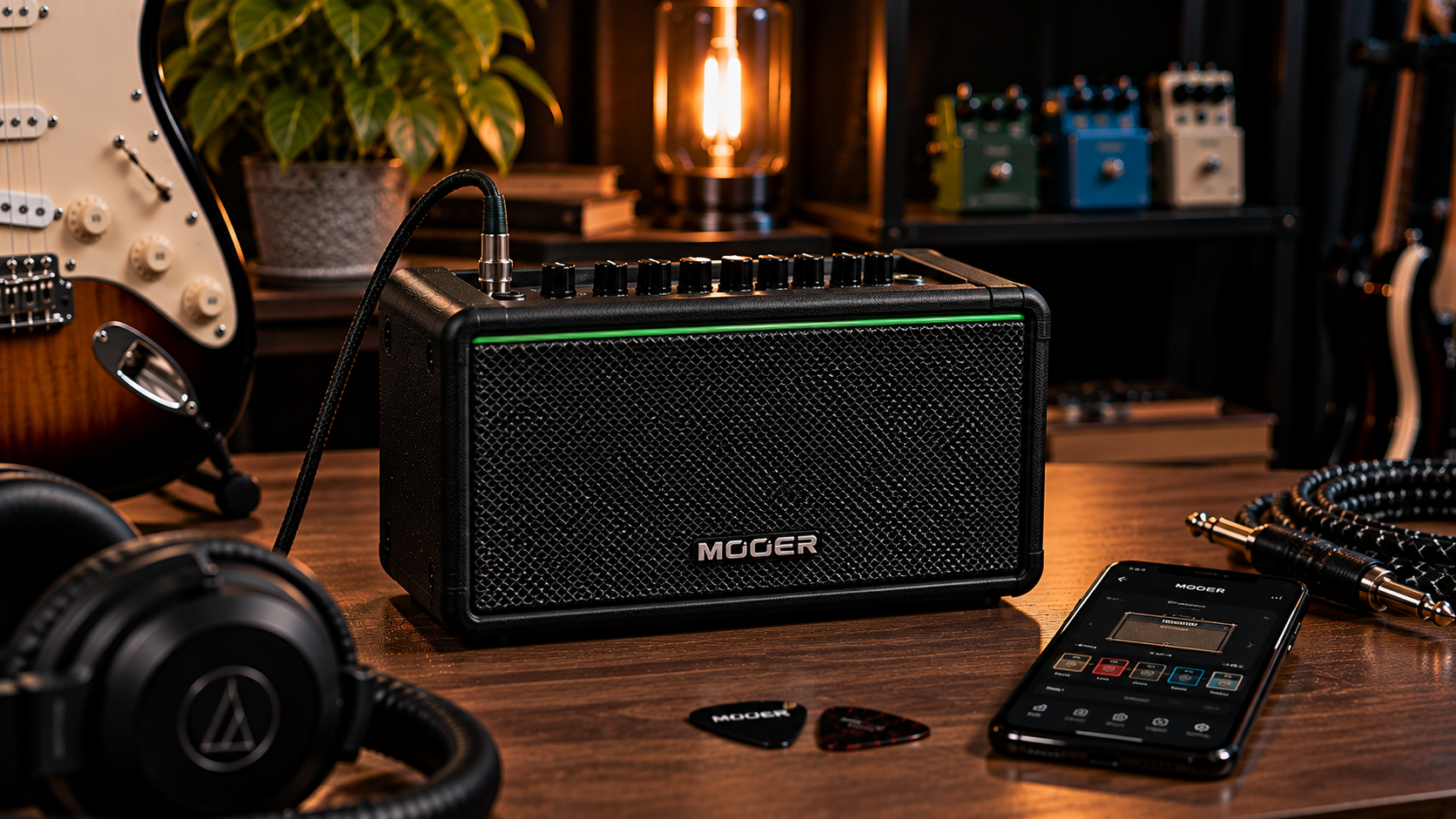
The SD10i looks like a small desktop speaker rather than a shrunken traditional combo. Its two full-range drivers support stereo effects and backing-track playback, while three main controls keep the top panel uncluttered. The Amp selector provides fast access to core sounds; Instrument and Audio levels separate guitar from streamed or USB playback.
That simplicity is deliberate because deep editing happens in the iAMP app. The amp can still produce sound without constant phone use, but owners who refuse app-based products will not access the reason to choose it. At 1.95 kg and with an internal battery, it is genuinely portable around the house or on a trip.
Sound: Models and Effects
The model count spans clean platforms, edge-of-breakup amplifiers, classic stacks and modern high-gain sounds. Mooer’s MNRS technology has already appeared across its modeling products, and the SD10i uses that experience rather than offering four generic voices. The useful benefit is not collecting models; it is finding a small set that responds well to your guitar.
Forty-nine effects cover dynamics, drive, modulation, delay and reverb. That is enough to build complete signal chains and create specialized practice sounds without pedals. Preset volume matching matters: community or factory tones can jump in level, so normalize your favorites before switching between them.
Stereo Speakers and Volume Range
Stereo presentation gives delays, reverbs and music playback a wider image than a single tiny driver. At desk and bedroom levels, reviews consistently describe clear tones and surprising low-end presence for the enclosure. That makes the SD10i more enjoyable than its dimensions suggest.
Physics appears when volume rises. Professional testing notes that the speakers struggle when pushed, and two 2-inch drivers cannot create the punch of an 8-inch combo. Treat the master level as a quality control, not a challenge. If the sound becomes congested, reduce bass and volume rather than adding more gain. The positioning tips in our bedroom tone guide are directly relevant.
Clean, Crunch and High-Gain Performance
Clean and lightly driven models suit the FRFR-style speakers because transient detail and stereo ambience remain audible. Compression, chorus and room reverb can produce polished practice sounds without hiding technique. Crunch tones also work well when lows are controlled and cabinet choice keeps the upper mids natural.
High gain exposes the enclosure sooner. The models can generate convincing distortion, but palm-muted weight through the speakers is limited. Headphones make the same presets feel larger because the model is no longer squeezed through tiny drivers. Use less gain and more midrange than a solo preset initially suggests; the guitar EQ cheat sheet provides useful correction points.
iAMP App and Presets
The top panel can recall four sounds from the active bank, but most editing and bank management happen in iAMP. Inside the app, the forty slots are arranged as four presets across ten banks. Moving to another bank requires the app, which is an important workflow detail if you hoped to control everything from the hardware.
The editor itself is easier to understand than the feature count suggests. Amp, effect and preset categories are clearly separated, and Mooer Cloud adds user-created sounds. I would treat cloud presets as raw material. Different pickups and monitoring levels make downloaded tones jump in volume or arrive with far too much gain. Save a clean, crunch, rhythm and lead bank of your own before browsing endlessly.
If opening a phone every time you want to shape a sound already sounds irritating, the SD10i is the wrong amp. A knob-driven model such as the Harley Benton DNAfx AmP10 gives up depth but gets you playing faster.
Looper, Drums and Metronome
An 80-second looper that can synchronise with the drum machine is more than a novelty. It supports chord-vamp practice, lead phrasing and quick writing without opening recording software. Forty drum patterns and ten metronome options provide enough variety to keep time work from feeling clinical.
Looping becomes far more useful with the optional wireless footswitch because hands-free start and stop are central to clean loops. Without it, the feature remains good for deliberate practice but is less fluid. Factor the controller into the real price if looping is a primary reason to buy.
Bluetooth, Headphones & USB Recording
Bluetooth 5.0 handles backing audio, while the guitar stays wired to avoid performance latency. The dedicated Audio control makes it easy to balance a track against the guitar. Headphone output is important because it reveals more of the amp and cabinet modeling than the miniature speakers can reproduce, particularly on high-gain and stereo-effect presets.
USB-C supports charging and OTG audio recording/playback, allowing the SD10i to capture ideas without a separate interface. Confirm routing and monitoring settings before serious work. If recording is the main goal, compare it with the dedicated choices in our amp sim, modeler and practice amp guide.
Battery Life and Portability
The internal 3000 mAh battery is rated for up to roughly five hours, with actual life depending on playback and volume. That is enough for several practice sessions or writing away from an outlet. USB-C power is more convenient than disposable cells, although an ageing internal battery is less easily replaced.
At just under two kilograms, the SD10i is portable rather than pocketable. It fits naturally on a desk, shelf or small table and can move between rooms without a power supply. That middle ground is useful: substantially fuller than a plug-in headphone amp, far easier to carry than a traditional combo.
Alternatives to Check Out
The Spark Mini is the closest lifestyle rival. Its app is more polished around learning, Smart Jam and community tones, and its larger consumer ecosystem makes tutorials easier to find. The SD10i answers with an 80-second looper that can sync to drums, forty editable preset slots and USB-C OTG recording. Add Mooer’s optional wireless footswitch and the looper becomes much easier to use, but that extra cost belongs in the comparison.
The Spark GO is much smaller and easier to throw in a bag. It gives up the SD10i’s wider dual-speaker presentation and dedicated looper workflow. Choose the GO when portability is the whole point; choose the Mooer when the amp will usually live on a desk and function as a writing station.
The NUX Mighty Lite BT MKII offers a more traditional mini-combo layout, user IR support and several power options. Mooer gives you a rechargeable battery, stereo speakers, more onboard models and the integrated looper. The decision is really IR flexibility versus a more complete self-contained practice workflow—not 52 models versus another number on a box.
Who the SD10i Suits Best
It fits the player who wants one portable box for tones, headphones, backing tracks, rhythm practice, looping and quick USB recording. It is especially compelling when an app is welcome and a conventional amp cabinet is unnecessary.
Skip it if you need rehearsal volume, dislike screen-based editing or want a speaker that reacts like a traditional guitar combo. The feature list is real, but the value comes from using those tools. If you only need one clean and one crunch sound, a simpler amp may encourage more playing.
Building a Practical Preset Library
The SD10i becomes easier to live with when the forty preset slots are treated as organized tools rather than empty storage. Build one balanced clean sound, one edge-of-breakup patch, one rhythm sound and one lead sound first. Match their perceived volume by ear at the same Instrument setting, then add specialized effects only when a song requires them. This avoids the common smart-amp problem where every practice session starts with twenty minutes of browsing.
Use the same reference guitar and riff while comparing amp models. A short clean chord, palm-muted rhythm and single-note line reveal more than switching randomly between presets. Save a second version before making major edits so a useful sound is never lost to experimentation. If cloud tones sound impressive alone but disappear under a backing track, reduce bass and ambience and restore midrange. The broader selection in our Hotone Pulze review provides a useful comparison with another app-driven desktop amp and shows why workflow matters as much as raw model count.
Verdict: A Portable Practice Studio
The SD10i is a strong choice for players who value sound variety, looping, backing tracks and portable recording. Its app is approachable and the headphone/USB experience avoids much of the small-speaker limitation. The dual 2-inch drivers sound good at sensible home levels but lose composure when pushed, so buy it as a desktop practice and writing tool—not a miniature rehearsal amp.
FAQ
Is the Mooer SD10i loud enough for gigs?
No. It is a 10-watt desktop practice amp with two 2-inch speakers. Its best use is home practice, writing and portable low-volume playing.
Can the SD10i record over USB?
Yes. Its USB-C connection supports OTG audio recording and playback as well as power.
Does the Mooer SD10i work without the app?
It can recall and play sounds from the hardware, but the iAMP app is required for deep model, effect and preset editing.
How long does the battery last?
Mooer rates the internal battery for up to about five hours. Real runtime varies with speaker volume, Bluetooth use and battery condition.