Empress Reverb Review: Deep Control Without Menu Hell?
This Empress Reverb review is really about one question: can a pedal be deep enough for serious sound design without making you live inside menus?
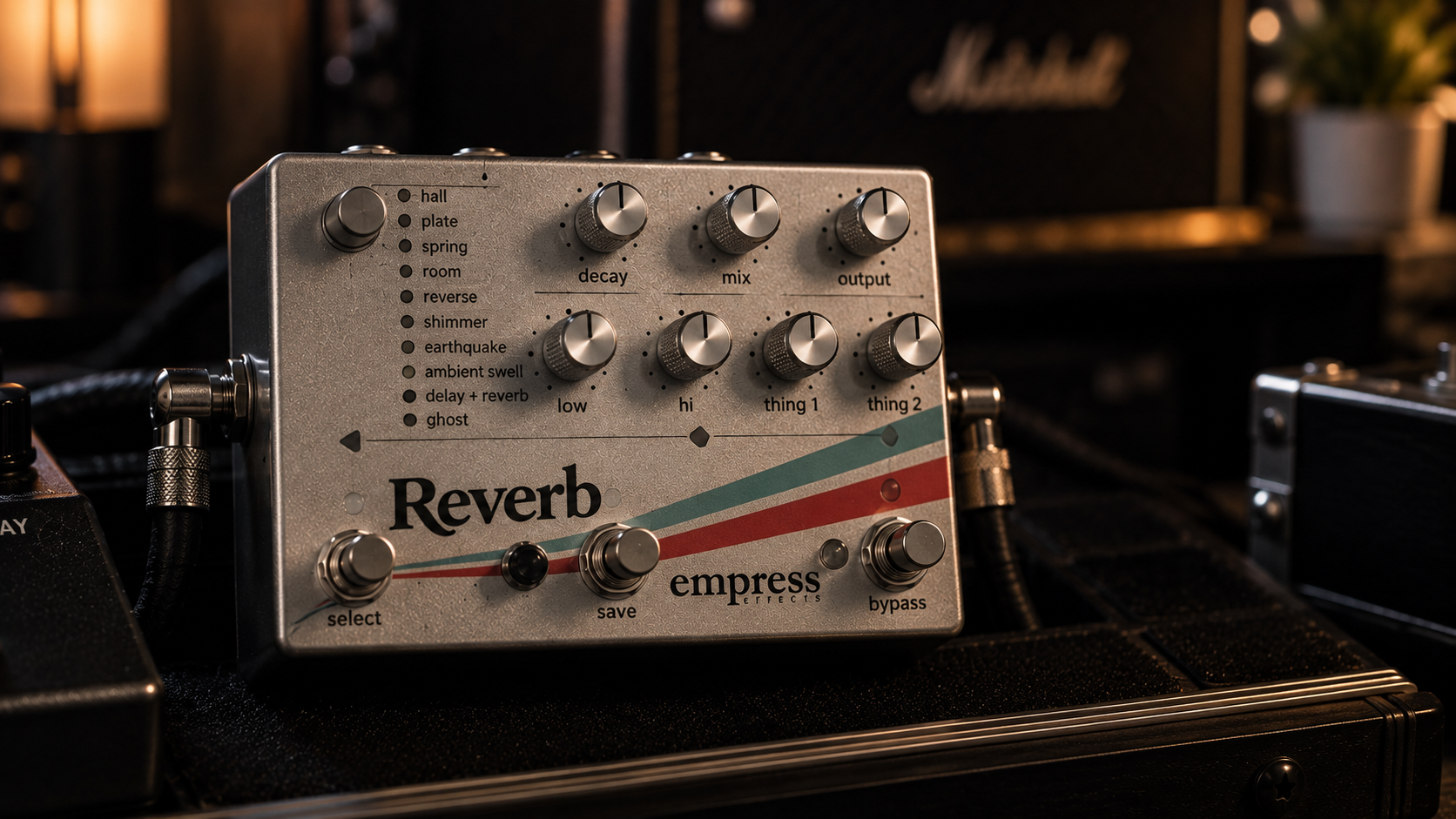
That is the Empress approach. The pedal gives you a large set of reverb families, multiple variations, presets, MIDI, stereo I/O and expression/control options, but keeps the primary controls on physical knobs. It can cover normal hall, plate, room and spring duties, then move into reverse, lo-fi, ghost, ambient swell and stranger territory without changing into a touchscreen workstation.
The trade-off is price and complexity. You are paying for a platform, not a basic “make my clean tone wider” pedal. If you only use one spring sound at low Mix, the Empress is excessive. If you need a premium Empress reverb pedal that can move from invisible ambience to full sound design and still work live, the feature set starts to justify itself.
Empress Reverb review: who is it actually for?
| Your situation | Fit | Why |
|---|---|---|
| You want one reverb to cover conventional and experimental sounds. | Strong fit | The algorithm range is broad enough to replace several narrower pedals. |
| You need presets, MIDI and stereo for live use. | Strong fit | Those features are part of the platform rather than add-ons. |
| You hate menu diving but still want deep editing. | Strong fit | Most decisions stay on physical controls. |
| You only need subtle always-on room or spring reverb. | Poor value | You would be paying for capabilities you are unlikely to use. |
Pros and cons
- Very broad algorithm range from realistic spaces to experimental ambience.
- Presets, MIDI and flexible control-port options.
- Stereo inputs and outputs.
- Physical controls keep most editing immediate.
- Firmware support has continued to expand the platform.
- Strong fit for both studio and complex live rigs.
- Premium price is difficult to justify for simple reverb use.
- More controls and mode variations mean a longer learning curve.
- 300 mA power requirement needs a capable isolated supply.
- Players who want a tiny stompbox will find the enclosure and workflow more involved than necessary.
We evaluate a platform like this from the signal path outward: how the dry signal is handled, how the algorithms differ, which controls remain consistent across modes, how presets and MIDI affect real use, and where complexity stops buying useful flexibility. Specs and mode behavior are cross-checked against Empress Effects’ current Reverb documentation and support material. Reputable demos and short shop or demo-room checks when a unit is available help verify the practical behavior, but we do not present brief access as long-term ownership.
Empress Effects Reverb architecture: deep without becoming a menu box
The Empress organizes its sounds into broad reverb families with variations inside them. Current categories include Hall, Plate, Spring, Room, Sparkle, Modulation, Ambient Swell, Delay + Reverb, Reverse, Ghost, Lo-fi and Beer. The important part is that the knobs remain the main interface instead of forcing every change through a display.
That architecture makes the pedal easier to understand than its feature count suggests. You choose the family, pick the variation, then shape the sound with the front-panel controls. Presets exist for recall, but the pedal does not require presets just to be usable.
| I/O | Stereo in/out |
|---|---|
| Presets | Yes |
| MIDI | Supported |
| Control port | Expression / external control options |
| Power | 9V DC, 300 mA |
| Size | 5.7 × 3.75 in enclosure footprint |
Hall, plate, spring and room: the boring modes matter most
Premium reverb pedals are easy to judge by their strangest sounds, but the ordinary modes decide whether the pedal works every day. Hall should create depth without masking pick attack. Plate should add a smooth tail that supports leads. Room should make a dry signal feel placed rather than washed. Spring should give enough character to feel intentional.
The Empress earns its flexibility here because the conventional sounds are not just filler before the experimental section. If you need a practical explanation of what these reverb families are doing, the reverb pedal guide gives the simpler foundation.
For rhythm guitar
Use shorter rooms, restrained plates or shorter halls with low Mix. The goal is depth around the dry note, not a separate layer of sound competing with it.
For leads
Longer plate or hall settings can add sustain around the line without creating obvious rhythmic repeats. If you already use delay, keep both effects more conservative than you would in isolation. Our delay and reverb order guide covers the interaction.
Ambient, reverse, ghost and lo-fi: why you would buy the Empress instead of a simpler pedal
This is where the premium platform begins to separate itself from an all-rounder such as the Boss RV-6. Ambient Swell can turn the reverb envelope into part of the phrase. Reverse changes the relationship between attack and tail. Ghost and Lo-fi deliberately move away from realistic spaces toward texture.
The useful question is whether those sounds belong in your music. If you mostly want a subtle room and occasional plate, the Empress is unnecessary. If the reverb tail is an instrument layer rather than background ambience, the extra control stops being feature creep.
Empress Reverb settings: practical starting points
Invisible room
- Mode: Room
- Decay: short
- Mix: low
- High-frequency content: slightly softened if the amp is bright
A useful test is that the guitar should feel oddly dry when you bypass the effect, not obviously wet when it is on.
Lead plate
- Mode: Plate
- Decay: medium
- Mix: low to medium
- Modulation: subtle or off
Keep the dry attack intact and let the tail support the note after the pick transient.
Ambient swell
- Mode: Ambient Swell
- Decay: long
- Mix: medium to high
- Preset: save it separately from normal rhythm sounds
This is where preset recall becomes much more useful than trying to move several knobs between songs.
Stereo, presets and MIDI: the real reason to step up
A premium stereo reverb pedal starts to make sense when the rest of the rig can use it. Into two amps, stereo FRFR, monitors or an interface, the spatial algorithms have more room to work. In a single mono combo, you still get the algorithms and presets, but not the full width advantage.
MIDI and preset recall matter for the same reason: repeatability. A compact knob-only pedal is faster when you use one sound. The Empress becomes faster when you use many sounds and need them to return exactly.
Empress has also continued firmware development, including new spring-related functionality in 2026. That matters because the platform is not frozen in the configuration it launched with.
Home, rehearsal and recording
At home
The danger is using the Empress as entertainment rather than as part of the rig. Huge tails sound impressive alone. For normal practice, start with conventional spaces and low Mix. If the base tone is weak, the bedroom tone guide will fix more than another algorithm.
At rehearsal
Preset recall becomes more valuable. One dry-ish rhythm preset, one lead plate/hall and one dedicated ambient sound covers more real-world ground than keeping every algorithm available at once.
Recording
Stereo and the breadth of algorithms make the pedal genuinely useful here, but print wet sounds deliberately. If the reverb is only for depth, recording less wet than your first instinct preserves more options at mix time.
Empress Reverb vs the obvious alternatives
- Want similar “many sounds, direct knobs” logic for less complexity? See the MXR M300 review.
- Want compact versatility without premium-platform depth? The Hall of Fame 2 is easier to justify.
- Want a simple all-rounder with no preset ecosystem? Start with the Boss RV-6.
- Want ambient texture specifically? The Walrus Slö is narrower but more focused.
For the wider category, see our best reverb pedal guide.
Is the Empress Reverb worth it?
The best reason to buy it is not “more reverb.” It is the ability to move between radically different spaces and textures without giving up immediate controls. If that flexibility solves a real problem in your set, studio workflow or ambient rig, the platform makes sense. If not, a simpler pedal is the better design for you.
Empress Reverb FAQ
Does the Empress Reverb have presets?
Yes. Preset recall is a core part of the pedal and becomes especially useful for live sets with different reverb roles.
Is the Empress Reverb stereo?
Yes. It has stereo inputs and outputs.
Does Empress Reverb support MIDI?
Yes. MIDI and the control port expand preset and external-control options for more complex rigs.
How much current does the Empress Reverb need?
Empress specifies 9V DC power with a 300 mA current requirement.
Is the Empress Reverb overkill for home use?
It can be. If you only use subtle room, hall or spring reverb, simpler pedals cost less and are faster. It makes more sense at home when sound design, presets or stereo are part of how you actually play.