Boss DD-8 Review: The Safest All-Round Delay Pedal?
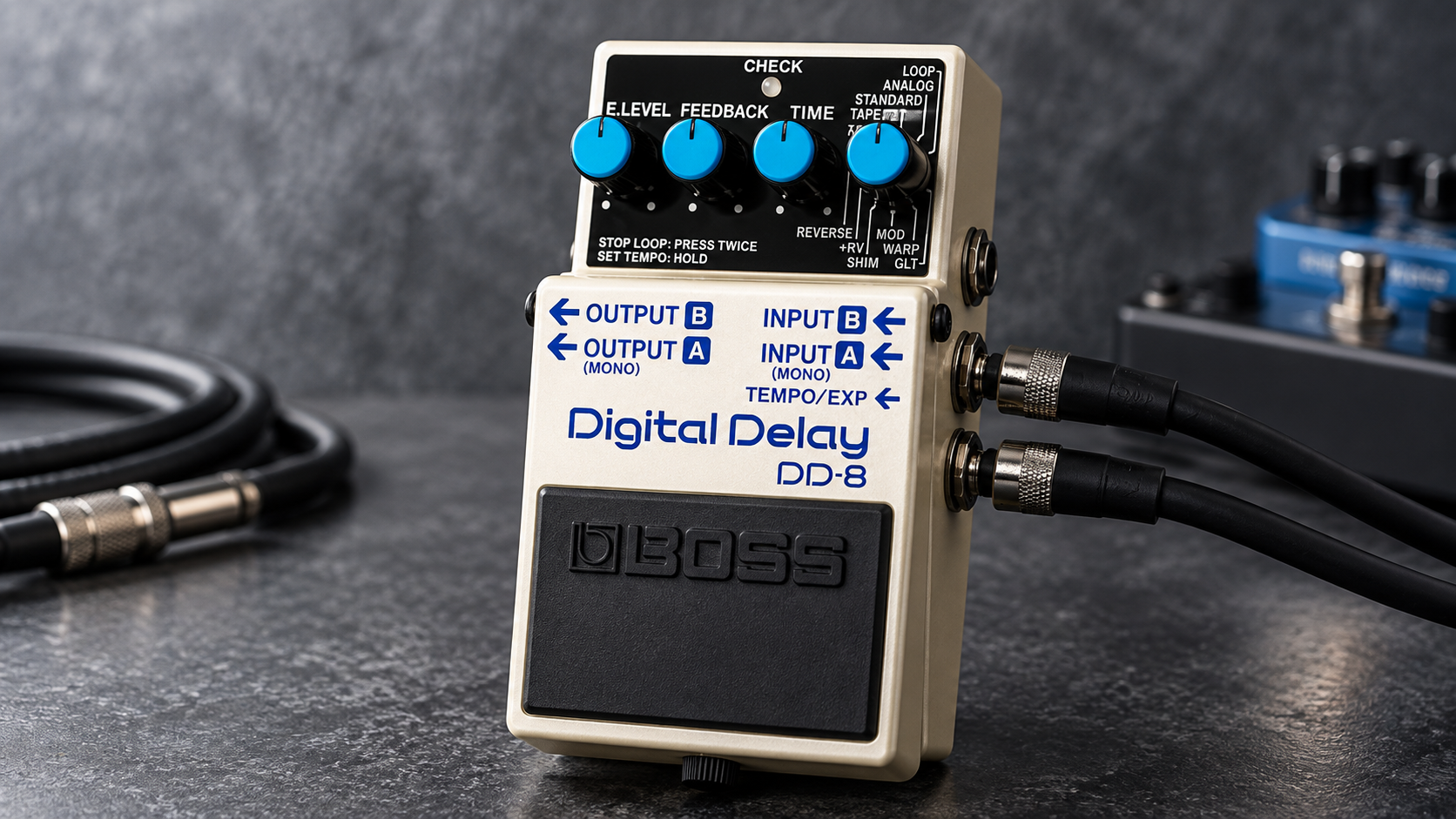
The Boss DD-8 makes sense when one compact pedal must cover several delay jobs. Its modes span clear digital repeats, warmer voices, tape-style movement and more unusual textures without adding a screen or menu. The practical question is how much of that range you need at once.
One Mode knob handles many different jobs. Standard delay sounds are quick to reach, but the lack of conventional preset recall matters if a set requires several carefully tuned sounds. The DD-8 offers breadth more than detailed control over each voice.
It is a strong choice for a player whose guitars, amps or styles may change. If you only want warm analog repeats or one straightforward digital echo, much of its range may go unused.
Boss DD-8 review: who should buy it?
Buy it if…
- You need one delay to cover conventional rhythm, lead and ambient parts.
- Stereo inputs and outputs matter now or may matter as your rig grows.
- You want tap tempo, carryover and an external control option without a large pedal.
- You prefer normal knobs and a rugged enclosure over apps and deep menus.
Skip it if…
- You only want one warm analog sound and would rather have a wider sweet spot.
- You need several saved sounds available during the same song or set.
- You dislike multi-mode pedals and want every control to have one permanent job.
- You need MIDI or detailed control over modulation and filtering.
Pros and cons
| What works | What you give up |
|---|---|
|
|
Controls and practical limits
| Area | What it means in a real rig |
|---|---|
| Delay character | Multiple digital algorithms including Standard, Analog, Tape, Warm, Reverse, +RV, Shimmer and Mod, plus looper functions. |
| Controls | Mode, Time, Feedback and Effect Level. Familiar layout, but the same knob positions behave differently across modes. |
| Routing | Stereo input and output with independent, panning and wide stereo options. |
| Control | Onboard tap functions plus support for external footswitch or expression control, depending on setup. |
| Bypass behavior | Buffered bypass with a carryover option for delay trails. |
| Power | Standard 9V Boss-format power or battery operation; check total current when planning a shared supply. |
The useful modes are the ordinary ones
Standard is the reference point: clear repeats that keep rhythmic patterns intact. Warm softens that clarity without turning the repeats into an obvious analog simulation. Tape adds more character, while Analog rolls away definition so the repeats sit behind the dry guitar.
Those four modes cover most real parts. Reverse, Shimmer and Mod are valuable when a song needs a recognizable texture, but they should not distract from the reason the DD-8 works as an all-rounder: its basic sounds are quick to place around clean, crunch and lead tones.
Stereo and control are not just specification-sheet extras
In mono, the DD-8 behaves like a very capable normal stompbox. In stereo, the different output modes make the pedal much more useful with two amps, an interface or a stereo modeler. Ping-pong movement can create width without increasing the wet level until the guitar disappears.
The external control option also matters more at rehearsal than at home. Separating tap tempo from bypass prevents the usual dance of holding or double-pressing one switch while the band waits.
Where the DD-8 becomes less convincing
The pedal cannot remember one short slapback, one dotted-eighth rhythm and one ambient wash for instant recall. A player who needs those three sounds every night will eventually want presets. The DD-8 can create them, but it cannot organize them.
Its range can also encourage unnecessary mode switching. A good Standard or Warm setting used musically will usually beat an exotic mode that was chosen because it looked interesting on the knob.
How the DD-8 reacts to guitars, amps and gain
The DD-8’s cleaner algorithms reveal more of the source tone than a dark analog delay, so pickup choice changes the result immediately. A bridge single-coil into Standard mode can make every repeat sharply defined, which is useful for rhythmic patterns but can become brittle through a bright amp. Warm or Tape mode usually solves that more naturally than turning the guitar’s entire treble response down. Neck humbuckers create the opposite problem: several full-range repeats can thicken the low mids until chords lose separation. Lowering Feedback and Effect Level is more effective than shortening the delay alone.
With pedals supplying the gain, placing the DD-8 after overdrive or distortion keeps the repeats intelligible because the complete driven sound is copied. Moving it before gain causes each repeat to hit the clipping stage again. That can create compressed, vintage-style smearing, but higher feedback settings become crowded quickly. Neither order is universally correct; the important distinction is whether you want the repeats to preserve the finished tone or become part of the distortion process.
Amplifier topology matters most when the amp’s own preamp is heavily driven. Into the front of a clean or edge-of-breakup channel, the DD-8 normally behaves predictably. Into a saturated preamp, clear repeats may collapse into a wash. An effects loop places the delay after that clipping and restores separation. Modelers and amp sims offer another option: run the DD-8 before the interface for a committed pedal performance, or keep delay inside the software when recall and post-recording adjustment matter more than hands-on switching.
A practical DD-8 workflow: reduce the choices first
The fastest way to learn the DD-8 is to treat it as four pedals before treating it as eleven. Use Standard when timing and definition matter, Warm when the repeat feels too exposed, Analog when the trail should sit behind gain, and Tape when a little movement helps sustained parts. Keep the same Time, Feedback and Effect Level while switching between them. That isolates the character of the algorithm instead of comparing four completely different settings.
Once one of those modes works, decide whether tap tempo or expression control solves a real performance problem. An external footswitch is sensible on a rehearsal board because it separates bypass from tempo entry; at home it may only add another cable. Stereo is similar: useful with two amps or an interface, irrelevant when the output always feeds one mono combo.
The DD-8 is buffered and draws more current than a basic analog pedal, so place it on a correctly rated output from a proper pedal power supply. In a conventional board it normally sits after drive and modulation. If the amp’s preamp supplies most of the distortion, compare the front input with the effects loop—clear digital repeats often sound cleaner after the preamp.
Boss DD-8 settings that make sense
These are starting points, not magic coordinates. Set the amp clean or only slightly breaking up, match the bypassed volume first, and adjust the mix in the room where you actually play.
| Use | Starting point | What to listen for |
|---|---|---|
| Clear rhythm delay | Standard; 300–420 ms; 2–3 repeats; low effect level | Repeats should outline the rhythm without competing with the next phrase. |
| Warm lead support | Warm or Analog; 380–480 ms; 3–4 repeats; modest level | Sustain should increase while the pick attack stays in front. |
| Wide ambient part | Mod or +RV; longer time; moderate feedback; stereo out | The tail can spread, but chords should remain readable when the full band enters. |
DD-8 roles across home, stage and recording
At home
At low volume the DD-8 is easy to hear because the cleaner modes retain detail. Keep Effect Level lower than feels impressive in isolation; small rooms exaggerate repeats and make moderate feedback sound busier than it will on stage.
At rehearsal
Standard and Warm tend to survive a band mix better than darker modes. Tap tempo and external switching become valuable here, while Shimmer and +RV need conservative level settings to avoid occupying the singer’s space.
Recording
Stereo modes can produce width without adding another plugin, but record a mono dry or minimally processed path when possible. It leaves room to change the ambience later rather than printing an oversized effect.
When a focused delay beats the DD-8
| Alternative | Choose it instead when… |
|---|---|
| Boss DD-3T | You want one straightforward digital voice, fast range selection and less temptation to browse modes. |
| MXR Carbon Copy | You prefer dark analog repeats and modulation over stereo range and pristine rhythmic definition. |
| TC Electronic Flashback 2 | TonePrint editing and the MASH footswitch matter more than the DD-8’s direct, self-contained workflow. |
| A preset delay | You must recall several exact sounds during a set rather than adjust one sound between songs. |
Is the Boss DD-8 worth it?
The DD-8 earns its all-rounder reputation through range that can grow with a rig: it works as a simple mono delay and also offers stereo routing, external control and more unusual textures.
That does not make it the best choice for every player. A focused pedal can feel faster and more characterful when one sound is all you need. If you are still finding your preferred delay style, the DD-8 is a flexible compact choice with few obvious dead ends.
For the wider context, start with what a delay pedal actually does, compare the full shortlist in the best delay pedals for guitar, and use the delay and reverb pedal guide when placing it in a complete signal chain.
Boss DD-8 FAQ
Does the Boss DD-8 have stereo inputs and outputs?
Yes. It supports stereo input and output and offers different stereo output behaviors, including panning and wider spatial operation.
Can the DD-8 keep delay trails after bypass?
Yes. The carryover function can allow the repeats to continue instead of cutting off immediately.
Does the Boss DD-8 save presets?
No. It is a single-current-setting compact pedal, so changing to a different sound requires adjusting the controls.
Is the DD-8 too complicated for a first delay?
Not necessarily. Start with Standard, Time, Feedback and Effect Level, and ignore the other modes until you understand how those three controls interact.