Keeley Caverns V2 Review: Delay and Reverb Without a Huge Board
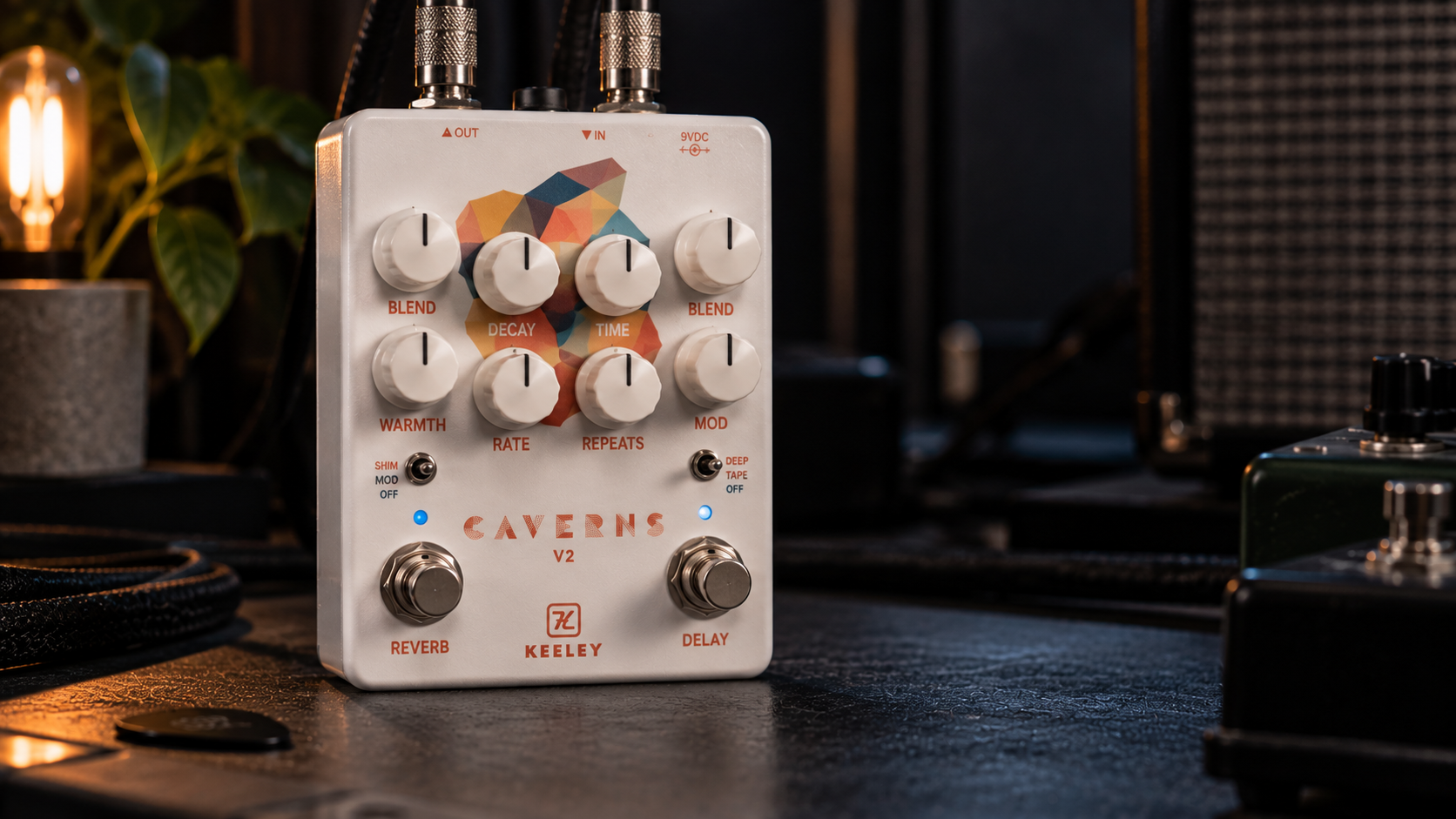
The Keeley Caverns V2 combines warm delay and characterful reverb in one enclosure. Each side has its own footswitch, so either effect can be engaged independently. That separation makes the space saving more useful than a single shared bypass would.
The 650 ms tape-style delay and selectable modulation sit behind the dry note, while Spring, Shimmer and Modulated reverb cover distinct roles. Either side can be used alone or both can be combined, with selectable bypass and trails behavior.
The key compromise is routing: both effects occupy one place in the signal chain, so another pedal cannot be inserted between them. Caverns fits a board where that relationship works; tap tempo, presets, stereo or independent routing call for a different setup.
Keeley Caverns V2 review: who should buy it?
Buy it if…
- You want both delay and reverb on a compact board.
- Separate footswitches are important so either side can work alone.
- Warm repeats and characterful reverb matter more than pristine rhythmic delay.
- A single mono end-of-chain ambience pedal matches the rig.
Skip it if…
- You need to place delay and reverb in different parts of a complex routing setup.
- Tap tempo, stereo operation or presets are essential.
- You want many conventional reverb rooms and plates rather than three character modes.
- You already own one ambience effect you love and only need the other.
Pros and cons
| What works | What you give up |
|---|---|
|
|
Two effects, one enclosure: controls and limits
| Area | What it means in a real rig |
|---|---|
| Delay | Warm tape-style delay up to approximately 650 ms. |
| Delay modulation | Selectable Deep, Light or Off behavior. |
| Reverb | Spring, Shimmer and Modulated modes with Blend, Warmth, Decay and Rate controls. |
| Switching | Independent delay and reverb footswitches. |
| Bypass | Selectable true-bypass or trails-style operation. |
| Routing and power | Mono I/O; standard 9V center-negative supply with roughly 75 mA requirement. |
The delay side is designed to sit behind the note
The Caverns delay is warmer and softer than a pristine digital echo. That makes it easy to combine with the reverb because the repeats do not remain painfully bright as they enter the tail.
The 650 ms limit is enough for lead support, medium rhythmic parts and spacious chords. The absence of tap tempo means exact synchronization must be set by ear.
The three reverbs are personalities, not a complete library
Spring is the most conventional option and can function as an always-on space. Modulated reverb adds movement without the obvious octave effect of shimmer. Shimmer is the specialized voice: useful for high, floating textures, but easy to overuse.
Players expecting Room, Hall, Plate and several size variations may find the selection narrow. The Caverns is selling a curated voice rather than a neutral reverb toolkit.
The fixed signal-chain position is the real decision
Inside one box, the two effects are designed to work as a pair. On a small board that removes cables, power outputs and setup decisions. On a larger board, it prevents you from placing another pedal between delay and reverb or routing them to different loops.
This is why the Caverns should be chosen for a compact rig you understand, not simply because two effects for one enclosure sounds efficient.
How pickups and amp gain change the Caverns balance
The Caverns combines two effects that both occupy the space after the dry note, so the source tone determines how much room remains. Bright single-coils can tolerate warmer delay repeats and a darker reverb setting while keeping the pick attack clear. Thick neck humbuckers need more restraint: lower delay feedback, shorter reverb decay and less Blend prevent the low mids from becoming a continuous pad. Shimmer may restore apparent brightness, but using octave content to fix mud often creates a new problem rather than solving the original one.
Clean amps reveal the distinction between the delay and reverb sides. The repeats provide timing and movement; the reverb defines the surrounding space. As gain increases, that separation becomes less obvious because sustained harmonics feed both effects. With an overdrive pedal before the Caverns, moderate settings remain manageable. With a heavily saturated amplifier preamp, placing the Caverns in front can smear every repeat and tail through the same clipping stage.
An effects loop is therefore especially useful for this pedal. It keeps the combined ambience after preamp distortion and makes the two footswitches behave more predictably. Not every loop is equally friendly—some run at levels that do not suit every stompbox—so compare noise and headroom at realistic volume. For modelers, the Caverns can function as a committed external character effect, but disable duplicate delay and reverb blocks at first. Once the Caverns sounds balanced, add any internal ambience only for a specific second layer.
Balancing two wet effects without losing the dry guitar
The Caverns becomes muddy when both halves are dialed as if the other one were bypassed. A delay with four loud repeats may sound excellent alone; a long modulated reverb may also sound excellent alone. Together, every repeat feeds a long tail and the wet energy multiplies. The solution is complementary settings, not simply lower master volume.
If delay supplies the rhythmic identity, keep reverb Blend and Decay restrained. If the reverb creates the pad, use fewer delay repeats and lower its blend. For an always-on sound, make each half slightly underwhelming by itself; the combined result will usually be large enough. This is the practical reason the fixed pairing can work so well on a small board.
Place the Caverns near the end of the signal chain, after drive and most modulation. With a dirty amp preamp, compare the effects loop. It requires a correctly rated 9V center-negative supply and should have its own suitable output where possible. Trails mode is useful for natural transitions, but check how it behaves with loop switchers before relying on it live.
Keeley Caverns V2 settings that make sense
These are starting points, not magic coordinates. Set the amp clean or only slightly breaking up, match the bypassed volume first, and adjust the mix in the room where you actually play.
| Use | Starting point | What to listen for |
|---|---|---|
| Always-on depth | Short warm delay, 1–2 repeats, low blend; Spring reverb with short decay | Bypassing the pedal should make the guitar feel smaller, not reveal a dramatic missing effect. |
| Lead ambience | 350–500 ms delay, 3 repeats; Modulated reverb at modest blend | The delay should extend the phrase while reverb smooths the edge. |
| Ambient pad | Longer delay with Light modulation; Mod or Shimmer reverb with longer decay | Keep one blend lower so two wet effects do not bury the dry note. |
Where a combined ambience pedal belongs
At home
The Caverns makes a small home board feel complete quickly. Use lower blends than expected; two ambience sections can accumulate far more wet signal in a bedroom than in a full band.
At rehearsal
Separate footswitches are useful, but the absence of tap tempo may matter for rhythmically exact songs. Spring and modest delay generally cut better than simultaneous long delay and shimmer.
Recording
The combined voice can be inspiring to print when it shapes the performance. Mono routing and the fixed internal relationship make a dry safety track valuable if the mix later needs different delay/reverb balance.
One Caverns or two separate pedals
| Alternative | Choose it instead when… |
|---|---|
| Separate delay and reverb pedals | You need independent routing, stereo or the freedom to upgrade one effect without replacing both. |
| Boss DD-8 plus a compact reverb | You want clearer rhythmic delay, stereo potential and broader independent control. |
| A larger dual-effects workstation | Presets, MIDI, tap tempo and deep routing justify more space and complexity. |
| A single delay pedal | Your amp or modeler already supplies reverb you actually like. |
If you do not need reverb in the same enclosure, compare the Caverns with the editable options in my Flashback 2 review and the warmer standalone approach in my MXR Carbon Copy review.
Is the Keeley Caverns V2 worth it?
The Caverns V2 works as a compact pair of ambience effects: separate switching, warm delay and three distinct reverb voices provide a path from subtle depth to obvious texture.
If the fixed mono chain conflicts with your rig, separate pedals give you the placement you need. When compactness and immediate control matter more, the combination is coherent rather than a compromise made only to save space.
For the wider context, start with what a delay pedal actually does, compare the full shortlist in the best delay pedals for guitar, and use the delay and reverb pedal guide when placing it in a complete signal chain.
Keeley Caverns V2 FAQ
Can delay and reverb be used separately?
Yes. Each side has its own footswitch, so delay, reverb or both can be active.
What is the maximum delay time?
The delay section reaches approximately 650 ms.
Does the Caverns V2 have tap tempo?
No. Delay time is set manually.
Is the Keeley Caverns stereo?
No. It uses mono input and output.
Can the pedal preserve trails?
Yes. The V2 provides switching options that include trails behavior as well as true bypass.