Electro-Harmonix Big Muff Pi Review: Huge Sustain, Big Trade-Offs
This Big Muff Pi review focuses on the part spec sheets usually miss: how the pedal’s huge sustain and thick compression behave in an actual rig. The Electro-Harmonix Big Muff Pi is easy to describe badly. “Huge fuzz, loads of sustain” is true, but it skips the part that actually decides whether you will love it: the same thick, compressed voice that makes single notes feel enormous can also make rhythm parts disappear once a bass player and cymbals enter the picture.
That trade-off is the whole Big Muff experience. It is not a subtle, touch-sensitive fuzz that follows every small move of your guitar volume knob. It is a big, smooth, sustaining wall that works brilliantly when you want size and texture — and can feel frustrating when you need tight low-end punch or obvious midrange cut.
That makes the buying decision fairly simple: this pedal works best when sustain and texture matter more than tight low-end control. If you want the wider category first, see our best fuzz pedal guide. If you are still deciding whether fuzz is even the right gain type, start with overdrive vs distortion vs fuzz.
| Your situation | Fit | Why |
|---|---|---|
| You want long sustain for leads, grunge, alt-rock or huge rhythm textures. | Strong fit | That compressed, singing sustain is exactly what the circuit does well. |
| You need precise palm-mutes and a tight modern low end. | Weak fit | The Muff voice is broad and saturated rather than percussive. |
| You mostly play alone at home and want an immediately huge sound. | Very good fit | The scooped, wide sound can feel enormous without a band competing for space. |
| You need one fuzz that cleans up dramatically from the guitar volume knob. | Look elsewhere | A Fuzz Face-style circuit is the more natural tool for that job. |
Who the Big Muff Pi is actually for
The classic Electro-Harmonix Big Muff pedal makes the most sense when sustain and texture matter more than touch-sensitive cleanup. It is a strong main fuzz for players who want a thick layer around the note rather than a circuit that behaves like an extension of the guitar volume control.
Buy it if…
- You want thick, smooth sustain for leads.
- You like grunge, alternative rock, stoner, shoegaze or big ambient layers.
- You want a simple three-knob fuzz with a very clear identity.
- You mostly play through clean or mildly driven amps and want the pedal to create the whole texture.
Skip it if…
- You need extremely tight heavy rhythm.
- You hate scooped mids or often struggle to be heard in a band.
- You want one pedal to clean up from almost-clean to full fuzz from the guitar knob.
- You prefer a dry, raw, less compressed fuzz feel.
Big Muff Pi review: pros and cons
- Massive sustain without needing complicated controls.
- Smooth, forgiving lead feel that can make single notes feel bigger.
- Works especially well for layered guitars and broad rhythm textures.
- Simple Volume, Tone and Sustain layout is hard to get lost in.
- The classic circuit is still affordable compared with many boutique fuzzes.
- The familiar mid scoop can make the guitar disappear in a dense band mix.
- Low end can feel loose if your amp is already bass-heavy.
- Not especially good at dynamic guitar-volume cleanup.
- High Sustain settings can turn rhythm detail into a blur.
- The large classic enclosure takes more pedalboard space than newer Nano-style variants.
We come at pedals like engineers rather than catalogue writers: first the circuit and signal path, then what the controls are actually changing, then how that should interact with pickups, amp voicing and a full mix. For this review, we focused on sustain, compression, tone-stack behavior and midrange placement. Hard specs are cross-checked against Electro-Harmonix’s current documentation, while published demos and reference circuits help us separate repeatable behavior from one rig’s quirks. Brief shop or demo-room impressions can be useful when we have access to a unit, but we do not treat a few minutes of hands-on time as long-term ownership.
Specs and controls: simple on purpose
| Circuit | Analog fuzz / distortion / sustainer |
|---|---|
| Controls | Volume, Tone, Sustain |
| Bypass | True bypass |
| Audio | Mono |
| Power | 9V battery or compatible 9.6V DC adapter |
| Current draw | 3 mA |
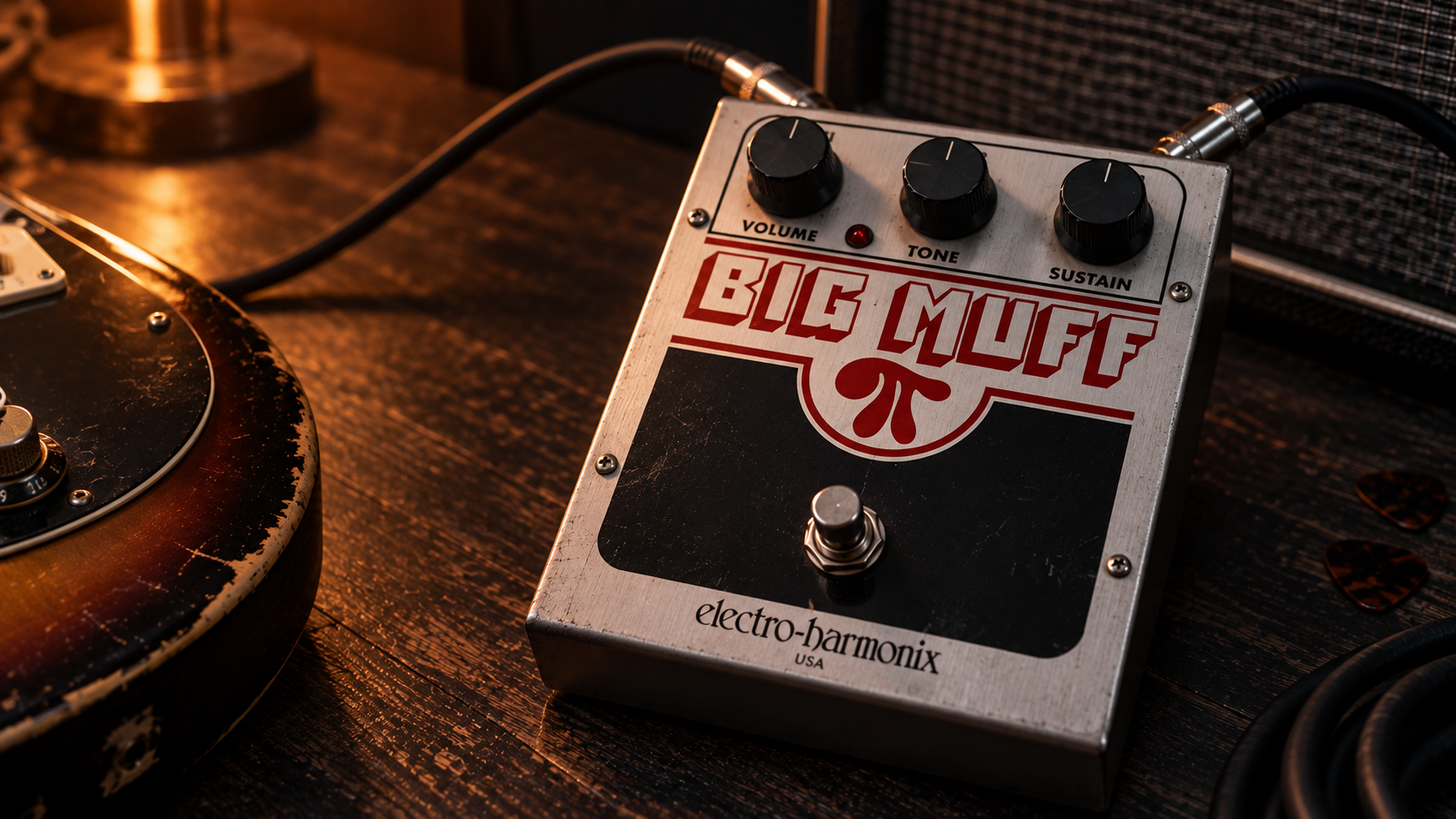
The controls look basic because they are. Sustain is the gain and compression engine. Tone moves the balance from darker/bassier to brighter/thinner. Volume sets output level. The trick is not finding hidden features — it is balancing those three controls so the pedal does not become either a woolly low-end blanket or a thin, fizzy sheet.
Big Muff Pi tone and feel: why this fuzz sounds huge
Low gain: more useful than people expect
With Sustain backed down, the Big Muff can sit closer to thick distortion than the stereotype suggests. If the basic clipping behavior is unfamiliar, it helps to think of this as a more compressed, sustain-heavy branch of fuzz rather than a dynamic overdrive. It still compresses more than a normal drive pedal, but chord edges stay clearer and the low end is easier to control.
This is a useful home setting because it keeps the character without asking a small speaker or headphone rig to reproduce a giant wall of saturated low end.
Medium gain: the practical sweet spot
Medium Sustain is where the pedal starts doing the thing people buy it for: long notes, smooth compression and enough fuzz around the attack to make leads feel wider. For rhythm, it still works if the amp is not already too bass-heavy.
High gain: huge, but not automatically better
Crank Sustain and the note becomes less about pick attack and more about a continuous saturated texture. That is perfect for certain riffs, shoegaze layers and singing leads. For tight rhythm, the same setting can erase the exact detail you were hoping to add.
The midrange problem
The classic Muff voice is famous for a scooped-feeling midrange. Alone, that makes the lows and highs feel enormous. In a full mix, guitar often needs the opposite: enough mids to live between bass and cymbals. If your Muff sounds huge at home and strangely absent at rehearsal, this is usually the reason.
Big Muff settings that are actually useful
| Goal | Volume | Tone | Sustain |
|---|---|---|---|
| Home rhythm | Unity | 11–1 o’clock | 10–noon |
| Singing lead | Slight boost | Noon–2 | 2–4 |
| Thick wall of fuzz | To taste | 10–noon | 3–max |
| Band mix starting point | Small boost | Noon–2 | 11–2 |
If you disappear in a band, do not immediately crank Volume or Sustain. First reduce bass at the amp, keep Tone from getting too dark, and consider a mid-forward overdrive before the Muff. The problem is often frequency space, not loudness.
Big Muff fuzz in the real world: home, rehearsal and recording
At home
The Big Muff is easy to enjoy at home because the broad sound feels satisfying even at moderate volume. If the entire rig gets fizzy or thin when you turn down, fix the amp, speaker or IR side before blaming the fuzz pedal. The trap is turning Sustain up to compensate for a small speaker or low listening level and ending up with fizzy compression. Start lower than you think.
At rehearsal
This is where the midrange issue becomes obvious. If the pedal suddenly seems smaller with drums and bass, use less low end, less Sustain, and more midrange somewhere else in the chain instead of chasing raw output.
For recording, the Big Muff is very easy to layer. A thick Muff track can sit behind a clearer distortion or cleaner double and create size without forcing one guitar sound to do every job. That is often a better use than trying to EQ one huge fuzz track into perfect definition.
Big Muff pedal placement and stacking
The Big Muff is less fussy about being first than a traditional Fuzz Face, so normal modern pedalboard order works fine. If you are still building the chain itself, our guitar pedalboard guide covers the broader order and signal-flow logic. A practical starting point is tuner → overdrive/boost → Big Muff → modulation → delay → reverb.
A low-gain, mid-forward overdrive before the Muff is one of the most useful stacks because it can tighten the low end and add the mid information the classic circuit lacks. Keep the front pedal’s gain low. The goal is not to create more clipping; it is to reshape what hits the Muff.
If you are new to stacking gain, remember that a small mid-forward push can change the feel more than another big jump in gain.
Big Muff variants: the name now covers a lot of ground
The classic NYC Big Muff Pi is only one part of the current EHX family. Alongside the familiar Deluxe Big Muff Pi and Big Muff Pi with Tone Wicker, Electro-Harmonix now has a separate dual-op-amp Big Muff Pi 2 branch. In 2026 that branch includes the Big Muff Pi 2 with Tone Wicker and the Deluxe Big Muff Pi 2, both voiced around the mids-forward character of the dual-op-amp design rather than simply replacing the classic NYC circuit.
- Classic Big Muff Pi: the simple three-knob reference sound with broad, smooth sustain.
- Deluxe Big Muff Pi: the classic family with more EQ and utility control, including adjustable mids.
- Big Muff Pi with Tone Wicker: adds tone-bypass and high-frequency filter options to the classic-style platform.
- Big Muff Pi 2 with Tone Wicker: dual-op-amp, more mids-forward, with tone-bypass and Wicker options.
- Deluxe Big Muff Pi 2: the dual-op-amp branch with blend, gate, Wicker and a footswitchable parametric mids section.
If the only thing stopping you from liking the classic Big Muff is the mid scoop, a version with dedicated mid control is a more logical move than buying the basic pedal and immediately building extra EQ around it.
What to buy instead
- Want better guitar-volume cleanup? Start with the Fuzz Face family.
- Want Muff sustain but more mix cut? The EarthQuaker Devices Hoof is the obvious alternative because its Shift control lets you reshape the mids.
- Want vintage feel with modern stability? See our Boss FZ-1W review.
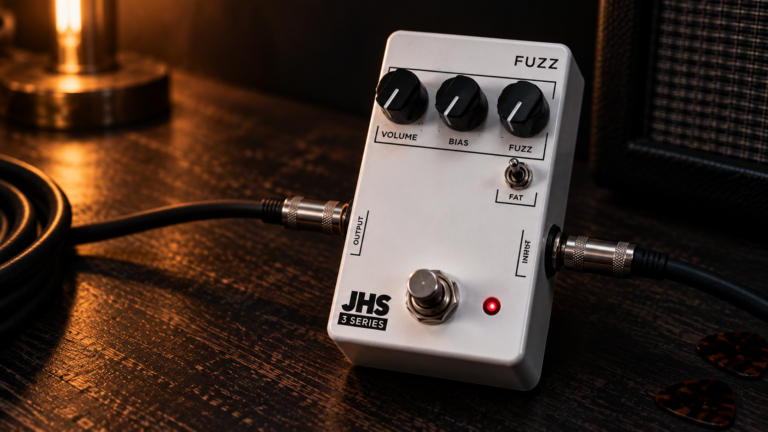
- Want more gated and adjustable fuzz textures? The JHS 3 Series Fuzz makes more sense.
Those differences matter more than asking which single fuzz is “best.” These pedals are solving different problems.
Is the Big Muff Pi still worth it?
The Big Muff survives because the trade-offs are part of the sound, not because it is universally flexible. It can make one note feel enormous, turn a simple riff into a wall, and give home players an instantly satisfying texture. Just do not confuse “huge alone” with “perfect in every mix.”
Big Muff Pi FAQ
Is the Big Muff a fuzz or distortion pedal?
EHX describes it as a fuzz/distortion/sustainer, and that is fair. In practical use it sits firmly in the fuzz family, but its smooth, compressed clipping can feel more distortion-like than a raw vintage fuzz.
Why does my Big Muff disappear in a band mix?
The classic voice can feel mid-scooped, so bass and cymbals occupy the frequencies that sounded huge when you were alone. Reduce low end, use less Sustain, and add mids elsewhere instead of only turning up.
Does a Big Muff clean up with the guitar volume knob?
Somewhat, but not like a Fuzz Face. It tends to stay compressed and fuzzy as you roll back, so players who want dramatic clean-to-fuzz control should look at a more interactive circuit.
Where should a Big Muff go in the pedal chain?
A normal starting point is after tuners and any low-gain boost or overdrive, before modulation, delay and reverb. It is generally less sensitive to buffers than traditional Fuzz Face circuits.
Is the Big Muff good at bedroom volume?
Yes. It can sound satisfying at low volume, but very high Sustain can become fizzy or blurry through small speakers and headphones. Moderate gain is usually the better starting point.