Boss DD-3T Review: Simple Digital Delay That Refuses to Become Obsolete
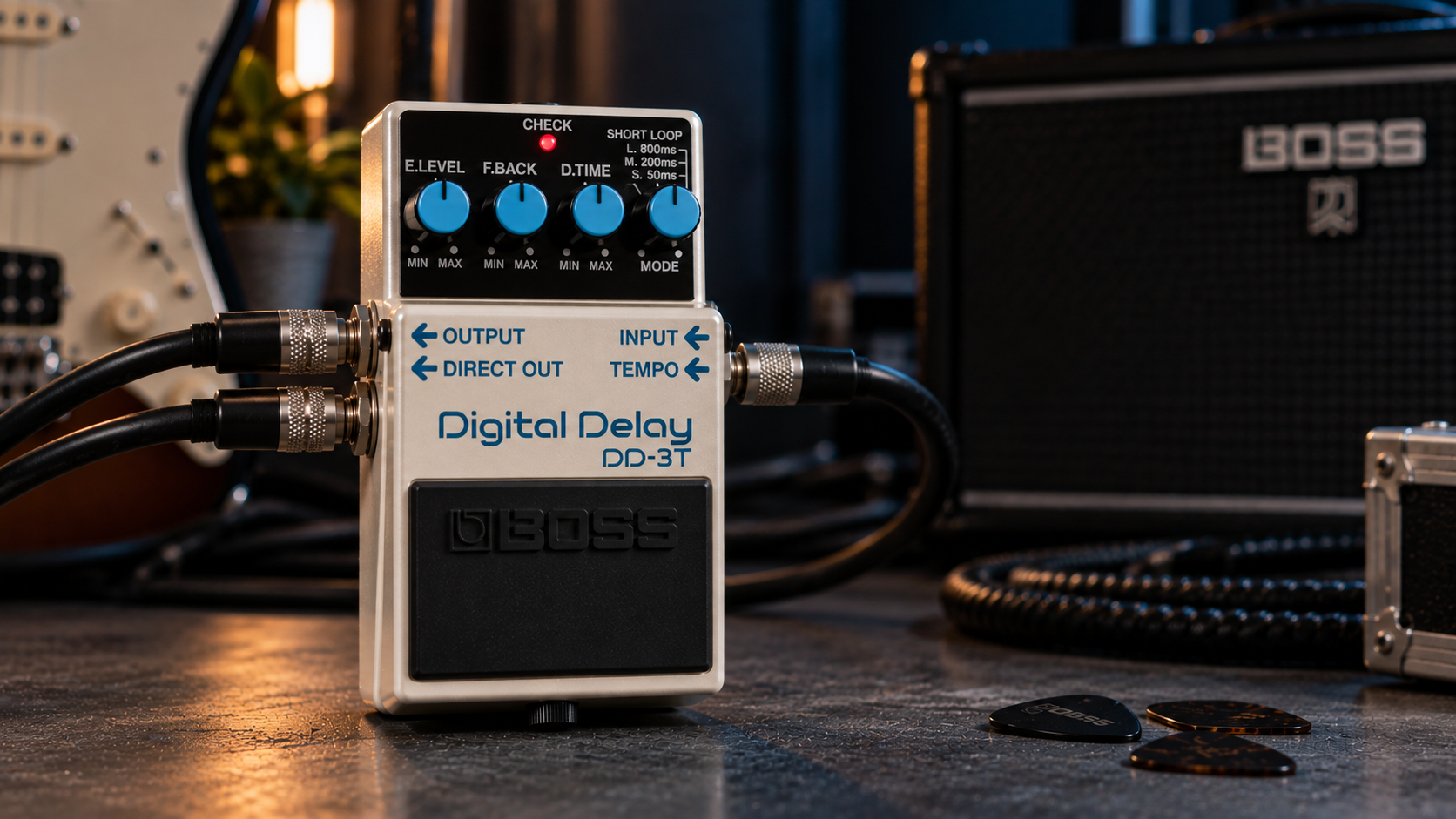
The Boss DD-3T makes a case for one clear digital delay voice. It offers three practical time ranges, a short looping function and tap tempo through the main or an external switch, without tape models, shimmer, stereo routing or an editor.
That limited feature set can be useful: clear repeats expose timing, cover slapback and rhythmic parts, and stay defined as the guitar sound changes. Dividing the delay range also makes the time knob easier to set than one long sweep.
It is a narrow choice by design. Players who need several delay colors should look elsewhere; players who want to set one direct delay sound quickly have a strong reason to consider it.
Boss DD-3T review: who should buy it?
Buy it if…
- You want one dependable digital delay voice.
- Tap tempo matters, but menus and multiple algorithms do not.
- Rhythmic definition is more important than dark analog character.
- You value quick stage adjustment and conventional Boss durability.
Skip it if…
- You want tape, analog, shimmer or modulated delay characters in one pedal.
- Stereo output is part of the rig.
- Long ambient delays or sophisticated looping are central.
- Saved presets are needed for multiple songs.
Pros and cons
| What works | What you give up |
|---|---|
|
|
The range switch, tap tempo and hard limits
| Area | What it means in a real rig |
|---|---|
| Delay time | Approximately 12.5 to 800 ms, divided into Short, Medium and Long ranges. |
| Controls | Effect Level, Feedback, Delay Time and Mode/range selection. |
| Tap tempo | Available from the main switch and more conveniently through an external footswitch. |
| Looping | Short Loop mode for brief repeated material, not full song-section looping. |
| Routing | Mono input and mono output. |
| Bypass and power | Boss buffered bypass; standard 9V Boss-format supply or battery operation. |
Range selection is more useful than it looks
Dividing the time knob into Short, Medium and Long ranges gives the control more usable resolution. A tiny movement does not have to cover everything from doubling to a long ambient echo at once.
Short handles doubling and slapback, Medium covers compact rhythm and room-like depth, and Long reaches the normal lead and song-synced territory. The system is easy to understand without a display.
Clear repeats reveal both good and bad timing
The DD-3T does not soften every repeat into the background. That clarity helps dotted or straight rhythmic figures stay intact, especially with clean tones. It can also expose sloppy timing or clutter dense gain sounds when the level and feedback are too high.
This is not a defect. It means the pedal should be mixed like another rhythmic layer rather than poured over the guitar as general ambience.
Tap tempo changes the practical value
Older simple digital delays were often easy at home and awkward with a drummer. Tap tempo removes much of that problem. An external switch is the cleanest arrangement because bypass and timing remain separate.
If songs do not demand synchronization, the feature can be ignored. The pedal remains fast to set by ear, which is part of the appeal.
Why the DD-3T exposes the rest of the rig
The DD-3T’s repeats are clear enough that pickup and amplifier choices remain obvious. A bright bridge single-coil produces sharp, articulate echoes that work well for rhythmic clean parts but may feel hard through a bright speaker. Instead of removing all treble from the amp, lower Effect Level and Feedback first; the dry guitar keeps its useful attack while fewer copies compete in the same frequency range. A neck humbucker creates thicker repeats, so two or three are usually enough for lead support.
Distortion makes the DD-3T either impressively precise or painfully cluttered. After an overdrive pedal, it copies the completed gain sound and keeps the rhythm of the repeats intact. This is useful for defined rock leads and synchronized patterns. Before distortion, each repeat is clipped again, which compresses the attack and makes later repeats merge. That order can imitate rougher vintage workflows but works poorly when tight stops and palm mutes matter.
If the amplifier’s preamp creates most of the gain, the effects loop is normally the cleaner position. The DD-3T’s direct digital voice will retain separation instead of being fed repeatedly into saturation. Clean and lightly driven amps are less demanding and usually accept the pedal at the front. This transparency is part of the DD-3T’s character: it does not automatically flatter every setup with dark filtering or modulation. It shows whether the wet level, playing timing and base tone are already under control.
Why the DD-3T range switch makes setup faster
A single time knob covering an enormous range can be difficult to set precisely. The DD-3T divides the job into Short, Medium and Long ranges, so the knob has more physical travel for the part of the range you actually need. Use Short for doubling and slapback, Medium for compact rhythmic echoes, and Long for the common lead-delay zone.
When matching a song, choose the range first, set Feedback to two or three repeats, lower Effect Level, and then enter the tempo. This prevents a loud chain of incorrect repeats from confusing the adjustment. Once timing is right, raise the level until the pattern supports the dry part. If the part stops sounding tight, the wet level is probably too high even when the tempo is correct.
An external tap switch makes sense if synchronized delay appears throughout a set; otherwise the onboard method keeps the pedalboard smaller. Place the DD-3T after gain for clear repeats, or test the amplifier’s effects loop when most distortion comes from the preamp. Its buffered bypass can also help a longer board drive cable capacitance, though it should not be treated as a cure for poor patch cables or incorrect power.
Boss DD-3T settings that make sense
These are starting points, not magic coordinates. Set the amp clean or only slightly breaking up, match the bypassed volume first, and adjust the mix in the room where you actually play.
| Use | Starting point | What to listen for |
|---|---|---|
| Slapback | Short range; low feedback; time 80–120 ms; modest level | One clear repeat should add bounce without sounding like a second guitarist. |
| Rhythmic clean | Medium/Long range; tap the song tempo; 2–3 repeats; level below dry | The repeats must land consistently and stop before harmony changes create clutter. |
| Lead delay | Long range; 350–500 ms; 3–4 repeats; modest level | Sustain increases while the original note keeps authority. |
Where a single clear repeat earns its space
At home
The clear repeats are easy to hear at low volume, which makes the pedal useful for timing practice. Keep the effect level low; headphones and small rooms make sharp repeats feel closer than they will in open space.
At rehearsal
This is the DD-3T’s strongest setting. Tap tempo, range selection and a familiar Boss switch make corrections quick. An external tap switch is worthwhile if several songs use synchronized delay.
Recording
The repeat remains defined and easy to edit around. Mono is not a problem for centered guitar parts, but wider productions may prefer adding stereo delay later or double-tracking.
DD-3T or a multi-mode digital delay
| Alternative | Choose it instead when… |
|---|---|
| Boss DD-8 | You want several delay characters, stereo operation and more creative range. |
| MXR Carbon Copy | You prefer warmer repeats that naturally move behind overdriven leads. |
| Flashback 2 | TonePrint, MASH and editable delay types are useful rather than unnecessary. |
| A full looper | You need reliable phrase recording and arrangement practice rather than the brief Short Loop function. |
Is the Boss DD-3T worth it?
The DD-3T remains relevant because a conventional delay part does not always need a platform. Repeat clarity, a practical time range and tap tempo cover its intended work without adding layers of editing.
It is poor value if you already need analog color, stereo or saved presets. It is a better fit when one digital delay must be adjusted quickly and reliably during a set.
For the wider context, start with what a delay pedal actually does, compare the full shortlist in the best delay pedals for guitar, and use the delay and reverb pedal guide when placing it in a complete signal chain.
Boss DD-3T FAQ
What is the Boss DD-3T delay-time range?
It covers approximately 12.5 to 800 ms across three selectable ranges.
Does the DD-3T have tap tempo?
Yes. Tempo can be entered with the onboard switch or an external footswitch.
Is the Boss DD-3T stereo?
No. It uses mono input and output.
What is Short Loop mode?
It captures a brief segment for repeated creative effects. It is not intended to replace a full-featured looper pedal.
Should I buy the DD-3T or DD-8?
Choose the DD-3T for one clear delay voice and a simpler workflow; choose the DD-8 for multiple delay types, stereo routing and broader creative range.