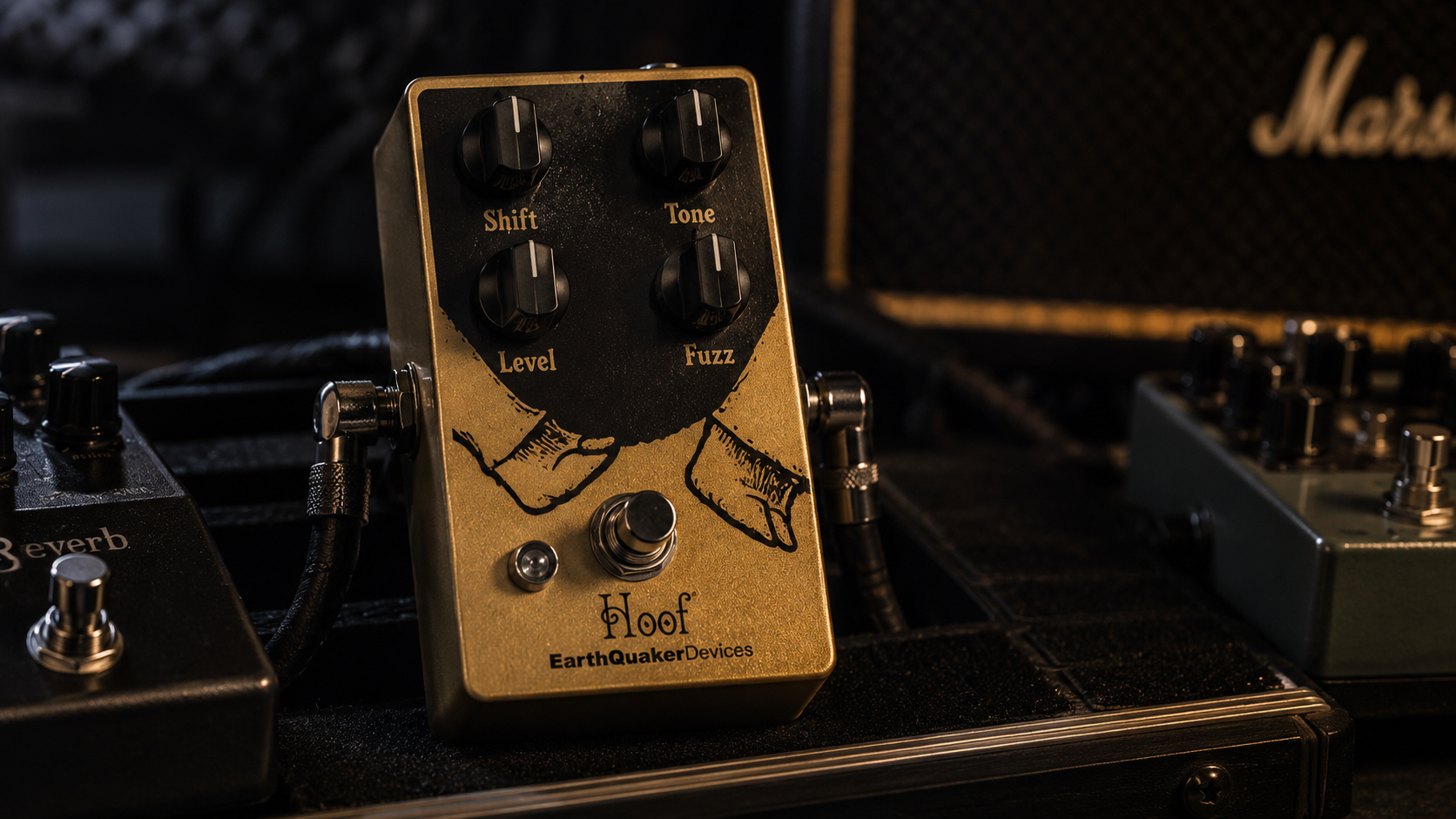
EarthQuaker Devices Hoof Review: Muff-Style Fuzz That Can Actually Cut?
The EarthQuaker Devices Hoof makes the most sense if you like what a Big Muff Pi does but keep running into the same problem: the sound is huge alone, then the guitar loses shape the moment the rest of the band comes in.
The Hoof keeps the thick sustain and fuzz weight of that general family, but adds one control that changes the whole experience: Shift. Instead of living with one baked-in mid character, you can move the response from more scooped to more mid-forward. That turns the Hoof from “another Muff-inspired fuzz” into a much easier pedal to fit around different amps, guitars and rooms.
This EarthQuaker Devices Hoof review focuses on that real-world advantage. If you want a historically exact Russian Muff reproduction, this is not it. If you want the broad idea with more control, more consistency and better mix placement, the Hoof is much easier to justify.
EarthQuaker Devices Hoof review: who should buy it?
| Your situation | Fit | Why |
|---|---|---|
| You love Muff-style sustain but keep disappearing in a band mix. | Strong fit | Shift lets you push mids forward instead of accepting a fixed scoop. |
| You move between different amps and need one fuzz that adapts. | Strong fit | Tone + Shift give you more control over the frequency shape than a classic three-knob Muff. |
| You want dramatic guitar-volume cleanup from almost clean to full fuzz. | Mixed | It responds, but that is not the main strength of this circuit family. |
| You want an exact vintage Russian Big Muff experience. | Look elsewhere | The Hoof is inspired by that family but deliberately modernized. |
Pros and cons
- Shift control fixes the biggest practical weakness of many Muff-style fuzzes: midrange placement.
- Germanium/silicon hybrid design balances smooth sustain with modern stability.
- Wide enough range for gritty lower-gain sounds and heavy saturated fuzz.
- Works well on guitar and can retain useful low-end definition.
- More adaptable to different amps than a fixed-voice classic fuzz.
- If you do not need the Shift control, a simpler Muff-style fuzz may be better value.
- The extra control means there are more ways to dial a sound that is technically big but badly placed.
- Not a replacement for a Fuzz Face if cleanup and touch interaction are your priority.
- Players chasing a very specific vintage Muff version may prefer an actual reissue.
We come at pedals like engineers rather than catalogue writers: circuit architecture first, then control interaction, then how those choices should translate into a real signal chain. With the Hoof, the important variables are the germanium/silicon hybrid design, Tone/Shift interaction, midrange placement and how much definition remains as Fuzz rises. Hard specs and control behavior are cross-checked against EarthQuaker Devices’ current Hoof documentation, then compared with published demos and familiar Muff-style reference circuits. Brief shop or demo-room impressions, when available, are useful as a sanity check but are not presented as long-term ownership.
EarthQuaker Hoof specs and controls at a glance
| Circuit | Germanium/silicon hybrid, Muff-inspired fuzz |
|---|---|
| Controls | Level, Fuzz, Tone, Shift |
| Switching | Relay-based true bypass / Flexi-Switch |
| Power | 9V DC center-negative |
| Current draw | 15 mA |
| Input impedance | 130 kΩ |
EarthQuaker describes the Hoof as loosely based on the old green Russian Muff family, but the hybrid transistor design and Shift control make the practical experience different. This is less about recreating one vintage unit and more about getting that broad sustain-heavy voice to behave consistently.
What the Shift control actually does
Shift changes the mid content and the way the Tone control behaves. Turn it clockwise and the sound becomes more scooped. Turn it counterclockwise and the mids become more pronounced.
That sounds like a small feature until you use fuzz with a band. A classic scooped fuzz can make the guitar sound gigantic alone because the lows and highs feel exaggerated. Add bass guitar, kick drum and cymbals, and the missing middle becomes obvious. The Hoof lets you put some of that middle back without abandoning the whole fuzz character.
Fast Shift-control fixes
- Huge alone, missing in the mix: move Shift counterclockwise for more mids.
- Too nasal or congested: move Shift clockwise slightly.
- Too dark: add Tone before adding Fuzz.
- Too loose: reduce Fuzz and low end before chasing more treble.
Hoof fuzz tone and feel: Muff weight with more definition
Lower gain
With Fuzz backed down, the Hoof gets grittier and more open than the “wall of fuzz” stereotype suggests. It can sit in a rough overdrive-to-fuzz zone where chord definition stays intact and the Shift control becomes more about character than rescue work. If you are comparing those gain families, our overdrive vs distortion vs fuzz guide gives the cleaner big-picture distinction.
Medium gain
This is the most versatile range. There is enough sustain to feel unmistakably fuzzed, but not so much compression that every rhythm part turns into the same texture. For a one-fuzz board, this is probably where most useful settings live.
High gain
Crank Fuzz and the Hoof gets into the big, sustaining territory people expect from a Muff-inspired design. The advantage is that Shift still lets you decide whether that wall sits back in the mix or pushes forward.
Pick response and cleanup
The Hoof is more articulate than many very compressed Muff-style circuits, but it is still not a Fuzz Face. Rolling the guitar volume down reduces saturation and can clean things up, yet the core feel remains thicker and more compressed than a classic two-transistor fuzz.
EarthQuaker Hoof settings to start with
| Goal | Fuzz | Tone | Shift |
|---|---|---|---|
| Gritty low-gain fuzz | 9–11 o’clock | Noon | 11–1 |
| Main rock rhythm | 1–2 o’clock | Noon–1 | 10–noon |
| Big sustaining lead | 3–max | Noon–2 | 10–1 |
| Scooped wall | 2–max | To taste | 2–4 |
These are starting points, not magic numbers. The Hoof exists partly because the right midrange depends on your amp and room. If you copy one thing, copy the dialing order: set Fuzz → get brightness close with Tone → place the mids with Shift → set final Level.
Home, rehearsal and recording
At home
The Hoof is easy to make impressive at low volume because it still has that wide Muff-style footprint. Avoid over-scooping Shift just because it sounds cinematic alone; that setting may not translate when you play with anyone else. If the whole rig gets harsh or thin when you turn down, fix the amp, speaker or IR side before you over-correct the pedal.
At rehearsal
This is where the Hoof earns the extra knob. Move Shift toward more mids until the guitar returns to the mix, then trim Tone if the added presence becomes sharp.
For recording, the Hoof is useful because you can place different layers deliberately. A scooped wide rhythm can sit behind a more mid-forward overdub from the same pedal. That gives you contrast without reaching for another fuzz box.
Stacking and pedalboard use
The Hoof works like a normal modern fuzz in the chain and does not need the special “must be first” treatment of a traditional Fuzz Face. Start with tuner → drive/boost → Hoof → modulation → delay → reverb. For the full routing logic, see our guitar pedalboard guide.
A low-gain overdrive before the Hoof can tighten the low end and add more mid push. Because the Hoof already has Shift, you usually do not need an extreme Tube Screamer-style mid hump unless you specifically want it. The point of that low-gain stage is shaping the signal, not piling on another full layer of clipping. Use the front pedal lightly and let the Hoof remain the main texture.
Stacking another high-gain pedal into a maxed Hoof can create more noise and compression than usable weight. Assign jobs: one pedal shapes, the other provides the main fuzz.
EarthQuaker Hoof vs Big Muff Pi
| Difference | Big Muff Pi | Hoof |
|---|---|---|
| Core feel | Classic smooth compression | Tighter, more defined |
| Mid control | Fixed by the tone circuit | Adjustable with Shift |
| Band mix | Can disappear if too scooped | Easier to push forward |
| Control range | Simpler, fixed mid character | More flexible mids via Shift |
| Best reason to buy | The classic voice itself | That voice with more control |
If you simply want the classic Big Muff experience, buy the classic. If you already know the midrange issue will annoy you, the Hoof is the more practical long-term choice.
What to buy instead
- Want cheaper classic Muff sustain? Electro-Harmonix Big Muff Pi.
- Want stronger guitar-volume cleanup? Fuzz Face family.
- Want vintage/modern switching and easy buffered-board integration? See our Boss FZ-1W review.
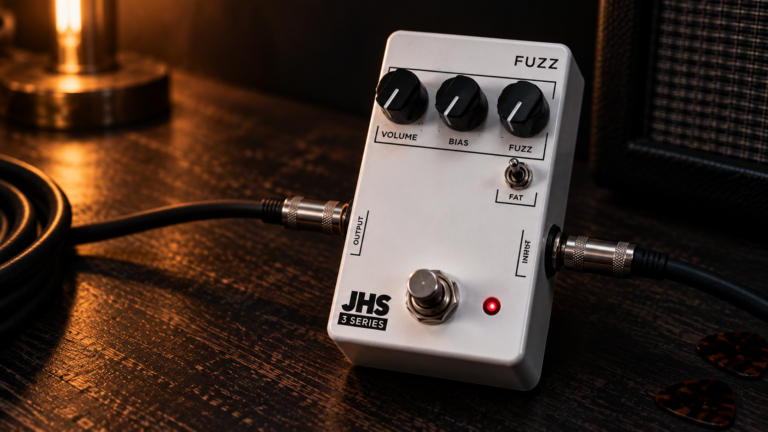
- Want gated textures and a simpler three-knob-plus-Bias approach? See our JHS 3 Series Fuzz review.
For the wider context, see our best fuzz pedal guide and how fuzz pedals work.
Is the EarthQuaker Devices Hoof worth it?
The best reason to buy it is not that it is “boutique” or more expensive. It is that Shift gives you control over the part of the sound that often decides whether fuzz works outside the bedroom. If that flexibility matters, the extra cost has a purpose. If it does not, a simpler Big Muff is hard to argue with.
EarthQuaker Devices Hoof FAQ
Is the Hoof based on a Big Muff?
It is loosely based on the green Russian Muff family, but EarthQuaker uses a hybrid germanium/silicon design and adds the Shift control, so it is not intended as an exact clone.
What does the Shift knob do on the Hoof?
It changes the mid content. Counterclockwise brings the mids forward; clockwise makes the sound more scooped.
Is the Hoof good for band use?
Yes. The adjustable mids are especially useful in a band because you can move the guitar forward in the mix instead of only turning the pedal louder.
Does the Hoof work with bass?
It can. The circuit is known for retaining useful low-end weight, but how well it fits depends on the bass, amp and how aggressively you set Tone and Shift.
Hoof or Big Muff for a first fuzz?
Choose the Big Muff if you want the classic sound at a lower price. Choose the Hoof if you already know you want that general texture but need more control over mids and mix placement.