Boss RV-6 Review: The Safe All-Rounder or Too Generic?
This Boss RV-6 review starts with the reason the pedal remains easy to recommend: it covers the main reverb jobs in a normal Boss enclosure without forcing you into presets, apps or menus.
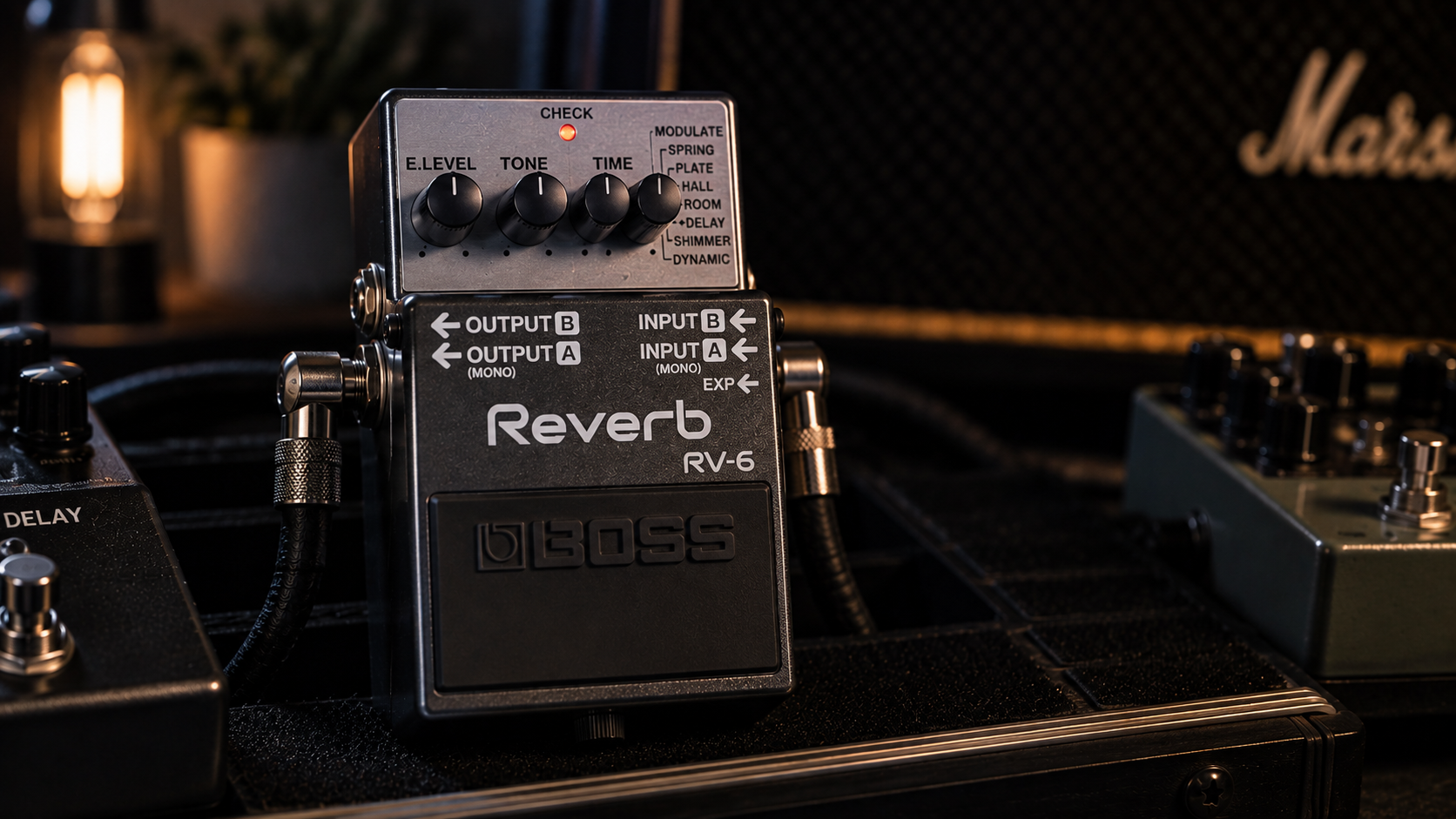
Room, Hall, Plate and Spring handle the conventional side. Modulate, Shimmer, Dynamic and +Delay push further without changing the four-knob workflow. The dry signal stays analog while the wet side is digital, and the I/O supports mono, mono-to-stereo and stereo-to-stereo operation.
The compromise is that the RV-6 is designed to be broadly useful rather than deeply specialized. It does not have the preset architecture of an Empress, the TonePrint ecosystem of the Hall of Fame 2, or the dedicated ambient personality of a Walrus Slö. As a Boss reverb pedal for players who want one compact box that is hard to outgrow, that middle ground is exactly the point.
Boss RV-6 review: who should buy it?
| Your situation | Fit | Why |
|---|---|---|
| You want one compact reverb for most styles. | Strong fit | Eight modes cover conventional and modern sounds with no menu layer. |
| You use stereo or parallel routing. | Strong fit | Flexible I/O includes stereo and 100% wet operation. |
| You need many exact song presets. | Weak fit | There is no onboard preset system. |
| You only need one classic spring sound. | Mixed | A simpler dedicated reverb can be cheaper and faster. |
Pros and cons
- Eight useful reverb modes in the standard Boss compact format.
- Analog dry path while the reverb is blended digitally.
- Mono, mono-to-stereo and stereo-to-stereo operation.
- Expression input controls effect level in real time.
- Dynamic mode solves a real clarity problem rather than adding another novelty sound.
- Can output 100% wet for parallel routing.
- No onboard presets or MIDI.
- Four knobs necessarily hide some algorithm-specific parameters.
- Shimmer and +Delay are useful extras, but not replacements for dedicated ambient platforms.
- Players with very simple needs may not use most of the mode selector.
We evaluate reverb from the signal path outward: dry-signal handling, mode range, what the front-panel controls change, how the pedal behaves in mono versus stereo, and whether the extra modes solve real guitar problems or just expand the spec sheet. Specs and mode behavior are cross-checked against BOSS’s current RV-6 documentation. Manufacturer demos, reputable demonstrations and short shop or demo-room checks when a unit is available are used as practical cross-checks rather than presented as long-term ownership.
Boss RV-6 specs and controls at a glance
| Modes | Hall, Plate, Room, Spring, Modulate, +Delay, Shimmer, Dynamic |
|---|---|
| Controls | E.Level, Tone, Time, Mode |
| Dry path | Analog |
| Stereo | Mono, mono-to-stereo and stereo-to-stereo |
| Expression | Yes, controls effect level |
| Power | 9V battery or adapter; current draw listed at 95 mA on current global specs |
The simplicity is deceptive. BOSS changes multiple internal parameters as Time and Tone move, so you are not directly editing every variable inside each algorithm. That is the design choice: less access, faster usable results.
Room, Hall, Plate and Spring: the modes you will probably use most
Room
Room is the easiest always-on starting point. Keep Time short and E.Level low and the effect adds depth without announcing itself. This is the mode to use when you want the guitar to feel less dry rather than obviously reverberant.
Hall
Hall is broader and more spacious. It works better for slower chord movement and lead lines where a longer tail has room to decay. Push it too far in dense rhythm parts and the same width becomes blur.
Plate
Plate is smoother and brighter than a room, making it useful when you want a polished tail around leads. It tends to work well at lower Mix than a big hall because the tail remains audible without needing huge decay.
Spring
Spring covers the amp-reverb lane. If spring is your only priority, compare the RV-6 with the simpler Holy Grail Nano. The Boss makes more sense when spring is one of several sounds you actually use.
For the basic difference between these reverb families, see what a reverb pedal does.
Dynamic, Modulate, Shimmer and +Delay: what makes the RV-6 more than a basic reverb
Dynamic
Dynamic is the smartest mode in the pedal because it addresses a real trade-off. Deep reverb can sound beautiful between notes but obscure the attack while you are playing. Dynamic mode adjusts the effect depth around your performance so you can keep more ambience without turning the front of the note into fog.
Modulate
Modulate adds movement to a hall-style tail. Use it conservatively and it makes sustained chords feel wider. Push the effect level and time and it becomes a clear ambient texture.
Shimmer
Shimmer adds bright upper overtones to the reverb. It is useful for pads and cinematic cleans, but it can get fatiguing quickly with bright pickups or speakers. Tone is the first control to reach for before simply reducing the whole effect.
+Delay
+Delay is a useful one-pedal shortcut, not a substitute for a dedicated programmable delay. If you regularly need rhythmic delay and reverb as separate jobs, the broader delay and reverb guide is a better framework.
Boss RV-6 settings to start with
Always-on room
- Mode: Room
- E.Level: low
- Tone: around noon
- Time: low to medium
Use this when you want the dry signal to feel less flat without hearing an obvious effect tail.
Lead plate
- Mode: Plate
- E.Level: low to medium
- Tone: slightly below noon on bright rigs
- Time: medium
The target is a longer note envelope without masking the pick attack.
Ambient but readable
- Mode: Dynamic or Modulate
- E.Level: medium
- Tone: neutral to slightly dark
- Time: medium to high
Dynamic is the better first move when a conventional long reverb starts blurring rhythm.
Stereo and expression: features that matter more as the rig grows
The RV-6 can start as a mono stompbox and later move into stereo without changing pedals. That matters if you eventually run a modeler into two monitors, stereo returns, dual amps or an interface.
Using the B input by itself gives a 100% wet output, which makes the RV-6 more flexible in parallel rigs than its four-knob layout suggests. Expression can control effect level in real time, useful for moving from dry rhythm to wetter lead or ambient passages without reaching down.
Home, rehearsal and recording
At home
Room and Plate at conservative levels are easier to live with than the showier modes. Reverb should not become a fix for a thin dry rig; if that is the underlying problem, start with the bedroom guitar tone guide.
At rehearsal
Dynamic becomes especially useful because longer reverb has to coexist with drums and bass. Keep E.Level lower than your bedroom setting and let the actual room provide part of the ambience.
Recording
Stereo and 100% wet routing make the pedal more flexible than a basic insert effect. If you are unsure, print less wet signal and preserve the option to add space later.
Boss RV-6 vs the obvious alternatives
- Want presets, MIDI and much deeper sound design? See the Empress Reverb review.
- Want six modes with an even more stripped-back three-knob workflow? The MXR M300 is a strong alternative.
- Want TonePrint customization and MASH? Read the Hall of Fame 2 review.
- Want ambient texture as the main purpose? The Walrus Slö is more specialized.
For the wider category, use our best reverb pedal guide.
Is the Boss RV-6 worth it?
Its broadness is the feature and the limitation. It will not beat a dedicated specialist at every single sound. It is more useful than most specialists if you need one pedal to solve several different reverb jobs without slowing down the board.
Boss RV-6 FAQ
How many modes does the Boss RV-6 have?
Eight: Hall, Plate, Room, Spring, Modulate, +Delay, Shimmer and Dynamic.
Is the Boss RV-6 stereo?
Yes. It supports mono, mono-to-stereo and stereo-to-stereo operation.
Does the RV-6 keep the dry signal analog?
Yes. BOSS states that the straight guitar tone remains analog while the digital reverb is blended in.
Can the RV-6 output only the wet signal?
Yes. Using the B input only produces a 100% wet output for parallel-processing setups.
Can an expression pedal control the RV-6?
Yes. An optional expression pedal can control the effect level while you play.