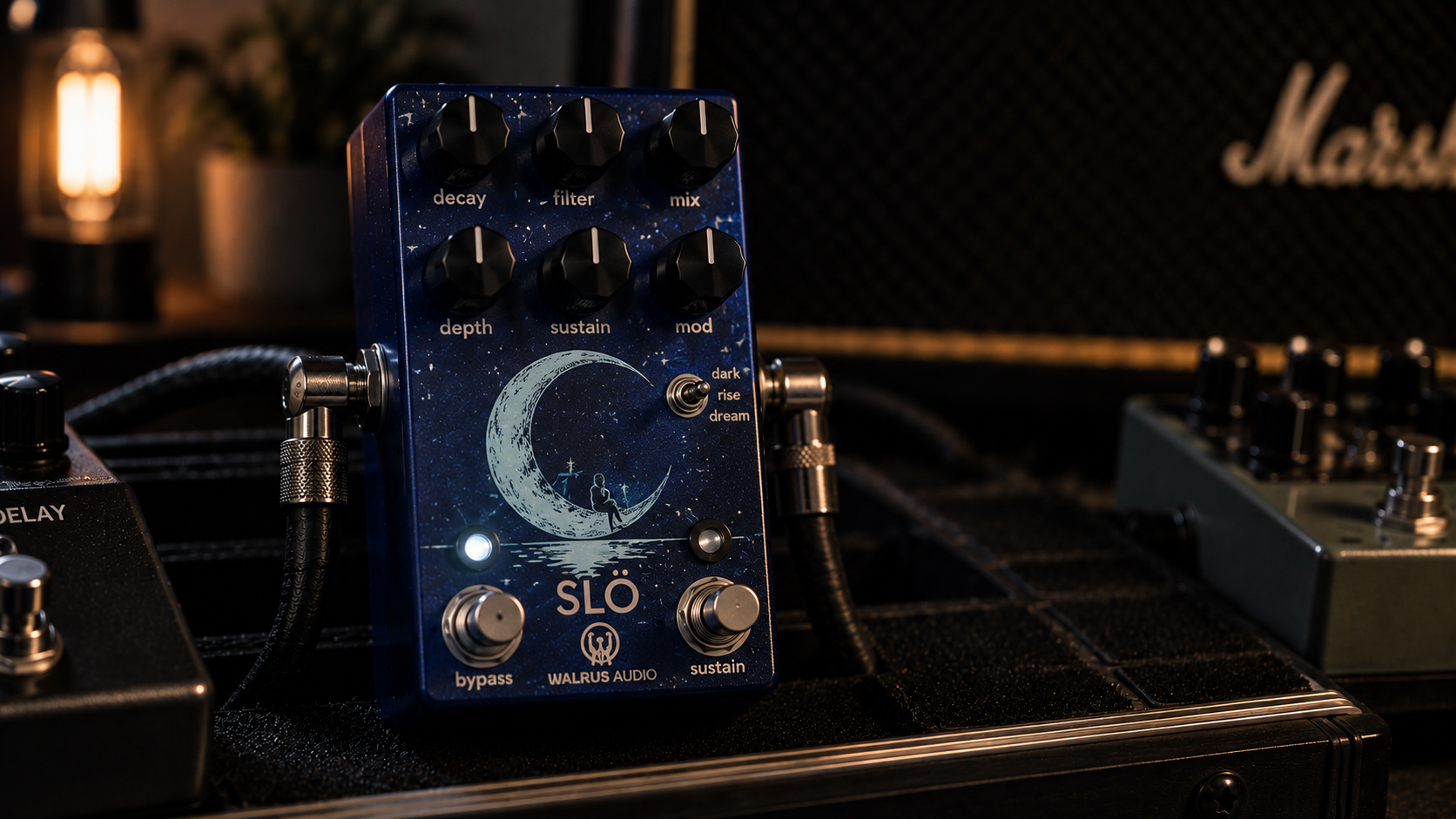
Walrus Audio Slö Review: Beautiful Ambient Reverb, Narrower Use Case
This Walrus Audio Slö review starts with a warning that is also the pedal’s main strength: the Slö is not trying to be your safest do-everything reverb.
Dark adds a lower octave to the reverb trail. Rise turns the effect into an auto-swell. Dream creates a lush reverb with a latching pad function. Add multiple modulation wave shapes, momentary sustain behavior and trails control, and the Slö becomes less about simulating a believable room and more about turning the tail into part of the instrument.
That makes the Walrus Audio Slö unusually easy to understand as a purchase. If you want spring, plate and room sounds for everyday use, other pedals are more practical. If you want an ambient reverb pedal that creates moving pads, swells and dark octave textures without becoming a large workstation, the narrow focus is exactly what makes it useful.
Walrus Audio Slö review: who should buy it?
| Your situation | Fit | Why |
|---|---|---|
| You build ambient, post-rock, worship or cinematic textures. | Strong fit | All three algorithms are designed around texture rather than generic spaces. |
| You want a latching pad under live playing. | Strong fit | Dream mode and the sustain switch make this a core behavior. |
| You need one pedal for spring, plate, room and ambient. | Weak fit | The Slö is intentionally specialized. |
| You run a stereo ambient rig. | Weak fit | The larger Slöer is the Walrus option built around stereo expansion. |
Pros and cons
- Three clearly differentiated ambient algorithms.
- Dream mode’s latching pad is genuinely useful for layering.
- Momentary sustain and bypass behaviors add performance control.
- Three modulation wave shapes expand the same algorithms without adding more modes.
- Trails or no-trails operation.
- Focused enough that the pedal is easier to learn than a large ambient workstation.
- Not the right choice for conventional spring/plate/room duties.
- Mono architecture limits stereo ambient rigs.
- Long modulated tails can dominate a mix quickly.
- No preset bank for recalling several exact sounds.
We evaluate the Slö by treating the reverb tail as a signal-processing layer rather than asking whether it sounds like a physical room. The important variables are envelope behavior, octave content, modulation shape, sustain control, trails behavior and how quickly the wet signal masks the dry attack. Specs and mode behavior are cross-checked against Walrus Audio’s current Slö documentation. Reputable demos and short shop or demo-room checks when available help confirm the interaction, but brief access is not presented as long-term ownership.
Slö Reverb controls and specs
| Algorithms | Dark, Rise, Dream |
|---|---|
| Modulation shapes | Sine, Warp, Sink |
| Trails | Selectable trails / no trails |
| Bypass | Buffered |
| Power | 9V DC, 100 mA minimum |
| Size | 4.77 × 2.6 × 1.39 in |
The X knob changes jobs depending on the algorithm. That is the control to understand first because it is what makes each mode more than a reverb preset with a different name.
Dark mode: lower octave without turning into a pitch pedal
Dark feeds a lower-octave signal into the reverb trail. The X knob controls how much of that -1 octave component is involved. Low settings keep the effect atmospheric. Higher settings make the tail feel heavier and more detached from the dry guitar.
This works especially well when you want a pad beneath single-note lines or sparse chords. It is easier to overdo on low-register rhythm because the octave content competes with the same space occupied by bass guitar and the lower part of the guitar itself.
Rise mode: auto-swell as part of the reverb envelope
Rise removes some of the normal immediate reverb attack and lets the ambience swell in after the dry note. The X knob controls the rise time. Shorter settings keep more connection to normal playing; longer settings make the effect feel closer to a volume-swell pad.
Walrus notes that this mode works especially well in front of the amp rather than necessarily in an effects loop. That is worth testing in your own chain because envelope behavior can change once preamp distortion becomes part of the path.
Dream mode: the reason to buy the Slö instead of a normal multi-reverb
Dream is the Slö at its most characteristic. The reverb itself is lush and modulated, but the latching pad is the real decision point. Press sustain to capture and hold the current reverb decay, then play over the sustained layer. Press again and the pad fades according to the Decay setting.
That turns the pedal into a simple performance layer without needing a looper. It will not replace a looper for structured overdubs, but it is much faster when the goal is “hold this harmonic bed while I play something else.”
Modulation, sustain and trails
Sine is the smoothest modulation shape. Warp pushes pitch upward asymmetrically. Sink pulls downward for a more drooping, detuned feel. The useful move is not to find the most obvious modulation; it is to match the movement to how busy the playing already is.
The sustain switch changes behavior by mode, and the bypass switch can also work momentarily. Those performance controls are why the Slö feels more like an instrument effect than a simple ambience box.
If you only want subtle depth, the reverb pedal explainer will point you toward more conventional uses. The Slö starts making sense once subtle depth is no longer the main goal.
Walrus Slö settings to start with
Dark pad under lead lines
- Mode: Dark
- Decay: medium to high
- X: low to medium octave amount
- Mix: moderate
Keep the lower octave supportive rather than letting it dominate the same frequency range as the dry guitar.
Slow cinematic swell
- Mode: Rise
- X: medium to high rise time
- Decay: long
- Mix: medium
Leave space between phrases so the envelope has somewhere to develop.
Dream pad + melody
- Mode: Dream
- Decay: medium to long
- X: set vibrato depth conservatively
- Sustain: latch a chord, then play above it
This is the setting that best demonstrates why the pedal exists.
Home, rehearsal and recording
At home
The Slö can make even a simple clean tone feel cinematic, which also makes it easy to hide timing and articulation problems under ambience. Keep a drier practice sound available. If the base tone is poor, fix that with the bedroom tone guide rather than adding more wash.
At rehearsal
Long ambient tails need arrangement space. Lower Mix before lowering the whole guitar volume; otherwise the effect can occupy the mix while the actual notes become harder to hear.
Recording
Dream and Rise are useful for printing intentional textures. If the reverb is only there as generic depth, print less than you think or keep the track dry and add conventional room/plate later.
Walrus Slö vs the obvious alternatives
- Want a broad all-rounder instead of a specialist? See the Boss RV-6 review.
- Want ambient capability plus presets, MIDI and much broader algorithms? The Empress Reverb is the bigger system.
- Want conventional sounds plus a few larger textures in a simple layout? Read the MXR M300 review.
- Want compact customization rather than a fixed ambient identity? The Hall of Fame 2 fits better.
For the wider category, use the best reverb pedal guide.
Is the Walrus Audio Slö worth it?
The Slö works because it commits to a lane. Dark, Rise and Dream solve different ambient jobs, and the sustain behavior gives the pedal a performance identity. Buy it because that identity matches your music, not because you simply need “a reverb.”
Walrus Slö FAQ
What are the three Slö modes?
Dark adds a lower octave to the reverb trail, Rise creates an auto-swell, and Dream provides a lush reverb with a latching pad function.
Does the Walrus Slö have trails?
Yes. You can choose trails or no-trails operation.
What does the sustain switch do?
It can extend the reverb tail momentarily, while Dream mode uses it as a latching pad control.
Is the Slö good as an always-on reverb?
It can be used subtly, but its strongest reason to exist is textural ambient reverb. A conventional multi-reverb is usually easier if “always-on room” is your main job.
Should I buy the Slö or Slöer?
Choose the Slö if the original mono ambient workflow is enough. The Slöer expands the concept with stereo and additional algorithms and controls.