Electro-Harmonix Holy Grail Nano Review: Simple Reverb That Still Makes Sense
This Holy Grail Nano review is about whether a reverb pedal with one main knob and three modes still makes sense when modern multi-reverbs can do far more.
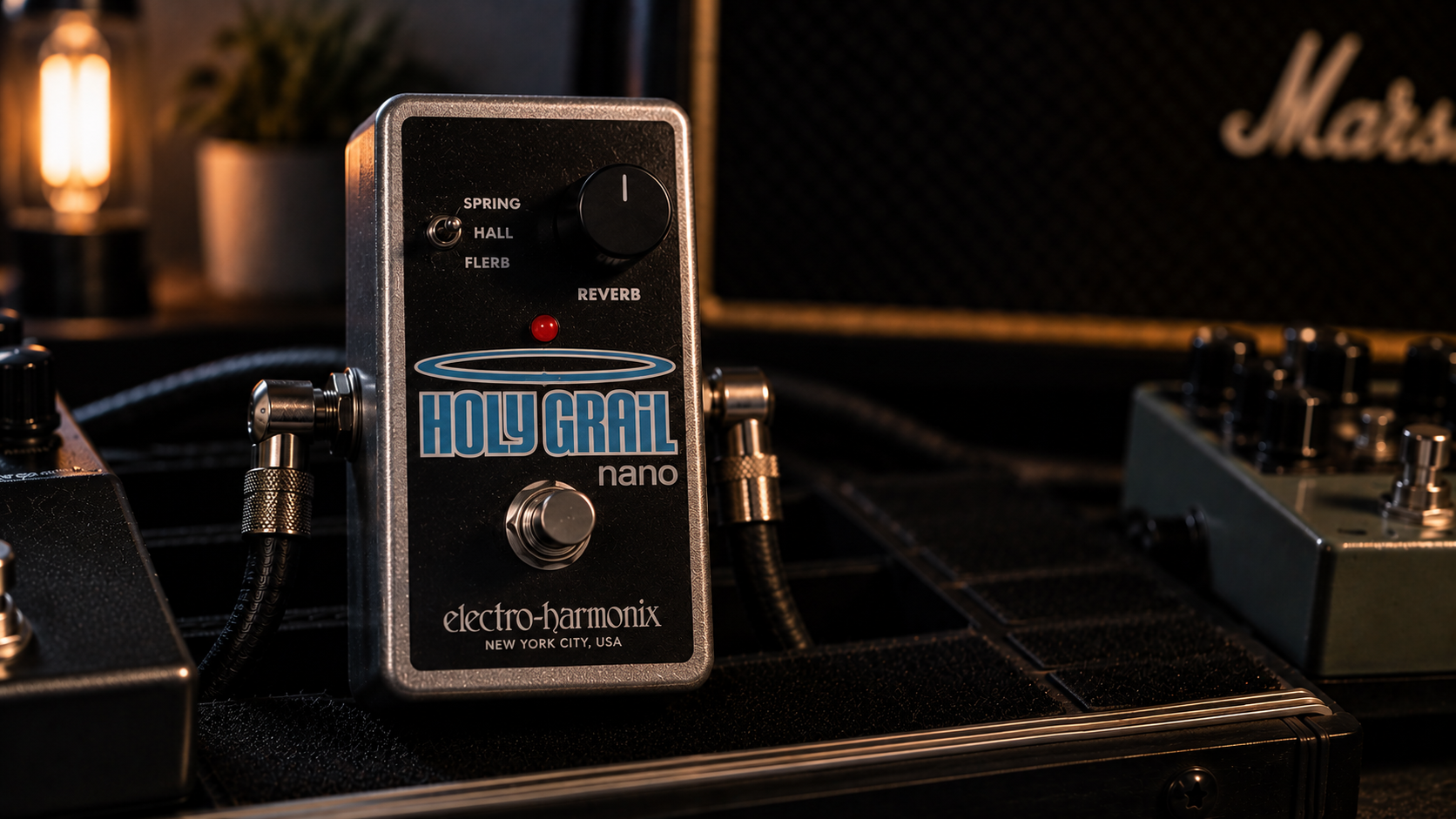
The answer depends on what you actually need. The Electro-Harmonix Holy Grail Nano gives you Spring, Hall and Flerb, then one Reverb knob that acts as the wet/dry control. There are no presets, no stereo outputs, no app, no secondary parameters and no attempt to be an ambient workstation.
That sounds limited because it is limited. But if your job is “give this dry amp a convincing spring or hall sound and stop there,” the simplicity becomes a feature. The Holy Grail reverb pedal is less attractive for players who want shimmer, modulation, stereo width or several exact sounds. It remains easy to understand for players who mainly want classic space.
Holy Grail Nano review: who should buy it?
| Your situation | Fit | Why |
|---|---|---|
| Your amp has no reverb and you mainly want spring. | Strong fit | The entire workflow is built around quick conventional reverb. |
| You want one always-on reverb with almost no setup. | Strong fit | Choose a mode, set wet/dry, play. |
| You want stereo, shimmer, presets or MIDI. | Poor fit | The Nano intentionally offers none of those features. |
| You need several different live reverb sounds. | Mixed | A multi-mode pedal with easier switching is more practical. |
The cleanest reason to skip the pedal is not that it sounds bad; it is that your needs have moved beyond what one wet/dry control can solve. If you already know you need separate decay and tone control, stereo routing, trails, presets, or several radically different sounds during a set, the Nano will make you work around the pedal instead of with it.
Pros and cons
- Extremely simple one-knob workflow.
- Spring mode is the main draw for classic guitar ambience.
- Hall gives a second conventional sound without adding complexity.
- True bypass and compact enclosure.
- Easy to use as a basic always-on effect.
- Mono only.
- No tone, decay, pre-delay or modulation-depth controls.
- No trails, presets or MIDI architecture.
- Flerb is niche compared with more broadly useful modern third modes.
- 105 mA current draw means it is still a digital pedal despite the simple interface.
With a simple pedal, the engineering question is not “how many features?” but whether the limited controls expose the decisions that matter. We focus on wet/dry behavior, how Spring and Hall occupy the guitar signal, whether the lack of decay and tone controls becomes a real limitation, and how well the pedal fits a mono board. Specs and modes are cross-checked against Electro-Harmonix’s current Holy Grail Nano documentation. Reputable demos and short shop or demo-room checks when available are practical cross-checks, not claims of extended ownership.
Electro-Harmonix Holy Grail Nano specs and controls
| Circuit | Digital |
|---|---|
| Modes | Spring, Hall, Flerb |
| Main control | Reverb wet/dry |
| Bypass | True bypass |
| Audio | Mono |
| Power | 9.6VDC adapter; 105 mA current draw |
| Dimensions | 4.5 × 2.75 × 2.1 in |
The Reverb knob does not give you direct access to decay or tone. As you increase it, you are primarily changing the wet/dry relationship rather than designing the algorithm. That is why the pedal is so fast and why it cannot solve every rig equally well.
Spring mode: the reason the Holy Grail Nano exists
Spring is the main purchasing argument. It gives dry amps the familiar bounce and splash associated with guitar-amp reverb without requiring an actual tank. Keep the knob low and it behaves like subtle amp ambience. Push it higher and the spring character becomes an obvious effect.
Because there is no tone control, the amp and guitar determine how bright the result feels. On a sharp rig, you cannot darken the reverb independently. That is one of the clearest reasons to step up to something like the Boss RV-6.
Hall mode: smoother and broader
Hall is less about classic amp identity and more about putting space behind chords and leads. It works when Spring feels too obviously “guitar amp” or too bouncy. For clean rhythm, keep the wet level modest. For slower leads, raising it creates a wider tail without adding a second effect type.
If you are not sure when to choose Hall versus Spring, the reverb pedal explainer covers the basic use cases.
Flerb mode: the weird extra, not the main buying reason
Flerb combines flanging with reverb. It is the experimental corner of an otherwise traditional pedal. That makes it useful for occasional movement and strange texture, but it is less broadly useful than the shimmer, modulation or dynamic modes found on modern multi-reverbs.
Do not buy the Holy Grail because you want a deep modulation-reverb platform. Buy it because Spring and Hall solve the normal job, then treat Flerb as a bonus.
What the Reverb knob actually changes in a real rig
The Holy Grail Nano looks almost too simple because the single Reverb knob is doing the one job most players actually adjust on a basic ambience pedal: changing the balance between dry guitar and processed tail. That sounds trivial, but the musical result changes much more than the control count suggests.
Low settings: depth without an obvious effect
At low settings, the dry guitar stays dominant and the reverb mainly fills the empty space after the pick attack. This is the useful zone for always-on rhythm work, especially if your amp sounds unnaturally dry at home. You still hear the front edge of chords clearly, but the note no longer feels like it stops at the speaker grille.
Middle settings: the reverb becomes part of the tone
Move toward the middle and the tail stops being background support. Spring becomes more obviously splashy, Hall starts to widen the apparent space around sustained notes, and the effect begins influencing how you phrase. This can be excellent for slower leads and sparse clean parts, but it is also where dense rhythm playing starts to lose definition if the room itself is already lively.
High settings: effect first, dry guitar second
At higher settings, the wet signal becomes a major part of what you hear. That can be the right sound for surf-style Spring or deliberately washed Hall textures, but the lack of independent decay and tone controls becomes more obvious. You cannot shorten the tail while keeping a high wet level, or darken the reverb while leaving the dry guitar bright. That is the exact point where a simple control scheme turns from advantage to limitation.
This is why the Holy Grail Nano is easiest to recommend to players who already know they like the basic character of the algorithm. The pedal lets you choose how much of that character you hear; it does not let you redesign the character around every rig.
Holy Grail Nano vs amp reverb: when a pedal actually adds something
If your amp already has a spring reverb you like, the Holy Grail Nano is not automatically an upgrade. A real spring tank is physically part of the amplifier and can feel unusually integrated with the amp’s own gain structure, speaker and EQ. Buying a pedal just to duplicate a sound you already enjoy usually adds cost and another cable without solving a problem.
The Nano makes more sense in three situations. First, your amp has no reverb at all. Second, the built-in reverb is too limited or noisy for the amount of space you want. Third, you use several amps, modelers or direct rigs and want the same basic reverb behavior to travel with the pedalboard instead of changing every time the amplifier changes.
| Situation | Better starting point | Why |
|---|---|---|
| Your amp already has a spring sound you love | Use the amp | The pedal may duplicate a job that is already solved. |
| Your amp is completely dry | Holy Grail Nano | Simple way to add familiar guitar ambience with minimal setup. |
| You switch between amps or direct rigs | Holy Grail Nano | The reverb sound travels with your pedalboard. |
| You need several reverb types and precise control | Multi-mode pedal | Separate tone, decay and routing controls become more useful than simplicity. |
Pedal placement and FX loop use
Reverb usually works best after gain. If your distortion and overdrive come from pedals into a mostly clean amp, the simple chain is guitar → gain pedals → Holy Grail Nano → amp. That keeps the reverb tail from being heavily re-distorted after the pedal.
If most of your distortion comes from the amp’s preamp and the amplifier has an effects loop, the loop is usually the cleaner place to start. Putting reverb after the preamp keeps the distorted guitar inside the simulated space instead of distorting the entire reverb tail. The difference becomes much more obvious as amp gain increases.
That is not a law. Reverb before gain can be a deliberate sound for shoegaze, blown-out ambience and older-style textures. It is simply a worse default when the goal is clarity. If you also run delay, our delay and reverb pedal order guide explains why delay → reverb is the safer baseline for most conventional boards.
Holy Grail Nano settings to start with
Always-on spring
- Mode: Spring
- Reverb: low
Set it so turning the pedal off makes the amp feel suddenly dry. If the reverb itself is the first thing you hear, reduce the knob.
Lead hall
- Mode: Hall
- Reverb: low to medium
Use enough wet signal to extend the line without blurring note changes.
Obvious surf-style space
- Mode: Spring
- Reverb: medium or higher
This is where the effect becomes part of the style rather than invisible ambience.
Home, rehearsal and recording
At home
The Holy Grail is difficult to overthink. Keep Spring or Hall low and it makes a dry practice amp feel less exposed. If the underlying tone is thin, fix that first with the bedroom guitar tone guide; reverb should add space, not repair EQ.
At rehearsal
Lower the wet level from your bedroom setting. The room itself is already contributing reflections, and too much pedal reverb can push the guitar backward in the mix. The Holy Grail’s simplicity helps here because there is almost nothing to troubleshoot: if the guitar feels too distant, turn the Reverb control down before changing the rest of the rig.
Recording
The simplicity is useful if you want to commit to a sound quickly, especially when the reverb is part of the performance rather than a mix decision. The limitation is that the pedal is mono and gives you no independent decay or tone shaping, so a plugin or more flexible stereo pedal is easier when the reverb needs precise placement later.
A practical approach is to print the Holy Grail when its Spring or Hall character is part of the take, but stay conservative with the wet level if you are unsure. You can always add more space in the mix. Removing a heavily printed reverb tail is much harder.
Holy Grail Nano vs Boss RV-6 vs MXR M300: which level of complexity do you actually need?
These three pedals are useful because they represent three different answers to the same question rather than a simple good/better/best ladder.
| Priority | Holy Grail Nano | Boss RV-6 | MXR M300 |
|---|---|---|---|
| Fastest workflow | Strongest | Very easy | Very easy |
| Conventional spring/hall use | Excellent if those are enough | Excellent | Excellent |
| Mode range | Limited | Broad | Broad |
| Stereo | No | Yes | Yes |
| Expression / performance control | No | Effect-level expression | Morphs between knob setups |
| Best fit | Simple classic reverb | Safe compact all-rounder | Direct controls with more routing flexibility |
Choose the Holy Grail if fewer decisions are genuinely useful to you. Choose the RV-6 if you want a compact pedal that can cover many styles with almost no learning curve. Choose the MXR M300 if you like the same direct-control philosophy but want stereo, more algorithm variety and expression morphing.
Holy Grail Nano vs the obvious alternatives
- Want more modes, stereo and expression in a compact box? See the Boss RV-6 review.
- Want six sounds and a simple three-knob layout? The MXR M300 is the broader step up.
- Want software customization and MASH? Read the Hall of Fame 2 review.
- Want ambient pads and swells instead of classic spring/hall? The Walrus Slö is solving a different problem.
If you also use delay, see the delay and reverb pedal order guide. For the wider shopping category, use our best reverb pedal guide.
Is the Holy Grail Nano still worth it?
The Holy Grail Nano remains relevant because it refuses to solve problems you may not have. Spring, Hall, one wet/dry control, done. That is either refreshingly direct or obviously insufficient, which makes the buying decision easier than with most modern reverb pedals.
Holy Grail Nano FAQ
Is the Holy Grail Nano analog or digital?
Digital. Electro-Harmonix lists the circuit as digital.
What modes does the Holy Grail Nano have?
Spring, Hall and Flerb.
Is the Holy Grail Nano stereo?
No. It is a mono pedal.
What does the Reverb knob control?
It acts as the wet/dry control, setting how much reverb is mixed with the dry signal.
Is the Holy Grail Nano good for spring reverb?
Spring is the pedal’s main conventional use case and the strongest reason to choose it over a more feature-heavy multi-reverb.